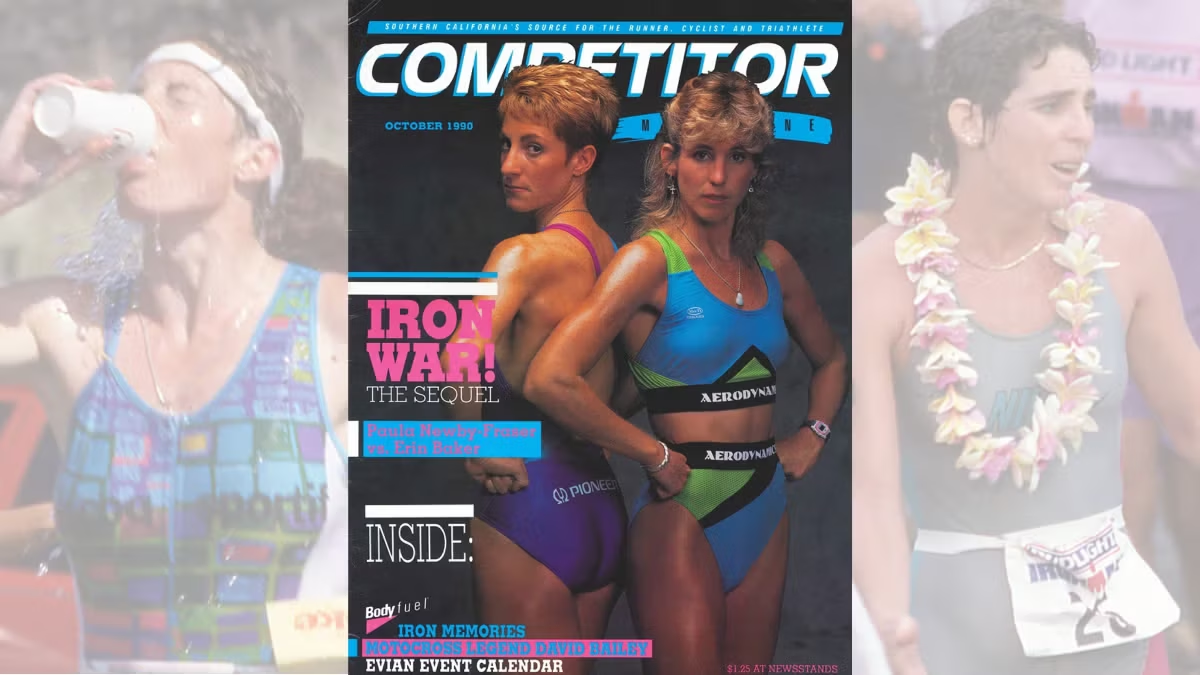
Newby-Fraser vs. Baker
The rivalry that elevated women’s long-course racing to new heights.
The Queen and The Rebel: The Rivalry That Forged a Sport#
Introduction: The Unspoken Truce on Ali'i Drive#
The finish line of the 1991 Ironman World Championship was a theater of exhaustion and triumph. Paula Newby-Fraser, having just reclaimed her crown, stood with her father, who had flown from South Africa to witness his daughter race in Hawaii for the very first time. In a moment of sportsmanship, she introduced him to her vanquished rival, the runner-up, Erin Baker. Baker, ever the iconoclast, politely shook his hand, then turned to Newby-Fraser and uttered a line that would perfectly encapsulate their years-long, deeply personal war: "I never pictured you as someone who had a family".
The comment, as Newby-Fraser would later reflect, was not necessarily meant to be curt. It was, instead, a window into the psyche of a competitor who, in her view, "almost had to dehumanize her competition to race well". That single, charged sentence laid bare the chasm between two of the greatest athletes the sport of triathlon has ever known. It was a rivalry that transcended mere competition; it was a crucible fueled by diametrically opposed personalities, deeply held political convictions, and a relentless drive for supremacy. Their conflict, played out on the unforgiving lava fields of Kona and on courses around the globe, did more than just crown champions. It shattered performance barriers, secured a future of gender equality in the sport, and fundamentally redefined what it meant to be a female professional athlete. This is the story of the Queen and the Rebel, and how their epic battles forged a sport in their own image.
I. The Forging of Champions: Two Paths to the Pain Cave#
The collision of Paula Newby-Fraser and Erin Baker was not a matter of chance, but of destiny, shaped by disparate origins and philosophies. Their paths to the pinnacle of triathlon were as different as their personalities, preordaining a rivalry that would be fought on political and psychological grounds as much as on the race course.
Paula Newby-Fraser: The Accidental Queen#
Paula Newby-Fraser's journey to becoming "The Queen of Kona" began not with a burning ambition, but with a curious whim. Born in Zimbabwe (then Southern Rhodesia) and raised in South Africa, her early athletic life was spent in the pool as a nationally ranked swimmer. After college, sports were a distant memory until her boyfriend convinced her to watch a local triathlon. Her initial reaction was that it was a "ridiculous thing to do".
Yet, the seed was planted. Eight weeks after buying her first bicycle, she entered her first triathlon. She didn't just finish; she won, setting a new course record for women and placing in the top ten overall. This flash of raw, prodigious talent led her to the South African Triathlon championships, which she also won, earning a trip to the famed Hawaii Ironman in 1985 With no specific long-course training—she had never run a full 26.2-mile marathon before—her plan was simply to finish. She came in third. Stunned to find herself only five or six minutes behind the winner, a realization dawned: with focused training, she could win. The quiet, internally driven prodigy had found her calling.
Erin Baker: The Born Rebel#
Across the globe in New Zealand, Erin Baker's path was being forged in fire and conviction. One of eight children in a remarkably athletic family, she was a gifted runner from the age of 15 Her approach to training was a reflection of her fierce independence and immense physical capacity. "I was self-trained," she stated. "I just trained as much as my body would handle, and that was a shit load".
From the very beginning, Baker's identity as an athlete was inextricably linked with her role as an activist. Her deeply held sense of justice was not a footnote to her career but its foundational text. In 1981, years before her triathlon debut, she was arrested and convicted for her role in protests against the touring South African Springbok rugby team, an act of defiance against the apartheid regime. This conviction would bar her from entering the United States for five years, shaping the early trajectory of her career. When she did enter the sport, her dominance was immediate and overwhelming. She won her first-ever triathlon in 1984 and went on to amass one of the most staggering records in sports history, winning 104 of her 121 professional races. She was a force of nature—athletically versatile, ideologically uncompromising, and unafraid of confrontation.
Their different origins set the stage for an unavoidable clash. Newby-Fraser, the quiet champion from a politically charged nation, was focused almost exclusively on performance. Baker, the passionate activist, viewed the sporting world as another front in the fight for justice. For Baker, Newby-Fraser was more than a competitor; she was a symbol. As Baker herself admitted, she believed that "whupping the ass of the top South Africa triathlete would get some attention back in South Africa". Newby-Fraser felt this acutely, later stating that Baker "dehumanised me. To her, I just represented the South African government". The rivalry was thus predestined, a collision of worldviews waiting for the starting gun.
II. A Rivalry Ignited: The Battle for Kona (1986-1987)#
The lava fields of Kona, Hawaii, became the definitive battleground for the two rising titans of the sport. Their first two encounters at the Ironman World Championship would set the tone for years to come, establishing a pattern of traded blows, shattered records, and a rivalry that escalated from political tension to a deeply personal and tactical war.
1986 - The Queen's Arrival#
The 1986 Ironman World Championship was a landmark event for women's triathlon. Paula Newby-Fraser, in only her second attempt, delivered a stunning performance. She won her first world title with a time of 9:49:14, becoming the first woman in history to break the formidable 10-hour barrier on the Kona course. Her victory eclipsed the previous record by more than 36 minutes, a quantum leap that shocked the triathlon world.
In stark contrast, the day was a disaster for Erin Baker. Having built a dominant reputation on the European circuit while banned from the U.S., her Kona debut was highly anticipated. However, she arrived "very, very ill" and, feeling pressure from sponsors, attempted to race anyway. The result was what she called the "only real blemish on my record"—her first and only DNF (Did Not Finish) up to that point. The Queen had been crowned, while the Rebel was forced into a frustrating retreat.
1987 - The Rebel's Revenge#
If 1986 was Newby-Fraser's coronation, 1987 was Baker's brutal counter-attack. The race became a pivotal turning point, transforming the nature of their rivalry. For much of the day, Newby-Fraser was in control, leading deep into the marathon. At the time, it was common practice for elite athletes to walk through aid stations to ensure they took in enough fluids and nutrition. Newby-Fraser, following the example of past champions, adhered to this strategy.
It was a tactical decision that would cost her the race. Baker, relentless and aggressive, saw an opportunity. As Newby-Fraser walked through an aid station late in the marathon, Baker ran straight past her, seizing a lead she would not relinquish. It was a devastating psychological and tactical blow. Baker stormed to victory in 9:35:25, shattering Newby-Fraser's year-old course record by more than 14 minutes. Newby-Fraser, who felt her confidence crumble, faded to third place.
The outcome of the 1987 race reshaped the entire dynamic. Prior to this, the animosity was largely driven by Baker's political convictions. But by beating Newby-Fraser head-to-head with superior tactics and grit, Baker made the rivalry intensely athletic. For Newby-Fraser, the loss was a profound awakening. "The loss to Erin...whilst walking through aid stations showed what was possible," she recalled. The defeat exposed a weakness not just in strategy, but in mental fortitude. Compounding the sting of the loss was a growing narrative in the triathlon community that her 1986 victory had been "lucky". The rivalry was no longer just about politics; for Newby-Fraser, it was now about professional pride, legitimacy, and vengeance.
III. The Queen's Retort: The 9:01 Barrier (1988-1989)#
The sting of the 1987 defeat and the whispers that her first title was a fluke ignited a fire in Paula Newby-Fraser. She channeled the public doubt and personal humiliation into a period of intense preparation, transforming herself from a champion into a legend. Her response on the race course was not merely a victory, but an act of total annihilation that would forever silence her critics and redefine the limits of female endurance performance.
The 1988 Annihilation#
The 1988 Ironman World Championship, the tenth anniversary of the event, was set for a monumental showdown between the 1986 champion, Newby-Fraser, and the 1987 champion, Baker. Newby-Fraser arrived in Kona a different athlete, having realized her previous defeat was due to a lack of mental toughness. She delivered what was, at the time, the single most dominant performance in the history of the women's race.
She won with a jaw-dropping time of 9:01:01. It was a mark that didn't just break Baker's course record; it obliterated it by over 34 minutes. She finished more than 11 minutes ahead of second-place Baker, a crushing margin of victory. The foundation of her victory was a revolutionary bike split of 4:57:13, a time nearly 30 minutes faster than the previous record, in which she simply rode away from the entire field. Her overall time was so fast that she finished 11th among all competitors, including the professional men, a landmark achievement that demonstrated a new level of female athleticism. The statement was unequivocal. There was no luck involved; there was only dominance. The Queen of Kona had truly arrived.
1989 - Consolidation of Power#
While the triathlon world was captivated by the legendary "Iron War" between Mark Allen and Dave Scott in the men's race, Newby-Fraser quietly went about the business of consolidating her power. She won her third Kona title and second in a row, proving her 1988 performance was no anomaly but the new standard.
During this period, Baker's impact was being felt just as profoundly off the course. At the inaugural ITU (now World Triathlon) World Championships in Avignon, France, it was announced that the prize money for men would be greater than for women. Baker, true to her activist roots, led a charge demanding equality. Her outspoken advocacy, supported by other top pros, was successful. The organizers relented, and equal prize money was granted. It was a monumental victory that helped establish triathlon as a leader in gender equity and cemented Baker's legacy as a trailblazer who fought for the soul of the sport, not just for finish-line tapes.
IV. The Rebel's Year: The Runner's Revenge (1990)#
After two years of Newby-Fraser's reign in Kona, Erin Baker returned in 1990 to remind the world of her ferocious versatility. While Newby-Fraser had perfected a formula for Ironman dominance built on an untouchable bike leg, Baker possessed a broader arsenal of athletic gifts. Her ability to win across multiple distances and her world-class running prowess gave her more ways to win, and in 1990, she used that versatility to dismantle the Queen's strategy and reclaim the sport's biggest prize.
The Ironman Canada Showdown#
The prelude to their Kona rematch came at the 1990 Ironman Canada, hyped as the "matchup of the year". The race played out as a perfect showcase of their contrasting strengths. Newby-Fraser executed her signature tactic flawlessly, pushing the pace on the bike to build what seemed like an insurmountable 11-minute lead heading into the marathon, breaking the bike course record in the process.
But Baker had a trump card. Having spent time away from triathlon to focus purely on running—a discipline she found more engaging at the time—she was in phenomenal running form. She unleashed a devastating marathon, running a blistering 2:47:47 split. She not only erased Newby-Fraser's 11-minute advantage but blew past her to win by over 15 minutes. The race was a tactical masterclass, proving that Baker's relentless run could neutralize Newby-Fraser's powerful bike. It demonstrated that Baker could absorb the Queen's best punch and deliver a knockout blow of her own.
Kona 1990#
Baker carried that momentum and confidence to the Big Island. The 1990 Ironman World Championship was her masterpiece. On a day where everything clicked, she was the superior athlete in all three disciplines, "out swimming, biking, and running Paula" to secure her second and final Kona crown. Her winning time was 9:13:42. Newby-Fraser finished in second place, more than six minutes adrift.
The victory was a testament to Baker's incredible range as an athlete. While Newby-Fraser was the undisputed master of the Ironman distance, Baker was a champion at every distance—long course, Olympic distance, and duathlon. This versatility was her ultimate weapon. It meant she didn't have to beat Newby-Fraser at her own game. By forcing the race to be decided on the run, she could shift the battle to her preferred territory. The 1990 season belonged to the Rebel, who proved that there was more than one way to conquer the Queen.
V. The Final Confrontations: An Exhausting War of Attrition (1991-1993)#
The final chapter of their rivalry was a grueling war of attrition. Having traded blows and titles for five years, the two athletes pushed each other to new heights of performance and to the very edge of their physical and mental endurance. In these final confrontations, Newby-Fraser would ultimately prevail on the race course, but the victories came at an immense psychological cost, highlighting the sheer intensity of their conflict.
1991 - The Queen Reclaims Her Throne#
Vowing not to be beaten again in Kona, Newby-Fraser returned in 1991 with renewed focus. She delivered a commanding performance, winning her fourth world title in 9:07:52. Baker finished second, but the margin was a decisive 15 minutes, re-establishing Newby-Fraser's supremacy on the Big Island.
1992 - The Sub-9 Hour Masterpiece#
While Baker was not a factor on the podium in 1992, the year was perhaps the most significant for Newby-Fraser's legacy. She won her fifth title, but the victory was secondary to the historic time. She became the first woman ever to break the mythical nine-hour barrier in Kona, finishing in a stunning 8:55:28. It was a record of such magnitude that it would stand for 17 years, a testament to how far she and Baker had pushed the sport—and each other.
1993 - The Last Dance#
The 1993 Ironman World Championship was the final time the two legends would face each other in Kona. The race was another victory for Newby-Fraser, her sixth, which tied Dave Scott's then-record for most Kona wins. She again broke the nine-hour mark with a time of 8:58:23. Baker finished second once more, in what would be her final race on the Big Island.
Though she stood atop the podium, the victory exacted a heavy toll on Newby-Fraser. The years of intense, high-stakes competition against Baker had been emotionally and mentally draining. After the race, she confessed, "I don't know if I can do this again," a stark admission of the burnout she felt from their relentless war. The quote revealed that the rivalry's endgame was not just a physical contest but a battle of psychological will. Baker retired from professional triathlon the following year to pursue a career in politics, bringing an end to the sport's most iconic rivalry. Newby-Fraser had won the final battles, but her ability to simply endure the mental pressure longer than her great rival proved to be the ultimate deciding factor in their head-to-head history.
Table 1: Head-to-Head at the Ironman World Championship (1986-1993)
| Year | Winner | Winner's Time | Key Rival's Finish | Rival's Time | Notes |
|---|---|---|---|---|---|
| 1986 | Paula Newby-Fraser | 9:49:14 | Erin Baker | DNF | PNF's first win; Baker ill |
| 1987 | Erin Baker | 9:35:25 | Paula Newby-Fraser | 3rd (9:40:37) | Baker shatters course record |
| 1988 | Paula Newby-Fraser | 9:01:01 | Erin Baker | 2nd (9:12:14) | PNF's stunning retort; crushes record |
| 1990 | Erin Baker | 9:13:42 | Paula Newby-Fraser | 2nd (9:20:01) | Baker's second and final Kona win |
| 1991 | Paula Newby-Fraser | 9:07:52 | Erin Baker | 2nd (9:23:37) | PNF reclaims the crown |
| 1993 | Paula Newby-Fraser | 8:58:23 | Erin Baker | 2nd (9:08:04) | Their final Kona showdown |
VI. The Unspoken Alliance: A Legacy of Elevation#
Though they were fierce adversaries, Paula Newby-Fraser and Erin Baker were unwitting partners in an unspoken alliance that elevated women's triathlon from a niche pursuit to a global professional sport. Their clashing styles and personalities created a compelling drama that captured attention, while their relentless competition forced a level of performance that had previously been unimaginable. Their combined legacy is not just one of individual greatness, but of mutual creation.
The performance legacy of their rivalry is written in the record books. They were the catalysts for each other's evolution. Baker's ferocious running ability forced Newby-Fraser to transform her own run from a liability into a weapon. Newby-Fraser's unparalleled dominance on the bike forced Baker and every other competitor to rethink their training and tactics. The result was a cascade of broken records and shattered time barriers. From Newby-Fraser's first sub-10-hour performance in 1986 to her historic sub-9-hour masterpiece in 1992, their rivalry made the impossible seem routine and continuously redrew the map of what was achievable.
Beyond the race course, their socio-political legacy is just as profound. Newby-Fraser, with her record eight Ironman World Championship titles and 24 total Ironman victories, became the sport's first global female icon. She created the benchmark of sustained dominance, the "Queen of Kona" against whom all future long-distance champions would be measured. Baker's legacy, meanwhile, is one of revolution. Her fearless and successful fight for equal prize money set a precedent that has made triathlon one of the most gender-equitable sports in the world. She was a champion of the sport's values, proving that an athlete's voice could be as powerful as their performance.
Together, they created the modern archetypes of the female professional triathlete. Newby-Fraser established the model of "The Specialist"—the athlete who achieves legendary status through focused, unparalleled dominance in a single format. Baker pioneered the archetype of "The All-Rounder/Activist"—the versatile champion who wins across all distances and uses her platform to drive meaningful change. Every great female champion since can trace her lineage back to either the Queen or the Rebel.
Conclusion: A Good Bottle of Wine#
In the years since their retirement, the fire of their rivalry has cooled, replaced by a quiet, mutual respect. "We don't have any relationship at all now," Baker has said. "I think we parted ways with a genuine mutual respect for each other's abilities, tenacity and work ethic".
It is Newby-Fraser who perhaps best captures the final sentiment on their epic conflict, looking back with the wisdom of time on the adversary who pushed her to her greatest heights. "Age, life and a good bottle of wine would make for a sensational conversation now," she reflected. "Much has changed, but much is the same at its core I suspect". It is a poignant postscript to a war that defined an era. They were bitter rivals who rarely spoke, but together, through their actions on and off the course, they authored the foundational text of modern women's triathlon.