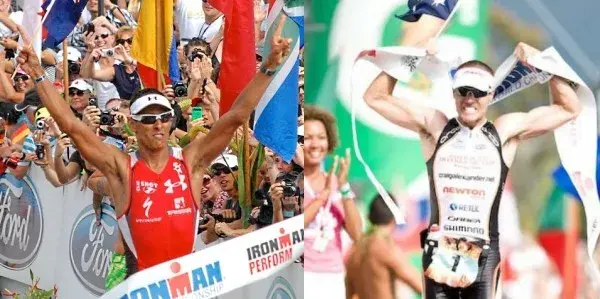
McCormack vs. Alexander
Six straight defeats—and then the greatest comeback.
The King and The King Slayer: Inside the Epic Rivalry That Defined an Ironman Era#
On the Kona coast of Hawaii, the Queen Kaʻahumanu Highway cuts a black ribbon through an ancient, unforgiving landscape of volcanic rock. The air is thick with a heat that radiates from the asphalt and a humidity, the locals call kona, that clings to the skin like a second layer. This is the crucible of triathlon, the place where the Ironman World Championship is decided. It is a solitary battleground of immense suffering, where athletes race against the clock, the elements, and the demons in their own minds. For five years, from 2007 to 2011, this brutal stage was the exclusive domain of two men, two Australians born just months apart, who transformed the race into a personal duel that would redefine the sport.
They were Chris "Macca" McCormack and Craig "Crowie" Alexander, two titans who could not have been more different. McCormack was the brash, outspoken showman, a "lightning rod" for controversy with a Master of Finance degree and a gunslinger's confidence. His approach to racing was a hostile takeover, analyzing weaknesses and leveraging every available asset, including the minds of his opponents. His mantra was emblazoned on the cover of his autobiography:
I'm Here to Win.5
Alexander was his antithesis. A physiotherapist by trade, he was the quiet, meticulous professional, a devoted family man known as a "gentleman competitor". He approached racing not as a battle of words, but as a scientific problem to be solved through consistency, adaptability, and a deep understanding of the human body. His talking was done on the race course, with a relentless, metronomic pace that broke the will of his rivals.
Their five-year stranglehold on triathlon's most coveted prize was more than a simple competition; it was a clash of philosophies, a tactical chess match played out over 140.6 miles of Hawaiian hell. It was a rivalry that forced each man to confront his own limitations and evolve, that controversially redefined the strategic landscape of Ironman racing, and that created one of the most compelling dramas in the sport's history.
Part I: The Forging of Champions (1993–2006)#
Before their paths collided in Kona, McCormack and Alexander were forged in the separate fires of early career setbacks, experiences that shaped their characters and set them on a convergent course toward Ironman immortality. Their journeys reveal a shared foundation of resilience, born from rejection by the very system they had initially sought to conquer. This common origin story—of being cast out and forced to find their own way—is fundamental to understanding the fierce independence that would later define their epic rivalry.
Macca's Meteoric Rise and Olympic Scars#
Chris McCormack was a force of nature from the start. After a youth spent playing soccer and rugby, he found triathlon at university and immediately excelled, winning two Australian Junior titles. Possessing a piercing intelligence and a natural charisma, he briefly worked in finance after graduating with a degree in economics, but the corporate world could not contain his ambition. In 1996, he sold his belongings and flew to Europe to chase a professional racing career.
The results were immediate and historic. By 1997, he had achieved what no male triathlete had ever done before: winning both the International Triathlon Union (ITU) World Championship and the ITU World Cup Series in the same season, cementing his status as the undisputed world number one. He was fast, tactically brilliant, and supremely confident.
Yet, this dominance did not guarantee him a place at the pinnacle of Australian sport. In 2000, despite being the highest-ranked Australian in the world, he was controversially left off the team for the Sydney Olympic Games. The snub was a defining moment. It hardened his resolve and fueled a profound sense of independence. He turned his back on the Australian federation and the draft-legal ITU circuit, moving to the United States to carve out his own empire. There, he became untouchable, embarking on a staggering three-year, 33-race undefeated streak in the country's most prestigious short-course events.
In 2002, he shifted his focus to the Ironman distance, winning Ironman Australia on his debut. He would go on to win that race a record five consecutive times. He had proven his versatility and endurance, but Kona remained a puzzle. He failed to finish in his 2002 debut and placed a disappointing 59th in 2003, learning the hard way that the Big Island demanded more than just raw talent.
Crowie's Calculated Ascent#
While McCormack was making global headlines, Craig Alexander was on a quieter, more methodical journey. Inspired to take the sport seriously after watching fellow Australian Greg Welch win Kona in 1994, Alexander began his first triathlon at age 20 while studying Physiotherapy at the University of Sydney. His approach was analytical, a reflection of his education in anatomy and physiology.
Like McCormack, Alexander's career reached a critical inflection point after a national team setback. In 2002, after being named to the initial squad for the Commonwealth Games, he fell ill and missed the final selection races. This disappointment prompted his own move to the lucrative U.S. racing circuit, where he found his niche. He became a dominant force in non-drafting Olympic and half-Ironman distance races, winning major city titles and the prestigious Triple Crown in 2004.
He established a long, unbeaten streak at the half-Ironman distance, a testament to his meticulous preparation and flawless race execution. This culminated in victory at the inaugural Ironman 70.3 World Championship in Clearwater, Florida, in 2006. That victory was more than just a world title; it was his ticket to the main event. It earned him a qualification spot for the 2007 Ironman World Championship in Hawaii, setting the stage for his first epic confrontation with McCormack.
The parallel nature of their paths is striking. Both men, after being denied the chance to represent their country in major games, turned to the fiercely individualistic American professional circuit and the Ironman brand to define their careers. This shared history of needing to prove the establishment wrong cultivated the relentless self-reliance that would make their eventual clash for the sport's ultimate individual prize so compelling. Furthermore, their professional backgrounds—McCormack the finance graduate and eventual CEO, Alexander the physiotherapist—were not mere biographical details but the very blueprints of their competitive philosophies. McCormack, the businessman, saw racing as a strategic game of market forces, psychological leverage, and hostile takeovers. Alexander, the scientist, saw it as a complex physiological system to be perfected through discipline, recovery, and flawless execution.
Part II: The Battle for Kona (2007–2012)#
For five consecutive years, the men's podium at the Ironman World Championship was occupied by either McCormack, Alexander, or both. Their rivalry became the central narrative of the race, a year-over-year saga of dominance, revenge, and tactical evolution that captivated the triathlon world.
Table 1: The Five-Year War: Macca vs. Crowie at the Ironman World Championship
| Year | Winner | McCormack Finish (Time) | Alexander Finish (Time) | Margin | Key Narrative Point |
|---|---|---|---|---|---|
| 2007 | Chris McCormack | 1st (8:15:34) | 2nd (8:19:04) | +3:30 | Macca's breakthrough; Crowie's stunning debut. |
| 2008 | Craig Alexander | DNF (Mechanical) | 1st (8:17:45) | N/A | Crowie inherits the crown; Macca's bad luck. |
| 2009 | Craig Alexander | 4th (8:25:20) | 1st (8:20:21) | +4:59 | Crowie defends his title; Macca humbled. |
| 2010 | Chris McCormack | 1st (8:10:37) | 4th (8:16:53) | -6:16 | Macca's tactical masterpiece; the bike alliance. |
| 2011 | Craig Alexander | Did Not Compete | 1st (8:03:56) | N/A | Crowie's record-breaking redemption. |
| 2012 | Pete Jacobs | DNF | 12th (8:40:49) | N/A | The changing of the guard. |
Note: Margin reflects the time difference between the two athletes.
Sources: 19
2007: The First Shot Fired#
The 2007 race was the genesis of their Kona rivalry. McCormack, having finally learned from his early failures on the island, arrived with a singular focus. He executed a near-perfect race, emerging from the water alongside Alexander and staying with the lead pack on the bike. The race came down to the marathon, a brutal footrace under the scorching Hawaiian sun. McCormack took the lead in the middle miles and pulled away, unleashing a blistering 2:42:02 marathon to finally claim the title that had eluded him for so long, finishing in 8:15:34.
Behind him, the Kona rookie, Craig Alexander, was making a statement. In his very first attempt at the world's toughest triathlon, he ran a superb 2:45:13 marathon to finish second in 8:19:04. It was a stunning debut that immediately established him as a primary threat. McCormack had finally conquered his nemesis, the island of Hawaii, but in doing so, he had awakened his next great rival.
2008–2009: The Reign of 'Alexander the Great'#
The next two years belonged to Crowie. In 2008, McCormack's title defense ended in heartbreak. While climbing to the turnaround point in Hawi on the bike leg, a snapped brake cable forced him to abandon the race—a cruel dose of mechanical misfortune. With the defending champion out, Alexander seized the opportunity. He ran a masterful 2:45:01 marathon to claim his first Ironman World Championship in 8:17:45, inheriting the crown he had come so close to winning the year before.
If 2008 was about opportunity, 2009 was about dominance. Alexander proved his victory was no fluke by defending his title, becoming only the fourth man in history to win back-to-back Kona championships. In a signature performance, he came off the bike with a deficit of over 12 minutes to the leader, American Chris Lieto, and systematically ran down the field with a commanding 2:48:05 marathon to win in 8:20:21. McCormack, meanwhile, struggled on the run and faded to fourth place. The lesson was clear: in a straight footrace, Alexander was unbeatable. This humbling realization would force McCormack to completely rethink his approach to winning in Kona.
2010: Macca's Masterpiece#
The 2010 Ironman World Championship stands as the tactical centerpiece of their rivalry. Realizing he could not outrun Alexander, McCormack decided to change the rules of the game. In the weeks leading up to the race, and as he later detailed in his book I'm Here to Win, he orchestrated a strategic alliance among the race's strongest cyclists. The explicit goal was to neutralize Alexander's greatest weapon—his run—by inflicting maximum damage on the bike.
The plan was to work together to push an unrelenting pace, particularly in the notorious crosswinds on the stretch back from Hawi, to isolate Alexander and "burn his matches" before he ever put on his running shoes. On race day, the plan worked to perfection. A powerful group of cyclists, including McCormack, drove the pace, leaving Alexander to battle the winds alone. By the time he reached the second transition, Alexander was almost nine minutes behind McCormack and faced a seemingly insurmountable deficit.
What followed was a display of pure grit from both men. Alexander, his legs battered from the solo bike effort, launched into the marathon at a "suicidal" pace in a desperate attempt to claw back time, eventually fading to a hard-fought fourth place. At the front, McCormack found himself in his own epic duel with Germany's Andreas Raelert. The two ran shoulder-to-shoulder until the final mile, when McCormack surged one last time to claim his second world title in an emotional victory.
The race was a tactical masterpiece, but it was also controversial. Fellow pro Torbjørn Sindballe expressed his shock at the pre-meditated alliance, feeling it violated the individual "race of truth" ethos of Ironman. McCormack had not just won the race; he had fundamentally challenged how it was fought, introducing a level of team-based strategy that was unprecedented.
2011–2012: Divergence and the Changing of the Guard#
The aftermath of the 2010 race saw their paths diverge. In a stunning move, McCormack announced he would forgo his Kona title defense to pursue a spot on the 2012 Australian Olympic team, an attempt to exorcise the demons of his 2000 snub.
With McCormack absent, Alexander delivered the ultimate answer to the tactical questions of 2010. He didn't just win the 2011 championship; he redefined his own capabilities. Having been exposed on the bike the year prior, he dedicated himself to becoming a complete triathlete. The result was breathtaking. He posted a phenomenal 4:24:05 bike split—a time on par with the sport's best cyclists and a full 13 minutes faster than his previous best—and ran his way to a third world title. His winning time of 8:03:56 shattered the 15-year-old course record. Earlier that year, he had also won his second 70.3 World Championship, becoming the first and only athlete in history to win both titles in the same year. It was a statement victory, a powerful piece of evidence that the 2010 loss had, as he later admitted, been "the best thing that happened to me" because it forced him to re-evaluate and evolve.
The 2012 race marked the end of their era. McCormack, his Olympic bid unsuccessful, returned to Kona but did not finish the race. Alexander, struggling with a back injury, finished a distant 12th. The crown passed to another Australian, Pete Jacobs, signaling a "changing of the guard" in the sport. The five-year war was over.
Part III: The Anatomy of a Rivalry#
The conflict between McCormack and Alexander was fought on the Queen K Highway, but its roots ran deeper, into their very personalities and philosophies of competition. Their rivalry was a perfect storm of contrasting brands, a public feud that belied a deeper, more complex professional relationship.
The Public vs. The Private Man#
McCormack cultivated a brand built on swagger and psychological warfare. He understood that rivalries sold tickets and created media buzz. He engaged in trash talk, not just with Alexander but with other rivals like Germany's Normann Stadler, using the press conference as a weapon to get inside his opponents' heads. The title of his book,
I'm Here to Win, was a perfect distillation of his public persona: aggressive, unapologetic, and singularly focused on the top step of the podium.
Alexander's brand was the polar opposite. He was the quiet professional, the family man whose own book, As the Crow Flies, was a photographic journal of his life, not a tactical manifesto. He consistently downplayed the rivalry in public, deflecting McCormack's verbal jabs with quiet dignity. "People like to play it up and Chris likes to talk, but I'm immune to all of that," he once said, adding a pointed barb of his own: "With some people, it doesn't matter how often you beat them you can't win". This dynamic created a compelling narrative for fans—the brash antagonist versus the stoic hero—that made their on-course battles all the more dramatic.
A Reflection of Competition#
While there was genuine friction between them—reports noted that by 2009 they "don't get along" 52—there was also a profound, if unspoken, professional respect. Their rivalry was an arms race of adaptation. Alexander's pure running prowess in 2008 and 2009 forced McCormack to become a master tactician in 2010. McCormack's tactical victory, in turn, forced Alexander to dismantle his own perceived weaknesses and rebuild himself into a more complete and ultimately more dominant athlete in 2011. They were locked in a competitive feedback loop, each man's success driving the other to evolve.
Alexander himself acknowledged this dynamic, stating, "You are a reflection of your competition. When they improve, you have to improve. Whatever I've won it's because of my competition". This sentiment reveals the core truth of all great rivalries: that the adversary is also the catalyst. The class behind the competitor was on full display in 2012. As Alexander was fading from contention, he saw the new leader, Pete Jacobs, on an out-and-back section of the run. He ran across the road to his countryman and offered words of encouragement: "relax, relax, relax – you've got this". It was a poignant passing of the torch, a moment that revealed the champion's character even in defeat.
Conclusion: Echoes in the Lava Fields#
The five-year reign of Chris McCormack and Craig Alexander over the Ironman World Championship was a golden era for the sport. Their rivalry was a captivating saga that played out on triathlon's grandest stage, a multi-act drama of triumph, despair, tactical genius, and redemptive evolution. McCormack's initial victory in 2007 was answered by Alexander's two-year dynasty. Alexander's run-focused dominance was countered by McCormack's brilliant and controversial tactical gambit in 2010. And that tactical masterpiece was ultimately answered by Alexander's record-shattering performance in 2011, the definitive statement of a champion who had been pushed to become something greater.
Their legacy is not measured simply in the five consecutive world titles they brought back to Australia, but in the way their conflict elevated the sport itself. They raised the bar for what it took to win in Kona, proving that it required not only supreme physical gifts but also deep strategic thinking and the capacity to evolve. McCormack challenged the very definition of Ironman as an individual pursuit, while Alexander demonstrated the profound power of responding to defeat with reinvention.
Today, their rivalry continues in a new arena, as the leaders of competing professional triathlon teams. But their shadows will forever linger over the black lava fields of Kona. They are the echoes of a time when two of the greatest athletes in the sport's history, two men so different in character yet so perfectly matched in will, went to war under the Hawaiian sun and, in the process, both became legends.