The Iron War: How Two Men Forged a Sport in the Fires of Rivalry#
Introduction: The Cocoon of Silence on the Queen K#
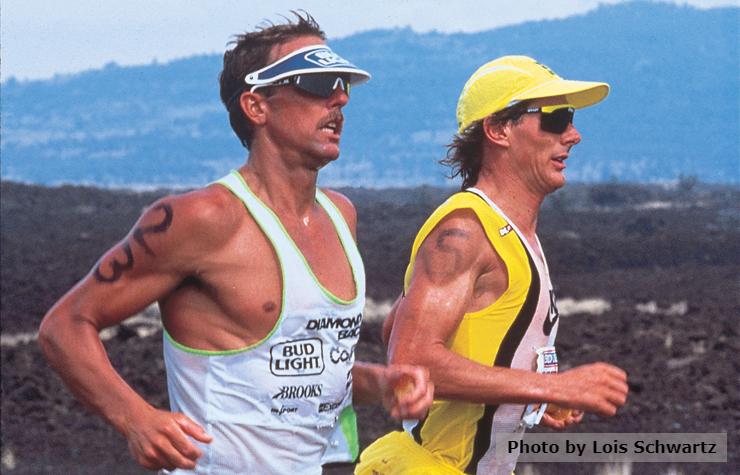
The air above the Queen Ka'ahumanu Highway on the Kona coast of Hawaii does not move; it hangs, thick and heavy with heat, a shimmering lens over the black, petrified seas of lava. On the afternoon of October 14, 1989, the only sound that cut through the oppressive stillness was the rhythmic slap of running shoes on asphalt and the distant whir of helicopter blades from the ABC Sports broadcast. Below, two men, locked in a silent, eight-hour duel, moved as one. They were a study in contrasts, a moving diorama of a sport's defining moment.
On the left, in a searing yellow kit, was Dave Scott, "The Man," the undisputed king of the Ironman World Championship. Six times he had come to this island, and six times he had conquered it, his body a monument to relentless will, his racing style a form of brutalist art. On the right, in a vibrant green, was Mark Allen, "The Grip," the perennial challenger, a man who had dominated the sport on every continent except this one. Six times he had come to Kona seeking victory, and six times he had been broken by the island, by the race, and most often, by the man now running beside him.
For more than seven hours, across a 2.4-mile ocean swim and a 112-mile bike ride through punishing crosswinds, they had been inseparable. Now, deep into the 26.2-mile marathon, they ran shoulder-to-shoulder, their proximity a physical manifestation of a decade-long psychological and philosophical battle. They were surrounded by an entourage of vehicles, yet they existed in a cocoon of silence, a vacuum of pure competitive will. Those who witnessed it understood they were watching history unfold; the closer the two men came to the finish line, still locked together, the more legendary the day became.
This was more than a race for the Ironman crown; it was the culmination of two divergent paths, two opposing philosophies, and years of brutal competition. It was the day one man’s relentless dominance met another’s unyielding quest for redemption. In their collision, they would not only decide the greatest triathlete of their generation but would elevate a fringe sport of human endurance into a global phenomenon, forever redefining the limits of what was thought possible.
Part I: The Forging of Champions: Two Paths to the Lava Fields#
Before they were legends bound by a single, epic race, Mark Allen and Dave Scott were products of entirely different athletic ecosystems. Their approaches to training, racing, and life itself were forged in disparate crucibles—one in the chaotic, physical combat of a pool, the other in the solitary, rhythmic pursuit of efficiency. Their inevitable clash on the lava fields was preordained not just by their talent, but by their fundamentally conflicting athletic DNA.
Dave Scott: The Man Who Invented the Race#
Dave Scott’s athletic identity was forged in the churning, aggressive waters of a water polo pool. Growing up in the heat of Davis, California, he excelled in the sport through high school and at UC Davis, earning All-American honors and a reputation as a "workout-aholic". Water polo is a sport of brute force, of short, violent bursts of effort, and of constant physical confrontation. Scott’s teammates recalled his obsessive dedication; he would out-lift the football players and lead conditioning sessions with a ferocious intensity. This background instilled in him a warrior’s ethos: you win by imposing your will, by being stronger and tougher than your opponent.
When Scott discovered the nascent sport of triathlon in the late 1970s, it was a chaotic, almost fringe pursuit. His first event in San Francisco in 1976 was mayhem, with no blocked-off streets and a turkey for the winner's prize. But it was at the 1980 Ironman on Oahu that he stamped his imprimatur on the sport. At the time, the Ironman was considered the ultimate test of survival, a question of whether one could simply finish. Scott changed the question. He didn't just endure; he
raced. He finished in 9:24:33, shattering the previous course record by nearly two hours and, in a single performance broadcast on ABC's Wide World of Sports, transformed the Ironman from a quirky endurance challenge into a legitimate, competitive race.
His training philosophy was a direct extension of his combative athletic origins. He was a "good old-fashioned jock of the no-pain-no-gain school". Entirely self-coached, he pioneered a regimen of punishing volume and intensity, believing that overwhelming strength was a fourth discipline of triathlon. He was obsessed with strength training, performing Olympic lifts and powerlifting exercises four times a week, convinced that superior core and gluteal strength could compensate for any biomechanical flaws. He never used a heart rate monitor, relying instead on an innate, almost primal, understanding of his body's limits. Central to his preparation were "marker sets"—brutal, solo time trials in swimming, biking, and running designed to measure his fitness and, just as importantly, to build an aura of invincibility. He would visualize himself crushing his competition during these sessions, creating a psychological dominance that began long before the starting cannon fired.
Mark Allen: The Seeker with a Finishing Kick#
Mark Allen’s journey began in a different world. He was an All-American swimmer at UC San Diego, a product of a sport defined not by combat, but by rhythm, efficiency, and the solitary pursuit of perfection in a fluid medium. His introduction to triathlon came not from a competitive drive, but from a biologist's curiosity. After graduating with a degree in biology, he saw the 1982 Ironman on television and was captivated by the question of how the human body could withstand such a feat.
His transition from the weightless environment of the pool to the punishing impact of land-based sports was arduous. His swimmer's body was not built for the pounding of the pavement, and he recalled that it took three full years before running finally began to "come easy". His initial training approach was a direct import from his swimming career: a simple philosophy of "do more faster". This method yielded some early success but soon led to a debilitating cycle of burnout, illness, and injury.
The turning point came in 1984, when Allen met Dr. Phil Maffetone, an applied kinesiologist who proposed a radical new approach. Maffetone argued that Allen was doing too much high-intensity, anaerobic work and had neglected his aerobic system. The prescription was a "train slow to race fast" philosophy, centered on the Maffetone method. For months at a time, Allen was to do all of his training below a specific, low heart rate, calculated using the "180 Formula" (
180−age), to build a powerful aerobic, fat-burning engine. The shift was mentally excruciating. To stay below his maximum aerobic heart rate of 155 beats per minute, Allen, one of the fastest triathletes in the world, had to slow his run pace to a jog, over three minutes per mile slower than his previous training pace. It required immense patience and a willingness to leave his ego at the door, but over time, the results were profound. His pace at that same low heart rate grew steadily faster year after year. This scientific, data-driven foundation was complemented by a deep exploration of the mental and spiritual side of performance. Allen embraced meditation, visualization, and worked with a Huichol shaman, Brant Secunda, learning techniques to quiet his mind and find a sense of calm and gratitude in the heat of competition.
The rivalry that would come to define an era was, therefore, not merely a clash of two great athletes, but a fundamental conflict between their athletic archetypes. Scott, the warrior forged in the physical battles of water polo, approached the Ironman as an act of attrition, a test of who could suffer more. Allen, the swimmer and biologist, approached it as a complex physiological puzzle to be solved with efficiency, patience, and mental tranquility. For Allen to conquer Scott in Kona, the one place where Scott’s warrior ethos reigned supreme, he couldn't just become fitter; he would have to undergo a profound transformation, learning to embrace the ferocity of battle without losing the quiet strength that was uniquely his own. It was a journey that would take seven agonizing years.
Part II: The Kona Enigma: A Kingdom and Its Challenger#
The Ironman World Championship in Kailua-Kona is more than a race; it is a crucible. The searing heat radiating from the black lava rock, the relentless, soul-crushing winds on the Queen K Highway, and the oppressive humidity create an environment that doesn't just test physical limits—it exposes the soul. For one man, it was a kingdom he ruled with absolute authority. For the other, it was a recurring nightmare, a puzzle he could not solve.
Scott's Reign: The Lord of the Lava#
From his revolutionary victory in 1980, Dave Scott established a dynasty in Kona that was unparalleled. He claimed the Ironman crown in 1980, October of 1982, 1983, 1984, 1986, and 1987. His dominance was so complete that he earned the nickname "The Man"—a title that signified not just his victories, but the standard of excellence he set. He was the first inductee into the Ironman Hall of Fame in 1993, a progenitor of the sport itself.
What set Scott apart was his unique symbiosis with the brutal Kona course. While other athletes, including Allen, dreaded the conditions, Scott seemed to draw strength from them. "He also thrived in the heat and wind of the Ironman," Allen admitted. "Dave embraced it". His training grounds in Davis, California, were a deliberate replica of Kona's harsh climate, and his preference for training in solitude forged a deep mental fortitude that made him impervious to the island's challenges. He was the Lord of the Lava, and for most of the 1980s, his reign was absolute.
Allen's Heartbreak: The Challenger's Curse#
While Scott ruled Kona, Mark Allen was conquering the rest of the triathlon world. He was particularly dominant at the prestigious Nice International Triathlon in France, a race he won an unprecedented ten consecutive times. He earned his own nickname, "The Grip," for his ability to apply relentless pressure until his opponents cracked, his face an impassive mask that betrayed no pain. Yet, despite this global dominance, Kona remained his personal enigma, a curse he could not break. Before 1989, he had competed six times in Hawaii and failed to win each time.
His defeats were not just losses; they were often spectacular and heartbreaking collapses that added to the mythology of his Kona curse.
- 1982: In his first attempt, a youthful Allen found himself riding alongside the champion, Scott. In a moment of bravado, he joked, "Hey Dave….how about we go for a run after the bike ride?" Scott, unamused, simply shifted gears and rode away. Moments later, Allen's derailleur failed, ending his race but planting a crucial seed: for a brief moment, he had been right there with the best.
- 1984: This was the race that should have been his. Allen came off the bike with a commanding 12-minute lead. He was euphoric, high-fiving spectators, believing the race was "in the bag." But out on the lava fields, his body betrayed him. He was reduced to a walk, a powerless spectator as Dave Scott "stormed by" around mile 13 of the run. Allen faded to fifth place as Scott claimed his fourth title.
- 1987: This was perhaps the most devastating blow. Allen had raced brilliantly, building a five-minute lead over Scott with only eight miles left in the marathon. Victory was within his grasp. Then, once again, he fell apart. He was forced to a walk as Scott, who later admitted he was also in "bad shape," strategically passed him on the far side of a media van to prevent Allen from latching on. While Scott celebrated his sixth championship, Allen was rushed to the hospital with internal bleeding, a physical manifestation of his Kona ordeal that left him questioning his future in the race.
- 1988: Fate seemed to offer Allen his best chance yet. The night before the race, Dave Scott withdrew with an injury. The throne was vacant. But the island was not finished with him. Allen suffered three flat tires on the bike course and limped home to another disappointing fifth-place finish.
The pattern was undeniable and psychologically crushing. Allen was the king everywhere but Kona. There, he was the challenger who could not close. The numbers told a stark and unforgiving story of one man's kingdom and another's futile siege.
| Year | Dave Scott Finish | Mark Allen Finish | Margin of Victory (Approx.) |
|---|---|---|---|
| 1983 | 1st (9:05:57) | 3rd (9:21:06) | N/A (Scott beat 2nd place) |
| 1984 | 1st (8:54:20) | 5th (9:35:05) | N/A (Scott beat 2nd place) |
| 1986 | 1st (8:28:37) | 2nd (8:36:04) | 7 min, 27 sec |
| 1987 | 1st (8:34:13) | 2nd (8:45:19) | 11 min, 6 sec |
Data compiled from official Ironman World Championship results.
Part III: 1989: The Greatest Race Ever Run#
The stage for the 1989 Ironman World Championship was set not just by years of history, but by a season of dramatic omens. It was a year in which both men reached new heights and plumbed new depths, arriving in Kona physically primed for the race of their lives but mentally fragile, each haunted by the myth of the other.
The Unspoken Showdown: A Season of Omens#
Mark Allen entered the 1989 season on a tear. From 1988 to 1990, he amassed an unprecedented 21-race winning streak, defeating every one of the top 50 triathletes in the world. He had beaten Scott head-to-head twice in half-Ironman distance races that year, and the narrative in the sport was beginning to shift. The question was no longer
if Allen would win Kona, but when.
Then, Dave Scott went to Ironman Japan. In a stunning display of power, he obliterated the Ironman world best time, finishing in a jaw-dropping 8:01:32. It was a clear and unequivocal message: the king was not ready to abdicate his throne. The performance reset the stakes entirely. To win, Allen would not just have to overcome his own demons; he would have to beat Dave Scott on the best day of his life.
Behind the scenes, however, both men were wrestling with profound internal struggles. Allen, despite his winning streak, was suffering from severe burnout. Weeks before Kona, after winning the inaugural ITU Olympic Distance World Championship in France, his body gave out. He collapsed in a bathroom, hitting his head on a urinal, and in that moment of physical and mental crisis, decided to quit the sport entirely. Scott, meanwhile, was grappling with the pressures of new fatherhood and his own private battles with self-doubt and depression. He consciously cultivated his media persona as a solitary, "mystical, self-driven" hermit to create a "fabricated 'Dave Scott' myth" designed to intimidate his competitors, especially Allen. Both men nearly failed to make it to the start line, a fact that makes what followed even more extraordinary.
The Swim & Bike: A 114.4-Mile Stare-Down#
The race began with a chaotic cannon blast, and in the churning waters of Kailua Bay, Allen quickly found his target: the unmistakable feet of Dave Scott. For the entire 2.4-mile swim, he shadowed the six-time champion, occasionally tapping his toes—a small psychological annoyance, a constant reminder: "Hello! I'm here!". They exited the water just seconds apart, and the real race began.
On the bike, the dynamic was a masterclass in tactical warfare. Scott, as was his custom, went to the front and set a punishing pace, attempting multiple times to surge and break his rival. But this was a new Mark Allen. Having learned from the catastrophic failures of previous years where he had tried to out-bike "The Man," he adopted a new, disciplined strategy: he would shadow Scott's every move, never letting him out of his sight. For 112 miles across the windswept lava fields, they were locked in a silent, high-speed chess match. "I never saw Mark's face during the bike ride," Scott would later recall, but he always knew he was there. Whenever Scott would glance back to gauge his rival's state, Allen would immediately look away, offering no clue, no sign of weakness. They rolled into the second transition together, having been separated by no more than the legal drafting distance for over five hours. The championship would be decided by a 26.2-mile footrace under the brutal Hawaiian sun.
The Marathon: A Duel in the Sun#
From the first steps out of transition, Scott set a blistering pace. Allen recalled thinking it was an "insanity" fast pace, one that surely could not be maintained for a full marathon after the day's efforts, but he knew he had no choice but to match it. For mile after agonizing mile, they ran side-by-side, a mirror image of effort and resolve. The physical proximity was intense; "neither of us wanted to give an inch," Allen stated.
They ran in a surreal bubble, surrounded by media vehicles and helicopters, yet enveloped in a profound silence. The only words spoken between them in nearly eight hours of racing were three from Allen—"That's not fair"—uttered when Scott's then-wife briefly ran alongside them with their newborn son. As the miles wore on, a subtle pattern emerged: Scott seemed stronger on the downhills, Allen stronger on the uphills. Deep in the pain cave, Allen found a new source of strength. He recalled an image he had seen in a yoga magazine of a 110-year-old Huichol shaman, and by envisioning the man's peaceful, powerful expression, Allen found a sense of calm and gratitude that transcended the suffering of the moment.
The breaking point came with less than two miles to go. As they approached the final significant climb on the course, a section of road now unofficially known as "Mark and Dave Hill," both men reached for fluids at an aid station. But in a split-second, race-defining decision, Allen pulled his hand back. "Something just said go," he later explained, "and it was like I was shot out of a cannon". He surged up the hill with an explosive power that caught Scott completely by surprise. The move was decisive. In about 15 seconds, Allen opened a 20-yard gap. For the first time all day, the invisible tether that had bound them together for 138 miles finally snapped. Scott, his legs empty, could not respond.
As Allen turned down Palani Road for the final stretch, he glanced back and saw "the most beautiful sight ever: an empty road". The reality of what he was about to achieve washed over him, and tears of joy streamed down his face as he ran toward the finish line. He had not only conquered Kona; he had beaten "The Man" on the greatest day of his career. The final margin was a mere 58 seconds.
The scale of their joint achievement was staggering. Both men had not just broken the old course record; they had annihilated it. Their performance elevated the sport to a new, almost mythical, plane.
| Athlete | Swim | Bike | Run | Final Time | Comparison to Old Record (8:28:37) |
|---|---|---|---|---|---|
| Mark Allen | 51:17 | 4:37:52 | 2:40:04 | 8:09:15 | -19 min, 22 sec |
| Dave Scott | 51:16 | 4:37:53 | 2:41:03 | 8:10:13 | -18 min, 24 sec |
| Greg Welch (3rd) | 51:21 | 4:43:41 | 2:57:13 | 8:32:16 | +3 min, 39 sec |
Data compiled from official Ironman World Championship results.
The numbers reveal a profound truth about their rivalry. Scott finished the race more than 18 minutes faster than he ever had before; it was, by any objective measure, the performance of his life. Yet it wasn't enough. To win, Allen had to produce a transcendent effort, bettering the old mark by over 19 minutes. The only variable that could possibly explain such a quantum leap in performance for both men was the presence of the other. For eight hours, they drafted not off each other's bodies, but off each other's willpower. Their greatest individual achievements were not accomplished in spite of each other, but because of each other. Their legacies, from that day forward, would be inextricably, symbiotically linked.
Part IV: The New King and The Old Guard#
The 1989 Iron War was not an end, but a beginning. It marked a definitive passing of the torch, launching one man into a new era of dominance while cementing the other's legacy as an ageless warrior who refused to fade away.
Allen's Dynasty: The Grip Tightens#
Having finally broken the Kona curse, Mark Allen unlocked a new level of mastery over the race that had haunted him for so long. The 1989 victory was the first of six Ironman World Championship titles he would claim. He went on to win five more times, including five consecutive victories from 1989 to 1993, and a final, dramatic win in 1995.
His sixth and final victory at the age of 37 was a perfect encapsulation of the athlete he had become. Facing a seemingly insurmountable deficit of nearly 17 minutes to German powerhouse Thomas Hellriegel after the bike, the old Mark Allen might have folded. But the new Allen, a master of pacing and mental fortitude, calmly executed one of the greatest come-from-behind victories in the sport's history, running a blistering 2:42:09 marathon to catch Hellriegel in the final few miles. He had achieved his ultimate goal, and in 1996, he retired from the sport at the absolute peak of his powers, his legacy secure.
The Man's Last Stand: An Ageless Warrior#
While Allen was building his dynasty, Dave Scott was redefining the limits of athletic longevity. His career did not end with the heartbreaking loss in 1989. After a few years away from the top of the podium, he returned to Kona in 1994 at the age of 40. In a performance that stunned the triathlon world, he finished second overall, very nearly winning a record seventh title. Scott himself has stated that this race was one of the proudest moments of his career, a revolutionary feat that proved age was no barrier to elite performance.
He wasn't done. Two years later, in 1996, at the age of 42, he returned again to finish fifth, clocking an incredible 2:45 marathon split. His final foray into the Ironman was in 2001 at the age of 47, a race that ended with a DNF due to back problems but which stood as a final testament to his enduring love for the sport and his unquenchable competitive fire.
Conclusion: From Rivals to Brothers#
The rivalry between Mark Allen and Dave Scott was the central, defining narrative of triathlon's golden age. Along with their contemporaries Scott Tinley and Scott Molina, they were the "Big Four," a group of athletes whose relentless competition against one another revolutionized the sport, transforming it from an obscure endurance test into a professional, global spectacle. Their battles, broadcast into living rooms by ABC's
Wide World of Sports, captured the public imagination and inspired a generation of athletes.
In the years since their retirement, the intense, often adversarial nature of their rivalry has softened, evolving into a deep and abiding friendship built on mutual respect. The two men who once communicated only through surges and silent stares on the race course now share stages for speaking engagements, collaborate on projects looking back at their shared history, and speak of each other with warmth, humor, and a clear appreciation for the role each played in the other's life.
The fire that fueled their competition was the very thing that forged their bond. Scott's uncompromising standards set a bar that forced Allen to grow not just as an athlete, but as a person. Allen's relentless pursuit provided Scott with the ultimate challenge, pushing him to the greatest performance of his career. In a recent open letter to his former nemesis, Mark Allen perfectly encapsulated the arc of their extraordinary journey from the heat of battle on the lava fields to the warmth of a shared, unparalleled legacy.
"We started as competitors—respectful, but not close. That changed," Allen wrote. "I've come to truly value your honesty, your intellect, and your passion for the sport... Not many get a rival like you. Fewer still get to call that rival a brother".