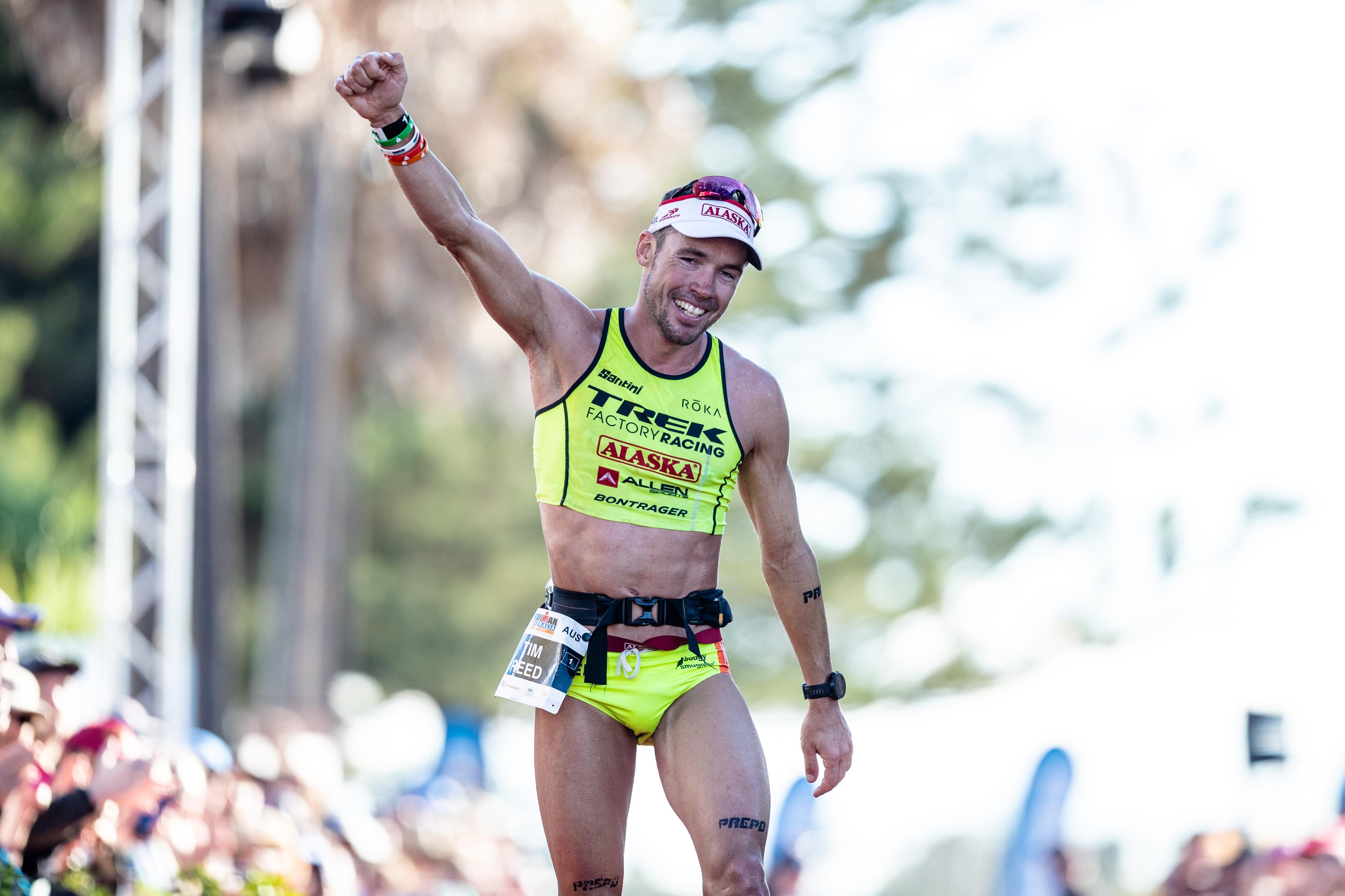
Tim Reed
The Engine and the Heart: The Enduring Power of Tim Reed.
The Engine and the Heart: The Enduring Power of Tim Reed#
Introduction: The Anatomy of Two Seconds#
The finish line is a blur of noise and color, a roaring tunnel of Australian voices on the Sunshine Coast. It is September 4, 2016, and for more than three and a half hours, two men have been locked in a brutal, lung-searing duel under the Queensland sun. On one side is Sebastian Kienle, the German titan, a two-time Ironman 70.3 World Champion, a machine of relentless power and Teutonic will. On the other is Tim Reed—shorter, lighter, running on home soil with the weight of a nation's hopes on his shoulders.
For the final kilometers of the half-marathon, they have traded blows like prize fighters. Kienle surges on the uphills, his immense power stretching the invisible cord between them to its breaking point. At one point, he opens a 30-meter lead, a seemingly decisive gap. Reed, by his own admission, is broken multiple times. But each time, fueled by the deafening roar of the crowd, he claws his way back. Now, in the final downhill sprint to the finish, it comes down to a handful of agonizing meters. Reed digs deeper than he has ever gone, finding one last gear. He crosses the line and collapses, a world champion by a mere two seconds.
That sliver of time, the difference between a career-defining victory and a valiant second place, is the culmination of a lifetime's journey. It is a victory forged not in the sterile perfection of a training lab, but in the chaotic reality of a life lived fully—a life of early failures, of relentless work on profound weaknesses, and of a quiet, unyielding mental fortitude. Tim Reed's story is not just that of an athlete with a world-class "engine," a physiological gift for endurance. It is the story of a man who spent his career learning to master the complex machinery of his own body, the anxieties of his own mind, and the vulnerabilities of his own heart. To understand how he found the strength for those final, decisive seconds, one must look back to his unlikely beginnings, to a boy built for neither of the sports he first loved, who discovered his true calling almost by accident.
Part I: The Accidental Endurance Athlete (1985-2009)#
Formative Years#
Tim Reed’s athletic journey began not on the sun-drenched triathlon courses of the world, but in the rugged landscapes of rural New South Wales. Born in 1985, he spent his first 11 years in Tumut before his family relocated to the remote, idyllic paradise of Lord Howe Island. It was here that a deep love for sport took root. Reed was relentlessly active, spending two to three hours a day playing rugby and basketball. By his own candid admission, neither sport could have been less suited to his physical frame. Standing at 1.70m, he was, as he puts it, "getting too short for basketball and too small for rugby".
This apparent mismatch between his physique and his chosen sports reveals a foundational element of his character. His dedication was not born from playing to his natural advantages but from a pure, unadulterated love of competition. He possessed what he would later call "mongrel"—a tenacious, gritty spirit that drove him to compete regardless of the odds. This competitive fire, banked during his youth in sports that favored larger athletes, was a powerful force waiting for the right outlet to be fully unleashed.
The Catalyst#
That outlet arrived after he finished school. Facing an early "retirement" from his team sports, Reed's path was fundamentally altered by a chance encounter with a mentor, Phil Whistler. It was Whistler who introduced him to the world of triathlon, rescuing him from athletic aimlessness and setting him on a course that would define his life. Yet, this was no story of a prodigy discovered. Triathlon was not a pre-ordained destiny but a fortunate, almost accidental, discovery.
An Unimpressive Debut#
Reed’s initial foray into endurance sport was a humbling lesson in humility. At age 18, with a mere six weeks of preparation under his belt, he threw himself into the deep end, tackling a full Ironman as one of his very first races. The result was a brutal reality check. He ended up walking the marathon, crossing the finish line far from impressed with his performance. His initial conclusion was stark: perhaps he simply lacked the talent for the sport. This inauspicious start, a world away from the polished debuts of many future champions, provides a crucial baseline for the monumental effort that would follow. It was a failure that grounded him, ensuring that nothing in his future career would be taken for granted.
Discovering the Engine#
The first true glimpse of his potential did not come in the attritional warfare of the Ironman, but in the explosive intensity of shorter, sprint-distance races. It was here, racing against seasoned professionals, that Reed discovered he could not only keep up but be competitive, especially on the run. This was the first tangible evidence of the "huge engine" that physiologists and competitors would later speak of. Around the age of 21, he began what he calls "proper training," the disciplined, structured work of an aspiring elite. The talent he thought he lacked was there all along; it had just been hidden, waiting for the right race distance and the right stimulus to reveal itself. The accidental athlete had finally found his sport.
Part II: Forging a Champion (2009-2015)#
The Professional Leap#
The decision to pursue triathlon professionally was a testament to Reed’s grit and self-belief. In 2008, at age 23, he took a shot at racing abroad, sending an email to, by his own account, "every tri club in Europe" in search of support. A single Spanish club replied. Despite not speaking the language, Reed packed his bags and set off, committing himself to a monastic life where his only focus was training. He returned to Australia to work as a coach, but the taste for elite competition lingered. In 2010, he decided to "bite the bullet" and fully commit to a professional career. He earned his pro card in March of that year and began the long, arduous climb up the professional ranks.
The Grind: Conquering the Swim#
Becoming a professional triathlete required Reed to systematically deconstruct and rebuild his athletic abilities. While his running talent was almost immediate and his cycling developed steadily over three to four years, his swimming was a profound weakness. He hadn't swum more than a few laps since he was ten years old. Transforming this liability into a weapon required an extraordinary level of dedication. As an age-group athlete, he subjected himself to grueling "30km swim weeks," a staggering volume of work aimed at learning efficiency and building the strength to become a front-pack swimmer in long-course racing. This period of intense, focused work on his greatest weakness is a hallmark of his methodical approach to the sport; he did not rely on his strengths but relentlessly attacked his limitations.
The Athlete-Coach Duality#
A defining and perhaps unique feature of Reed's career was the early and continuous integration of coaching. Armed with university degrees in Physical and Health Education (BPDHPE) and Education (BEd), he began coaching other athletes long before he reached his own peak. Initially, this was a practical decision, a way to support himself and his family without being entirely dependent on race winnings. However, this duality had a profound and positive psychological effect. "I've used my university education and triathlon experience to run a coaching business for a number of years now," he explained, "which has really helped me enjoy my racing because I'm not entirely financially dependent on racing".
This financial security created a psychological buffer, freeing him from the crushing, race-to-race pressure that has ended many promising careers. It also created a powerful feedback loop. The analytical mindset required for coaching made him a more intelligent and self-aware athlete, while his own experiences in the crucible of professional racing provided invaluable, real-world insights for his clients. This symbiotic relationship between athlete and coach became a cornerstone of his sustained success.
Building a Career#
The hard work began to pay off. In 2011, he captured his first major professional victory at Ironman 70.3 Canberra, the very race where he had made his pro debut just a few years earlier. This win was the first of many. Over the next several years, he became one of the most consistent and respected athletes on the global 70.3 circuit, accumulating over 39 professional podium finishes in the early part of his career and building a reputation for tenacity and tactical intelligence.
Mentorship and Evolution#
Reed's development was shaped by a series of influential coaches and mentors. Early on, Grant Giles of Aeromax Coaching taught him the critical importance of mindset, of finding a "neutral focus" during the duress of racing and training. Later, he joined forces with Matt Dixon of Purplepatch Fitness. Dixon’s philosophy, which emphasizes integrating training into a balanced life rather than allowing it to consume everything, resonated deeply with Reed. Under Dixon's guidance, Reed continued to refine his approach, learning how to achieve peak performance without compromising his role as a husband and father. This evolution from raw talent to a tactically astute and balanced professional set the stage for the greatest year of his career.
Part III: The Perfect Storm: Anatomy of a World Championship (2016)#
The year 2016 stands as the zenith of Tim Reed’s professional career, a season where years of relentless work, tactical intelligence, and personal growth converged in a series of spectacular performances. It was a year that saw him conquer the full Ironman distance for the first time and then, against all odds, claim the most coveted prize in middle-distance triathlon.
A Year of Triumph#
The momentum for his landmark year began in May at Ironman Australia. In a performance that showcased his signature running prowess and mental toughness, Reed entered the marathon facing a daunting eight-minute deficit to the leader, Clayton Fettell. Over the course of 42.2 kilometers, he methodically and relentlessly cut down the lead, eventually running his way to a commanding victory of over five minutes. It was his first win over the full distance, a massive psychological breakthrough that proved he could excel at the sport's most iconic challenge. This victory, combined with a successful defense of his Asia-Pacific 70.3 Championship title, positioned him as a major contender for the upcoming World Championship on home soil.
The "Imperfect" Preparation#
What followed was not the focused, monastic training block one might expect from a world title hopeful. Instead, the weeks leading up to the Mooloolaba race descended into domestic chaos. His two young sons, Oscar and Arthur, fell ill, turning Reed and his wife Monica into full-time nurses. To compound matters, a surprise, last-minute wisdom tooth extraction further disrupted his training.
In a candid interview, Reed contrasted this period with his preparation for the 2015 World Championship. That year, he had done everything by the book, achieving what he called a "perfect preparation." He had sacrificed immensely, and so had his family, to create the ideal training environment. The result, however, was not peak performance but crippling anxiety and pressure. He went into that race overly focused on the fear of failure and ultimately did not finish.
The chaotic build-up to the 2016 race, while stressful, had an unintended and liberating effect. It stripped away the pressure. "This time I didn't have the perfect preparation at all," he admitted. "Whatever the result, it would be a bonus". This release from the burden of expectation proved to be the accidental key that unlocked his ultimate performance. The external chaos of his family life became an unexpected antidote to the internal turmoil that had plagued him in the past, allowing him to approach the starting line with a sense of calm and freedom that a "perfect" preparation had denied him.
Table 1: Tim Reed - Career Milestones & Key Victories
| Year | Achievement |
|---|---|
| 2009 | Turns Professional Triathlete |
| 2011 | First Major Win: Ironman 70.3 Canberra |
| 2014 | Ironman 70.3 Australian Champion |
| 2015 | Ironman 70.3 Asia-Pacific Champion |
| 2016 | A Landmark Year |
| • Ironman Australia Champion (First Full-Distance Win) | |
| • Ironman 70.3 Asia-Pacific Champion | |
| • Ironman 70.3 World Champion | |
| 2019 | 20th Ironman 70.3 Victory (Ironman 70.3 Philippines) |
| 2021 | Publicly discusses diagnosis of Supraventricular Tachycardia (SVT) |
| Post-2021 | Undergoes successful ablation for SVT; transitions focus to coaching and media |
Race Day: A Tactical Masterclass#
When the cannon fired in Mooloolaba, Reed was mentally and emotionally unburdened. "As soon as I got into the swim warm-up I could tell that things were good," he recalled. "The same feeling happened the moment I got on the bike – I knew the legs were there".
- The Swim: He executed the 1.9 km swim perfectly, emerging from the clear blue ocean in a lead group of about a dozen athletes. Crucially, his main rival, Sebastian Kienle, was some 90 seconds behind.
- The Bike: On the technical 90 km bike course, Reed rode with tactical acumen. He positioned himself smartly within the lead group, conserving energy while responding to the surges from powerful riders like Kienle and Andreas Dreitz, who worked hard to close the gap. By the time the lead pack entered the second transition (T2), a thrilling race had developed, with 14 men all within 40 seconds of each other. Reed was perfectly placed, just 10 seconds off the lead.
- The Run: The 21.1 km run quickly became the epic duel the sport would remember. Reed and Kienle, along with Sam Appleton and Maurice Clavel, formed an initial lead group, but by the halfway point, it had become a two-man race. Kienle, known for his punishing run strength, launched a series of brutal surges. "He broke me about four times," Reed said, "but with this amazing crowd I was able to fight back". Reed demonstrated remarkable self-awareness, understanding the tactical nuances of the battle. He knew Kienle was stronger on the uphills but believed he held an advantage on the descents. His entire strategy became about survival—hanging on during Kienle's attacks, refusing to let the gap become insurmountable, and waiting for his opportunity. That opportunity came in the final kilometer. On a downhill stretch heading towards the finish, Reed unleashed a final, desperate sprint, coming over the top of his rival to seize the win by the slimmest of margins.
The Power of the Present#
In the aftermath, Reed attributed his victory not to superior fitness, but to a superior mindset. He had long worked on a philosophy he calls "the power of the present"—the ability to lose himself in the moment, focusing only on immediate tasks like breathing or cadence, rather than dwelling on the pain or the pressure of the outcome. On that day in Mooloolaba, his imperfect preparation had inadvertently created the perfect mental conditions for this philosophy to flourish. Freed from the weight of his own ambitions, he was able to simply race, moment by moment. That mental clarity, that ability to compartmentalize the entire race into one final, decisive sprint, was what made the two-second difference. In a beautiful, poignant twist, he would later tell his sons that they had helped him win his world title, acknowledging that the demands of being a family man had paradoxically forged him into a stronger, more resilient champion.
Part IV: The Man Behind the Machine: Relationships & Rivalries#
Tim Reed’s career was never a solo endeavor. It was built upon a foundation of deep relationships—with a respected rival, a brotherly friend, and, most importantly, his family. These connections humanized his journey, providing the support, motivation, and perspective necessary to sustain excellence in a brutally individual sport.
The Kienle Dynamic#
The rivalry with Sebastian Kienle, which culminated in their legendary 2016 duel, was defined by immense mutual respect. Reed openly viewed the German champion as an idol, someone he had looked up to for years. He described Kienle as "tenacious," an athlete who "never races for second". Their battle on the Sunshine Coast was not one of animosity but of two supreme competitors pushing one another to the absolute zenith of their abilities. "Just to be even running alongside him I'm like, 'how cool is this?'" Reed remarked after the race, his admiration for his rival evident even in the moment of his own greatest triumph. This dynamic elevated their contest from a simple race to a showcase of sportsmanship at the highest level.
The Brotherly Bond with Sam Appleton#
Perhaps no relationship is more illustrative of Reed's character than his unique, decade-long friendship with fellow Australian professional Sam Appleton. Their bond has evolved through distinct phases, mirroring the life cycle of an elite athlete.
- Phase 1: Mentor to Protégé: Around 2012, Reed, already an established pro, noticed the raw talent in a young Appleton. Reaching out via social media, he began offering advice and eventually took Appleton on as an athlete, transforming him from a "domestic pretender to international contender".
- Phase 2: Competitors and Teammates: As Appleton's success grew, the coach-athlete dynamic became complicated. Reed, still fiercely competitive, found it conflicting to coach one of his primary rivals. "I decided I had to be a selfish pro," he recalled with a laugh. They amicably parted ways as coach and athlete but remained close friends, both choosing to be coached by Matt Dixon at Purple Patch Fitness.
- Phase 3: The Full Circle: By 2022, the dynamic had shifted once more. Reed, now in the twilight of his racing career and expanding his coaching business, and Appleton, in his prime, reunited. Appleton made the decision to return to his original mentor, seeking the wisdom and experience Reed had accumulated over his long career.
This evolving relationship, which saw Reed serve as a groomsman at Appleton's wedding, demonstrates a friendship that could successfully navigate the complex pressures of professional rivalry. It is a rare example of two elite competitors prioritizing mutual growth and respect over ego, a testament to the maturity and character of both men.
The Family Man#
The bedrock of Reed's life and career has always been his family. His wife, Monica, whom he married in 2012, and their sons, Oscar (born 2012. and Arthur (born 2015), are the central figures in his story. Nearly every major career decision—from managing his training volume to his eventual decision to scale back his racing—has been filtered through the lens of his commitment to being a present husband and father. He consciously refined his training to a "sweet spot" of around 20 hours per week, believing it allowed him to perform at his best without compromising "the other more important aspects of my life". The iconic image of him being greeted by Monica and his two young sons at the finish line of his World Championship victory is the most powerful symbol of this balance, a poignant reminder that his greatest triumphs were always shared.
Part V: A Different Kind of Endurance: The Battle Within#
For all his battles against external competitors, Tim Reed’s most grueling and persistent fights were often waged against the internal wiring of his own body. His career is a compelling case study of an athlete whose world-class aerobic engine was constantly being tested by his body's underlying vulnerabilities. This journey of learning to listen to, manage, and ultimately heal his own physiology represents his most profound endurance test.
The War on Cramps#
For years, Reed was plagued by severe, performance-limiting cramps. He described himself as a "'twitchy', 'crampy' sort of guy," a condition that went far beyond typical race-day discomfort. This neuromuscular issue was a significant handicap, repeatedly derailing his ambitions at the highest level. At the 2013 World Championships, he finished a strong 5th but was left wondering "what if?" as twitching muscles forced him to back off his pace. In 2014, adductor cramps struck hard while he was in second place, again forcing him to slow down. The 2015 World Championship was his worst yet, with cramps beginning in the warm-up swim and persisting throughout the entire race. His search for a solution was relentless, and he credits his discovery of the anti-cramping product HOTSHOT as a "game changer" that finally allowed him to race aggressively and without fear in his championship-winning 2016 season.
The Heart of the Matter: Supraventricular Tachycardia (SVT)#
A far more serious and frightening challenge emerged in the form of a genetic heart condition: supraventricular tachycardia (SVT). Triggered by the kind of near-threshold efforts that are the very definition of professional triathlon, the condition would cause his heart rate to spike uncontrollably from a sustainable 150 beats per minute to a terrifying 220 bpm, leaving him dizzy, out of rhythm, and with blurred vision.
Initially an infrequent occurrence, the episodes became more common in 2021, culminating in a dramatic and public incident at the 70.3 World Championships in St. George. Coming out of the swim with his heart in SVT, disoriented and "blurry," he made an uncharacteristic and dangerous mistake, jumping onto his bike while still in his swimskin. The world was spinning, and he was forced to withdraw from the race. In hindsight, he realized the condition had likely impacted numerous race results over the years, including one in Taupo, New Zealand, where he lost a significant lead in the final kilometers with little memory of what had happened.
The decision to seek treatment was complicated by the realities of his profession. As a pro athlete with a family to support, taking time off for a medical procedure meant missing races, losing income, and foregoing opportunities. Because SVT is not typically life-threatening, he tried to manage it, putting off the definitive treatment—a cardiac ablation. Ultimately, his motivation to undergo the procedure was driven by a desire for long-term health, not just for his career but for his life. He wanted to be able to push his limits in a local park run or a triathlon for the rest of his days without fear. The procedure was a success, but it left him with a poignant reflection: "I wish I had pursued the ablation 10 years earlier," he stated, acknowledging the years he spent racing with the fear that his heart would give out. This open and vulnerable discussion of his health underscores a critical lesson from his career: that elite fitness and fundamental health are not always the same thing.
Part VI: The Third Act: The Coach, The Thinker, The Voice#
As his professional racing career has naturally wound down, Tim Reed has not faded from the sport. Instead, he has executed a masterful transition, leveraging his immense experience into a multifaceted "third act" as a respected coach, an insightful thought leader, and a prominent voice in the triathlon community. This evolution ensures his influence will extend far beyond his own finish lines.
RPG Coaching: A Philosophy of Balance#
Reed has channeled his passion and knowledge into his coaching business, RPG Coaching. The company's philosophy is a direct reflection of his own hard-won lessons, emphasizing a personalized and sustainable approach to training that prioritizes balance and consistency over punishing, unsustainable volume. The RPG motto, "We've made most of the mistakes so you don't have to," perfectly encapsulates his value proposition. He offers his athletes not just training plans, but the wisdom gleaned from a career of triumphs, setbacks, and deep self-analysis. Testimonials from athletes, from age-groupers achieving massive personal bests to professionals like Steve McKenna winning major titles, speak to the effectiveness of his methods.
The Athlete as a Thinker#
Beyond one-on-one coaching, Reed has become an articulate and influential contributor to the broader discourse of endurance sports. Through his insightful blogs and interviews, he has shared his philosophies with a global audience. One of his most notable concepts is encapsulated in his article "Do Nothing to Get Faster". In it, he champions the counter-intuitive but critical importance of a proper off-season and dedicated rest. Drawing from his own experience, he argues that his best seasons consistently followed significant breaks, while his worst patches of racing came when he "pushed on for months on end, hoping that training more would improve my form". This willingness to challenge the "more is always better" mentality of many endurance athletes demonstrates his evolution into a true thought leader.
Triathlon Therapy#
His current role as a co-host of the popular "Triathlon Therapy" podcast, alongside Sam Appleton and Clint Rowlings, represents the latest stage in his evolution. The podcast is a platform for candid, humorous, and insightful conversations about all aspects of the sport, from race tactics and training theory to the mental and emotional challenges faced by athletes. In this role, Reed has become an elder statesman of the sport, generously sharing his knowledge, fostering a sense of community, and helping to demystify the journey of an elite triathlete. This conscious move from being a subject of sports media to a creator of it marks a successful transition from athletic capital to intellectual and commercial capital, securing his relevance and impact for years to come.
Conclusion: The Measure of a Legacy#
The two seconds that separated Tim Reed from Sebastian Kienle on that sunny afternoon in Mooloolaba will forever define the peak of his racing career. Yet, to measure his legacy by that single moment is to miss the profound richness of the journey that made it possible. His victory was not an isolated event but the symbolic culmination of a career built on a foundation of quiet resilience.
Tim Reed’s ultimate legacy is a multifaceted one. It is etched in the grit of his 30km swim weeks, a testament to his willingness to confront his greatest weaknesses head-on. It is found in the mental fortitude that allowed him to transform the anxiety of a World Championship into a state of relaxed, present-moment focus. It is revealed in the vulnerability he showed by speaking openly about his heart condition, reminding the endurance world that fitness is not a perfect shield against human fragility. And it is embodied in the wisdom he now shares as a coach and mentor, championing a philosophy of balance, health, and long-term fulfillment.
He is the accidental triathlete who became a world champion, the fierce competitor who nurtured one of his greatest rivals, and the elite athlete who never lost sight of his role as a husband and father. Tim Reed stands as a model of the complete athlete—a champion defined not just by the titles he won, but by the methodical way he built his career, the grace with which he navigated adversity, and the generosity with which he continues to give back to the sport he accidentally found and ultimately mastered.