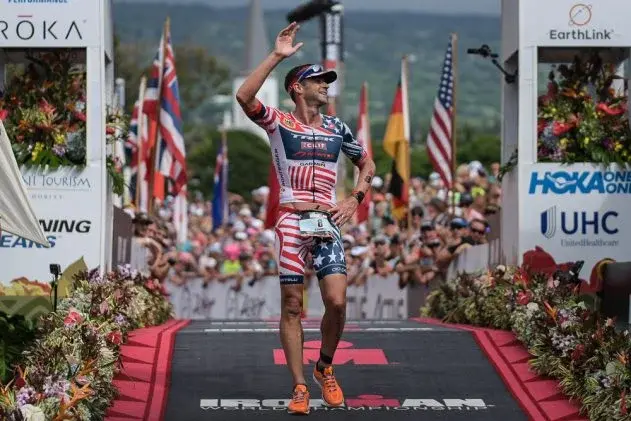
Tim O'Donnell
The Measure of the Heart: Tim O'Donnell's Race Against the Odds.
The Measure of the Heart: Tim O'Donnell's Race Against the Odds#
Part I: The Officer and the Athlete: Forging a Foundation of Discipline#
The character of a person, like the strength of a ship, is often forged in unseen depths, under pressures that shape and temper long before it ever meets the open sea. For Timothy O’Donnell, one of America’s most decorated and resilient long-course triathletes, the foundation of his extraordinary career was laid not on the lava fields of Hawaii, but in the perpetual motion of a nomadic childhood and the unyielding discipline of the United States Naval Academy. His is a story not of effortless talent, but of cultivated toughness—a unique alloy of inherited grit and engineered resolve.
A Nomadic Upbringing#
Long before he was a professional athlete navigating global race circuits, Tim O’Donnell was a boy navigating a constantly changing American landscape. His father’s career in the automotive industry was a restless one, pulling the family through a succession of homes in Florida, California, Michigan, New Jersey, Massachusetts, and Oregon. For many children, such a peripatetic existence would be a source of instability. For O’Donnell, it became an unintentional but perfect psychological conditioning program. “I personally loved it,” he would later recall. “I think it fit my personality type. New environments. New chances to excel”. This constant adaptation bred a form of anti-fragility; instead of being weakened by change, he learned to thrive on it, a trait that would prove indispensable in the unpredictable world of professional sport.
The constants in this life of motion were family and sport. His father, a former lacrosse and hockey player for Boston State, was a man of “fiery” competitive drive, instilling in his four children an unquenchable thirst for competition. Wherever the family landed, a basketball hoop would soon appear, a symbol of the competitive spirit that bonded them. His mother, a retired school teacher, was the diplomatic counterweight—the resilient operational commander who managed four children born within a mere four-and-a-half-year span, often single-handedly navigating airports while her husband moved ahead for work. O’Donnell inherited this potent blend of traits: his father’s competitive fire, tempered by his mother’s measured diplomacy.
Swimming was the family’s sport of choice, a year-round commitment that became the central pillar of O’Donnell’s early athletic life. Yet, success did not come easily. He was not a prodigy. In the early days, he often found himself in the shadow of his contemporaries, persevering against the odds. He was the kid who received the "coach's award" while his older brother took home the MVP trophy, a dynamic that instilled a crucial lesson in perseverance long before he ever contemplated a professional career. It was a pattern that would define his journey: starting from behind and, through sheer tenacity, finding a way to prevail.
The Crucible of Annapolis#
In 1999, O’Donnell traded the uncertainty of civilian life for the rigid structure of the United States Naval Academy at Annapolis. He arrived as a swimmer, competing on the varsity team for two seasons, his best event the 400-meter freestyle. But it was at the Academy that his true calling found him. On the advice of his older brother Thomas, a fellow Naval Academy graduate, he tried triathlon. The sport was a perfect synthesis of his powerful swimming background and the immense discipline demanded by military life.
His aptitude was immediate and undeniable. He quickly became a dominant force in the collegiate ranks, leading the Naval Academy Men’s Team to two U.S. National Triathlon Championship titles. But his life at Annapolis was a dual pursuit. While excelling as an athlete, he was also being molded into a naval officer, majoring in Naval Architecture and earning a coveted service selection for Explosive Ordnance Disposal (EOD), a high-stakes special operations field. This academic and military path reveals a mind that was as analytical and methodical as his body was powerful. After graduating in 2003, he continued his education while serving as a Navy Ensign, earning a Master of Engineering in Ocean Engineering from the University of California, Berkeley, in 2005.
This combination of disciplines—the physics of naval architecture, the fluid dynamics of ocean engineering, and the calm-under-pressure precision of EOD training—provided him with a unique competitive advantage. Ironman racing, at its core, is a complex, long-duration equation involving the meticulous management of nutrition, hydration, power output, and heart rate. It is as much an engineering problem as it is a physical test. O’Donnell’s background equipped him to approach the sport with the mind of a systems analyst. He could deconstruct the challenge, devise a race plan, and execute it with the methodical calm of a technician disarming a bomb. This engineer’s mindset, housed within a world-class athlete’s body, would become his secret weapon.
Part II: The Long Road to the Top: The Kona Quest#
Every great athlete’s career is defined by a singular pursuit, a quest that focuses their ambition and measures their worth. For a long-course triathlete, that quest inevitably leads to the black, sun-scorched lava fields of Kailua-Kona, Hawaii, home of the Ironman World Championship. For Tim O’Donnell, the journey to the pinnacle of his sport was a long and arduous campaign, marked by consistent excellence, frustrating near-misses, and the formation of a partnership that would define both his life and his career.
A Star on the Rise#
While still serving in the U.S. Navy, O’Donnell began to lay the groundwork for his professional career. He was utterly dominant in military competition, capturing six consecutive Armed Forces National Championships from 2003 to 2008. This period served as an apprenticeship, honing his race craft while he fulfilled his service obligations. In 2007, his talent was formally recognized with an assignment to the U.S. Olympic Training Center in Colorado Springs.
The year 2009 marked his explosive arrival on the international long-course scene. It was a season of stunning breakthroughs: he claimed victories at the prestigious Ironman 70.3 St. Croix and Ironman 70.3 Calgary, setting course records at both. The season culminated in Perth, Australia, where he was crowned the ITU Long Distance World Champion. This trifecta of wins announced to the world that a new American force had arrived. By 2012, he made the pivotal decision to transition from the Navy to become a full-time professional triathlete, dedicating himself completely to conquering the sport’s biggest challenges.
The Power Couple and the Kona Campaign#
As his professional career took flight, so too did his personal life. He met Mirinda "Rinny" Carfrae, a ferocious competitor from Australia who was already a multiple-time Ironman World Champion. They married in 2013, becoming triathlon’s undisputed power couple. Their shared existence was a unique one; they understood, in a way no outsider could, the monastic dedication, the physical toll, and the emotional volatility of life at the elite level. They were partners in life and in the grueling business of pushing human limits.
With his life and career fully aligned, O’Donnell turned his focus to the ultimate prize: Kona. Year after year, he arrived on the Big Island as a legitimate contender, and year after year, he delivered performances of remarkable consistency. He was a perennial fixture in the top ten, a testament to his world-class ability: 8th in 2012, 5th in 2013, 3rd in 2015, 6th in 2016, and 4th in 2018. He proved he had the engine to win the world’s biggest races, taking a commanding victory at Ironman Brazil in 2013 where he tied the existing American record with a time of 8:01:32. Two years later, at the same race, he shattered his personal best, finishing in a blistering 7:55:56.
Yet, the top step of the podium in Hawaii remained tantalizingly out of reach. In 2014, he began working with legendary coach Mark Allen, a six-time Ironman World Champion, in an effort to find the final missing piece of the puzzle. Allen identified a surprising weakness in the disciplined naval officer: he was, perhaps, too nice. “As a person, Mark's biggest complaint about me is that I'm too nice,” O’Donnell acknowledged. “He always tells me you have to get that nice guy out of you on race day”. The final frontier was not physical, but psychological—a quest to unlock a fiercer, more ruthless competitive instinct.
This quest was compounded by a unique pressure. As he consistently finished as the top American at the World Championship, he became the face of a nation’s hopes. Since 2011, the dream of ending a long American drought in the men’s race had been “pinned on Tim O'Donnell”. This was more than just the internal pressure to perform; it was the weight of carrying a nation’s expectations on his shoulders. Each year, the narrative was not just whether Tim could win, but whether an
American could win. This context reframes his consistent top finishes not as failures to secure the crown, but as remarkable displays of mental fortitude under a level of national scrutiny that his European rivals did not face.
| Year | Race | Result |
|---|---|---|
| 2003-2008 | Armed Forces National Championship | 1st (6x) |
| 2009 | ITU Long Distance World Championship | 1st |
| 2009 | Ironman 70.3 St. Croix | 1st |
| 2010 | Ironman 70.3 World Championship | 3rd |
| 2012 | Ironman World Championship | 8th |
| 2013 | Ironman Brazil | 1st |
| 2013 | Ironman World Championship | 5th (Top American) |
| 2015 | Ironman World Championship | 3rd (Top American) |
| 2016 | Ironman World Championship | 6th |
| 2017 | Ironman Boulder | 1st |
| 2018 | Ironman World Championship | 4th |
| 2019 | Ironman World Championship | 2nd (Top American) |
| 2022 | Ironman World Championship | 13th (Top American) |
Part III: The Perfect Day: Breaking Eight in Kona#
In the unforgiving theatre of the Ironman World Championship, the perfect day is a mythical beast—an elusive alignment of physical readiness, mental clarity, and tactical brilliance. For years, Tim O’Donnell had hunted this beast, only to see it slip through his grasp in the race’s cruel final miles. Then came October 12, 2019. On a day that began with the heavy cloud of a significant injury, he would go on to execute a masterpiece of endurance racing, a performance that would not only define his career but also etch his name into the history books.
An Imperfect Build-Up#
The narrative of a perfect race rarely begins with a perfect preparation. O’Donnell’s 2019 Kona campaign was a testament to this fact. A mere seven weeks before the biggest race of his life, he suffered a broken foot. It was a devastating blow, an injury that would sideline most athletes entirely. For O’Donnell, it transformed his build-up into a delicate balancing act of healing and maintaining fitness, a process fraught with uncertainty and doubt. He arrived on the Big Island not with the swagger of a favorite, but with the quiet resolve of an underdog who had already won a significant battle just by making it to the start line.
This compromised preparation, however, may have contained a hidden advantage. For an athlete who had so often carried the weight of being America’s best hope, the injury provided a strange sort of liberation. The immense pressure to win was subtly replaced by a more fundamental goal: to execute a smart, controlled race and see what was possible. By entering the race with tempered expectations, he may have inadvertently freed himself from the very psychological burden that had contributed to the infamous "meltdown moments" on the run in previous years. The injury, a seeming catastrophe, might have created the perfect mental state for his greatest performance—one of focus, not force.
Executing the Masterpiece#
From the moment the cannon fired in Kailua Bay, it was clear this was a different Tim O’Donnell.
The Swim: He navigated the turbulent 2.4-mile swim with tactical precision, exiting the water in 47 minutes and 38 seconds, firmly entrenched in the front group of contenders. It was a crucial first move. “I was with a good group of swimmers who got away from the pack, and that made the race,” he later said. He had avoided the costly effort of chasing from behind, positioning himself exactly where he needed to be.
The Bike: Out on the searing 112-mile bike course through the lava fields, he was a picture of controlled power. He rode a masterful 4-hour, 18-minute, and 11-second split, staying with the leaders and refusing to yield an inch. There was no wasted energy, no ill-advised surges. It was the execution of a plan, the work of an engineer calmly managing the variables of heat, wind, and effort.
The Run: The marathon is where Kona dreams are made or broken. For O’Donnell, it had often been the latter. But not this day. As he set out for the final 26.2-mile journey, something was different. “This is the first year that I never had that meltdown moment during the run, where I had to regain (my composure) and try to salvage and make up time,” he reflected. Fueled by a meticulously planned nutrition strategy centered around UCAN’s SuperStarch, which provided steady energy without the spikes and crashes that can plague athletes, he maintained a relentless pace. He ran with a strength and composure that had previously eluded him on this course, clocking a blistering 2-hour, 49-minute, and 45-second marathon.
The Finish: The final stretch down Ali‘i Drive is one of the most iconic finishes in all of sport. As O’Donnell made the final turn, he saw the clock. The dream was within reach. He grabbed an American flag, soaking in the roar of the crowd, and sprinted toward the line. He crossed it, arms raised in triumph, stopping the clock at 7 hours, 59 minutes, and 40 seconds.
It was a monumental achievement on multiple levels. He had secured second place, his highest-ever finish at the World Championship. He had shattered the mythical 8-hour barrier on the sport’s toughest course. And he had recorded the fastest time ever by an American in the history of the race. It was the perfect day, born from an imperfect build-up—a career-defining performance that was the culmination of a decade of relentless pursuit.
Part IV: When the Engine Fails: The Widowmaker#
An elite athlete’s body is a marvel of engineering, a high-performance engine tuned for maximum output and extraordinary endurance. But even the most powerful engines have their limits, and sometimes, a catastrophic failure can occur without warning. In March 2021, at the height of his career and just 17 months after his greatest triumph, Tim O’Donnell’s engine failed. In the middle of a race, he was confronted not with the limits of his performance, but with the stark reality of his own mortality.
The Race in Miami#
The setting was the Challenge Miami triathlon on March 14, 2021 O’Donnell, now 40 years old, was by all external measures a picture of perfect health—one of the fittest men on the planet, coming off the race of his life. The race began like any other, but about two-thirds of the way through the bike leg, something went terribly wrong.
“I started getting just chest pains across my chest, shooting pains down my left arm, then my jaw started to lock up,” he recounted. The symptoms were classic, the textbook signs of a heart attack. A chilling question formed in his mind:
Is this a heart attack? But the athlete’s brain, conditioned over decades to normalize extreme pain and push through any discomfort, immediately rationalized it away. “I was literally in my [aero]bars asking myself that question… and my response was, ‘You wouldn't be pushing 300-and-whatever watts if you're having a heart attack right now’”.
This moment reveals a terrifying paradox at the heart of the elite endurance mindset. The very grit and mental toughness that are the prerequisites for greatness can become a fatal liability. O’Donnell’s ability to disconnect from his body’s pain signals, a skill that had won him championships, was now making him ignore its most desperate cry for help. He got off the bike and began the 11-mile run. Struggling to breathe, he pushed through the agony and crossed the finish line in 11th place—an incomprehensible feat of endurance that nearly cost him his life.
The Aftermath and Diagnosis#
Back at his hotel, his condition worsened. Nausea and vomiting set in. A call to his wife, Mirinda, and then to his doctor, led to an urgent command: get to an emergency room immediately. At the hospital, the terrifying truth was revealed. He had suffered a massive heart attack, colloquially known as the “widowmaker.” A soft plaque in his left anterior descending (LAD) artery—the main artery supplying blood to the heart—had ruptured, causing a blockage that was estimated to be between 80 and 95 percent. It is one of the most lethal cardiac events imaginable, with a survival rate of just 12 percent. “We were this close to not having him around anymore,” a shaken Carfrae would later say.
The cause was not a failure of lifestyle, but a betrayal of genetics. O’Donnell had relatively normal cholesterol and blood pressure; he was the antithesis of a typical cardiac patient. The root cause was a genetic predisposition to heart disease, a family history he had not been fully aware of. His father had also suffered a heart attack at a young age, and further investigation would reveal a long history of cardiovascular disease in his family.
His story became a dramatic and public dismantling of the pervasive myth that supreme fitness equates to invulnerability. It was a stark reminder that the metrics of performance—VO2 max, power output, race times—are entirely separate from the metrics of underlying health, like arterial plaque and genetic markers. His fitness may have even saved him; years of endurance training can promote the growth of ancillary blood vessels that can create natural bypasses, and these may have kept his heart supplied with just enough blood to survive. But the event forced a crucial and long-overdue conversation within the endurance community. As O’Donnell himself would later put it, offering a powerful public service announcement forged in the crucible of his own near-death experience, “However fit you are, you can't fitness your genes”.
Part V: The Second Act: A New Perspective#
Surviving a widowmaker heart attack is not an end, but a violent, life-altering beginning. For Tim O’Donnell, the journey back from the brink was more arduous than any Ironman. It was a fight waged not against competitors on a race course, but against physical damage, psychological trauma, and the daunting uncertainty of his own future. In emerging from this trial, he was reborn—not just as an athlete, but as a survivor, a mentor, and a man with a profoundly recalibrated understanding of victory, purpose, and the true measure of a strong heart.
The Road Back#
The physical recovery began with the placement of a stent to open the blocked artery. The months that followed were a landscape of fear and caution. Training, once a matter of pushing limits, became an exercise in restraint. He was forced to keep his heart rate below 150 beats per minute for an extended period and was understandably nervous about training alone. The mental hurdles were even more formidable. He had to overcome the deep-seated trauma of the event and learn to trust his body again, a process that was far more challenging than rebuilding physical fitness.
Yet, the competitive fire still burned. With the clearance of his doctors, who determined the event was acute and that he had suffered minimal long-term damage to his heart muscle, he began the slow, methodical return. In May 2022, just 14 months after his heart attack, he toed the line at Ironman 70.3 Chattanooga. His 6th place finish was a monumental victory, a testament to his resilience. A few weeks later, he secured a 3rd place finish at Ironman Des Moines, a performance that earned him a qualifying spot for the Ironman World Championship.
His return to Kona in October 2022 was one of the most emotional moments of the race season. The man who had nearly died on a race course was back on the sport’s greatest stage. He finished in 13th place, and in a fitting tribute to his incredible journey, he was once again the top American finisher. It was not a podium finish, but it was perhaps the most meaningful result of his entire career.
Evolution and New Horizons#
The heart attack irrevocably shifted O’Donnell’s perspective. The all-consuming pressure of chasing the Kona crown was replaced by a sense of gratitude for life itself. He has since "hard launched his exit" from the relentless grind of professional Ironman racing, seeking ways to remain in the sport that are healthier for his family and his own internal well-being.
This new chapter has led him to the dirt. He has embraced the world of off-road and XTERRA triathlon, a discipline that requires an entirely new skillset. His approach to this new challenge reveals a profound re-calibration of what success means to him. After a career defined by podiums and stopwatches, he is now racing with "no expectations of winning," finding joy in the process of learning to ride a mountain bike and simply participating. Success is no longer measured by the finish time, but by the experience itself.
This evolution from competitor to steward of the sport is most evident in the coaching business, "Salty Bears Racing," that he and Mirinda launched in 2023. Their coaching philosophy is a direct reflection of their new outlook on life, emphasizing a balance between performance and the things that truly matter: health, wellness, and family. They are dedicated to coaching the "whole person," helping athletes achieve their goals without losing sight of their lives beyond the finish line.
A Life Redefined#
Today, Tim O’Donnell’s identity is multifaceted. He is a husband and a father to three young children—Isabelle, Finnian, and Jameson. He is a coach and a mentor. And he is a powerful advocate for heart health, using his platform to share his story and urge others, especially type-A athletes, to understand their family history and listen to their bodies.
His journey has been one of profound transformation. He speaks openly of his evolution from an "angry 20-something kid full of piss and vinegar" to a man who now competes from a place of "joy, happiness, and gratitude". It is a maturity forged in the crucible of a near-death experience, a perspective that could only be gained by staring into the abyss and choosing to live.
He has faced the ultimate test, one that had nothing to do with swimming, biking, or running. He survived, and in doing so, discovered a new way to race, and a new way to live. The boy who thrived on new chances to excel has become a man who cherishes every chance he gets, understanding more than most the precious, fragile, and ultimately triumphant measure of the human heart.