Tim Don
The Don: A Study in Resilience.
The Don: A Study in Resilience#
Introduction: The Man in the Halo#
The image is stark, almost medieval. A man is encased in a carbon fiber ring, a medical halo held in place by four titanium screws bored directly into his skull. The pressure is immense, tightened to eight newton meters, double the torque used to secure a bicycle seat post. For three months, he cannot sleep for more than 90 minutes at a time, forced into an upright chair to avoid agonizing pressure on the open wounds in his head. Simple acts like showering require the help of his wife, Kelly; getting dressed is a 50-minute ordeal. This is not a portrait of an athlete in their prime. It is a study in profound vulnerability, a man trapped within what he would later call a "barbaric" device.
The man in the halo is Tim Don. Just months before this photo was taken, he was on top of the world, the undisputed king of his sport. On May 28, 2017, he had executed the perfect race, completing the Ironman South American Championship in a staggering 7 hours, 40 minutes, and 23 seconds—a new world record. He arrived at the Ironman World Championship in Kailua-Kona, Hawaii, that October as a favorite to win, the culmination of a 20-year professional career.
Then, three days before the race, on a final training ride along the iconic Queen Ka'ahumanu Highway, a truck turned in front of him. The impact resulted in a "hangman's fracture" of his C2 vertebra, a catastrophic injury high in the neck. He was presented with a choice that stripped his life down to its essential components. He could opt for vertebral fusion surgery, a procedure that would guarantee a stable neck but would unequivocally end his career. Or, he could choose the halo, an instrument of torture that offered a 90% chance of a full recovery and a return to professional racing.
His decision to endure the halo was more than a medical one; it was an existential declaration. It was a choice to accept a physical prison to avoid the permanent confinement of a career ended on someone else's terms. The story of Tim Don is therefore not merely about athletic achievement, but about the very nature of identity. It poses a fundamental question: what forges an individual who can not only reach the zenith of human performance but can also endure its absolute nadir, and then, against all odds, begin the long climb back?
Chapter I: The Making of a Champion (1998-2012)#
The Prodigy from Hounslow#
Long before he was an Ironman, Timothy Don was a product of West London's crucible of athletic ambition. Born in Isleworth, the son of former Premier League referee Philip Don, his competitive journey began representing the borough of Hounslow in the London Youth Games. It was an environment teeming with talent; at the local running club, he trained alongside a young Mo Farah, part of a generation of hungry athletes who, as Don recalled, were all "striving for excellence". His entry into triathlon was almost accidental, invited to a local race at age 15, but his talent was immediately apparent.
The turning point came in 1998. At the ITU Junior World Championship in Lausanne, Switzerland, a 20-year-old Don captured his first world title. That victory was the anointment, the moment that validated his potential and secured the professional contracts that would launch his career. It was the first act in a drama that would see him return to the shores of Lake Geneva for the most significant moments of his short-course career.
A Unique Quartet of Crowns#
What followed was a demonstration of unparalleled versatility. Over the next eight years, Don assembled a collection of world championships across a spectrum of multisport disciplines that remains unique in the sport's history. He proved he could win with or without a swim, on the road or in a hybrid format, showcasing a complete athletic skillset. His quartet of crowns includes:
- 1998: ITU Junior Triathlon World Champion (Lausanne)
- 2002: ITU Duathlon World Champion (Alpharetta, USA)
- 2005: ITU Aquathlon World Champion (Gamagori, Japan)
- 2006: ITU Triathlon World Champion (Lausanne)
The Apex: 2006 World Championship#
The culmination of this era came on September 3, 2006, back where it all began: Lausanne. That year, Don had felt like "the nearly man," finishing fourth at the Commonwealth Games and missing out on a World Cup win. The world championship race seemed to be following a similar script. A powerful group including the reigning Olympic champion, Hamish Carter of New Zealand, broke away on the bike, quickly establishing a 45-second lead. Caught in the chase pack, Don realized no one was willing to commit to the effort. In a moment of decisive courage, he launched a solo attack, bridging the gap alone over the course of a single, grueling lap.
Once on the run, the race became a duel between Don and Carter. Don pushed the pace, and at the 6 km mark, a glance over his shoulder revealed a 10-meter gap. He held his nerve and pulled away, crossing the line 17 seconds ahead of the Olympic champion to claim the elite world title. It was a landmark victory, Great Britain's first elite men's title since the era of Simon Lessing and Spencer Smith, and it cemented Don's place at the absolute pinnacle of the sport. The city of Lausanne, which had witnessed his arrival as a junior, now hosted his coronation as the best in the world.
The Olympic Journey and Its Discontents#
Despite his world championship success, Don's Olympic journey was one of promise mixed with frustration. He competed in the first-ever Olympic triathlon at the 2000 Sydney Games, securing a respectable 10th place. A disappointing 18th followed in Athens in 2004. His final Olympic appearance in Beijing in 2008 was fraught with difficulty. He was controversially selected despite serving a three-month ban for missing three out-of-competition drug tests—a lapse an independent tribunal attributed to "forgetfulness and a lack of understanding of the new system" rather than intent to cheat. Competing while ill, he was pulled from the race and registered a DNF.
The final act of his short-course career was perhaps the most symbolic. In 2010, back in Lausanne for the inaugural ITU Sprint World Championships, he took a silver medal, finishing behind a 20-year-old Jonny Brownlee, an athlete 12 years his junior. It was a passing of the torch. The ultimate blow came when he failed to qualify for the 2012 London Olympics, a decision he felt was driven by team politics prioritizing domestiques for the Brownlee brothers over individual performers. The sting of missing a home Games became the catalyst for a radical reinvention, forcing him to close the book on one chapter and begin writing the next.
Chapter II: The Long Road (2013-2017)#
Reinvention#
The disappointment of London 2012 was the crucible in which the second act of Tim Don's career was forged. In September 2013, he officially made the pivot to long-course racing, a move born from the need for a new challenge. This was not merely a change in race distance; it was a fundamental reimagining of his athletic identity. He had to unlearn the explosive, reactive instincts that had defined him as a short-course athlete and cultivate the patience, metabolic efficiency, and relentless pace of an endurance machine.
To do this, he overhauled his training philosophy. He described the frantic nature of ITU racing, where if you miss the first swim pack, your race is effectively over. For Ironman, the approach was different. He strategically reduced his swim intensity, redirecting that energy toward building formidable strength on the bike and deep endurance in his run. He enlisted a new coaching team, including Julie Dibens and bike specialist Matt Bottrill, to help him build what he called a "superhero suit" for the unique demands of Ironman. This demonstrated a rare athletic intelligence—the ability to deconstruct his own ingrained methods and rebuild them for a new purpose.
Immediate Success and Learning Curve#
The transition was remarkably swift. In his very first month of long-course competition, he won Ironman 70.3 Augusta. This was no fluke. Over the next few years, he amassed no fewer than 13 victories at the Ironman 70.3 distance and twice stood on the podium at the 70.3 World Championships, taking bronze in 2014 and 2017.
His mastery extended to the full distance as well. In his debut at Ironman Mallorca in 2014, he claimed a commanding victory. It was clear that his talent was not confined to one style of racing. His unrivaled foot speed, honed over years of 10 km finishes, translated seamlessly to the marathon, while his newfound bike strength made him a complete long-distance threat.
The Boulder Base#
This professional transformation was mirrored by a personal one. Don relocated his family to Boulder, Colorado, a global mecca for endurance athletes. There, he settled into a new rhythm, balancing the grueling 30-hour training weeks of a world-class professional with his role as a husband to Kelly and father to his children, Matilda and Hugo. The image of the world champion fitting his training around the school run humanized an athlete who was, at that very moment, quietly building towards the performance of a lifetime.
Chapter III: The Perfect Day: Ironman Brazil 2017#
The Build-Up#
By the spring of 2017, all the pieces were in place. Don, now 39, arrived in Florianópolis, Brazil, for the Ironman South American Championship in the form of his life. He was coming off dominant wins at Ironman 70.3 races in Campeche, Mexico, and Liuzhou, China, and felt he had finally "cracked the code" of Ironman racing. He was ready to win, but even he could not have anticipated the perfect storm of fitness and execution that was about to unfold.
A Race Against the Clock#
On May 28, 2017, Tim Don delivered a performance that would redefine the limits of the sport. His race was a masterclass in solo, front-running dominance, a seven-hour and forty-minute battle against the clock.
- Swim (44:16): He launched an aggressive swim, exiting the water near the front and immediately seizing control of the race. This single act was the strategic key to his entire day. His short-course background, once a tool for survival in the pack, was now weaponized to create a gap that his rivals would never close.
- Bike (4:06:56): On the bike, he was relentless. For the first 90 minutes, he pushed power numbers typically reserved for a half-Ironman, a high-risk strategy that paid off spectacularly. By the time he reached the second transition, he had built an astonishing 20-minute lead over the field. It was a mentally punishing effort, riding completely alone for hours, a testament to his focus and fortitude.
- Run (2:44:46): As he began the flat marathon course, spectators lining the streets began shouting about a record. Don, locked in his own world of pain and effort, was initially confused, unsure which record they meant. He only learned it was the world mark with about 13 km to go. Realizing he needed a sub-2:48 marathon to break it, he dug deep. In the final meters, still uncertain if he was on pace, he summoned a desperate sprint to the finish line.
Deconstruction of a World Record#
The clock stopped at 7:40:23. He had shattered the previous Ironman-branded world record, held by the Canadian powerhouse Lionel Sanders, by more than four minutes. The moment he turned and saw the time, he dropped to his knees in disbelief, a gesture of pure, overwhelming emotion. "I’ve been a professional for 25 years," he later said, "and I can literally count on one hand when everything has gone right". It was, in every sense, the perfect day.
A breakdown of his performance against the previous record reveals the brilliance of his strategy.
| Discipline | Tim Don (IM Brazil 2017. | Lionel Sanders (IM Arizona 2016. | Difference |
|---|---|---|---|
| Swim | 44:16 | 53:45 | -9:29 |
| Bike | 4:06:56 | 4:04:38 | +2:18 |
| Run | 2:44:46 | 2:42:21 | +2:25 |
| Total | 7:40:23 | 7:44:29 | -4:06 |
The data shows that Don did not simply outpace Sanders across the board. He built a colossal 9-minute and 29-second advantage in the swim, a lead so significant that he could afford to be slightly slower on the bike and run and still demolish the overall record. It was the ultimate validation of his reinvention.
Chapter IV: Three Days in October#
The Height of Confidence#
Five months after his world record, Tim Don arrived in Kona for the 2017 Ironman World Championship at the absolute zenith of his career. He was the fastest man in history over the distance, brimming with a quiet confidence that he was ready to claim the sport's "holy grail". "I was the best prepared I'd ever been," he recalled. "I'd no injuries nor niggles, my bike numbers were up, and I was running and swimming well".
The Crash#
On the Wednesday before the race, just three days out, that confidence was shattered. During a final, easy bike ride on the Queen K Highway, a white truck turned directly into his path. He remembered skidding and then the impact. The next thing he knew, he was waking up 30 minutes later in the emergency room. His initial thought was whiplash, a desperate hope he might still be able to race. The gravity of the situation became clear when it took eight nurses to lift his body onto the MRI table.
The Diagnosis and the Choice#
The diagnosis was catastrophic: a hangman's fracture of the C2 vertebra, the second vertebra down from the skull. He was flown to Colorado and consulted with Dr. Alan Villavicencio, a neurosurgeon who also happened to be a Kona competitor. The options were laid out with brutal clarity: fuse the vertebrae and end his career, or be fitted with a halo, a device that would immobilize his head and neck for three months but offered the best chance to race again. For an athlete who had defined his life by movement, the choice was agonizing but clear. He chose the halo.
Life in the Halo#
What followed was an ordeal of physical and psychological torment. The four titanium screws were tightened into his skull with a medical torque wrench, a pain he said was not fully numbed by local anesthetic. The first three weeks were a sleepless hell, spent upright in a chair. The side effects from pain medication caused him to vomit, an act of pure horror when his gag reflex was engaged but his neck could not move. At one point, he told his wife to get an Allen key and take the device off his head. The low point came at Christmas, when one of the screws had worked so loose it was nearly touching his brain, forcing doctors to drill a fifth hole in his skull.
Throughout this period, he battled anger, depression, and the daily fear that his career was over. Yet, in the midst of this suffering, he deployed the most powerful weapon in his arsenal: his athletic mindset. Just as he would break down an Ironman into manageable segments, he began to break down his day. The goal was no longer the finish line in Kona, but simply getting through the next hour, making his son breakfast, or preparing the bathroom for a shower. He focused on what he could control, not what he couldn't. The mental discipline honed over two decades of professional racing became his primary tool for survival.
Chapter V: The Comeback ("The Man with the Halo")#
First Steps#
The road back began with the smallest of steps. While still confined in the halo, Don returned to the gym. His first session on a stationary bike lasted just five minutes at a meager 80 watts of power—all he could muster. It was a humbling return to "ground zero" for the world's fastest Ironman, but it was a start.
The Boston Marathon: A Line in the Sand#
On April 16, 2018, almost exactly six months after the accident, Tim Don stood on the starting line of the Boston Marathon. The conditions were notoriously brutal: freezing temperatures, a driving rain, and powerful headwinds that led to some of the slowest winning times in decades. Don's goal was simple: to run close to the 2:50 marathon split he had run in Brazil. On limited training, with a longest run of just under 17 miles, he crossed the finish line in 2:49:42. More important than the time, the race was a psychological turning point. As he said later, it marked the end of his identity as a "recovering athlete" and the beginning of his return as a professional. "Goodbye broken neck," he declared, "Hello Kona!".
Return to the Podium#
Two months later, the comeback became truly tangible. At Ironman 70.3 Costa Rica, in his first triathlon since the accident, Don won. The victory, just eight months after breaking his neck, was an emotional and surreal moment that proved he could not only compete but win at the elite level again.
The Road Back to Kona#
The ultimate goal, however, was a return to the site of his trauma. The qualification process for the 2018 World Championship was an arduous one. He finished ninth at Ironman Hamburg, falling short of the required points. A DNF at Ironman Copenhagen seemed to have sealed his fate. But in a dramatic twist, another qualified athlete turned down their spot, and Don, as the next man on the list, was in. Crucially, he had earlier turned down a "wildcard" entry offered by Ironman, insisting that he would only return if he
earned his place on the start line. This decision spoke volumes about his character; the victory he sought was not just finishing the race, but reclaiming his identity as a competitor on his own terms.
Kona 2018: Closing the Circle#
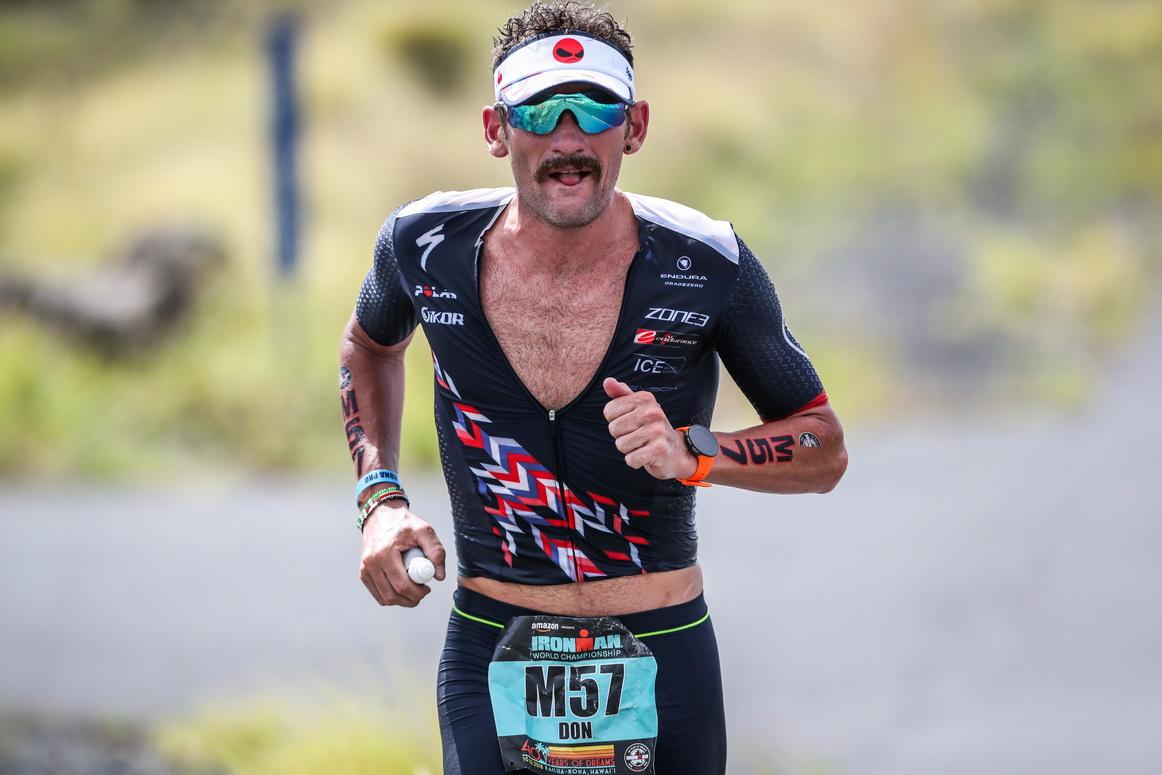
On October 13, 2018, one year and three days after the crash, Tim Don completed his journey back to the Big Island. He finished the race in 8:45:17, placing 36th among the professional men. The result was secondary. The triumph was in being there, in transforming a place of profound trauma into a symbol of ultimate resilience. The entire unfathomable comeback was chronicled in the Emmy Award-winning documentary,
The Man with the Halo, cementing his story as one of the most inspirational in the history of sport.
Conclusion: The Enduring Legacy of 'The Don'#
In the years since his return to Kona, Tim Don has gracefully transitioned into the role of an elder statesman of triathlon. Now in his mid-forties, he continues to race, but has also embraced his status as a respected coach, mentor, and voice within the sport. He has served as a team captain for the dynamic Super League Triathlon series and as a backup guide for the Paralympics, demonstrating a deep commitment to giving back to the community that supported him through his darkest hours.
His coaching philosophy is the direct distillation of a career defined by both glorious success and unimaginable hardship. The principles he teaches—"consistency, communication, and performance, not results"—are not generic mantras but hard-won truths forged in the fire of experience. It is the wisdom he earned while locked inside the halo, the understanding that the true measure of an athlete lies not in the outcome, but in the integrity of the process.
Ultimately, Tim Don's legacy will be defined not just by his four world titles or his astonishing world record. He will be remembered for his remarkable longevity, his rare adaptability across distances, and, above all, his profound resilience. The story of "The Man with the Halo" has transcended triathlon, becoming an enduring testament to the capacity of the human spirit to face down adversity and emerge stronger. His greatest victory was not won on the sun-drenched roads of Brazil, but in the quiet, agonizing, and triumphant battle to define his own finish line.