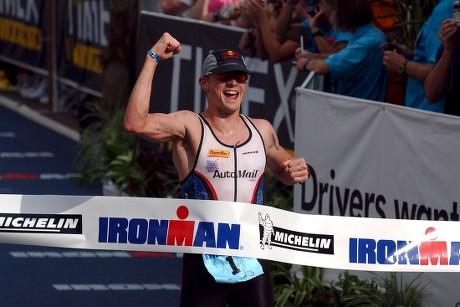
Tim De Boom
The Quiet American: The Unassuming Grit and Lasting Reign of Tim DeBoom.
The Quiet American: The Unassuming Grit and Lasting Reign of Tim DeBoom#
In the modern pantheon of endurance sports, origin stories are often explosive, near-mythical tales. We are drawn to the supernova, the athlete who bursts onto the scene from seemingly nowhere, like Chrissie Wellington conquering the Ironman World Championship in her rookie appearance. We are captivated by the redemption arc, the journey from addiction and despair to world-class performance, a narrative embodied by figures like Lionel Sanders. These are stories of revelation, of dramatic transformation.
Tim DeBoom’s story is not one of them. His is a narrative written not in lightning strikes but in the steady, metronomic tapping of a chisel on stone. There was no single, cinematic moment of discovery, no dark past to overcome. There was just a man from Iowa and the quiet, daily decision to do the work. “I started as a true age-group athlete from Iowa and slowly worked my way up,” DeBoom states, his own summary as unadorned as his approach. “It was an unpredicted path with lots of setbacks, but I never gave up. I believed in myself”.
This unassuming character, a man defined by process over personality, by grit over glamour, holds one of the most significant and enduring titles in American triathlon: he is the last American man to win the Ironman World Championship. He claimed the crown in 2001 and defended it in 2002, joining the hallowed company of Dave Scott and Mark Allen as only the third man in history to win back-to-back titles in Kona. With each passing year, as the drought of American male champions on the Big Island of Hawaii has grown longer, the weight and meaning of DeBoom’s reign have only intensified.
In an age of spectacle and self-promotion, how did a self-described "normal guy" climb to the absolute pinnacle of the world's hardest one-day endurance event, not once, but twice? The answer lies in a story of quiet obsession, of calculated patience, and of a blue-collar work ethic forged in the American Midwest—a story of the last great quiet American champion.
The Iowa Work Ethic: Forging a Foundation#
The bedrock of Tim DeBoom’s character was laid in the fertile soil of the American Midwest. Growing up in Iowa with his athletically inclined brothers, including his older brother and future professional triathlete, Tony, life was a mix of sport and creativity. While the athletic side came easily to the DeBoom boys, their mother, a schoolteacher, nurtured their artistic sensibilities with trips to museums, plays, and concerts. When they weren't running around outside, they could often be found on the floor, sketching for hours. This upbringing fostered a sense of balance, a foundation that would be tested later by the all-consuming demands of elite sport.
The Reluctant Swimmer, The Natural Runner#
From a young age, DeBoom’s athletic journey was marked by a peculiar paradox. He possessed a prodigious, almost effortless talent for running. In elementary school, he set city records in distance events, and as a 10-year-old, he ran a 5K in under 20 minutes to place third overall. In high school, as part of his swim team’s pre-season training, he consistently ran timed miles in the low four-minute range, prompting the track coach to tell him he had a legitimate shot at winning the prestigious Drake Relays.
Yet, when the cross-country team came to his house before his junior year to recruit him, he turned them down flat. “Sorry guys, I’m a swimmer,” he told them. The irony was that he didn’t even particularly like swimming. His father had to bribe him with toys just to get him to attend lessons as a child. While he had some success in the pool, he was a realist even at a young age and knew his ability would never take him to the Olympics.
This early decision reveals a core trait that would define his professional success: a profound capacity for disciplined commitment, even in the absence of overt passion. His self-identification as a "swimmer," despite his natural gifts and inclinations lying elsewhere, suggests a mindset less concerned with finding the sport he loved and more with mastering the sport he had chosen. It was an early glimpse of the blue-collar approach that would characterize his career. The work was not a passion to be followed, but a job to be done with unwavering excellence.
The Unpredicted Path to a Profession#
His entry into triathlon mirrored this methodical nature. There was no grand calling, no singular moment of inspiration. Instead, it was a slow, deliberate progression from a "true age-group athlete". He was the top American age-group finisher at the ITU World Championships in both 1993 and 1994 before taking the leap and earning his pro card in 1995. He took pride in this slow burn, a path marked by numerous setbacks that taught him resilience and self-belief.
This journey led him to a pivotal crossroads. A premed graduate, he faced a choice between the stable, respectable path of medical school and the precarious, uncertain life of a professional triathlete. After momentarily suppressing his inner "realist," he chose the latter, a quiet but profound bet on himself. This decision also shaped his ambitions. When triathlon was added to the Olympics, the qualification process required a globe-trotting chase for points. As a young pro with a young wife and limited finances, DeBoom recognized the impracticality of that path. Having just placed third in Kona, he believed he had a better chance of winning the Ironman World Championship than of securing an Olympic berth. He chose the path that looked more promising and secure, and in doing so, let his Olympic dream fade without regret.
It was during this formative period that another cornerstone of his life and career fell into place. On a flight to the 1995 ITU World Championships in Cancun, a lucky seat assignment placed him next to Nicole Molzahn, a standout swimmer from Yale University who was also embarking on her own triathlon journey. They married a year later, forging a personal and professional partnership that would anchor him through the highs and lows of the grueling years to come.
The Crucible of Contention (1995-2000)#
The early years of Tim DeBoom’s professional career, which officially spanned from 1995 to 2012, were a period of steady, incremental growth. He represented the United States at the Goodwill Games and Pan American Games, honing his craft on the international stage. His debut at the Ironman World Championship in Kona in 1995 was a sign of his potential; he finished 10th overall, a remarkable achievement for a newcomer. He was learning the unforgiving calculus of the Big Island, slowly building the physical and mental fortitude required to contend.
Breakthrough in New Zealand (1999)#
The moment that signaled his arrival as a true Ironman force came in March 1999, at Ironman New Zealand in its new location of Taupo. The race was a significant "confidence builder," as he later described it. For years, the marathon had been his perceived weakness in the Ironman distance. In New Zealand, he turned that perception on its head. In a thrilling battle with local favorite Cameron Brown, DeBoom used his run to secure the victory by a razor-thin margin of just 13 seconds. He finished in 8:32:41, with his 2:46:55 marathon split being the decisive weapon. "I won it on the run," he said, "and that had been my weak point... now I feel like it is a strength instead of a hindrance". The win was a breakthrough, not just in the standings, but in his own mind. He now knew he could win major titles.
Forging a Rivalry#
As DeBoom’s star rose, so did that of a formidable Canadian competitor, Peter Reid. The two became training partners and friends, pushing each other in the high-altitude training grounds of Boulder, Colorado. Their relationship was a classic sports paradox: genuine camaraderie off the course that gave way to fierce, unflinching competition on race day. This dynamic would come to define the pinnacle of men’s professional Ironman racing at the turn of the millennium.
The Two-Minute Wound (Kona 2000)#
After his breakthrough in New Zealand, DeBoom arrived in Kona in 1999 and validated his new status, finishing on the podium in 3rd place. This set the stage for the 2000 Ironman World Championship, a race that would become the single most important catalyst of his career.
On October 14, 2000, DeBoom and Reid engaged in a grueling, head-to-head battle across the lava fields. At the finish line on Ali'i Drive, they embraced as training partners who had taken first and second at the most important triathlon on earth. But beneath the sweat-soaked congratulations, their thoughts were worlds apart. Reid had won his second world title, but the victory had been agonizing. "Winning that race was so hard knowing that Tim was coming back on me," Reid recalled. "Every step was agony".
For DeBoom, the feeling was far simpler and far more painful. He had lost by just 2 minutes and 9 seconds. The proximity to victory was not a comfort but a torment. "I was thinking, 'I lost the Ironman by two lousy minutes,'" he remembered. "I knew that every time I went out for a ride or a run or a swim for the next 12 months, that two minutes would both haunt me and push me".
The two minutes that separated him from Peter Reid were more than a deficit on a clock; they became a psychological wound. For the next 365 days, those 129 seconds would be the ghost in every workout, the silent motivator in every lonely mile. He was haunted by the image of "Peter running away from me". The agonizingly close defeat provided a specific, quantifiable, and deeply personal target that focused his immense work ethic into an unstoppable force. This single race transformed a world-class contender into a man obsessed with redemption, setting the stage for the defining moments of his career.
An American Champion, Forged in Fire (2001)#
The year 2001 was DeBoom’s mission to reclaim 129 seconds. Every training session was a down payment on a debt he felt was owed. His season began with a stark reminder of the sport's unpredictability. At Ironman Australia, he overheated severely in the warm water of the swim, fell unconscious, and had to be pulled from the course by a lifeguard—a frightening and abrupt end to his race.
The Brother's Bond: Ironman California#
Needing to recalibrate, he signed up for Ironman California just six weeks later. The race, held on May 19, 2001, became a historic and deeply personal moment for the DeBoom family. Tim and his older brother, Tony, found themselves working together. After exiting the swim together, they spent the 112-mile bike ride chasing down the aggressive pace of Australian Craig Walton. They entered the final transition just 2:30 behind. On the run, they ran side-by-side, a familiar sight from their training days in Boulder, and passed Walton around the six-and-a-half-hour mark. It wasn't until mile 18 that Tim, the stronger marathoner, began to pull away.
Tim broke the tape in 8:22:14, securing his first Ironman victory and a massive confidence boost. Just five minutes later, Tony crossed the line in second place. They became the first and only pair of brothers to finish 1-2 in an Ironman race, an emotional moment capped by an embrace at the finish line. "It's a dream to be able to race like this with him," Tim said. "We've talked about it for years".
Redemption in the Lava Fields: Kona 2001#
He arrived on the Big Island in October a man on a mission, but the race took place under a somber cloud. The Ironman World Championship on October 6, 2001, was one of the first major international sporting events held after the September 11th terrorist attacks. The atmosphere was heavy with emotion, and for many, an American victory would carry a special significance.
The race itself was a tactical crucible. The infamous Kona winds were in full force, with gusts up to 50 mph battering the athletes on the Queen Ka'ahumanu Highway. The day's narrative was quickly shaped by two key rivals. Steve Larsen, a brash newcomer and former professional cyclist who had been a teammate of Lance Armstrong, brought a cyclist’s aggressive mentality to the race, aiming to destroy the field on the bike. Meanwhile, defending champion Peter Reid was struggling, the product of a year spent overtraining with a new coach in an attempt to "dominate" rather than just win.
DeBoom’s race was a masterclass in patience and control, a direct lesson learned from the pain of 2000. Early in the bike leg, he was flagged for a drafting violation, incurring a three-minute penalty to be served in the transition area before the run—a setback that could have shattered his focus. As Larsen rode away from the field, building a lead that stretched to nearly 10 minutes over DeBoom by the time he served his penalty, the temptation to chase must have been immense. But DeBoom refused to be goaded. He stuck to his plan, trusting his preparation and his greatest weapon: his run.
He started the marathon with a huge deficit to overcome. But while Larsen’s legs, shredded by his suicidal bike pace, began to stiffen, DeBoom was methodical. He "put his faith in his running," and that faith was justified. He ran with a controlled fury, reeling Larsen in and passing him at the 10-mile mark. From there, he never looked back. He powered through the marathon with the day's fastest split, a blistering 2:45:54, and ran down Ali'i Drive alone. He crossed the finish line in 8:31:18, more than 15 minutes ahead of second-place finisher Cameron Brown. As he broke the tape, he held an American flag aloft, an emotional and symbolic victory for a nation in mourning. He was the first American man to win in Kona since the legendary Mark Allen in 1995 The two-minute wound of 2000 was finally healed.
The Weight of the Crown (2002)#
Returning to Kona in 2002, Tim DeBoom was no longer the hunter. He was the hunted, the reigning champion with a target on his back. The pressure was immense, but he arrived prepared to defend his title. The race on October 19, 2002, would prove to be an even tougher fight, a victory that would cement his legacy among the sport's all-time greats.
The day began with dreary conditions and heaving waves that made for one of the toughest swims in the race's history. DeBoom emerged from the choppy waters as part of a main chase pack that was already four minutes behind the leader. The dynamic on the bike was aggressive. Kona rookie Chris McCormack, known for his bravado, pushed the pace hard, building a significant lead over the field. By the time the top contenders, including DeBoom, reached the second transition, they faced a daunting eight-minute deficit.
Once again, DeBoom found himself in a familiar position: behind, with only the marathon left to change his fate. And once again, he demonstrated his supreme mastery of the final leg. As McCormack, the early aggressor, began to cramp and fade, eventually dropping out of the race, DeBoom started his relentless charge. He methodically worked his way through the field, erasing the eight-minute gap. He caught the leaders out on the desolate lava fields before the turn into the Natural Energy Lab, the race's traditional breaking point. He seized the lead and never relinquished it.
He powered home with the day's fastest run split, a scorching 2:50:22, to claim his second consecutive World Championship in a time of 8:29:56—over a minute faster than his 2001 victory. His great rival, Peter Reid, finished second, more than three minutes behind. With this victory, DeBoom joined Dave Scott and Mark Allen as only the third man in history to win back-to-back titles in Kona, a feat that solidified his status as a legend of the sport.
| Metric | 2001 World Championship | 2002 World Championship |
|---|---|---|
| Overall Time | 8:31:18 | 8:29:56 |
| Swim Split (Rank) | 0:52:01 (1) | 0:52:02 (1) |
| Bike Split (Rank) | 4:48:17 (4) | 4:45:21 (8) |
| Run Split (Rank) | 2:45:54 (1) | 2:50:22 (1) |
| Margin of Victory | 14:52 | 3:10 |
| Runner-Up | Cameron Brown | Peter Reid |
Data compiled from race results.
The data from his two championship victories tells a clear and consistent story. In both races, his run was his ultimate weapon, as evidenced by his number one ranking in the marathon. He won by executing a superior run strategy, regardless of the race dynamics ahead of him. Whether coming off the bike in 4th place as in 2001 or 8th as in 2002, his approach remained the same: patient, disciplined, and devastatingly effective.
The Long Road Back (2003-2012)#
The pinnacle of sport is a precarious place. The intense, all-consuming focus that had fueled DeBoom's back-to-back victories was a double-edged sword. It had made him a champion, but it was ultimately unsustainable, and in 2003, his body began to call in the debt.
The Agony of Defeat (Kona 2003)#
DeBoom entered the 2003 Ironman World Championship aiming for a historic three-peat, a feat not seen since Mark Allen's reign. The race was unfolding according to plan; he was locked in another classic duel with Peter Reid deep into the marathon. Then, around mile 9 of the run, disaster struck. DeBoom was hit with a sudden, ferocious pain that felt "like a knife to the bowels". In an act of pure grit, he struggled on for another five miles, desperately drinking water in the hope the pain would subside. Finally, at mile 13, he could go no further. He collapsed at an aid station and was taken to a local hospital, where he passed a kidney stone. Reid ran on to win his third world title, while DeBoom was left to contemplate the brutal, unpredictable nature of the sport.
Years of Struggle and a Quiet Retreat#
The kidney stone was a harbinger of a difficult period to come. The years of pushing his body to its absolute limit began to take their toll. In 2004, he returned to Kona and finished a courageous 12th while running the marathon with stress fractures that would have crippled a lesser athlete. He dropped out mid-race in 2005 and withdrew due to injury before the race even started in 2006 The champion who had seemed invincible was now battling his own body.
During these years, DeBoom retreated from the spotlight, becoming almost reclusive. The cheerful, observant man known throughout the sport was replaced by someone hoarding every ounce of energy simply to fight injuries and stay in the game. He later reflected that his championship years were the "most unbalanced times in my life," where his entire existence revolved around a single race. The single-mindedness that had forged a champion was now breaking the athlete.
Resilience and Return (Kona 2007)#
By 2007, Tim DeBoom was largely off the radar as a Kona contender. Yet, in a testament to his enduring class and resilience, he put together one last great race on the Big Island. He led the main chase pack for much of the bike and ran a superb 2:48:29 marathon to finish in 4th place. It was a deeply satisfying performance, a return to form that proved he could still compete with the world's best. Afterward, he was more relaxed than he had been in years, having found a new, healthier relationship with the race that had both made and nearly broken him.
His professional career began to wind down. He raced his final professional Ironman in Kona in 2011 and officially retired from the elite ranks in 2012, closing a chapter that had defined nearly two decades of his life.
Conclusion: A Dedicated Life#
Retirement from professional racing was not an end for Tim DeBoom, but a liberation. He consciously shed the "triathlete" label that had defined him for so long, a label he felt had, at times, been confining. He embraced a new identity as an "all-sport" athlete, seeking out new and formidable challenges that rekindled his love for endurance. In 2011, while still a pro, he traveled to Norway and won the legendary Norseman Xtreme Triathlon, one of the world's toughest endurance events. In the years since, he has become a fixture in the rugged mountain sports scene, competing in the Leadville 100 mountain bike race and countless trail running events throughout the Colorado Rockies.
This evolution led him and his family to move from the triathlon hub of Boulder to the mountain town of Steamboat Springs, Colorado. There, he has found a new purpose as a coach and mentor. Shying away from leveraging his past fame, he started by volunteering to coach six-year-olds on cross-country skis. He now coaches youth mountain bike and ski mountaineering (skimo) programs, founding one of the first kids' skimo programs in the country. He and his brother also founded a coaching company, DeBoom Sports Mecca, working with age-group athletes and the triathlon team at West Point. He is passing on the lessons of a lifetime in sport, not through grand pronouncements, but through quiet, hands-on guidance.
In this new chapter, he has found the balance that eluded him at the height of his career. His priorities have shifted, with his relationships with his wife, Nicole, and their daughter, Wilder, now at the center of his world. The man who once admitted to being "not the most balanced guy" now knows what is most important.
His legacy in triathlon is secure. He is a two-time Pro Triathlete of the Year and a member of both the USA Triathlon and Ironman Halls of Fame. Yet his most enduring title remains the one that grows in stature each year: the last American man to win the Ironman World Championship. In a recent interview, he shared the tenets of what he calls "A Dedicated Life". It is a philosophy built on compassion, moderation, and humility. Looking at Tim DeBoom today—a father, a coach, a quiet man still finding joy in the daily grind of training in the mountains—it becomes clear. The world titles were not the destination. They were simply milestones on the path of a life defined not by singular moments of glory, but by the unwavering, day-in, day-out dedication to the process.