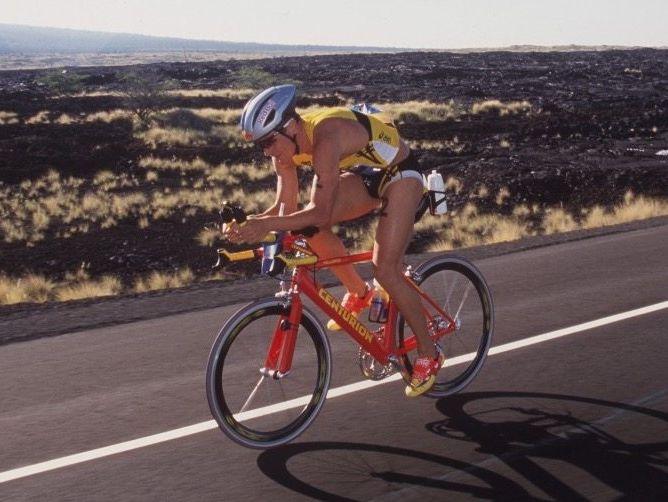
Thomas Hellriegel
Hell on Wheels: The Man Who Broke the Ironman Mold.
Hell on Wheels: The Man Who Broke the Ironman Mold#
The Day the Race Changed#
The Queen Kaʻahumanu Highway shimmered, a black ribbon of asphalt laid across an ancient, unforgiving landscape of volcanic rock. Under the searing Hawaiian sun, the 1995 Ironman World Championship was unfolding according to a familiar script. The sport’s reigning king, Mark Allen, a five-time champion, was executing his master plan: survive the swim, manage the bike, and unleash a devastating marathon to crush all challengers. But miles up the road, a 24-year-old German named Thomas Hellriegel was tearing that script to shreds.
To the press, spectators, and his fellow competitors, Hellriegel’s assault was an act of audacious, almost suicidal, aggression. He wasn't just leading the bike leg; he was trying to break it. When he dismounted his bike and ran into the second transition, the clock told a story that was almost impossible to believe. His bike split was a blistering 4:29:37, a full 17 minutes faster than the legendary Allen. He began the marathon with a lead of thirteen minutes and thirty seconds, an advantage so vast it was considered insurmountable in the modern era of the sport. This was the race that earned him his moniker: "Hell on Wheels". It was more than a nickname; it was a perfect description of a man who rode with such ferocious power that he single-handedly changed the tactical DNA of the Ironman.
This performance was not merely a display of raw physical power; it was a strategic revolution. For nearly two decades, the Ironman World Championship had been defined by a simple, brutal calculus established by the sport's titans, Dave Scott and Mark Allen: the race was won on the run. The 112-mile bike ride was a long, grueling preamble, a test of patience and conservation. Hellriegel’s ride was the antithesis of this philosophy. He weaponized the bike, transforming it from a bridge between the swim and the run into the central battleground of the entire event. His strategy was a direct assault on the established paradigm, an attempt to make the marathon prowess of champions like Allen irrelevant by building a lead so monumental that even the greatest runners would simply run out of road. In doing so, he forced a fundamental shift in how the race was contested. No longer could the favorites ride conservatively in the pack; they now had to respond to his aggression, often burning precious energy that would haunt them on the run. Thomas Hellriegel changed the question the race asked, from "Who is the best runner?" to "Who can survive the bike and still run?"
The Rebel from Büchenau: Forging an Ironman#
Born on January 14, 1971, in the small town of Büchenau, Germany, Thomas Hellriegel was an athlete seemingly destined for the iron distance, even when the established path pointed elsewhere. As a teenager, his talent was undeniable, earning him a coveted spot on Germany's short-course national squad, a program geared towards the fast-twitch, high-intensity world of Olympic-distance racing. Yet, a rebellious streak and an innate pull towards the sport's ultimate endurance test were already simmering beneath the surface.
This tension came to a head in a defining act of defiance. At just 18 years old, Hellriegel secretly sneaked away from his parents' home to compete in the legendary Ironman Roth. He finished the grueling race in just over nine hours—a remarkable feat for a teenager. But the consequences were swift. When the German triathlon federation learned of his unsanctioned foray into long-distance racing, he was unceremoniously dismissed from the national team. For the federation, it was a breach of protocol; for Hellriegel, it was the first clear declaration of his true calling. This was not a youthful indiscretion but a powerful demonstration of a character drawn to the extreme demands of Ironman, a pull so strong it superseded the pragmatic considerations of a conventional career.
Despite this early commitment to the long-course ethos, Hellriegel possessed formidable speed over shorter distances. He was, by any measure, a "short course stud". In 1992, he finished an impressive 6th at the ITU World Championships in Muskoka, proving he could race with the fastest in the world. In 1995, he won the World Military Championships, defeating a field that included future Ironman World Champion Normann Stadler. His early career was also marked by podium finishes and a victory in the ETU Triathlon European Cup series. This success in the short-course arena highlights the fundamental conflict that defined his early years. While his natural talent was perfectly suited to the Olympic-distance format, his spirit and unrelenting drive were destined for the Ironman. His eventual dominance in the sport was not simply a career choice; it was an inevitability, a journey pre-written by his own psychology. The rebellion at Roth was the moment his innate character overpowered the structured path others had chosen for him.
The Engine Room: Building the Überbiker#
Thomas Hellriegel's revolutionary bike prowess was not a product of chance; it was forged in a crucible of monumental training volume that bordered on the mythical. Rumors and reports from his peers painted a picture of a man with an almost insatiable appetite for work. Training weeks of 50 to 60 hours were not uncommon, with an astonishing 90% of that time spent on the bike. It was said that his annual cycling mileage fell somewhere between 20,000 and 25,000 kilometers—a distance that would take one more than halfway around the globe.
This extreme work ethic was, in part, a product of the German triathlon system of the era. Coaches like Steffen Grosse, with roots in the demanding East German sporting philosophy, cultivated a culture where 40-hour training weeks were the baseline, and suffering was a prerequisite for success. Hellriegel thrived in this environment, pushing the boundaries of what was thought possible. His training grounds were deliberately chosen to mirror the harshness of his racing style. He spent countless weeks in the Canary Islands, particularly on Lanzarote, a place notorious for its punishing hills and relentless winds—the perfect environment to build the physical durability and mental fortitude required for his go-for-broke strategy.
This punishing regimen was about more than just building a massive aerobic engine; it was a core component of his psychological warfare. To attack a 112-mile bike leg in an eight-hour race is a physiologically and mentally perilous gamble, risking a catastrophic collapse on the marathon. To make such a high-risk strategy viable, an athlete requires two things: a body that can sustain an incredible power output for over four hours, and the absolute, unwavering conviction that it will not break. Hellriegel's extreme training volume built both. Physiologically, it created an engine of unparalleled durability. Psychologically, the knowledge that he had consistently "out-trained everyone else" created a powerful mental armor. It transformed what looked like a reckless gamble from the outside into a calculated assault, founded on a bedrock of suffering and self-belief forged over thousands of hours on the lonely, windswept roads of Lanzarote.
Heartbreak on the Queen K: The Agony of '95 and '96#
1995 – The King's Final Stand#
In his 1995 Kona debut, Hellriegel put his strategy into devastating effect. After a solid 55:17 swim that left him slightly behind the main contenders, he unleashed his weapon on the bike course. He rode with a fury the race had never seen, seizing control and building a seemingly unassailable lead. The race then shifted into a dramatic pursuit, with Hellriegel as the hunted prey and the great Mark Allen as the relentless predator. Allen, in what would be his final Ironman, faced a deficit that required him to gain 30 seconds per mile, every single mile of the marathon, just to have a chance. For hours, Hellriegel held the five-time champion at bay, but the effort began to take its toll. Allen could sense the shift. As Hellriegel later admitted, "I didn’t need to have anyone tell me he was coming. I could feel him coming. He was like a man eater!". The inevitable finally happened at mile 23 of the run, where Allen surged past the fading German to claim his sixth and most difficult World Championship title. Allen finished in 8:20:34; Hellriegel, the man who had redefined the race, was second in 8:22:59, a mere two and a half minutes behind.
1996 – Lightning Strikes Twice#
One year later, the script seemed to repeat itself, but with a new antagonist. Hellriegel was even more dominant on the bike. He scorched the 112-mile course in 4:24:50, setting a new bike record that would stand for an astonishing 11 years. Once again, he entered the marathon with a significant lead. But this time, the challenger was not a seasoned champion but a Belgian rookie named Luc Van Lierde. Van Lierde represented a new breed of triathlete. He rode a phenomenal 4:30:44, nearly matching Hellriegel's pace, and did so despite being forced to serve a three-minute drafting penalty. Then, on the run, he unleashed a stunning 2:41:48 marathon, one of the fastest in the race's history, to hunt down the German. Van Lierde crossed the finish line in a new overall course record of 8:04:08. For the second consecutive year, Hellriegel was the runner-up, his time of 8:06:07 also shattering the old record but not enough to hold off the Belgian sensation.
While personally devastating, these back-to-back losses were the very catalysts that forced the evolution of the modern professional triathlete. Hellriegel had proven that the "Überbiker" strategy was powerful enough to control the race and bring even the greatest runners to their knees. In doing so, he inadvertently raised the barrier for what it took to win in Kona. To beat him, it was no longer enough to be a specialist. His rivals had to become complete athletes, capable of producing near-record bike splits and world-class marathons. Mark Allen, a legendary runner, had to summon a historic effort to catch him. Luc Van Lierde, the prototype of the modern champion, was the first to demonstrate the new formula required to win. Thomas Hellriegel was ultimately defeated by the very evolution he had forced upon the sport, cementing his legacy in his losses as much as in his eventual victory.
Redemption in the Furnace: The 1997 World Championship#
Hellriegel returned to Kona in 1997, no longer an unknown disruptor but a two-time tragic hero. The pressure to finally break through was immense. The island seemed determined to make his quest as difficult as possible. Race day dawned with some of the most brutal conditions in a decade: "strong and steady headwinds averaging 30 mph" battered the athletes on the bike, while "cloudless skies with temperatures in the low 90s" turned the run course into a furnace. The times would be slow, and the race would be a war of attrition.
This time, Hellriegel did not win with brute force, but with tactical brilliance. Having learned the painful lessons of the previous two years, he raced with a newfound maturity. On the bike, he did not try to obliterate the field from the start. Instead, he rode a controlled, powerful leg, posting the second-fastest split of the day (4:47:57), just behind his countryman Jürgen Zäck (4:45:33). In a post-race interview, he revealed his strategy: knowing that Zäck was a formidable cyclist but often struggled with running in the intense Hawaiian heat, Hellriegel made the calculated decision to let him go in the final kilometers of the bike, conserving precious energy for the marathon.
The decision proved to be a masterstroke. On the run, Hellriegel was the stronger man. He methodically reeled in Zäck and powered through the brutal heat with a strong 2:51:56 marathon. It was a victory earned on the run, a poignant and fitting reversal of his previous defeats. As he crossed the finish line, arms raised in triumph with a time of 8:33:01, he was not just the Ironman World Champion; he was the anchor of a historic moment for his nation. He was soon followed by Jürgen Zäck in second (8:39:18) and Lothar Leder in third (8:40:30), completing an all-German podium sweep—a feat of national dominance not repeated by any country for nearly two decades. The 1997 victory was more than just redemption; it was the mark of his evolution from a one-dimensional warrior into a complete, thinking champion. He had finally mastered the art of winning Ironman, not just the art of riding a bike fast.
A Champion's Legacy: Global Victories and Enduring Influence#
While his Kona story is legendary, Thomas Hellriegel's career was far from defined by a single race. For over a decade, he was a dominant force across the globe, a prolific winner who proved his mettle on the world's toughest courses. His aggressive racing style, however, stood in stark contrast to his off-course persona. Anecdotes from fellow athletes and fans paint a picture of a quiet, modest, and deeply respected man, known for his sportsmanship and humility. In a powerful display of his character, during the 2001 Ironman World Championship, he came upon a struggling Peter Reid—a major rival—who was walking on the marathon course. Hellriegel encouraged Reid to run with him, a selfless act given that a recovered Reid could easily have outrun him to the finish.
The 1997 all-German podium that Hellriegel led was not an anomaly but the crystallization of a rising national power in triathlon. German athletes like Wolfgang Dittrich and Jürgen Zäck had been "upping the ante" for years, but the 1-2-3 finish in Kona was the moment the door was kicked wide open. This triumph provided a massive source of national pride and inspiration, fueling interest and investment in the sport throughout Germany. It established a legacy of hard training and bike-centric dominance that would influence the next generation of German champions, from fellow "Überbiker" Normann Stadler to Faris Al-Sultan, who would go on to coach future champion Patrick Lange. Hellriegel's victory was a pivotal moment in establishing Germany as the sport's modern superpower.
His record of victories and high placings across a wide range of challenging courses over an 18-year professional career speaks to his remarkable consistency and longevity.
| Year | Event | Result | Notable Details |
|---|---|---|---|
| 1992 | ITU World Championships (Muskoka) | 6th | Demonstrated elite short-course speed against the world's best. |
| 1995 | Ironman World Championship | 2nd | Kona debut; revolutionized the race with a 13-min lead off the bike vs. Mark Allen. |
| 1996 | Ironman Canada | 1st | Set a course record of 8:09 that stood for years. |
| 1996 | Ironman World Championship | 2nd | Set a bike course record (4:24:50) that stood for 11 years. |
| 1997 | Ironman World Championship | 1st | Redemption; led a historic all-German podium sweep in brutal conditions. |
| 1999 | Ironman Lake Placid | 1st | Victory at a major North American event. |
| 2000 | Ironman New Zealand | 1st | Demonstrated global competitiveness on a classic course. |
| 2001 | Ironman World Championship | 3rd | Final podium finish at Kona, showcasing his enduring class. |
| 2003 | Ironman Lanzarote | 1st | Conquered one of the world's toughest and windiest Ironman courses. |
| 2008 | Challenge Roth | 6th | Still competitive at the highest level late in his career with an 8:25 finish. |
The Long Fade and Lasting Imprint#
Like many pioneers who push their bodies to the absolute limit, Hellriegel's later career saw the inevitable consequences of his high-volume, high-intensity approach. The immense physical toll may have contributed to a gradual decline in performance, a condition some researchers have termed "fatigued athlete myopathic syndrome," where years of cumulative muscle damage limit an athlete's ability to tolerate high training loads. Yet, he continued to race professionally well into the 2000s and 2010s, a testament to his enduring love for the sport.
Thomas Hellriegel’s legacy is far greater than that of a one-time Kona champion. He is one of the sport's great tactical innovators, a man whose impact is measured as much by the courage of his near-misses as by the brilliance of his victory. He permanently altered the strategic landscape of Ironman racing, forcing the evolution from an era of specialists to one that demands the complete, well-rounded athlete who dominates the sport today. He was the quiet, humble man from Büchenau whose ferocious racing style spoke volumes, the spearhead of German triathlon's golden era who, for a few brilliant years in the mid-1990s, was quite simply Hell on Wheels.