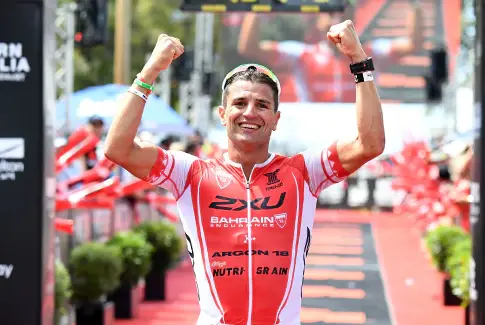
Terenzo Bozzone
TThe Enduring Spirit: Terenzo Bozzone and the Anatomy of a Comeback.
The Enduring Spirit: Terenzo Bozzone and the Anatomy of a Comeback#
Introduction: The Finish Line in Busselton#
The air on the Western Australian coast on December 2, 2018, was a thick, suffocating blanket of heat. For the athletes deep into the marathon of Ironman Western Australia, it was an elemental adversary, a force that baked the tarmac and drained the will. On that punishing course, two figures were locked in a silent, grueling war of attrition. Ahead was Cameron Wurf, the prodigious "uber cyclist" who had transitioned from the professional road cycling peloton to triathlon, a man who had shattered the Kona bike course record just months earlier. He had built a formidable four-minute lead coming out of the second transition. Behind him, relentlessly, was Terenzo Bozzone.
For Bozzone, this was more than a race; it was the culmination of an impossible journey. This was only his second event in a planned comeback, coming just one week after a victory at Ironman 70.3 Western Sydney that had shocked the triathlon world, himself included. He was running on borrowed time and borrowed fitness, his preparation severely hampered by a lingering Achilles issue that had confined his run training to a treadmill until just weeks before his return. Each foot strike was a test of faith in a body that had been catastrophically broken.
The kilometers ticked by under the oppressive sun. Wurf, a titan on the bike, was now vulnerable on the run. Bozzone, the seasoned champion, methodically chipped away at the deficit. Then, at the 33-kilometer mark, the moment came. Bozzone surged past Wurf, the lead changing hands for the final time. He crossed the finish line in 7:56:00, claiming his third consecutive title at the event and his second victory in eight days. It was a monumental athletic achievement. But its true significance lay in the five months that preceded it—a period of darkness, pain, and uncertainty that had nearly ended his career and his life. This victory was not just a win; it was a defiant roar against fate. To truly understand the measure of Terenzo Bozzone, one must look beyond the staggering list of world titles and course records. His legacy was not forged in the glory of the finish chute, but in the profound moments of adversity that demanded he rise, again and again, from the abyss. His story is the ultimate embodiment of the triathlon ethos: the relentless, often brutal, act of simply moving forward.
Chapter I: The Accidental Champion#
Terenzo Bozzone was born in South Africa on March 1, 1985, but his story as an athlete began in earnest after his family moved to New Zealand when he was a young boy, seeking better opportunities. From his earliest days, he was a vessel of kinetic energy. "I often had too much energy and sport was a great way to channel that," he would later recall. This energy was funneled into a dizzying array of sports: tennis, soccer, cricket, swimming, and even karate, which he began at the age of five. The martial art instilled in him the core principles of honor, self-control, and discipline—words he recited daily until their meaning was branded into his character. This foundation of discipline and a natural, multi-faceted athleticism made him a prodigy in waiting.
His primary focus, however, was swimming. He became a nationally ranked breaststroker, dedicating himself to the relentless pursuit of tenths of a second in the pool, his sights set on one day reaching the Olympics. But at age 13, during a summer holiday, his athletic trajectory was violently and irrevocably altered. While wakeboarding, he attempted a backflip and landed squarely on his head. The impact burst his eardrum. The injury was severe and stubbornly refused to heal properly, leading to a grueling seven-hour operation that forced him onto dry land for an extended period. What seemed like a devastating setback for a young swimmer would, in his own words, become a "blessing in disguise".
The core of Bozzone's character was revealed in his response to this forced hiatus. He was constitutionally incapable of being idle. "I couldn't just do nothing," he explained, "so I found a duathlon, borrowed a bike and had a go. I didn't win the race, but I loved it". This single decision was the cornerstone of his origin story. His entry into multisport was not a calculated choice but a primal necessity, an outlet for an unstoppable internal motor. When he was finally cleared to return to the water, the progression to triathlon was a natural and seamless one. The wakeboarding accident, therefore, was not the event that created a champion; it was the catalyst that channeled a pre-existing champion's mentality and a deep well of multi-sport talent toward its ideal expression. His elite drive was already present, honed by years of disciplined training across various fields. The accident simply provided the unforeseen, and ultimately fortuitous, redirection.
Chapter II: A Phenom on the World Stage#
Once Bozzone found triathlon, his ascent was not just rapid; it was historic. He burst onto the international scene with a force that left the junior ranks reeling. Beginning with his first World Championship race in Calais, France, in 2000, he embarked on a three-year campaign of utter dominance. Between 2001 and 2003, he amassed an incredible four junior world titles across two disciplines, an achievement that immediately signaled the arrival of a generational talent.
His performance in 2002 was particularly remarkable. He won both the Junior Elite Duathlon World Championship and the Junior Elite Triathlon World Championship, becoming the first person in history to hold both prestigious titles simultaneously. This rare feat underscored his exceptional versatility and his capacity to excel under the highest pressure. He successfully defended his duathlon title from 2001 and his triathlon title in 2003, cementing a junior career unparalleled in the sport's history.
| Year | World Championship Title |
|---|---|
| 2001 | ITU Junior Elite Duathlon World Champion |
| 2002 | ITU Junior Elite Duathlon World Champion |
| 2002 | ITU Junior Elite Triathlon World Champion |
| 2003 | ITU Junior Elite Triathlon World Champion |
Even at this young age, Bozzone’s ambitions were boundless. He wasn't merely content with winning races; he harbored a desire to elevate the entire sport. He famously stated his goal was to become "the Tiger Woods or Michael Jordan of triathlons," a clear indication of a mindset focused on transcendence and legacy. This maturity and grand vision did not go unnoticed. His coach, sports scientist Jon Ackland, observed that Bozzone "operates like a 30-year-old," possessing the full package of talent, confidence, work ethic, and intelligence. Ackland astutely summarized his protégé's mentality: "He's not interested in being the king of the lily pad. He'd rather take on the entire pond". The world stage was not a destination for Bozzone; it was merely the starting point.
Chapter III: When One Door Closes#
Every elite athlete's career is marked by critical junctures, moments of profound disappointment that can either derail a journey or redefine it. For Terenzo Bozzone, that moment arrived in 2008. His focus following his junior dominance had been on the shorter, draft-legal ITU circuit, with the singular goal of representing New Zealand at the Beijing Olympics. It was the dream that had fueled him for years. However, a combination of an ill-timed injury, a resulting lack of sufficient qualification points, and what he felt were "controversial politics" within the selection process saw his name left off the team.
The exclusion was a "massive blow," a moment he would later describe as one of the "toughest" hurdles of his entire career. For many athletes, such a profound disappointment would trigger a period of disillusionment, a season lost to introspection and doubt. Bozzone's reaction, however, was immediate, decisive, and a powerful demonstration of his unique psychological fortitude. Instead of retreating, he pivoted. He immediately shifted his focus to the burgeoning world of long-course, non-drafting triathlon.
In that very same year, 2008, he channeled the immense energy of his Olympic heartbreak into a new, equally ambitious goal. He dominated the Ironman 70.3 circuit and arrived at the World Championship in Clearwater, Florida, as a man on a mission. He didn't just win; he obliterated the field, setting a new course record and claiming his first professional world title. This performance was more than just a career change; it was a profound act of psychological redirection. He possessed an innate ability to re-channel the potent force of disappointment, converting what could have been debilitating negative energy into a powerful performance fuel. He effectively bypassed the typical grieving process that stalls so many careers, immediately identifying the next highest peak and conquering it. Looking back, he would frame the entire experience with remarkable clarity: "I learnt that when one door closes many more open... if I had been selected for the Olympics I may never have got into long course racing. In a way it was a blessing in disguise". This ability to re-contextualize a major setback as a hidden opportunity would become a defining characteristic of his career, a mental skill that would be tested again in the most extreme circumstances imaginable.
Chapter IV: The Long Road to Kona#
The 2008 Ironman 70.3 World Championship was not an endpoint but a launchpad. For the next decade, Bozzone established himself as one of the most dominant and consistent athletes the sport has ever seen over the half-Ironman distance. His resume became a staggering testament to his talent and relentless racing schedule, with victory counts varying across sources but all pointing to an astonishing level of success: "23 Ironman 70.3 titles," "33 international half Ironman titles," and "over 50 international race victories". He was a global force, standing atop podiums from Brazil to Dubai, Mont Tremblant to Miami. He became the undisputed king of the 70.3 distance.
Yet, for all his success, one prize remained tantalizingly out of reach: the Ironman World Championship crown in Kailua-Kona, Hawaii. The lava fields of the Big Island are where legends are made, and Bozzone was acutely aware that his legacy would ultimately be measured there. The full Ironman distance, however, proved to be a difficult puzzle for him to solve. He spoke openly about the challenge: "I can't work it out yet... as soon as I double the distance I struggle a bit more". This struggle humanized the phenom, demonstrating that even an athlete of his caliber found Kona to be a unique and formidable beast.
His journey in Hawaii was one of perseverance through mixed results. He showed great promise with an 11th place finish in his debut in 2009, followed by a 20th place finish in 2010 A DNF (Did Not Finish) in 2014 was a significant setback, a stark reminder of how unforgiving the island can be. But he kept returning, chipping away at the code.
The breakthrough finally came in 2017. In a masterful performance, he raced to a 6th place finish, his best-ever result on the Big Island, with a time of 8:13:06. This was the validation he had been seeking. It proved he could compete with the very best on the sport's biggest stage and signaled that he had finally unlocked the secrets to racing well in the heat and humidity of Kona. The performance set the stage for 2018, a year he entered with the belief that the top step of the podium was finally within his grasp.
| Year | Event | Overall Place | Finishing Time |
|---|---|---|---|
| 2009 | Ironman World Championship | 11th | --- |
| 2010 | Ironman World Championship | 20th | 8:38:23 |
| 2014 | Ironman World Championship | DNF | --- |
| 2017 | Ironman World Championship | 6th | 8:13:06 |
Chapter V: The Silence on Waitākere Road#
The first half of 2018 was the apotheosis of Terenzo Bozzone's long-course career. He was, by all accounts, in the "form of his life". In March, he achieved a deeply personal and career-defining victory at Ironman New Zealand. After nine previous attempts and five podium finishes, he finally stood on the top step, not only winning but shattering the course record with a time of 7:59:57, becoming one of a select group of athletes to break the elusive 8-hour barrier. With this performance, he had firmly established himself as a prime contender for the Ironman World Championship podium in October.
Then, on July 3, 2018, his world went silent. While on a training ride on Waitākere Road, a familiar route near Kumeū, northwest of Auckland, he was involved in a catastrophic incident. An eyewitness reported seeing Bozzone on the ground and his bike in two pieces after a truck, which had initially stopped, drove off at speed. Bozzone was rushed to Auckland City Hospital in serious condition.
The aftermath was a grim inventory of severe injuries: a major concussion, serious head and facial trauma, a broken cheekbone that would require three titanium plates, and a hand injury needing surgical repair. When he awoke in the hospital, he had no memory of the crash, a black hole where the most traumatic event of his life should have been.
The physical trauma was compounded by a deeply unsettling psychological one. A police investigation followed, but it concluded with a statement that there was "no evidence" to suggest a truck was involved, and that it was more likely he had crashed into a stationary vehicle. This official narrative stood in stark, jarring contrast to the physical evidence of his shattered bike and his own deep-seated professional identity. Bozzone's rebuttal was firm and unequivocal: "I am a world class professional athlete and an extremely skilled bike rider – and I do not ride into the back of stationery vehicles". The unresolved nature of the crash left him without closure. The absence of a clear narrative, coupled with an official conclusion that challenged his very expertise, created a profound cognitive dissonance. His recovery would require not just healing his broken body, but navigating the mental anguish of an event that existed for him only as a void, a silent and ambiguous trauma.
Chapter VI: The Fairytale Return#
In the quiet, sterile environment of his hospital room, as the full extent of his injuries became clear, a thought entered Terenzo Bozzone’s mind. He could let this be the end. The crash was, as he later reflected, a "pretty good excuse" to walk away from the grueling demands of professional triathlon. But the thought was fleeting, dismissed almost as soon as it arrived. "I didn't need to think twice about it, or even for a second," he said. "I still have a lot of unfinished business in this sport". This sentiment became the emotional core of one of the most remarkable comebacks in the sport's history.
The road back was arduous. The recovery was a frustrating process of "two steps forward, one step back". He pushed his body to its limits, traveling to Kona for a training camp with the desperate hope of being ready for the World Championship. Ultimately, he made the painful but wise decision to withdraw, acknowledging that his body, less than three months after the crash, simply wasn't ready to compete at the necessary level. The journey was a testament to his incredible will, a process witnessed up close by his wife, Kelly. "He's just blown my mind," she said, overcome with emotion. "I think he was back out on his bike three or four days later, some nights I'd go to sleep like, 'I actually don't even know you, you are incredible'".
Five months after the accident, Bozzone pinned on a race number again. He entered Ironman 70.3 Western Sydney on November 25, 2018, with minimal expectations and even less run training under his belt. In a performance that surprised everyone, himself most of all, he won. "I never dreamed my first race back would have such a fairytale ending, but I will take it," he wrote afterward.
If the win in Sydney was a fairytale, what happened one week later was a definitive statement. At Ironman Western Australia, he engaged in an epic, race-long battle with Cameron Wurf. After being distanced on the bike, Bozzone methodically hunted him down on the run, making the decisive pass deep into the marathon to claim an emotional and monumental victory. The crash had threatened to become the tragic final chapter of his career. But through these two victories, Bozzone seized control of his own story. He was not a victim; he was a champion, forged anew. He actively rewrote the narrative of his 2018 season, transforming it from one of tragedy into one of unprecedented triumph and resilience.
Conclusion: A Legacy Forged in Fire#
The incredible comeback of late 2018 was the emotional peak of Terenzo Bozzone’s career, but it was not a seamless return to his former dominance. The subsequent years brought further challenges that continued to test his resolve. The 2019 season proved to be a tough one as he struggled to find momentum, and his body once again betrayed him, requiring a second surgery on his Achilles tendon.
In the years that followed, his presence on the professional circuit became quieter. While no formal retirement announcement was ever made, a 2021 discussion among the triathlon community suggested he was "taking a break" from the immense difficulty of racing internationally from New Zealand, focusing instead on property development—a relatable and understandable transition for a veteran athlete with a young family.
To measure Bozzone's career solely by his five world titles and dozens of international victories would be to miss the point entirely. His true legacy is not etched on a trophy but in his profound and unwavering resilience. His entire career can be viewed as a series of powerful responses to adversity: the burst eardrum that accidentally steered him to his destiny; the Olympic disappointment that he immediately converted into a world championship; the debilitating Achilles injuries he battled through; and finally, the near-fatal crash from which he emerged not broken, but stronger in spirit.
He is regarded by his peers as one of the "good guys," an approachable and gracious ambassador for the sport. But it is his grit that defines him. His comeback was driven by a motivation that transcended personal glory. "A big driver in coming back from the adversity of the past few years is to tell my kids this story when they are older," he said. "I want them to see that hard work and perseverance pays off". In this, he has achieved his greatest victory. Terenzo Bozzone’s story is a powerful lesson in what the sport of triathlon truly represents. It is not just about the glory of the finish line, but about the indomitable will to keep moving forward when every force imaginable is trying to hold you back.