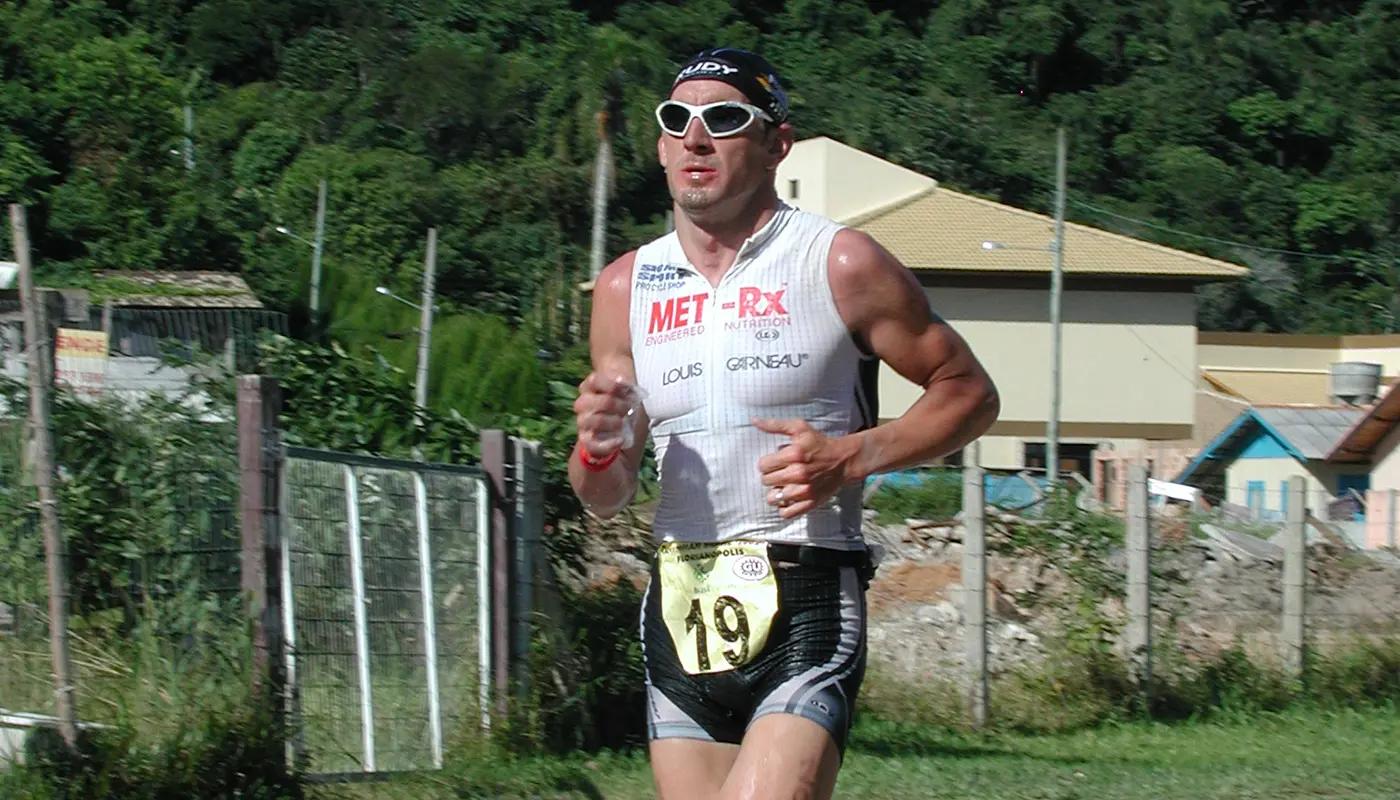
Spencer Smith
The Gladiator: The Triumphs, Trials, and Tenacity of Spencer Smith.
The Gladiator: The Triumphs, Trials, and Tenacity of Spencer Smith#
Introduction: The Gladiator in Manchester#
The air in Manchester’s city center on August 22, 1993, was thick with anticipation. A crowd of 50,000, immense for the still-nascent sport of triathlon, pressed against the barriers, their collective roar a testament to a rivalry that had captured the nation's imagination. They were there for a showdown, a battle for supremacy between two British titans: the reigning world champion, Simon Lessing, and the precocious young challenger from Hounslow, Spencer Smith.
As the athletes transitioned from the bike to the run, the tension reached its zenith. Chris McCormack, a future world champion himself, was in the crowd, and he would later recall the moment with cinematic clarity. “Suddenly Spencer came flying around the corner, and he was alone,” McCormack said. “The crowd was electric”. Smith, just 20 years old, had broken the field on the bike, arriving at the transition with a commanding lead. But it was what he did next that would forever cement his legend. In a gesture of supreme confidence and theatrical flair, he leaped from his bike and, in one fluid motion, hurled his helmet into the adoring crowd “like a gladiator”.
It was an act that perfectly encapsulated the man: audacious, charismatic, and utterly dominant. He went on to win his first senior world title by nearly two minutes, a phenomenal margin over a competitor as formidable as Lessing. The victory made him the youngest-ever World and European Champion in the sport’s history. Yet, even in this moment of ultimate triumph, the seeds of future conflict were sown. Several national federations lodged a protest, demanding his disqualification for the helmet toss. The incident was a microcosm of the career that would follow—a spectacle of brilliant victories, fierce rivalries, and profound controversies that would test the limits of his resolve. The gladiator had arrived, and the world of triathlon would never be the same.
This performance was not merely a spontaneous outburst of youthful exuberance; it was the crystallization of a persona. Smith’s “no-nonsense, lead from the front tactics” were already well known, but this public display of bravado established a brand. It was this blend of raw power and undeniable charisma that made him not just a champion, but one of the most marketable figures in the sport. He understood, perhaps intuitively, that professional sport was as much about narrative as it was about results. In that single moment, he gave the world a story it would not forget.
Chapter I: The Hounslow Hurricane#
Long before he was a world champion, Spencer Smith was a boy from West Middlesex, Great Britain, whose athletic journey began not on the road, but in the chlorinated confines of a swimming pool. From the age of four, he dedicated himself to the water, honing a powerful stroke that would eventually see him compete at a national level by the time he was 15 But the relentless monotony of following the black line at the bottom of the pool began to wear on him. “I was a swimmer originally but I just got bored with it,” Smith later recalled.
The catalyst for change came from a friend who posed a simple question: “Why don’t you try triathlons?”. Smith’s initial response was one of unfamiliarity—“I then asked him what a triathlon was”—but from that moment, a new passion was ignited. He took up cross-country running at school, got on a bike, and the three disciplines clicked into place. He burst onto the international scene as a precocious 16-year-old, quickly establishing himself as a prodigious talent.
His early career was defined not by a rush to the senior ranks, but by a singular, almost obsessive, objective: to win the ITU Junior World Championship. This goal reveals a crucial aspect of his psychology. Even as a teenager, he possessed a methodical, perfectionist mindset. He felt he could have moved up to the elite level sooner, but he refused to do so until he had conquered the junior division completely. “I think the hardest one to win was my junior championship,” Smith stated years later, viewing it as his “most satisfying result”. This drive to prove he was unequivocally the best at every stage, to leave no doubt, was a psychological hallmark that would underpin his entire career. After two previous attempts, he finally achieved his goal in 1992 at the age of 19 For Smith, the victory was more than a title; it was “closure” on his junior career, the final, necessary step before he could turn his full attention to conquering the world.
Throughout this meteoric rise, one figure was a constant, towering presence: his father, Bill Smith. Spencer was famously accompanied by a “feisty entourage” led by his “late great father”. Their bond was the engine room of his career. In a poignant interview years after his father’s passing, an emotional Smith struggled to articulate the depth of their connection, explaining that Bill handled every single facet of his life outside of competition. His father’s role was to absorb all the pressure, manage the logistics, and shield his son from the myriad distractions of the professional circuit. All Spencer had to do was race. “All he said,” Smith recalled, his voice thick with emotion, “son, get out there and do what you got… if you win on the day you win on the day if you don’t doesn’t matter we’ll come back it’s all right son”. This unwavering support system was the bedrock upon which the Hounslow Hurricane was built, freeing him to channel all his energy and focus into the singular act of winning.
Chapter II: An Era of Dominance and Rivalry#
With the junior world title secured, Spencer Smith wasted no time in making his mark on the senior circuit. In the same year he became junior world champion, 1992, he also claimed the European Championship title in Lommel, Belgium, in a stunning display that saw Great Britain sweep the podium. It was a clear statement of intent. The following year, at the World Championships in Manchester, he fulfilled that promise, becoming the youngest-ever ITU World Champion at just 20 years, 3 months, and 11 days old.
This period of Smith's career, however, cannot be understood without the context of the defining rivalry of that era: his fierce, and often acrimonious, competition with fellow Briton Simon Lessing. Their battles were legendary, elevating the sport and captivating audiences. “It was in 1992 that we started getting triathlon magazines from Europe telling stories about Simon and Spencer,” Chris McCormack remembered. “They were dominating every race in Europe”.
The rivalry was fueled by a potent mix of professional ambition and clashing personalities. Leading up to the 1993 Manchester race, a war of words played out in the media. Smith, the homegrown talent, deliberately positioned himself as the “true British athlete”. This was a pointed contrast to Lessing, who had grown up in South Africa and, in Smith’s narrative, was using his U.K. passport to access better funding and facilities. While both men respected each other’s immense talent, they were fundamentally different people who shared an intense hatred of losing to one another. Years later, at a public event, Lessing would jokingly refer to their dynamic as a “hate / hate relationship,” a quip that hinted at the genuine animosity that once existed.
Yet, their rivalry was also marked by a profound, underlying sportsmanship. This was never more evident than in the immediate aftermath of Smith’s 1993 victory. When other federations protested to have Smith disqualified for throwing his helmet into the crowd, it was Lessing, the man who had the most to gain, who came to his defense. He unequivocally told the officials, “If you DQ Spencer, then I’ll DQ myself. Give the man his title”. It was an extraordinary act of integrity, a refusal to win by any means other than a fair fight.
After the high of 1993, Smith admitted to struggling with the pitfalls of success, including complacency. “When you have already become world champion, it is hard to get up for smaller races,” he said. This made his victory at the 1994 World Championships in Wellington, New Zealand, all the more significant. He felt this second consecutive title was more important for his legacy than the first. It proved that 1993 was not a “fluke” and “validated me as a legitimate champion”. He dominated the race, finishing in a time of 1:51:04, a comfortable 45 seconds ahead of Australia’s Brad Beven. He had become the first male triathlete to win back-to-back senior world titles, a phenomenal achievement that solidified his place at the pinnacle of the sport. His era of dominance was further cemented with a second European Championship gold in Vuokatti, Finland, in 1997 and a bronze medal at the 1996 ITU Long Distance World Championships, showcasing his versatility.
Table 1: Spencer Smith - Major Championship Podiums (1992-1997)
| Year | Championship | Location | Distance | Medal |
|---|---|---|---|---|
| 1992 | ITU Junior World Champs | Huntsville, Canada | Olympic | Gold |
| 1992 | ETU European Champs | Lommel, Belgium | Olympic | Gold |
| 1993 | ITU World Champs | Manchester, UK | Olympic | Gold |
| 1994 | ITU World Champs | Wellington, NZ | Olympic | Gold |
| 1995 | ETU European Champs | Stockholm, Sweden | Olympic | Bronze |
| 1996 | ITU Long Distance World Champs | Muncie, USA | Long | Bronze |
| 1997 | ETU European Champs | Vuokatti, Finland | Olympic | Gold |
Chapter III: The Long Shadow of Nandrolone#
Just as Spencer Smith was proving his prowess over longer distances, his career was thrown into turmoil by a challenge far greater than any rival. In October 1998, after a strong 5th place finish at the prestigious Hawaii Ironman World Championship, he provided a routine urine sample for anti-doping control. A month later, his world was turned upside down. The British Triathlon Association (BTA) informed him that the sample, analyzed at the International Olympic Committee (IOC)-accredited laboratory at UCLA, had tested positive for metabolites of the banned anabolic steroid nandrolone. The reported concentration was approximately 11 nanograms per milliliter (
ng/ml), an amount significantly higher than the 2 ng/ml threshold that might be attributed to natural causes or contamination.
Smith vehemently denied any wrongdoing. “There is no way I am going to take nandrolone,” he stated, arguing that the muscle-bulking steroid would be counterproductive for an endurance athlete. “I weigh 180 pounds, and I do not want to run that marathon weighing 185”. Thus began a grueling 17-month legal and emotional battle to clear his name, a fight that would take place across three separate hearings and two continents.
The first round took place in March 1999 before an independent BTA disciplinary panel. Smith’s legal team, led by attorney Anthony Morton-Hooper, focused their defense not on the science of the test result itself, but on the procedures surrounding it. They successfully argued that the chain of custody for the sample had “serious potential flaws,” casting sufficient doubt on the integrity of the evidence. The panel agreed, ruling that there was “no case to answer” and clearing Smith of the charges.
The victory was short-lived. USA Triathlon (USAT), the governing body that had sanctioned the Hawaii race, appealed the BTA’s decision to the International Triathlon Union (ITU). In September 1999, the case was heard by the ITU’s appeals board. This time, the defense found a different vulnerability. The document from the UCLA lab containing the test results included a critical warning: “Estimates only, not to be used in litigation”. This crucial detail rendered the key scientific evidence inadmissible. The ITU panel dismissed the appeal, once again siding with Smith.
Still, the governing bodies persisted. The ITU and USAT escalated the case to the highest authority in sports jurisprudence: the Court of Arbitration for Sport (CAS) in New York. In March 2000, after a final, lengthy hearing, the CAS rejected the appeal, bringing the 17-month ordeal to a definitive close. Spencer Smith was officially exonerated.
The personal toll of the protracted battle was immense. “It’s a fantastic feeling to have proved my innocence,” Smith said after the final verdict. “But I’ve had to do that at three separate hearings, so it’s been a difficult time for me and my family”. He spoke of the “huge burden” he had carried on his shoulders and the difficulty of shaking off the stigma that inevitably accompanies such an allegation, even after a full vindication. His manager, Robert Burnell, hinted at darker undercurrents, suggesting that Smith’s status as a genuine contender for the upcoming Sydney Olympics made him a target. “I’m sure there were plenty of people who wanted him out of the way,” Burnell remarked. Though he had won his fight, the long shadow of the nandrolone case would linger over his career.
Chapter IV: Forged in Fire and Steel#
The period during which Spencer Smith fought the doping allegations was one of profound uncertainty. Facing a potential career-ending ban from the sport he dominated, he made a pragmatic and audacious pivot. For the 1999-2000 season, he traded his triathlon bike for a road racing machine, signing with the high-profile Linda McCartney professional cycling team. This move was not a whimsical detour but a calculated contingency, a way to remain a professional athlete while his triathlon future hung in the balance. The timing was no coincidence; his tenure with the team perfectly overlapped with the duration of his legal battle.
He joined a roster that included established names like Max Sciandri and a young, future Tour de France winner in Bradley Wiggins. While his time in the professional peloton was not marked by individual victories—ProCyclingStats records show he earned zero ranking points during the 2000 season, suggesting a role as a domestique—the experience proved his adaptability and resilience.
Once fully cleared by the CAS in March 2000, Smith returned to triathlon with a vengeance, his focus now squarely on long-course racing. His comeback was spectacular. He won Ironman Florida in a record-breaking time, silencing any doubts about his form or focus. He also proved his mettle on the sport's biggest stage, backing up his 5th place finish at the Ironman World Championships in 1998 with a strong 8th place in Kona in 2000, a result that felt like a powerful vindication.
Just as he had re-established himself at the top, fate dealt him another devastating blow. While training for the 2005 season, he was involved in a horrific accident that nearly claimed his life. During a training ride, he was struck by a car and became trapped beneath its hot engine. The injuries were catastrophic: third-degree burns, a broken scapula, a broken clavicle, and six broken ribs. For any athlete, such trauma would be career-ending; for many, it would be life-altering.
Yet, in what can only be described as an astonishing display of fortitude, Smith refused to be broken. He not only recovered but returned to elite-level competition with incredible speed. In April 2006, less than a year after the near-fatal crash, he “astonished the triathlon community” by finishing second at Ironman Arizona. His time of 8:22:56 was a world-class performance that secured his qualification for the Ironman World Championships for a fifth time.
This comeback was perhaps the ultimate testament to his character. He had faced down the sport's governing bodies in a legal battle for his reputation and had stared down death on the side of a road. In both instances, he emerged not just intact, but stronger. However, these back-to-back traumas, while overcome with immense strength, inevitably exacted a psychological toll. The man who returned to the sport was forged in fire and steel, but the relentless fight for his career and his life had subtly reshaped his relationship with the sport he once loved without reservation. The physical scars healed, but the psychological ones would influence the final chapter of his racing career.
Chapter V: The Elder Statesman and Enduring Legacy#
In the years following his remarkable comeback, Spencer Smith’s perspective on his career began to shift. While he remained a formidable competitor, placing 4th at Ironman UK in 2008, he found the all-or-nothing demands of Ironman racing increasingly taxing. “Ironman consumes your entire life and you can become quite one dimensional,” he explained in an interview. He spoke candidly about his passion for the distance waning, admitting that the race in Hawaii, where he had experienced both triumph and bad luck, no longer gave him “goose bumps”. Acknowledging he was in the “latter stage” of his career, his focus turned toward 70.3 racing and a desire to simply “enjoy what I do”.
This evolution led to a seamless and natural transition into the next phase of his life in the sport: coaching. He founded his company, S2Coaching, with the mission of helping multi-sport athletes of all abilities reach their potential through world-class training. Drawing on his decades of experience, his coaching philosophy centered on patience, consistency, and clear communication—lessons learned from his own storied career. He became a respected mentor, sharing detailed training advice and contributing articles to major triathlon publications.
His commitment to giving back to the sport took on a global dimension when he accepted the role of head coach for the fledgling Ghana Triathlon Federation in 2016 Tasked with building a national program from the ground up, his goal was not just to coach but to cultivate a sustainable culture of triathlon in the West African nation. “Mighty oaks from little acorns grow,” he said of the project’s potential, embodying the patience and long-term vision of a seasoned statesman.
Spencer Smith’s legacy is complex and multifaceted. He is remembered as one of the pioneering figures of British triathlon, a charismatic champion who, along with Simon Lessing, put the sport on the map in the United Kingdom. Their rivalry is etched into the sport’s history as one of its all-time greatest, a clash of titans that defined an era. As a competitor, he was a force of nature, a “beast on the bike” whose powerful swim-bike combination was perfectly suited to the non-drafting format of the 1990s, where he would simply ride away from the world’s best.
However, his legacy is defined as much by his resilience as by his victories. He is the ultimate survivor, an iconic figure whose career is a powerful narrative of overcoming adversity. He fought the sport’s highest authorities for his name and reputation and won. He battled back from a near-fatal accident to compete at the highest level once more. In recognition of his immense impact, the British Triathlon Federation awarded him its most prestigious honor, the Golden Pin, for his “outstanding contribution to the sport”.
The brash young gladiator who electrified the crowd in Manchester in 1993 ultimately evolved into a respected coach, mentor, and elder statesman. Yet, the core attributes remained unchanged. The tenacity, the charisma, and the sheer, indomitable will to fight—whether against a rival on the race course, a governing body in a courtroom, or fate itself on a lonely stretch of road—are the enduring hallmarks of Spencer Smith’s indelible mark on the world of triathlon.