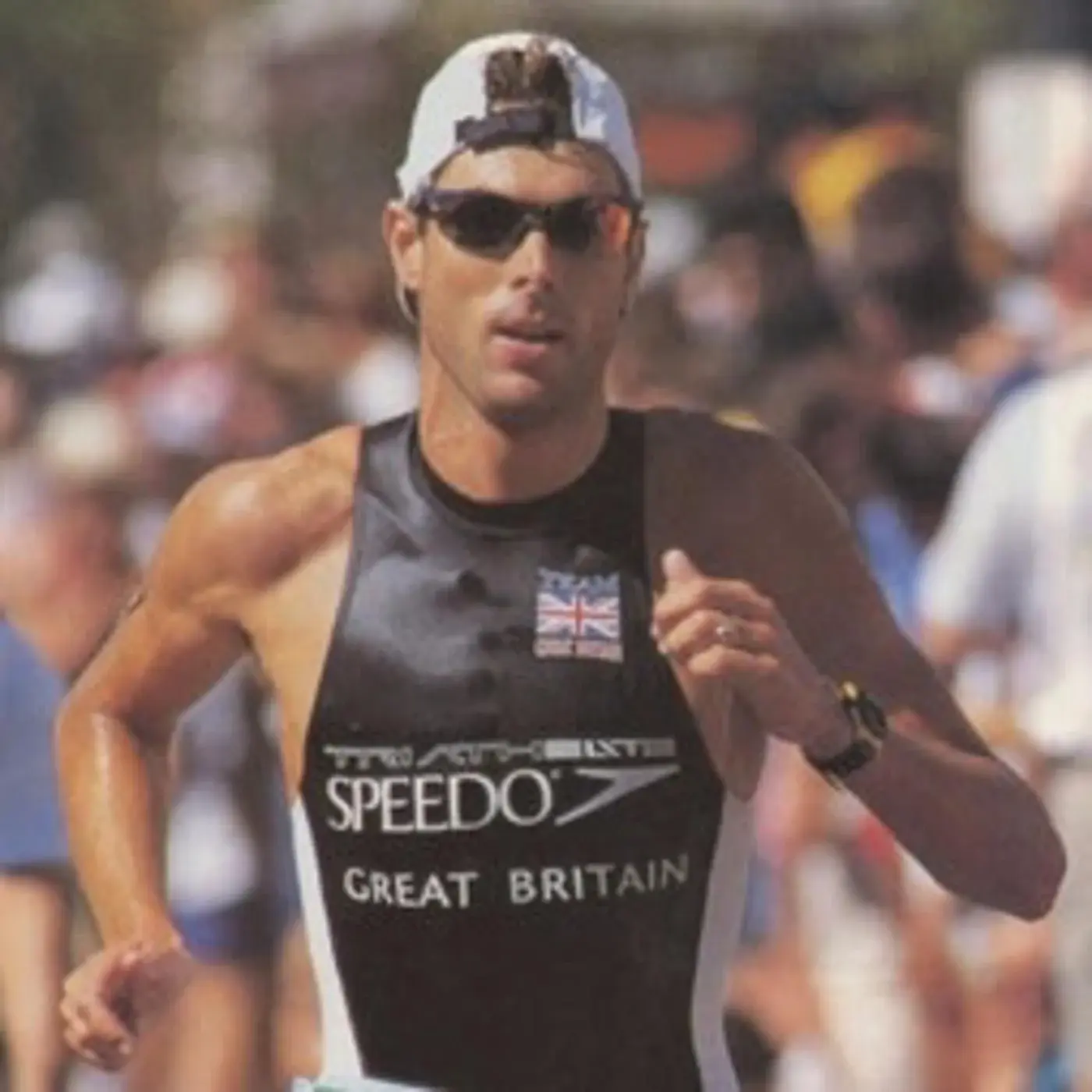
Simon Lessing
The Colossus of Triathlon.
The Colossus of Triathlon: The Unyielding Reign of Simon Lessing#
Before there was Gomez, Frodeno, or the Brownlee brothers, there was a man who bestrode the burgeoning world of triathlon like a colossus. In the raw and punishing landscape of the 1990s, Simon Lessing was not just a champion; he was a force of nature, a tall, regal exemplar of high standards and a white-hot competitive will that defined an era. Any debate about the greatest triathlete of all time must include his name, for his legacy of sheer dominance inspired a generation. This is the story of a career defined by staggering consistency, a revolutionary training ethos, and profound personal principle. It is a chronicle of a journey from a conscientious objector in apartheid South Africa to a five-time world champion for Great Britain, a path shaped by a relentless will to compete on his own terms, culminating in a legacy of near-total dominance, a legendary rivalry, and one iconic, public disappointment on the sport's biggest stage.
A Son of Two Nations (1971-1989)#
Formative Years in a Divided Land#
Born in Cape Town, South Africa, on February 12, 1971, Simon Christopher Lessing’s formative years unfolded against the backdrop of Table Mountain. The nephew of Nobel Prize-winning author Doris Lessing, he was immersed in an athletic environment from a young age; his mother was a swim coach, and his parents supported his diverse interests. When the family moved to the port city of Durban at age nine, he resisted the pressure to conform to the dominant local sports of surfing and rugby, instead dedicating himself to a demanding schedule of sailing, swimming, track, and cross-country. By the end of his fifth year at school, he had already won provincial honors in swimming, sailing, and biathlon, laying the multi-disciplinary foundation for his future career.
His upbringing in apartheid-ruled South Africa was also a crucible for his character. From a young age, Lessing displayed a principled defiance against the injustices of the state. In one instance, he and a friend removed duplicate books from their school's storeroom and gave them to a nearby black school that had none. In 1987, he made a more public stand, withdrawing from a prestigious athletics meeting to protest the exclusion of a black student, an act that earned him the scorn of selection committees. This innate sense of principle, this willingness to stand apart from the prevailing system, would become a defining trait, echoing years later in an athletic methodology that unapologetically bucked convention.
The Birth of a Triathlete#
It was at Kloof High School that the sport of triathlon found him. His swim coach, Dave McCarney, organized a family-oriented race and encouraged Lessing to participate. The connection was immediate and profound. "I pretty much fell in love with triathlon the first time I tried it," Lessing later recalled. "People often ask me how I found triathlon. I actually think triathlon found me. I found what I was good at, quite honestly".
His ascent was meteoric. In 1988, at just 17 years old, Simon Lessing was crowned the South African triathlon champion, a phenom on the cusp of a major life decision.
The Exile's Choice#
Upon completing high school in November 1988, Lessing faced compulsory national service in the South African military. As a long-time supporter of the End Conscription Campaign, the choice was clear. "It was an easy decision to leave South Africa and try to fulfill his athletic dreams in Europe," one account notes. His decision was not merely about athletic ambition; it was a political and moral stand.
The path forward was made possible by his mother, who was born in England, granting him dual citizenship from an early age. At a time when South Africa was banned from all international sporting competitions due to apartheid, this British passport was his only route to a professional career. At 18, having never before left the isolated nation, he moved to Europe. "As an 18 year old it was a huge eye opener," he explained. "It was also an opportunity". Though he was selected for the prestigious South African Springbok triathlon team in 1989, a broken leg from a local triathlon accident prevented him from ever competing in its colors, marking a final, symbolic break with his birth country's sporting establishment.
The Conquest of Europe and a New Method (1990-1992)#
Arrival and Ascent#
Arriving in Europe, Lessing initially joined a group of South African athletes in France under coach Andrew Dean. His impact was immediate and undeniable. In his first ITU World Championship race in Orlando in 1990, the 19-year-old finished a remarkable 7th, following it up with a 6th place finish in 1991 These results served notice to the triathlon world.
Representing Great Britain, he claimed his first major international title at the 1991 ETU European Championships, a victory that validated his difficult decision to leave home. The following year, at just 21, he reached the pinnacle of the sport, winning the 1992 ITU World Championship in Huntsville, Canada. This victory was a pivotal moment, transforming him into a global star and opening the door to major sponsorships from companies like Nike and Oakley, which provided the financial backing for a truly professional career.
The Lessing Method: Forging a Champion#
Lessing's dominance was built on a training philosophy that was as unique as it was brutal, becoming the stuff of legend among his peers. His arch-rival, Spencer Smith, summarized it best: "Lessing's training, like his personality, was to the point, and deadly effective". He eschewed the conventional wisdom of long, slow, high-volume training. Instead, his method was founded on several core tenets:
- Relentless Intensity: Lessing was famed for his daily high-intensity sessions. He "didn't waste his time with long slow runs or steady bike rides". Fellow triathlete Rich Allen noted he was the only athlete he had ever met who could cope with high-intensity training day-in and day-out, with "no easy training to speak of".
- Purposeful Specificity: There was no "junk mileage" in Lessing's regimen. Every session was designed to simulate the sharp end of a race. He would regularly test himself against elite single-sport athletes, going head-to-head in running workouts with five-time world cross country international Rob Whalley, pushing the intensity to "beyond warp speed".
- Psychological Warfare: His ability to "destroy many top triathletes in training built his great mental strength". He practiced race tactics, like surging, during hard workouts, creating a psychological advantage over his rivals. The effect was profound. Allen admitted that because he could never beat Lessing in training, he went into races believing he couldn't win.
- Uncompromising Focus: His personality mirrored his training. He "wasted little energy in day-to-day niceties" and was known for his blunt, direct manner. His infamous quote, "train with girls, race like a girl," while controversial, reveals a singular, almost brutal focus on performance above all else.
The Duel of the Decade: Lessing vs. Smith (1993-1994)#
A Rivalry that Defined an Era#
Just as Lessing reached the top, a new challenger emerged from within his own team. Spencer Smith, two years his junior, won the junior world title in 1992 on the same day Lessing won the senior crown. Their subsequent rivalry became triathlon's version of running's great Coe vs. Ovett duels, a clash that captivated the sport throughout the early and mid-90s. It was a battle of personalities and narratives. The media framed it as the "true British athlete" in Smith against the South African-born Lessing, who was perceived as using his UK passport for better funding and opportunities. This storyline, fueled by their mutual hatred of losing, drew massive crowds and unprecedented interest to the sport.
The Showdown in Manchester: 1993 World Championships#
The rivalry reached its zenith at the 1993 ITU World Championship in Manchester, England. Lessing was the defending champion, but Smith was the home-crowd favorite. Future world champion Chris McCormack, then a spectator, recalled the electric atmosphere as 50,000 fans awaited the leaders off the bike. "Suddenly Spencer came flying around the corner, and he was alone," McCormack said. "The crowd was electric. Spencer leapt off his bike and threw his helmet into the adoring crowd like a gladiator". Smith rode away from the field, building an insurmountable lead and winning his first world title by nearly two minutes. Lessing, ever the formidable runner, secured the silver medal.
An Act of Legendary Sportsmanship#
The drama, however, was not over. In the aftermath, several national federations lodged a protest, demanding Smith be disqualified for illegally discarding his helmet into the crowd. Lessing's response became a defining moment of his career. McCormack recalled his exact words: "If you DQ Spencer, then I'll DQ myself. Give the man his title".
This was more than just good sportsmanship; it was a powerful public statement. In a rivalry that had questioned his national identity, Lessing demonstrated that his competitive drive was governed by a higher code of honor. By refusing to win on a technicality, he silenced the "not truly British" narrative and cemented a legacy built as much on integrity as on victory, transforming a point of contention into a source of immense respect. While Smith held the world title, Lessing reclaimed his European crown that year and won it again in 1994, underscoring the intensity of their back-and-forth battle for supremacy.
| Year | Simon Lessing | Spencer Smith |
|---|---|---|
| 1992 | Gold | DNP (Junior World Champion) |
| 1993 | Silver | Gold |
| 1994 | DNP | Gold |
| 1995 | Gold | Bronze |
| 1996 | Gold | DNP |
| 1997 | Bronze | Gold |
| 1998 | Gold | DNP |
| 1999 | Silver | DNP |
Table: A Decade of Dominance: Lessing vs. Smith at the ITU World Championships (1992-1999)
The Peak of the Mountain (1995-1999)#
The Untouchable Year: 1995#
The year 1995 marked Lessing's annus mirabilis, a season of such dominance that it remains a benchmark in the sport's history. He achieved an unprecedented double, winning both the ITU Olympic Distance World Championship in Cancún and the grueling ITU Long Distance World Championship in Nice, France. This feat showcased his incredible range, proving he could win at any distance. His victory in Nice was particularly significant; he had tested himself there two years prior against the legendary nine-time champion Mark Allen, staying with him until the final 5 kilometers of the run, a performance that foreshadowed his eventual triumph on the iconic course.
The World Record: Cleveland 1996#
Lessing's 1996 performance at the ITU World Championships in Cleveland was another signature moment. He claimed his third Olympic distance world title, becoming the first man in history to do so. More remarkably, he set a new world record for the draft-legal Olympic distance, finishing in a blistering time of 1 hour, 39 minutes, and 50 seconds. From the start, he dictated the race, emerging from the 1500m swim alongside Australia's Craig Walton with a 20-second lead on the chase pack. While some speculated that the course may have been slightly short, his absolute dominance on the day was never in doubt.
Unwavering Consistency#
Throughout the latter half of the decade, Lessing was a constant presence on the podium. He took bronze at the 1997 World Championships in Perth, stormed back to win his fourth gold medal in Lausanne in 1998, and secured a dramatic silver in Montreal in 1999, where he was passed by Kazakhstan's Dmitriy Gaag in the final 500 meters.
This relentless success was the hallmark of his career. In 37 ITU starts over 13 years, he finished on the podium 27 times, winning on 22 occasions. He himself identified this as his proudest achievement. "The one thing I would say I'm proudest about is not a particular race or result, but my consistency," he stated in an interview. "For me, triathlon is about who you beat and what position you came. If you can prove your consistency in that, that defines who you are as an athlete". This consistency was no accident; it was a direct product of his revolutionary training. By maintaining a state of near-race-intensity year-round and mentally rehearsing victory by dominating his peers in training, he systematically removed much of the variability of competition. His race-day consistency was simply a public reflection of his unwavering, brutal consistency in training.
The Ghost in the Machine: Sydney 2000#
The Weight of Expectation#
As triathlon prepared for its Olympic debut at the Sydney 2000 Games, Simon Lessing was the overwhelming favorite. He was hailed as the "greatest ever exponent" of the sport and widely tipped to win Great Britain's first gold medal of the millennium. His status was cemented when he was appointed a Member of the Order of the British Empire (MBE) in the 2000 New Year Honours. Even his chief rival, Australia's Craig Walton, conceded that Lessing would win if he was on form. The weight of a nation's expectations rested squarely on his shoulders.
The Race#
The scene was set against the iconic backdrop of the Sydney Opera House, with an estimated 100,000 fans lining the course. Lessing emerged from the swim with the lead pack, positioned perfectly for the 40km bike leg. However, it was on the bike that the race unraveled. In a critical tactical miscalculation, he "overcooked the bike leg," pushing too hard to keep pace and expending vital energy he would need for the run. "By trying to keep pace during the cycling I wore myself out," he admitted post-race. The result was a ninth-place finish with a time of 1:49:24., a profound disappointment for him and his country.
The Aftermath and Analysis#
While a tactical error is the simplest explanation for the result, a deeper analysis suggests a more complex story. The eventual gold medalist, Canada's Simon Whitfield, observed that Lessing looked "terrified" before the race and did not seem to be "enjoying the occasion," indicating the immense psychological pressure he was under. Furthermore, Lessing later expressed that he was "sick and tired of the style of short distance racing and the inconsistency of it," referring to the new draft-legal format that defined Olympic competition. This points to a potential disconnect. Lessing's entire athletic identity was forged on imposing his will through raw, individual power, often in non-drafting races. The new, more tactical, pack-oriented dynamics of Olympic racing may have blunted his greatest weapon. The Sydney failure may not have been just a bad day, but a sign that the sport, on its biggest stage, had evolved in a direction that no longer perfectly suited the strengths of its most dominant champion. True to form, Lessing was stoic in defeat, making no excuses and absorbing the disappointment in private.
The Second Act: A New Distance, A New Challenge (2001-2008)#
The Transition#
Following the Sydney Olympics, Lessing began a "natural progression" into the next phase of his career. He wrapped up his ITU career in 2003 and turned his full attention to long-distance racing, a format that played to his strengths. He quickly found success, winning numerous Ironman 70.3 (or Half Ironman) events, including the inaugural Ironman 70.3 Florida in 2004 and 2005, setting a course record at the prestigious Wildflower Triathlon in 2005, and taking titles at Vineman in 2006 and Timberman in 2007.
The Statement: Ironman Lake Placid 2004#
His full Ironman debut at Lake Placid in July 2004 was one of the most anticipated in the sport's history, and he delivered a performance for the ages. This was not just a successful debut; it was a powerful reassertion of his athletic identity. He led wire-to-wire, exiting the 2.4-mile swim in a stunning 47:08 and riding the 112-mile bike course largely alone, his climbing prowess honed by years of training in Boulder with legendary coach Dave Scott. He capped the day with a blistering 2:46:39 marathon, shattering the existing course record by ten minutes with a final time of 8:23:12. The performance was a triumphant validation of his core strengths, proving that when he was free to race his own race, unconstrained by pack dynamics, his high-intensity engine was perfectly suited for the ultimate endurance test.
The Frustration of Kona and a Final Hurrah#
Despite his spectacular debut, the Ironman World Championship in Kona, Hawaii, remained an elusive prize. Lingering and chronic back problems forced him to withdraw from the race in both 2004 and 2005, a frustrating end to seasons that had held so much promise.
He had one last hoorah at the inaugural Ironman 70.3 World Championships in Clearwater, Florida, in 2006. In a miraculous performance, he finished second to Craig Alexander, securing a silver medal just weeks before undergoing major back surgery for a chronic spinal disc herniation that had caused shooting pains and a 40 percent strength imbalance in his leg.
Retirement#
The cumulative toll of 23 years in the sport, coupled with a cascade of injuries (Achilles, hamstring, and knee issues) that followed his back surgery, ultimately led to his decision to retire in 2008 at the age of 37 The physical and mental fatigue had become overbearing. For a man whose personal standard was only first place, finishing tenth held no satisfaction. It was time to move on.
The Sage of Boulder#
Legacy and Accolades#
Simon Lessing's career is unparalleled in the annals of triathlon. His résumé includes five World titles, three European titles, a world record, and more professional victories than anyone else in the sport's history. His contributions were formally recognized with his appointment as a Member of the Order of the British Empire (MBE) and his inductions into the Boulder Sports Hall of Fame in 2012 and the inaugural World Triathlon Hall of Fame in 2014.
The Next Chapter: Boulder Coaching#
After retiring from professional racing, Lessing settled in Boulder, Colorado, where he co-founded Boulder Coaching with his wife, Lisa, and fellow elite athlete Darren de Reuck. His influence on the sport continues through his coaching, where he helps triathletes of all levels "reach their sport potential". This transition from dominant athlete to mentor completes his career arc, allowing him to pass on the wisdom forged through two decades of uncompromising excellence.
Final Reflection#
Simon Lessing was a pioneer who professionalized triathlon through sheer force of will. His career was a testament to the power of consistency, born from a principled, almost defiant, self-belief that allowed him to forge his own path. He was the Colossus who set the standard for a generation, a champion whose impact is measured not only in a staggering list of victories but in the indelible mark he left on the character and evolution of the sport itself.