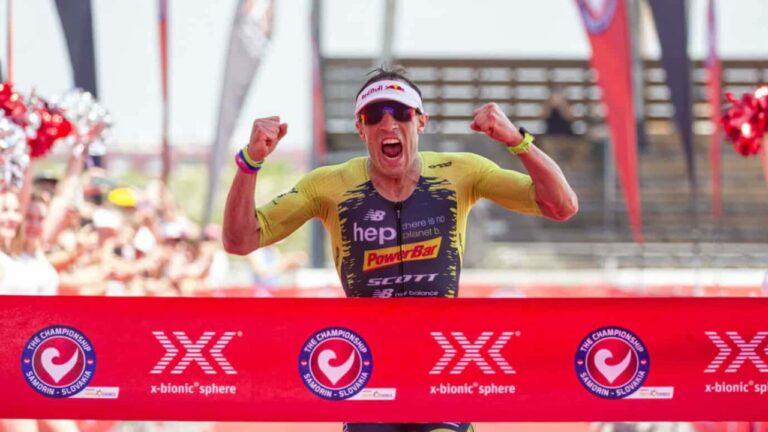
Sebastian Kienle
The Last Hurrah of the Uberbiker: Charting the Enduring Legacy of Sebastian Kienle.
The Last Hurrah of the Uberbiker: Charting the Enduring Legacy of Sebastian Kienle#
Introduction: A Final Fight in Cozumel#
The Caribbean sky over Cozumel was a canvas of agitated grey. On the morning of November 19, 2023, the ocean, usually a placid turquoise, churned with a restless energy that mirrored the soul of the man about to race for the last time. Sebastian Kienle, the German titan of triathlon, stood on the precipice of his final professional act, a career swan song that was supposed to be a triathlon but was about to become something else entirely.
Race officials, citing safety concerns over the choppy seas, made an unprecedented call: the swim was cancelled. Kienle’s triathlon would be a duathlon. For a man whose entire career was a masterclass in overcoming a swim deficit, the irony was thick. "My personal opinion is that [for] the pros, there would have been absolutely no problem swimming," he stated, respecting the decision but with the unmistakable tone of a warrior denied his preferred battlefield. Instead of the familiar chaos of a mass swim start, his final race began with the sterile precision of a time trial on the bike—a lonely battle against the clock that served as a fitting, if unexpected, metaphor for a career defined by individual will.
What followed was pure Kienle. He threw down a scorching bike split, a final, blistering testament to the engine that had earned him the moniker "uberbiker," briefly taking the lead and reminding the world of the raw power that had once broken the field in Kona. But the humid Mexican heat is an unforgiving adversary. On the run, the effort began to tell. He faded, fighting for a podium spot that seemed within his grasp until the final, agonizing moments. In a cruel twist of the time-trial format, another athlete, Robert Wilkowiecki, who had started 15 seconds behind him, crossed the line alongside him, officially pushing Kienle into fourth place. He had missed a final podium appearance by the slimmest of margins, a poignant, bittersweet conclusion to a legendary career.
This final, chaotic, and brutally hard day was the perfect encapsulation of Sebastian Kienle’s journey. It was never just about the wins, though they were plentiful. It was about the fight. It was about adapting to the unforeseen, pushing through pain, and leaving every ounce of himself on the course. He had added this last race to his farewell tour because, as he put it, he wanted "to know before the race that this is the last one". In Cozumel, he got his wish: one last, glorious, all-out battle, a final hurrah for one of the sport's most respected and relentless champions.
| Career Highlights & The Triple Crown |
|---|
| Ironman World Champion (Kona, 2014) |
| Ironman 70.3 World Champion (Las Vegas, 2012 & 2013) |
| Challenge Roth Champion (2018) |
| Ironman European Champion (Frankfurt, 2014, 2016, 2017) |
| The Championship Winner (Samorin, 2019) |
| Ironman World Championship Runner-Up (Kona, 2016) |
| Ironman World Championship 3rd Place (Kona, 2013, 2019) |
| Ironman 70.3 World Championship Runner-Up (Zell am See, 2015; Mooloolaba, 2016) |
Chapter I: The Boy Who Dreamed of Wetsuits#
Every legend has an origin story, a single moment where the trajectory of a life is irrevocably altered. For Sebastian Kienle, that moment came in 1992. He was eight years old when his father, Xaver, took him to watch a small local triathlon in Germany. For most children, it would have been a fleeting spectacle. For Kienle, it was an epiphany. He watched the athletes emerge from the water, sleek and powerful, and saw something profound. "Those guys in wetsuits seemed like superheroes to me," he would later recall. "I wanted to be like them. I loved it. I had a goal".
The ambition was not a passing phase; it was an immediate and unwavering conviction. He told his third-grade teacher that he wanted to grow up to be a professional triathlete, a declaration of intent so clear and powerful that it would guide him for the next three decades. By age 12, he was competing in his first race, and the fire was lit.
What made this burgeoning ambition so potent was the environment in which it was nurtured. His parents, Nina and Xaver, provided a foundation of unwavering support, yet they were careful to never apply pressure. "My parents never pushed me to win races," Kienle explained after his 2014 Kona victory. "They always guided me, but the enthusiasm to succeed was solely mine". This distinction is critical. A career in endurance sports is a long, arduous journey, filled with far more anonymous hours of training than moments of glory. External pressure, particularly from family, can create a fragile, results-dependent motivation that often leads to burnout. Kienle’s drive, however, was entirely his own. It was not about pleasing his parents or meeting their expectations; it was about chasing the vision of the superheroes he saw as a boy. He recalls his father actively trying to hide his pride after good results, a conscious effort to ensure that his love was never perceived as being contingent on athletic success.
This psychological bedrock—an intrinsic motivation forged in childhood awe and fostered by unconditional support—was perhaps his greatest gift. It allowed him to develop the immense patience and single-mindedness required to "chase one goal for more than ten, fifteen years". Even as he pursued a formal education, studying physics and later international management, the dream remained his true north. There were moments of doubt, times when he thought he might never become a professional athlete, but he "never stopped dreaming". It was this resilient, self-generated passion that would fuel him through the countless hours of pain and sacrifice necessary to turn a childhood dream into a world-beating reality.
Chapter II: Forging a Weapon on Two Wheels (2005-2011)#
As Kienle transitioned into the professional ranks, his raw talent was immediately apparent, though it first found a home on the dirt. In 2005, he competed in his first XTERRA off-road triathlon in Germany and won, calling it "an absolutely great race". He returned the following year to defend his title, proving his versatility and toughness. But his destiny lay on the pavement, where one of his three disciplines was rapidly evolving from a strength into a fearsome weapon.
Even as a junior, Kienle's power on the bike was so prodigious that it caught the eye of professional cycling teams, who saw in him the potential for a pure time-trial specialist. But Kienle’s heart was set on a different prize. "All he ever wanted to do," one profile noted, "was Ironman Hawaii". He began to dominate on the German circuit, with victories in 2009 at the prestigious Challenge Kraichgau and Ironman 70.3 Wiesbaden establishing him as a major force in European long-course racing.
His development as an "uberbiker" was not merely a matter of playing to his strengths; it was a strategic imperative. By the standards of the elite male field, Kienle was a relatively weak swimmer, a reality he has acknowledged throughout his career. He consistently exited the water several minutes behind the lead pack, a deficit that would be insurmountable for most. To have any chance of winning, he had to transform the 180-kilometer bike leg from a simple mode of transport into an offensive onslaught. His race strategy became a signature: limit the damage in the swim, unleash hell on the bike to catch and pass the leaders, and then hang on for dear life during the marathon.
The first full-distance proof of this concept came in 2010 at the legendary Challenge Roth. In his iron-distance debut, Kienle executed his strategy to near perfection. He finished second to Denmark's Rasmus Henning but made global headlines by becoming the first rookie in history to finish under the mythical eight-hour barrier, clocking in at 7:59:06. The performance was a monumental statement of intent, but it came at a staggering physical cost. "Immediately after the race I collapsed," he recalled. "I could hardly move for the three weeks afterwards". It was a brutal initiation into the demands of the full distance, a physical boundary experience that taught him the true meaning of emptying the tank. He returned to Roth in 2011, even faster and more experienced, finishing second again with a new personal best of 7:57:06. The world was now on notice. The German with the monstrous bike leg was no longer just a European contender; he was a global threat, armed with a weapon powerful enough to challenge for the biggest titles in the sport.
Chapter III: The King of Vegas and the Kona Contender (2012-2013)#
The moment Sebastian Kienle transformed from a European threat into a global superstar can be pinpointed to a single, searingly hot day in the Nevada desert. The 2012 Ironman 70.3 World Championship in Las Vegas was the stage, and Kienle delivered a performance that would become part of triathlon folklore.
The race began in familiar fashion. Kienle emerged from the 1.9-kilometer swim at Lake Las Vegas with a three-minute deficit to the leaders, a group that included the formidable defending champion, Craig Alexander of Australia. What happened next was a demonstration of cycling power so overwhelming that it redefined what was thought possible in a championship race. As the athletes battled the rolling hills and desert heat, the race helicopter’s camera captured an iconic image: Kienle, low and relentlessly powerful on his Scott bike, closing the gap on the lead pack. He didn't just catch them; he blew past them with such devastating speed that it looked as if they were standing still. By the time he reached the second transition, his bike split of 2:07:54 was more than five minutes faster than anyone else in the field. This was no mere "bike for show, run for dough" effort. He backed up his cycling dominance with a solid 1:16:45 half-marathon, holding off Alexander to claim his first world title and set a new course record.
That victory was more than just a gold medal; it was a profound psychological turning point. It was the moment Kienle’s internal belief caught up with his physical capabilities. "I always had the dream about winning the biggest races in our sport," he reflected, "but from that point onwards the dreams became goals. I realized that I did not dream too big". The visually stunning and strategically dominant nature of his win, immortalized by that helicopter footage, created a powerful and easily digestible narrative that resonated across the triathlon world. He was no longer just a strong cyclist; he was the "uberbiker," a force of nature on two wheels.
To prevent being pigeonholed as a half-distance specialist, he followed up his Vegas triumph just five weeks later with his debut at the Ironman World Championship in Kona. On the sport's biggest stage, he proved his engine was more than ready for the full distance. Despite suffering a flat tire on the bike that cost him an estimated five minutes, he still managed to post the day's second-fastest bike split and finish in a remarkable fourth place. The performance was a stunning debut, signaling that he was not just a future contender but an immediate threat to the Kona throne.
The following year, 2013, solidified his status. He returned to Las Vegas and successfully defended his Ironman 70.3 world title, demonstrating that his 2012 victory was no fluke. He then returned to Kona and took another step up, landing on the podium for the first time with a third-place finish. The progression was clear, methodical, and ominous for his rivals. In the space of two seasons, Sebastian Kienle had conquered the middle distance twice and established himself as a perennial podium threat in Hawaii. The boy who dreamed of wetsuits was now a global triathlon icon, standing on the cusp of his ultimate goal.
Chapter IV: The Pinnacle on the Pier: Conquering Kona (2014)#
The path to a world championship is supposed to be paved with flawless preparation and unwavering confidence. Sebastian Kienle’s journey to the 2014 Ironman World Championship was anything but. His build-up was a study in adversity. A nagging Achilles injury had hampered his training, a persistent ghost in the machine of his formidable run. Worse, he was coming off a disastrous title defense at the Ironman 70.3 World Championship in Mont-Tremblant, a race he described as having "gone completely to shit," where he finished a distant 18th.
He arrived on the Big Island of Hawaii not with the swagger of a favorite, but with a profound sense of self-doubt. "This disappointment plunged me into a slump in form that I had never experienced before," he confessed. "When I stepped out of the well-tempered airplane cabin, I ran into a wall. Not just one of tropical heat and humidity, but metaphorically". He was physically compromised and mentally fragile, a combination that is usually a death knell in the unforgiving lava fields of Kona.
Yet, on race day, October 11, 2014, Kienle authored a masterpiece of tactical brilliance and mental fortitude. The day began with its familiar rhythm. He exited Kailua Bay after the 3.8-kilometer swim in 38th place, three and a half minutes adrift of the lead group, which included his countryman and future rival, Jan Frodeno. It was a deficit he had faced a hundred times before. As the athletes headed out onto the Queen Ka'ahumanu Highway, the infamous Kona winds began to pick up—conditions that deter the timid but embolden the powerful. For Kienle, it was an invitation. He methodically began his work, reeling in the leaders with relentless efficiency. Well before the turnaround at Hawi, the 3.5-minute gap had been erased. But simply catching the leaders was not the plan. In the final 20 miles of the bike leg, with the winds at their most treacherous, he launched an attack of such ferocity that it shattered the race. He arrived in T2 having clocked a blistering 4:20:46 bike split, a time that was more than ten minutes faster than any other athlete in the top ten.
He began the marathon with a three-minute lead, but the race was far from over. Behind him, a host of world-class runners were ready to pounce. Kienle responded not with panic, but with controlled aggression, clicking off the first three miles at a sub-six-minute pace to solidify his advantage. His marathon of 2:54:36 was not the day's fastest, but it was a champion's run—a gritty, determined effort that was more than enough to hold off the chasers. As he ran down the finishing chute on Ali'i Drive, the emotion of his improbable victory was etched on his face. He had won the Ironman World Championship by over five minutes.
His victory was not born from a place of supreme confidence, but from a profound acceptance of his own vulnerability. He later spoke of a moment of clarity just before the start, floating on his back in the water. "I let myself drift along... and thought how awesome it is to live a life that kicks me like that - one full of ups and downs. I was completely satisfied with that". This was the key. He had let go of the need for perfection and embraced the struggle. He acknowledged that he had to "clear my mind and get rid of doubt" and that even at 100% fitness, a clouded mind would render him useless. His Kona crown was therefore a triumph of mental resilience over physical uncertainty. It was a victory achieved not because of perfect preparation, but in spite of it, revealing a champion who could find his greatest strength in his moment of greatest doubt.
Chapter V: The German Wars#
Sebastian Kienle’s reign as Ironman World Champion coincided with the rise of one of the sport's all-time greatest athletes, his compatriot Jan Frodeno. Their subsequent rivalry would define an era, a golden age for German long-distance triathlon that captivated the world. It was a classic clash of styles: Kienle, the raw, overwhelming power of the "uberbiker," against Frodeno, the polished, technically perfect Olympic champion who seemed to have no weaknesses.
The first salvos were fired during Kienle's championship year in 2014. In his debut season at the distance, Frodeno finished third behind Kienle at both the Ironman European Championship in Frankfurt and the World Championship in Kona. In both races, Frodeno was hampered by flat tires and penalties, yet his raw talent was undeniable, signaling the epic battles to come. From 2015 onwards, the tide turned. Frodeno ascended to become the undisputed king of the sport, winning in Kona in 2015, 2016, and 2019.
The apex of their rivalry came at the 2016 Ironman World Championship. It was the head-to-head duel the triathlon world had been waiting for. Kienle, fiercely motivated to reclaim his title, overcame a four-minute swim deficit with a masterful bike leg, entering T2 with a slight lead over Frodeno. The two Germans then ran shoulder-to-shoulder for the first 10 miles of the marathon, a tense, tactical battle playing out under the searing Hawaiian sun. Ultimately, Frodeno’s peerless running form proved decisive, and he pulled away to take the win, with Kienle finishing a hard-fought second. "I would've loved to have won another Kona title," Kienle later admitted. "I think in 2016 everything was set up perfectly, but I missed it. That hurt a lot". Despite the intensity of their competition, the rivalry was underpinned by a deep mutual respect. Frodeno lauded Kienle’s aggressive, "balls to the wall" racing style, while Kienle consistently named Frodeno as his greatest rival.
This rivalry was not a zero-sum game; it was symbiotic. Frodeno's complete athletic profile forced Kienle to evolve. He could no longer rely solely on his bike to win; he had to become a more complete triathlete, and his run, in particular, developed into a formidable weapon in its own right. Conversely, Kienle's overwhelming bike strength changed the calculus for the entire professional field. Athletes like Frodeno could no longer afford to let him build a ten-minute lead, forcing them to become stronger and more tactical cyclists. Together, they pushed each other, and the sport, to new heights.
While Frodeno was his defining rival, Kienle also engaged in a series of memorable duels with Canadian powerhouse Lionel Sanders. Their battles at The Championship in Samorin in 2017 and 2018 were legendary, with Kienle narrowly losing both electrifying, down-to-the-wire races. Though he came out second best, he cherished the experience. "They will stick in my mind and I will always remember," he said, emphasizing that the creation of such memories was a victory in itself. These rivalries, against both the polished technician and the raw powerhouse, showcased Kienle's defining characteristic: a fierce love for the fight, no matter the opponent.
Chapter VI: The Mind of a Champion, The Body of a Veteran#
Beyond the watts and the race splits, Sebastian Kienle’s most enduring contribution to the sport may be his willingness to articulate the complex inner world of an elite athlete. He provided a rare, unfiltered window into the psychological toll of performing at the highest level. Central to his philosophy was the concept of mental strength as a finite resource, which he described with a powerful metaphor: a "box of matches that eventually runs out".
He argued that pushing oneself to the absolute physical limit, to the point of collapse, does not necessarily build mental fortitude. Instead, it can instill a deep-seated fear of returning to that dark place. "If you've seriously pushed your limit once, you're more likely to be afraid to get there again," he explained. "That's also why I was able to go much lower in my first long distance races than years later. You learn more to manage that condition". This was a revolutionary idea in a sport often defined by a "no pain, no gain" ethos, a nuanced perspective that acknowledged the psychological cost of extreme physical exertion.
This mental fatigue was compounded by the physical realities of a long career. Kienle was remarkably candid about his struggles with injuries, which ultimately precipitated his retirement. A persistent Achilles tendinosis was a recurring antagonist, flaring up at critical moments and derailing seasons. He spoke openly about the mental drain of the relentless cycle of injury, rehab, and comeback. "It's breaking your heart," he said in 2021. "You're fit and every race gets cancelled. Then we have races and you can't really do them or you are not 100 percent fit. It's tough". He was also his own harshest critic, admitting to making mistakes by pushing too hard when his body was sending warning signals. "There is a thin line between fit and fucked," he once wisely noted, admitting he had crossed it by choice on occasion.
A significant shift in his perspective came with the birth of his son, Nino, in July 2021 Fatherhood reordered his universe. "Up until that point, I was the center of our family universe, and right now, Nino is," he explained. While it made the logistics of a professional athlete's life—the travel, the training camps—more difficult, it also provided a powerful new source of motivation and a deeper sense of purpose beyond the race course.
This combination of mental weariness, chronic injury, and a new family-centric perspective created the context for his decision to retire. In being so open about his struggles, Kienle helped redefine the archetype of a champion. He was not an invincible machine, but a deeply human competitor whose vulnerability did not diminish his strength but, in fact, enhanced it. Fans and rivals alike respected him not just for his ferocious competitive spirit, but for his honesty about the human cost of that fight. His career serves as a bridge between an old-school, stoic generation of athletes and a new era where openness about mental and physical health is seen not as a weakness, but as a form of strength.
Chapter VII: The Discontinued Tour: A Farewell to Arms#
Most athletic careers end with a whimper, a quiet fading away as injuries mount and results decline. Sebastian Kienle was determined to end his with a bang. He chose to retire on his own terms, curating his final 2023 season as a grand farewell he branded the "Discontinued Tour". It was a deliberate, self-aware strategy to control his own narrative and celebrate the sport that had defined his life for nearly three decades.
The decision was born from a desire to avoid the pitfalls he had seen other athletes fall into. "I've seen a lot of athletes who have a bad race and you think like 'I don't want to retire like that, I have to make up for this'," he explained. By announcing his retirement a year in advance, he effectively "cut off my way back," removing the temptation to chase one last perfect result. The tour was not about winning championships but about ticking off a series of "bucket list" races, a shift in focus from pure competition to a celebration of the sport's most iconic and challenging venues.
The tour was a global pilgrimage. It began at Ironman New Zealand, a classic race he had always dreamed of competing in. It included a poignant stop at Challenge Roth, the site of his first-ever long-distance race, for what would be his last in Europe. But the centerpiece of the tour was arguably his pilgrimage to the Norseman Xtreme Triathlon in Norway, widely considered one of the toughest endurance challenges on the planet. His runner-up finish in the brutal event—which involves a swim in a frigid fjord, a mountainous bike ride, and a run culminating on a mountaintop—was a powerful statement. It was proof of his enduring class and his deep love for the pure, unadulterated challenge of the sport. He described the battle with Norwegian winner Jon Breivold as "fun and brutal," encapsulating the spirit of the entire endeavor. The tour concluded with the dramatic duathlon in Cozumel, a final, unpredictable chapter in a meticulously planned farewell.
The "Discontinued Tour" was more than just a series of races; it was a legacy statement. By actively branding his final season, Kienle created a year-long narrative arc that allowed fans, media, and sponsors to share in his journey. His choice of events, particularly Norseman, signaled that his passion for triathlon extended far beyond the podiums of Kona and Vegas. It was a masterclass in how to exit a sport with grace, purpose, and a profound sense of gratitude. He wasn't just ending his career; he was writing its final, powerful chapter himself.
Conclusion: The Measure of a Man#
The transition away from the all-consuming life of a professional athlete is a notoriously difficult one. Kienle was acutely aware of this, quoting HYROX co-founder Mo Fuerste's poignant observation: "Professional athletes die twice". The sentiment resonated deeply, describing the sense of loss that accompanies the end of a competitive life. "This notion describes the sense of loss I often felt," Kienle wrote, "not the thrill of embarking on a new venture, but the sorrow of concluding my life as a professional athlete".
Yet, true to form, Kienle did not drift into inactivity. The competitive fire that had fueled him for three decades still burned, and he quickly found a new outlet: the burgeoning sport of HYROX, a demanding fitness competition blending running with functional strength exercises. In November 2024, he competed in Hamburg and not only won his 40-44 age group but finished 14th overall in a field of 8,500, a testament to his enduring athleticism and insatiable need to test his limits.
Assessing Sebastian Kienle's place in the triathlon pantheon requires looking beyond his formidable resume. The results, of course, speak for themselves. He is one of the very few athletes to have won the "Triple Crown" of long-distance triathlon: the Ironman World Championship, the Ironman 70.3 World Championship, and Challenge Roth. He has stood on the Kona podium four times and amassed eight total world championship podium finishes. He is, by any objective measure, one of the all-time greats.
But his true legacy is richer and more complex. He will be remembered as much for his character as for his championships. He was an athlete of immense integrity, a fair and honest racer who earned the profound respect of his peers. "I always thought he was a legend of a sportsman," said fellow pro Braden Currie, "but getting to know him now – I realise he is a legend of a man". He was also one of the sport's most thoughtful and articulate ambassadors, capable of dissecting the nuances of a race or the existential struggles of an athlete with equal eloquence.
This is the duality that defines Sebastian Kienle. He was the feared "uberbiker," a physical force who could single-handedly break a world-class field apart on the bike. He was also the sport's philosopher-king, the introspective champion who could speak candidly about doubt, fear, and the finite nature of mental strength. He inspired a generation of athletes not just by showing them how to win, but by showing them what it means to compete with heart, intelligence, and an unwavering passion for the fight itself. He took the risk to listen to his heart, and in doing so, he fulfilled the dream of an eight-year-old boy, becoming, in the end, one of the very superheroes he had once looked up to in awe.