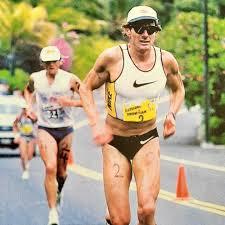
Scott Molina
The Terminator.
The Terminator’s Cadence: The Life and Times of Scott Molina#
I. The Pittsburg Runner: Forging an Engine of Endurance#
Some athletes are meticulously crafted, their potential identified early and honed by science in state-of-the-art facilities. Others are forged in crucibles of a different sort, their engines built not by lactate meters and wind tunnels, but by the relentless friction of a working-class life and an insatiable appetite for mileage. Scott Molina belongs to the latter. Born on a Leap Day, February 29, 1960, in the industrial Northern California town of Pittsburg, he was a product of an environment that valued grit over glamour.
Molina grew up as one of seven children in a large, Catholic, sporting family, an upbringing that demanded a certain innate competitiveness simply to be heard. In a striking parallel that would prove almost prophetic, his future wife and fellow triathlon legend, Erin Baker, was raised in a nearly identical environment on the opposite side of the planet. Before triathlon had even entered his lexicon, Molina’s identity was being shaped by the foundational disciplines of endurance. He was, in his own words, a "total running nut". From the age of 16 to 20, he immersed himself in the solitary pursuit of high-volume running, idolizing athletes who embodied a powerful work ethic. This was no casual hobby; it was a profound calling. Before his 21st birthday, he had already competed in multiple marathons and won a 50-mile ultramarathon, battling through cyclone conditions with atrocious headwinds and rain the entire way. This early feat was a clear harbinger of the immense capacity for suffering that would later define his greatest victory. Complementing this terrestrial obsession was a decade spent as a competitive swimmer, building the other half of the physiological chassis required for multisport dominance.
This athletic development did not occur in a vacuum. It was set against a backdrop of grueling work. As he transitioned into adulthood, Molina’s life was a juggling act of necessity. He coached swimming, attended school, and worked a series of physically demanding jobs—stocking shelves in a liquor store, flipping burgers at K-Mart—all to make ends meet. This period was instrumental in cementing the unyielding resolve that would propel his professional career. He was not a curated prodigy; he was a worker who happened to possess a world-class aerobic engine.
This unique combination of a blue-collar background and a self-directed, high-volume immersion in swimming and ultra-running created the perfect prototype for a pioneer in a new and brutal sport. When triathlon emerged in the early 1980s, it was not the polished, technologically advanced affair it is today. It was raw, unforgiving, and largely uncharted, a sport that rewarded pure toughness as much as talent. Molina’s constitution—a "grinder" mentality forged in the workplace and a massive endurance base built over thousands of solitary miles—made him uniquely equipped to thrive in this new environment, not in spite of its difficulty, but because of it.
II. The Dawn of a Sport, The Rise of a Legend (1982-1987)#
The nascent sport of triathlon found its defining narrative in June 1982 at the inaugural U.S. Triathlon Series (USTS) event in San Diego. It was here that four men, who would become the sport’s Mount Rushmore, first clashed. Dave Scott and Scott Tinley were already established forces, but on that day, they were joined by a 22-year-old Scott Molina, who had barely scraped together enough gas money to get there, and a fresh-faced newcomer named Mark Allen. The race was a thunderclap, announcing the arrival of a new era. Scott took the victory, but Molina finished a close second, with Tinley third and Allen fourth. This result set the stage for over a decade of ferocious competition that would elevate triathlon from a niche curiosity to a mainstream spectacle.
While the Ironman in Hawaii was the sport’s mystical peak, the USTS circuit became Scott Molina’s kingdom. He was not just a participant; he was a force of nature, a relentless winning machine who amassed an astonishing 50 USTS victories over the course of his career. By 1986, his dominance was so absolute that he had won 23 of the 30 USTS events he had entered. It was this consistency, this seemingly pre-programmed ability to crush the competition week after week, that earned him his iconic nickname: "The Terminator". He had another, less intimidating moniker, "Skid," given to him by a friend in 1984 after a series of bike crashes, a reminder of the inherent risks of racing on the limit.
The rivalry between the "Big Four," as they came to be known, was the central drama of the sport. Yet, their dynamic was more complex than simple animosity. While Dave Scott, "The Man," often trained in self-imposed isolation in Davis, California, the other three—Molina, Allen, and Tinley—formed an informal but powerful "hive-mind" training group. They spent summers pushing each other to new limits in the altitude of Boulder, Colorado, and winters logging thousands of miles together in San Diego. This created a unique incubator for performance, an environment where they were simultaneously collaborators in pushing the sport forward and fierce rivals for its biggest prizes.
This very dynamic—the constant head-to-head battles and the compelling, distinct personalities—became the engine for triathlon's professionalization. Their rivalry was a story that was easy to sell, and major outlets like ABC's Wide World of Sports broadcast their clashes into living rooms across America. This media exposure attracted sponsors and prize money, allowing Molina and his peers to finally transition from working odd jobs to becoming full-time athletes on groundbreaking teams like Team J David. The relationship was symbiotic: their public rivalry fueled the media narrative and grew the fanbase, while their private collaboration in training created an arms race of fitness that rapidly pushed the boundaries of human endurance. Molina, as the ever-present "Terminator" of the USTS circuit, was a central character in this ongoing drama, the man to beat every weekend, which only heightened the stakes for the season-ending showdown in Hawaii.
Table 1: Scott Molina - A Career of Dominance
| Title/Event | Year(s)/Quantity |
|---|---|
| Ironman World Champion | 1988 |
| USTS Victories | 50 |
| World's Toughest Triathlon Titles | 2 |
| Ultraman World Champion | 1 |
| Zofingen Duathlon Champion | 1991 |
| USA Professional Championships | 6 |
Data compiled from 1
III. The Kona Redemption: A Champion in the Cauldron (1988)#
The 1988 Ironman World Championship was supposed to be a coronation. After a dramatic battle in 1987 where Mark Allen faded late, allowing Dave Scott to capture his sixth title, the triathlon world eagerly awaited the rematch. But the volcanic island of Hawaii, as it so often does, had other plans. The narrative was shattered before the cannon even fired. Scott, the indomitable six-time champion, was forced to withdraw with a debilitating knee injury, a stunning development that created a power vacuum at the top of the sport. With Scott out, the consensus was clear: the race was Mark Allen’s to lose.
Scott Molina arrived in Kona as an afterthought, "the unknown factor". He was the king of the shorter, Olympic-distance races, but his history on the Big Island was checkered. He was known to struggle in the oppressive heat and humidity that radiates from the black lava fields. Molina himself was wrestling with a sense of decline, confessing that his attitude had deteriorated and that he was feeling "over done, over cooked, over triathlonized". This race was, in his mind, "one more try" at the one prize that had eluded him, a final shot at redemption on the sport's biggest stage.
The race unfolded as a brutal epic of attrition. The swim began as expected, with the main contenders—Molina, Allen, and the powerful short-course specialist Mike Pigg—exiting the waters of Kailua Bay in a tight pack. On the bike, as they headed out onto the lonely Queen Ka'ahumanu Highway, Molina and Pigg asserted themselves, pushing the pace at the front. Then, disaster struck the heir apparent. Mark Allen, the overwhelming favorite, suffered not one, but two flat tires—a cruel twist of mechanical fate that saw his dreams for 1988 hiss away on the sun-baked asphalt. The flats cost him a massive 18 minutes, effectively ending his bid for victory and leaving the race completely unpredictable.
The marathon became a grueling, two-man duel for the soul of the race. It was Molina versus Pigg, two athletes known for their speed, now locked in a battle of pure will under the punishing Hawaiian sun. Out on the Queen K, they were separated by mere hundreds of meters, each man isolated in his own world of pain. Molina would later recall the profound mental anguish of leading the world's most difficult race. "I really want to drop out but I can't because I'm in the lead," he remembered thinking, a powerful testament to the psychological burden of being the hunted. As Pigg chased, Molina dug into a reservoir of toughness forged over years of ultra-running and blue-collar work. Slowly, inexorably, he began to pull away.
Scott Molina crossed the finish line on Ali'i Drive with a time of 8:31:00, a mere two minutes ahead of a charging Mike Pigg, to claim his first and only Ironman World Championship. The victory was the ultimate "cherry on top of an incredible racing career". It was not a win born of overwhelming dominance, but a masterclass in execution and mental fortitude. In a race defined by the chaotic removal of its two titans—Scott by injury, Allen by misfortune—Molina won by being the most durable and composed athlete on the course. Mark Allen, in a display of his own incredible resolve, would go on to run the day's fastest marathon (a 2:57 split compared to Molina's 3:02:42), but he was too far back to matter. Molina wasn't necessarily the strongest athlete on that October day, but he was the best
racer. He managed the chaos, endured the suffering, and seized the fleeting opportunity to etch his name into history.
IV. A Partnership Forged in Endurance: The Molina-Baker Dynasty#
The same year that Scott Molina conquered Kona, a chance encounter in a hotel lift in Utah would irrevocably alter the course of his life and that of another triathlon titan. Erin Baker, the formidable New Zealander and 1987 Ironman World Champion, was at a crossroads. Despite her immense success, she was disillusioned with the relentless demands of the sport and was on the verge of quitting for good. Molina, fresh off his own career-defining season and, like Baker, recently out of a long-term relationship, asked her to breakfast.
What followed was the formation of one of endurance sports' greatest power couples. They married in February 1990 and became a force of nature on the global triathlon circuit. Between them, they held three Ironman world titles and had amassed over 200 professional victories, collecting podiums around the world like stamps in a passport. Their partnership was a deeply symbiotic alliance that strategically and emotionally extended both of their careers. Molina, with his process-driven approach, taught Baker how to find joy in the sport again. "Scott taught me how to enjoy the sport," Baker recalled, crediting him with re-igniting a passion that had nearly been extinguished. This renaissance led directly to her second Ironman World Championship victory in 1990.
In return, Baker provided Molina with a training partner of unparalleled toughness. "I've never run with a woman who can go that hard, that fast, that long," Molina admitted, a testament to the intensity she brought to their shared sessions. Their lives became a whirlwind of training, travel, sponsor obligations, and logistical planning, a complex dance they navigated as a team. Their similar upbringings in large, athletic, Catholic families gave them a deep, instinctual understanding of one another, a shared foundation upon which they built their professional and personal lives.
Their partnership represented a fusion of the two dominant triathlon cultures of the era: the pioneering American scene and the rugged, uncompromising New Zealand approach. In 1994, this fusion became literal when they made the life-altering decision to move to Baker's hometown of Christchurch, New Zealand. This move signaled a significant transition, the winding down of their high-profile careers based in the United States and the beginning of a new chapter focused on family and building a different kind of life within the sport they had helped to define.
V. The Second Act: Coach, Father, and Lifelong Athlete#
For many elite athletes, retirement is a finish line. For Scott Molina, it was merely a transition. The man once known as "The Terminator" evolved, shedding the skin of the relentless competitor to become a respected coach, mentor, and family man. His second act is not a departure from the sport but a deeper immersion in it, guided by a philosophy refined by the brutal lessons of his professional career.
Molina's coaching ethos stands in fascinating contrast to his own hyper-competitive past. Where his career was defined by winning, his coaching is defined by the journey. He emphasizes the importance of enjoying the process, of finding satisfaction in the daily challenges of training, believing that the results will then take care of themselves. His approach is deeply pragmatic and realistic, tailored to the lives of age-group athletes who must balance their passion with jobs, families, and mortgages. He is selective about the athletes he works with, preferring those who understand the commitment required but who also have the wisdom to seek balance in their lives, a lesson he learned the hard way.
This philosophy found its ultimate expression in Epic Camp, a venture he co-founded with coach Gordo Byrn. Conceived as a "Tour de France of Triathlon," Epic Camp takes athletes to their physical and mental limits in some of the world's most spectacular locations, from the Italian Dolomites to the French Alps. It is a way to institutionalize the best parts of his own career—the adventure, the camaraderie, the profound satisfaction of pushing one's boundaries—and share it with others.
Crucially, Molina never truly left the game. Unlike many of his peers who hung up their shoes for good, he has remained a dedicated and disciplined athlete. He consistently trains around 20 hours per week, a volume that would exhaust athletes half his age, and continues to compete in age-group events. He is driven not by a need to recapture past glory, but by a pure love for the process of preparation and the physical life. His life in Christchurch with Erin and their three children—Jennifer, Miguel, and Tandia—is a testament to this balance, a rhythm of personal training, coaching, and family.
Scott Molina's legacy is etched not only in the record books but in the very fabric of professional triathlon. He was a foundational architect of the sport, a central figure in its most legendary cohort, and now, an elder statesman whose evolution offers a powerful lesson. The punishing intensity of his first act, with some 265 professional races in 13 years, taught him the critical importance of sustainability, balance, and intrinsic joy. His second act is the application of that hard-won wisdom. He is the embodiment of the lifelong athlete, a man who successfully translated the brutal lessons of elite competition into a sustainable and fulfilling life in sport. He is not retired; he has transformed, his cadence now set not for a finish line, but for the long, rewarding road ahead.