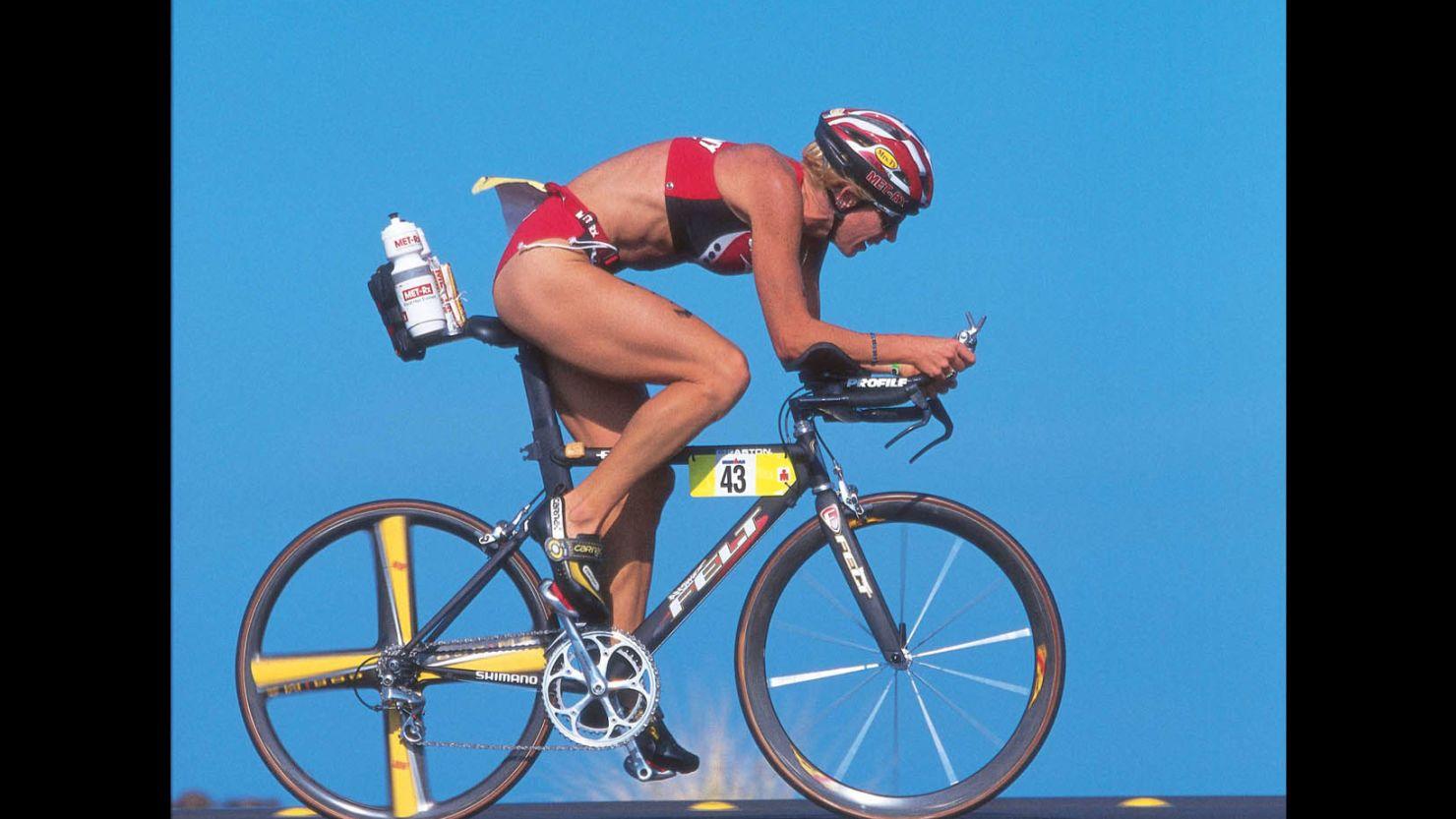
Paula Newby-Fraser
The Queen of Kona—eight-time champion and enduring icon.
The Unravelling and Redemption of the Queen of Kona#
Prologue: The Unravelling of a Queen#
The air on Ali'i Drive in Kailua-Kona is a physical presence. On this October afternoon in 1995, it is a suffocating blanket of heat and humidity, shimmering off the black tarmac, thick with the scent of salt, sunblock, and spent human effort. For hours, a dense gauntlet of spectators has lined the final stretch of the Ironman World Championship, their cheers a roaring wave of sound. The large digital clock hanging from the finish-line arch has ticked past the nine-hour mark, a testament to the brutal honesty of the 140.6-mile crucible of swim, bike, and run.
Paula Newby-Fraser, the seven-time champion, the undisputed "Queen of Kona," is supposed to be here by now. She had come off the 112-mile bike ride with a seemingly insurmountable 11-minute lead. Her eighth victory, a coronation that would elevate her beyond even the male legends of the sport, was considered a formality. Friends had stopped wishing her luck, so certain was her dominance. They called her an "invincible Cyborg," a woman for whom winning was not an achievement but a "birthright".
But just 400 meters from the finish, the cyborg shattered. The steady, metronomic stride that had carried her to 21 Ironman victories around the globe faltered. She stumbled, her body suddenly a stranger to her own commands. She slowed to a walk, then collapsed onto the curb, her face a mask of disbelief and anguish. As second-place finisher Karen Smyers ran past to claim an unexpected victory, Newby-Fraser lay on the pavement, the queen dethroned in the most public and visceral way imaginable. Her partner, Paul Huddle, sprinted from a nearby television studio, his voice cracking as he called for an ambulance.
It was one of the most shocking moments in the history of endurance sports—the public disintegration of an icon. This was not merely a physical failure, a simple case of dehydration or poor nutrition, though those were the immediate symptoms. This was the culmination of a year-long psychological crisis, a cautionary tale of hubris, insecurity, and the crushing weight of expectation. How did the greatest female endurance athlete the world had ever seen, a woman who had redefined the limits of human possibility, arrive at this breaking point? The answer lies not in the final 400 meters of that race, but in the winding, improbable journey that brought her from a privileged childhood in Southern Africa to the lava fields of Hawaii, a journey that would see her rise, fall, and ultimately, find redemption.
Part I: The Accidental Champion: An Unlikely Ascent (1962-1985)#
A Privileged Upbringing in a Land of Endurance#
Paula Newby-Fraser’s story does not begin with the obsessive, single-minded focus of a prodigy. It begins in comfort and variety. Born on June 2, 1962, in Southern Rhodesia (now Harare, Zimbabwe), she was raised in the coastal city of Durban, South Africa. Her parents were wealthy; her father, a successful industrialist who owned a large paint company, provided a life of privilege.
Crucially, her upbringing was steeped in the unique sporting culture of South Africa, a nation where endurance is not a niche pursuit but a national pastime. She grew up watching iconic events like the Comrades Marathon, a grueling 54-mile road race, and the Dusi Canoe Marathon. "Growing up in South Africa is basically THE influence that led me to being an athlete," she later reflected. "I spent every spare moment outdoors being active". She did everything: ballet, swimming, netball, hockey, even karate.
Swimming was where her natural talent first surfaced. Under coach Alisdair Hatfield, she became a nationally ranked swimmer while still in high school, representing the province of Natal at national championships between 1975 and 1978. But the intense training took its toll. At 16, she burned out, quitting both swimming and ballet to happily pursue what she called "beaches, bars and boys". She enrolled at the University of Natal, and for the next several years, athletics were a distant memory. She graduated in 1984 with a degree in psychology, having gained a significant amount of weight and feeling she needed a break from the athletic grind.
From Jogging to Triathlon#
The path back to sport was not born of ambition, but of a simple desire to get back in shape. After graduating and starting a full-time job, Newby-Fraser began a fitness regimen of jogging, aerobics, and weightlifting. It was then that she first encountered the sport that would define her life. An Ironman-distance triathlon was being held in her hometown, and she and her boyfriend went to watch. Her initial impression was one of bemused disbelief. It was, she thought, a "ridiculous thing to do".
Despite her skepticism, her boyfriend convinced her to give it a try. They bought bicycles, and a new chapter began with startling immediacy. Just two months after purchasing her bike, in January 1985, Newby-Fraser entered her first local triathlon. She didn't just compete; she won, setting a new women's course record and placing among the top ten finishers overall. The spark was lit. Her innate talent, dormant for years, had found its ideal expression.
The Fateful Trip to Hawaii#
Three months later, she won the South African national Ironman. The prize was a free trip to the sport's Mecca: the Ironman World Championship in Hawaii. Her preparation for this world-class event was, by professional standards, nonexistent. She had never run a full 26.2-mile marathon. She had never biked 112 miles in a single day, let alone in a week. Her goal was simply to survive the distance, to learn from the experience.
Upon arriving in Hawaii, the oppressive heat and humidity were a shock. Yet, in the race, something extraordinary happened. Running on pure, untapped talent and grit, the unknown and unprepared 23-year-old from South Africa stunned the triathlon world, and herself, by finishing in third place. That single performance was the catalyst. Standing on the podium, she looked at the women who had beaten her and had a profound realization: with proper, dedicated training, she could win.
This origin story is fundamental to understanding her entire career. She was not groomed for greatness in triathlon; she stumbled into her destiny. This "accidental" start meant her early years were driven by a pure love of the challenge, unburdened by the weight of expectation that would later prove so corrosive. In March 1985, she made the life-altering decision to leave South Africa and move to Southern California, the epicenter of the burgeoning sport, to become a professional triathlete. The accidental champion was about to begin building her empire.
Part II: Forging a Dynasty: The Queen of Kona (1986-1994)#
The Reign Begins#
Newby-Fraser's professional career in California began with immediate success, earning her $25,000 in her first year of American competition. It was there she met fellow triathlete Paul Huddle, who would become her longtime training partner, companion, and eventually, her husband. Her ascent to the throne in Kona, however, was as unconventional as her entry into the sport. In the 1986 Ironman World Championship, she crossed the line in second place behind Patricia Puntous. But when Puntous was later disqualified for illegally drafting on the bike course, Newby-Fraser was declared the winner. It was her first Kona title, won with a new course record of 9:49:14, making her the first woman ever to break the 10-hour barrier.
After a third-place finish in 1987, she returned in 1988 with a performance that would forever change the perception of what a female endurance athlete could accomplish. She didn't just win; she annihilated the field and the record book. Her finishing time of 9:01:01 was a staggering 34 minutes faster than the previous course record, held by her great rival Erin Baker. Perhaps more remarkably, she finished in 11th place overall, beating a host of elite professional men. The era of the Queen had truly begun.
The Rivalry that Defined an Era: Newby-Fraser vs. Baker#
No dynasty is forged without a worthy adversary. For Newby-Fraser, that adversary was Erin Baker of New Zealand, a two-time Ironman World Champion (1987, 1990. and a force of nature in her own right. Their rivalry was one of the most compelling in the sport's history, a clash of personalities, politics, and athletic philosophies that pushed both women to unprecedented heights.
The animosity was real and deeply personal. Baker was outspoken, brash, and politically charged. A fervent anti-apartheid activist, she had been arrested during protests in New Zealand and was banned from entering the United States for five years. She viewed Newby-Fraser—a white athlete who grew up in apartheid-era South Africa but represented her birth country of Zimbabwe to circumvent travel sanctions—as a symbol of a system she despised. Baker was explicit about her motivation: "I did think whupping the ass of the top South Africa triathlete would get some attention back in South Africa," she stated.
On the race course, their battles were legendary. They traded victories and records, their contrasting styles making for high drama. Baker, a powerful swim-biker, liked to attack from the front, while Newby-Fraser's strength was her relentless, metronomic consistency, particularly on the run. Their rivalry was so mentally taxing that after finally besting Baker in a hard-fought race at the 1993 Ironman World Championship, a drained Newby-Fraser confessed, "I don't know if I can do this again". While their relationship was frosty—Baker once admitted she had to "dehumanize her competition to race well"—they shared a mutual respect for each other's tenacity and work ethic. The pressure they exerted on one another was a crucible that forged greatness, forever elevating the level of competition in women's triathlon.
Breaking Barriers and Building a Legend#
Fueled by this rivalry and her own internal drive, Newby-Fraser embarked on a streak of dominance unparalleled in the sport. In 1992, she achieved her most iconic performance. On a perfect day in Kona, she executed what she called "as close to a perfect race as an athlete can have," a totally self-powered and controlled effort. She crossed the finish line in 8:55:28, becoming the first woman in history to break the mythical 9-hour barrier. It was a record that would stand for an astonishing 17 years, a testament to a performance that was years ahead of its time.
Her toughness was on full display the following year. In 1993, she won her sixth title despite having her preparation severely hampered by a stress fracture in her ankle, an injury that cost her six months of run training. From 1991 to 1994, she was untouchable, winning four consecutive world championships. By the end of the 1994 season, she had won seven Kona crowns and 21 of the 26 Ironman races she had entered worldwide. She was not just the best; she was an institution, the undisputed Queen of Kona.
| Year | Finishing Time | Key Notes |
|---|---|---|
| 1986 | 9:49:14 | First victory; awarded win after initial winner's disqualification. New course record. |
| 1988 | 9:01:01 | Second victory; obliterated previous course record by over 34 minutes. Finished 11th overall. |
| 1989 | 9:00:56 | Third victory; secured back-to-back titles. |
| 1991 | 9:07:52 | Fourth victory; beginning of four-year consecutive winning streak. |
| 1992 | 8:55:28 | Fifth victory; became the first woman to break the 9-hour barrier. A record that stood for 17 years. |
| 1993 | 8:58:23 | Sixth victory; won despite a stress fracture limiting her run training. |
| 1994 | 9:20:14 | Seventh victory; completed four consecutive wins. |
| 1996 | 9:06:49 | Eighth and final victory; a redemptive win following the 1995 collapse. |
Part III: The Hubris of a Champion: The Breaking Point (1995)#
The Psychology of Invincibility#
By 1995, Paula Newby-Fraser had achieved a level of dominance so complete that it began to work against her, not on the race course, but inside her own mind. The burning amazement her victories once inspired had cooled into the quiet nod of reconfirmed expectation. "Friends said, 'I don't even need to wish you good luck,'" she recalled. "They thought it was easy. But it wasn't". The title "Queen of Kona," once a celebration of her achievements, now felt like a gilded cage, making her feel taken for granted, as if winning were her destiny rather than her accomplishment.
This psychological burden created a profound need to do something spectacular again, to recapture the awe of her 1988 performance and "blow people's minds". She wanted to demolish her own course record and challenge the top men once more. Compounding the pressure, she announced that the 1995 Ironman would be her last, framing the race as the grand finale of her storied career. This internal and external pressure set the stage for a fateful decision, a departure from the very principles that had made her a champion.
A Fateful Shift in Philosophy#
Throughout her career, Newby-Fraser had been a disciple of the "less-is-more" training philosophy, influenced by the renowned South African exercise scientist Dr. Tim Noakes. His approach advocated for the minimum amount of work necessary to win, focusing on quality, recovery, and listening to one's body. It was a regimen that had served her magnificently.
But in her quest for a history-making performance in 1995, she abandoned this trusted method and joined what fellow pro Scott Tinley called the "arms race" of ever-increasing training loads. "I thought if I wanted to race like the men, I was going to train like the men," she explained. She dramatically increased her training volume, pushing her weekly cycling from a typical 200-250 miles to an astonishing 375-425 miles, and increasing her running volume by 20%.1 She undertook punishing 150-mile training rides with Mark Allen, the five-time men's champion, whose own course record was nearly 48 minutes faster than hers. This was not a decision based on physiological wisdom, but one born of a psychological need to prove her greatness anew. It was an act of hubris, a belief that she could simply will her body to a new level through sheer volume, ignoring the formula that had brought her unparalleled success.
The Meltdown on the Lava Fields#
Initially, the high-volume experiment seemed to be a resounding success. She recorded commanding victories at Ironman Lanzarote and Ironman Germany, reinforcing the media's prediction of a cakewalk in Kona. This string of wins fostered a dangerous sense of overconfidence. In a pre-race interview with NBC Sports, she made a chillingly prescient statement: "I've broken all the rules of training this year... So either I'm going to go out there and feel great or I've put myself so far down a hole I'm never coming out again".
On race day, that overconfidence metastasized into carelessness. As she built her commanding lead, she admitted to becoming "smug" and "careless," completely forgetting the fundamental basics of endurance racing. She neglected her nutrition and hydration plan, skipping aid stations in the marathon to save a few precious seconds—a rookie mistake from the sport's most seasoned professional.
The collapse, when it came, was the inevitable physiological consequence of a year-long psychological error. The body, overtrained from months of excessive volume and now critically under-fueled, simply shut down. The image of the greatest champion in the sport's history, sitting on a curb for 20 minutes, being doused with ice water by spectators before eventually getting up to walk across the finish line in fourth place, was seared into the collective memory of the triathlon world. The experience was personally devastating, leaving her crushed for months. The meltdown was not a random accident; it was the final, tragic domino in a chain reaction that had begun in her mind long before she ever set foot on the island that year.
Part IV: The Queen's Redemption (1996-2002)#
The Comeback#
The humiliation of 1995 could have been the end of her career. For many athletes, such a public failure would be an insurmountable psychological blow. But for Newby-Fraser, it became a crucible. "I was devastated for months afterwards," she admitted, "and to be honest it really took coming back the next year to get past it". That decision—to return to the site of her greatest trauma and face her demons—would lead to the most defining victory of her career.
Her approach to the 1996 Ironman World Championship was the antithesis of the previous year. The hubris was gone, replaced by a hard-won humility and respect for the unforgiving nature of the course. She returned to the principles that had made her a champion, racing with intelligence, patience, and a meticulous focus on the basics. The result was what many have called her "smartest race ever". She won her eighth and final Kona crown, a victory that was less a display of overwhelming physical dominance and more a testament to her profound mental and emotional resilience.
This eighth victory was arguably the most important. While her other seven titles could be attributed to her immense talent, this one required something more: the character to learn from a catastrophic failure and the courage to rise again. It completed her narrative arc, transforming the 1995 collapse from a story of failure into a necessary chapter in a larger story of redemption. It proved she could conquer not just the lava fields, but herself.
Winding Down a Legendary Career#
While 1996 marked her final coronation in Kona, Newby-Fraser's competitive fire was not extinguished. She continued to race at the highest level for several more years, ultimately amassing an incredible 24 career Ironman victories by the time she retired from elite competition in 2002.
Her later career was marked by poignant victories that brought her story full circle. In 2000, she returned to her childhood home to win the inaugural Ironman South Africa, a deeply meaningful experience where she competed in front of her parents. In 2001, at the age of 39, she won Ironman Japan, making her the oldest person at the time to win an Ironman event. She also began to explore new endurance frontiers, branching out into ultramarathons. In April 1997, she won the Ridgecrest High Desert 50k, setting a new course record of 4 hours and 6 minutes, proving her passion for endurance extended beyond the confines of triathlon.
Part V: The Elder Stateswoman: Life After the Finish Line (2002-Present)#
From Athlete to Entrepreneur and Mentor#
Paula Newby-Fraser’s transition from competitor to mentor was not an afterthought but a concurrent evolution. Even at the height of her dominance, she was laying the groundwork for a life beyond the finish line. In 1989, she co-founded the Multi Sport School of Champions, an early venture into coaching camps that allowed her to share her hard-earned knowledge. This later evolved into Multisports.com, a coaching business she formed with her husband Paul Huddle and fellow coaches Roch Frey and John Duke.
Her influence extended into publishing and business. She authored two books on fitness, Cross-Training: The Complete Training Guide for All Sports (1992) and Paula Newby-Fraser's Peak Fitness for Women, sharing her training methodologies with a wider audience. She also ran a business that produced athletic apparel for women and made a savvy early investment, becoming the first investor in the innovative Newton running shoe brand.
Today, her role as a mentor is formalized. As an Ironman U Master Coach, she is one of the most respected voices in the sport, guiding a new generation of athletes. Her coaching philosophy is a direct reflection of the lessons learned from her own career. It is built on five pillars: Balance, Consistency, Endurance, Adaptability, and Recovery. These principles are the very ones she violated in 1995 and subsequently embraced for her redemptive 1996 victory, making her a uniquely authentic and powerful guide.
A Deeper Philosophy: Balance and the Middle Path#
The trials of her career, particularly the 1995 collapse and a stress fracture in her ankle caused by overtraining, spurred a deeper philosophical exploration. She began to study Buddhism, describing herself humorously as a "total dabbling yuppie Buddhist beginner". She found that the core Buddhist teaching of balance—the "middle path"—resonated deeply with her experiences. "I was out of balance," she said of the period leading to her injury. "I realized I was trying to say that I was invincible... what this experience said to me was that I was lacking spirituality".
She found her meditative practice not on a cushion, but in motion. "When I'm alone and running for, like, two and a half hours, I feel it is a meditation," she explained. "Being in my body completely as I run is a deep practice for me". This mindset allowed her to reframe her motivation for competing. It became less about winning and more about the internal challenge, the pursuit of a state of "effortlessness" where the physical and mental align. "For me, racing needs to be more about the personal challenge, and less about the money and recognition," she stated. "I've had my greatest races when I've had that state of mind".
Legacy and Enduring Influence#
Paula Newby-Fraser's legacy is etched in the record books, but her influence transcends statistics. She is, and always will be, the "Queen of Kona". Her eight world championships remain the benchmark for greatness, a feat only recently matched by Daniela Ryf. Her 1992 sub-nine-hour performance stood for 17 years, a mark of her revolutionary talent.
She remains a vital presence in the sport, a respected commentator and a passionate advocate for women's racing. She has spoken eloquently about the importance of giving the professional women their own dedicated race day at the world championships, allowing them to emerge from the "shadows" of the men's race and command the full spotlight. Her career fundamentally changed the perception of what female endurance athletes could achieve, and her story—of incredible highs, a devastating low, and a triumphant return—continues to inspire.
Epilogue: The Queen in Perpetuity#
Today, Paula Newby-Fraser lives and trains in Encinitas, California, a U.S. citizen who has found a home far from her African roots. The grueling, high-volume training of her professional days is a thing of the past. She still exercises almost every day, but now it is driven by inspiration, not obligation. "There is no rhyme or reason to anything other than what I am inspired to do," she says. She finds her joy on the dirt, favoring trail running and mountain biking in the quiet beauty of nature.
Her legacy is not just one of victory, but of wisdom earned through both triumph and failure. She learned the hard way that the greatest battles in endurance sports are fought not on the race course, but within the "chaos of your mind". Her journey teaches that true strength lies not in invincibility, but in the resilience to face one's own fallibility and rise again. The Queen of Kona's reign is not a relic of the past; it is a timeless lesson in the heart of a champion.