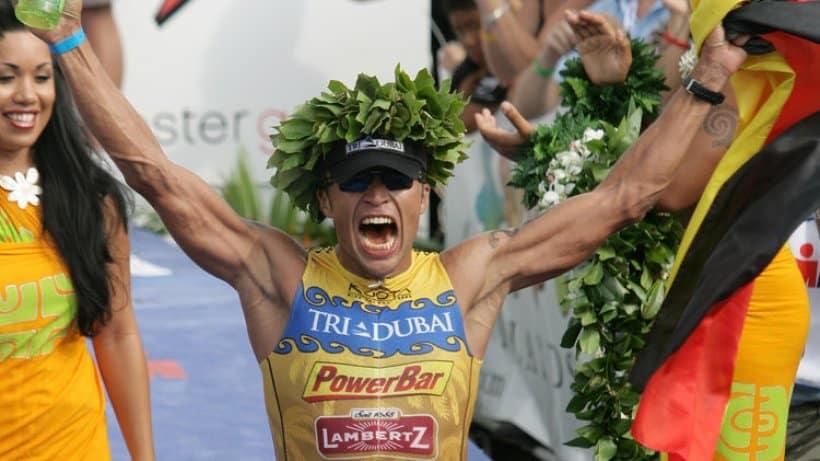
Norman Stadler
The Norminator: Fire in the Lava Fields.
The Norminator: Fire in the Lava Fields#
Introduction: The Meltdown on the Queen K#
The Queen Kaʻahumanu Highway shimmers, a black ribbon of asphalt laid across an ancient, unforgiving landscape of black lava rock. On this stretch of road during the 2005 Ironman World Championship, the oppressive Hawaiian heat radiates in waves, distorting the air and the ambitions of the world’s greatest endurance athletes. All eyes are on the reigning champion, Germany’s Normann Stadler, a man who a year prior had not just won this race, but had brutally dismantled it. But on this day, the champion’s armor is about to crack.
The first fissure appears on the descent from the turnaround at Hawi. A flat tire. For a professional, this is an inconvenience, not a catastrophe. But as the television cameras zoom in, a frantic, desperate struggle unfolds. Stadler, his face a mask of raw frustration, claws at the tubular tire, trying to rip it from the wheel rim. His efforts are futile. In a moment of pure, unfiltered agony, his voice cracks as he screams the phrase that would become an iconic part of triathlon lore: "Too much gluuuue!". He had entrusted the crucial task of gluing his tires to an unfamiliar bike shop, a small deviation from his routine that would have catastrophic consequences.
Though he eventually gets a replacement wheel from tech support, the damage is done—not to the bike, but to his psyche. Around mile 90, fate strikes again: a second flat tire. This time, there is no fight left. In a gesture of ultimate surrender, Stadler dismounts, lifts his high-tech carbon fiber machine, and hurls it into the stark, jagged lava fields lining the road. He collapses, breaking down in tears as his dream of a repeat victory dissolves under the Kona sun. "I quit because I was empty—body and mind," he would later reflect. This dramatic failure, broadcast to the world, was not an anomaly but the perfect encapsulation of the man himself: a passionate, emotional, all-or-nothing athlete whose career was a volatile mix of brilliant, paradigm-shifting victories and spectacular, heartbreaking defeats.
This collapse was not merely a product of bad luck; it was a direct consequence of the immense pressure and distraction that followed his revolutionary 2004 victory. In a single race, he had transformed from a contender into "the guy to beat," a status that brought a whirlwind of media attention, sponsor demands, and public expectation that fundamentally altered his preparation. Stadler himself admitted that while the attention was great, "those demands distracted me from doing the homework for the big dance in October," noting his preparation was "'OK' but not like the year before". The fateful decision to outsource the gluing of his tires was a symptom of this larger loss of focus on the small, critical details he once meticulously controlled. The spoils of his greatest victory had sown the seeds of his most public failure.
Part I: The Forging of a Weapon (1973-2003)#
Born on February 25, 1973, in Wertheim, Germany, Normann Stadler seemed destined for a life of endurance. His athletic journey began with a feat that remains astonishing: at the age of just 11, he ran his first full marathon, an early and profound indicator of an innate capacity for long-distance suffering and a will to push beyond conventional limits.
This prodigious talent was quickly channeled into the burgeoning world of multisport. In 1988, at 15 years old, he joined the German national triathlon team, beginning his formal apprenticeship in the sport. His elite credentials were solidified in 1994 when he won the World Duathlon Championship, a title that showcased the powerful run-bike combination that would become his signature weapon.
The Ironman Proving Ground#
After making his debut at the Ironman World Championship in 1999 as an age-group athlete, Stadler announced his arrival on the professional long-course scene in 2000 In April of that year, he claimed victory at Ironman Australia with a commanding time of 8:30:37, signaling that a new force had arrived. But it was his performance in Kona that October that truly put the triathlon world on notice. He finished in 3rd place, but it was the
way he raced that was revolutionary. With a 52:51 swim, a solid 2:56:00 run, and a blistering 4:35:14 bike split—the fastest of the day by a significant margin—he laid down a blueprint for a new way to win in Hawaii. Even race winner Peter Reid acknowledged the young German's formidable talent.
This performance was more than just a podium finish; it was a declaration of intent. For years, the conventional wisdom in Kona held that strong cyclists would inevitably be reeled in and passed on the marathon by superior runners. Stadler’s 2000 race was a direct challenge to that orthodoxy. His bike split was over four minutes faster than the winner's, a deliberate, aggressive move designed to test the limits of that established strategy. While he was ultimately outrun, he had proven a vital point: a massive, race-altering lead could be built on the bike. He was not just racing; he was a strategist actively testing a hypothesis, refining a formula that would one day change the sport. The subsequent years, which saw him finish 4th in 2001 and 4th again in 2003, were his apprenticeship, a period of honing his craft and learning the brutal lessons of the Big Island, all in preparation for the masterpiece to come.
Part II: The Revolution on Two Wheels (2004)#
The 2004 Ironman World Championship was held on a "horrendously difficult windy day," the kind of conditions that typically reward conservative tactics and punish audacious risks. It was the perfect stage for Normann Stadler to attempt the unthinkable.
Executing the Unthinkable#
His race was a masterclass in calculated aggression. A solid swim of 54:27 placed him just a minute behind his key rivals, positioning him perfectly for the assault to come. Once on the bike, he wasted no time. He "blew by the field around the airport" and began to systematically dismantle the competition. His performance on the 112-mile bike leg was not just dominant; it was legendary. He posted a phenomenal time of 4:37:58 in the brutal winds, a split that was nearly 15 minutes faster than the next-best cyclist. Peter Reid, who would finish second, lost a staggering 24 minutes to Stadler on the bike alone, coming into the second transition with a split of 5:01:38. By the time Stadler racked his bike, he had built an insurmountable lead.
All that remained was to hold on. His marathon was not the fastest of the day, but his solid 2:57:53 was more than enough to carry him to victory. He crossed the finish line with a total time of 8:33:29, his arms raised in triumph, more than 10 minutes ahead of Reid.
The Aftermath: A Paradigm Shift#
Analysts immediately recognized the significance of the performance, calling Stadler a "game changer". He had done what was thought to be impossible in the modern era: he had won the Ironman World Championship on the bike. From that day forward, as one observer noted, "no one was going to take the bike for granted". He had single-handedly rewritten the tactical playbook for the sport's biggest race.
His victory did more than just win a title; it created a new archetype in long-distance triathlon—the modern "Überbiker"—and triggered an athletic arms race in cycling technology, aerodynamics, and power-based training that continues to shape the sport. Before 2004, the prevailing belief was that Kona's marathon would always neutralize a cyclist's advantage. Stadler provided definitive proof of concept that an overwhelming bike leg, paired with a merely solid run, was a winning formula. This validation spurred a new generation of athletes like Chris Lieto, Torbjorn Sindballe, and later Sebastian Kienle, to model their strategies on his, elevating the importance of cycling prowess to new heights. His win marked an inflection point in the professionalization of the bike leg, accelerating the sport's focus on technology and specialization. Stadler did not just change a race; he changed the very DNA of the elite Ironman athlete.
| Year | Finishing Place | Overall Time | Swim | Bike | Run | Key Notes |
|---|---|---|---|---|---|---|
| 1999 | N/A (Age Group) | N/A | N/A | N/A | N/A | First Kona experience. |
| 2000 | 3rd | 8:26:44 | 52:51 | 4:35:14 | 2:56:00 | Breakout performance; fastest bike split. |
| 2001 | 4th | 8:41:53 | 52:03 | 4:48:15 | 2:56:54 | Solidifies contender status. |
| 2003 | 4th | 8:32:47 | 51:59 | 4:47:40 | 2:49:04 | Strong performance, still chasing the win. |
| 2004 | 1st | 8:33:29 | 54:27 | 4:37:58 | 2:57:53 | The Revolution: Wins the race on the bike. |
| 2005 | DNF | N/A | N/A | N/A | N/A | The infamous "Too Much Glue" meltdown. |
| 2006 | 1st | 8:11:56 | 54:05 | 4:18:23 | 2:55:03 | Redemption: New bike course record. |
| 2007 | DNF | N/A | N/A | N/A | N/A | Withdraws due to illness. |
| 2010 | N/A | 9:25:27 | 56:05 | 5:01:21 | 3:21:40 | Final Kona appearance. |
Part III: Redemption's Edge (2005-2007)#
The psychological toll of his 2005 DNF was immense. Stadler spoke of the crushing weight of expectation and the feeling of being "empty inside" after his race fell apart, a champion left exposed and vulnerable on the world's biggest stage. This public failure, however, became the crucible for his return. His preparation for the 2006 race was defined by a renewed, meticulous focus. He learned a valuable lesson about controlling every variable, stating grimly of his equipment mishap, "I never did it again".
The 2006 Masterpiece#
His comeback at the 2006 Ironman World Championship was nothing short of a masterpiece of power and resilience. He unleashed an astonishing assault on the bike course, shattering the existing record with a blistering 4:18:23 split. This ride gave him a seemingly comfortable 10-minute lead over his primary challenger, the formidable Australian Chris "Macca" McCormack.
What followed was one of the most thrilling chases in Kona history. McCormack, a renowned runner, tore through the marathon with a blistering 2:46 pace, relentlessly hunting down the German leader. The 10-minute gap began to evaporate. With every mile, the tension mounted as the lead shrank—from ten minutes to four, then to two, then to just over a minute. But Stadler did not crumble. He dug deep, holding his form and his nerve, and crossed the finish line with a total time of 8:11:56, a mere 71 seconds ahead of McCormack in one of the closest men's finishes the race had ever seen. This was not a victory of pure dominance like in 2004; it was a triumph of pure grit.
The Rivalry Ignites#
The drama spilled over from the finish line. In the aftermath, Stadler controversially accused McCormack of drafting on the bike, igniting a heated and intensely personal feud. The animosity escalated into a near-physical confrontation at the post-race party, cementing one of the sport's most passionate rivalries. McCormack later revealed the depth of the feeling, stating, "Norman Stadler on the other hand has fuelled my belly to train for the next 12 months again and I look forward to racing the champ at every possibility".
The stage was set for an epic showdown in 2007. The rivalry, however, ended not with a bang, but with a whimper. Stadler, suffering from severe gastrointestinal issues, was forced to withdraw from the race, vomiting on the side of the road in a scene of physical distress. McCormack went on to claim his first, long-awaited Kona crown. This period perfectly illustrates the duality of Stadler's character. The same raw, untamed emotion that led to his public breakdown in 2005 was the very fuel for his incredible redemption in 2006 and the fiery rivalry that defined the era. His passion was both his greatest weakness and his most potent strength; he could not have had one without the other.
Part IV: The Final Heartbeat (2008-2011)#
In the years following his second championship, Normann Stadler remained a formidable presence at the front of major races, but another Kona crown eluded him. His career entered a twilight phase, a slow fade rather than a sharp decline. His final appearance on the Big Island came in 2010, where he finished the grueling day alongside fellow former champion Tim DeBoom. As they crossed the line together, they reportedly vowed it would be their last time racing on the island.
The Unseen Threat#
Unbeknownst to the triathlon world, a far greater challenge was looming. During a training camp, Stadler began experiencing an unusual and profound fatigue, struggling to keep pace with teammates in workouts he would normally dominate. These were the first warning signs that something was fundamentally wrong, not with his fitness, but with his body's most vital engine.
In 2011, a shocking medical diagnosis revealed the truth. An ultrasound uncovered a serious congenital heart condition: Stadler was born with a bicuspid aortic valve, which had become damaged, and his aorta had dilated to a dangerous 7 cm—nearly three times its normal size. The condition put him at imminent risk of a fatal aortic aneurysm.
On July 4, 2011, he underwent emergency open-heart surgery at the University of Heidelberg to repair the faulty valve and the aneurysm. The procedure was a success, saving his life. Just four weeks later, at the age of 38, Normann Stadler announced his retirement from professional triathlon. His statement was both poignant and pragmatic: "I am flattered that so many people believe in my comeback. Nevertheless I know that I wouldn't be able to achieve a world class level again". A legendary career, defined by its power and ferocity, was cut short not by a rival or a crash, but by a hidden flaw in his own heart.
Stadler's story represents a profound paradox of elite endurance sport. While his heart condition was congenital, the immense cardiovascular load of decades of Ironman training, starting from his first marathon at age 11, likely placed extraordinary stress on his already-flawed anatomy, exacerbating the underlying weakness. His career-ending diagnosis transcends a personal medical issue and becomes a powerful commentary on the unforeseen physiological costs of pushing the human body to its absolute limits. It serves as a stark reminder that the same biological engine that produces world-championship performances can also be a site of catastrophic failure.
Conclusion: The Echo of the Norminator#
Normann Stadler’s legacy is forged in fire and etched into the lava fields of Kona. He will forever be remembered as the tactical innovator who shattered the conventions of the Ironman World Championship, proving that the race could be won with a dominant bike leg and forever changing the sport's strategic landscape.
Yet his impact transcends race strategy. As "The Norminator," he was a compelling, emotional, and at times controversial character whose public displays of passion, frustration, and triumph made the sport more dramatic and engaging. His career was a human story, filled with dizzying highs and crushing lows, not just a series of statistics.
In his life after the finish line, Stadler has transitioned into a new role, channeling his immense experience as a coach, motivational speaker, and consultant. As a father to two boys, he has found a new identity beyond the relentless demands of the race course.
The enduring image of Stadler may be of him hurling his bike into the lava in a moment of despair. But his true legacy is now permanently part of the mystique of that island. He was a force of nature—as fierce, volatile, and unforgettable as the landscape where he twice became a legend. Normann Stadler showed the world that to conquer the lava fields, you had to be willing to race with fire.