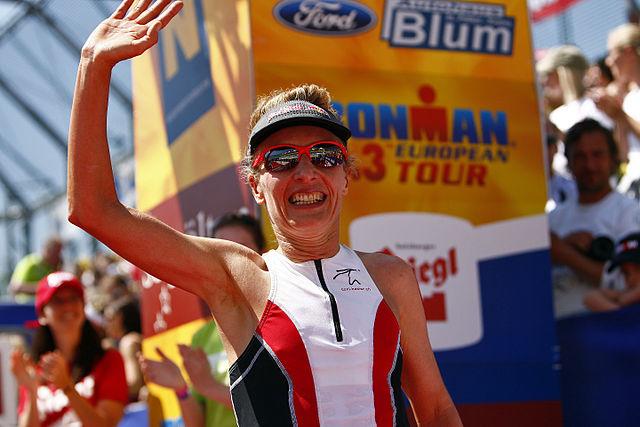
Natascha Badmann
The Swiss Miss.
The Smile and the Steel: The Unconquerable Spirit of Natascha Badmann#
Introduction: The Queen of Contradictions#
The Queen Kaʻahumanu Highway in Kailua-Kona, Hawaii, is a place of reckoning. A ribbon of black asphalt cutting through a desolate landscape of volcanic rock, it is where the dreams of the world’s toughest athletes are either realized or vaporized under an unforgiving sun. In October 2006, this brutal stretch of road bore witness to a scene that perfectly encapsulated the paradox of its six-time queen. Natascha Badmann, the reigning Ironman World Champion, a woman synonymous with an irrepressible smile and a seemingly effortless glide, was doubled over on the roadside, her tiny 1.65 m, 52 kg frame convulsed by violent heaving.
Stomach issues that began early in the bike leg had become debilitating during the marathon. Spotters on the course radioed in reports with a sense of disbelief: the champion was throwing up, then dry heaving, struggling to even walk. For any other athlete, this would have been the end. But for Badmann, it was merely a different kind of test. Fueled by what she would later describe as a duty to the cheering fans and the volunteers who had supported her, she began to jog, tears streaming down her face. She would cross the finish line that day in 10th place, a testament not to dominance but to sheer, unyielding will.
This moment reveals the truth of Natascha Badmann. Her story is not simply one of athletic prowess, but a profound testament to personal transformation. It is the journey of how an individual who felt she had no control over her life meticulously built a framework for success, not just to win races, but to redefine her very existence. The ever-present smile, her famous trademark, was not a mask for the pain but a weapon against it—a conscious choice, honed through years of mental discipline. Her career is a masterclass in resilience, a narrative that proves true strength is measured not only in the six world championship wreaths she collected, but in the grace and determination she displayed during her deepest, most public struggles. She is the queen of contradictions: the joyful sufferer, the fragile force of nature, the embodiment of both the smile and the steel.
Chapter I: An Accidental Beginning (1966-1990)#
Born in Basel, Switzerland, on December 6, 1966, Natascha Badmann’s early life gave no indication of the legendary athlete she would become. By her own admission, she was an "unathletic and overweight" child who was never the best at sports in school. Her path seemed set for a conventional existence, far from the punishing lava fields of Hawaii. She worked as a secretary, a life of quiet routine that belied a growing inner turmoil.
Life took a sharp, challenging turn just days before her 18th birthday when she gave birth to her daughter, Anastasia. The relationship with her first love, the child’s father, dissolved, leaving the young mother to navigate a future she described as "dark and sad". This period was marked by a profound sense of dissatisfaction and depression. She felt overworked and lost, throwing herself into her work while seeking solace in chocolate and engaging in "crazy diets" in a desperate search for something more. It was a life defined by a lack of control, a state of inertia that seemed inescapable.
The trajectory of her life was irrevocably altered at the age of 23. It was then that she met Toni Hasler, the Swiss national triathlon coach. Where Badmann saw a young woman who was overweight and unhappy, Hasler saw untapped potential. He became the catalyst for her transformation, not with a grand athletic pronouncement, but with a simple, foundational suggestion: "Miss, you're not going to be happy like this. Start eating right. And then do some exercise". He encouraged her to start jogging, beginning with just "one block at a time". This seemingly small step was, in fact, the first stride in a journey that would take her to the pinnacle of global sport.
This meeting was more than a fortunate encounter; it was the genesis of a symbiotic partnership that would define her entire career. Badmann’s state before Hasler was one of aimless despair; she lacked the vision and structure to change her circumstances. Hasler provided not only the initial spark but also the architectural blueprint for a future she could not imagine for herself. Her subsequent success was never a solitary achievement but the product of a unique co-creation, where his strategic vision, meticulous planning, and unwavering belief met her latent, undiscovered willpower. Without Hasler’s intervention, the champion known as the "Swiss Miss" would almost certainly never have existed. This dynamic of absolute trust and shared purpose would become the bedrock of her athletic dynasty.
Chapter II: Forging a Champion: The Four Pillars (1990-1997)#
Badmann’s entry into sport was not driven by a desire for glory, but by a fundamental need to lose weight and reclaim a sense of self. The initial, tentative jogs around the block soon ignited a passion. She committed to the sport for five years, telling herself she would decide her next steps after that period. This methodical, long-term approach hinted at the discipline that would become her hallmark. Her raw endurance talent quickly became apparent, and her journey from a hesitant runner to a world-class athlete culminated in 1995 when she won the Duathlon World Championships in Cancun, Mexico. It was a victory she would later cite as one of her proudest moments, a validation of her new path before she had even competed in a full Ironman.
This formative period saw the development of the philosophy that would govern her career. Together with Hasler, she created the "Four Pillars of Success": Training, Nutrition, Equipment, and Mental Training. This holistic system was more than a training regimen; it was a framework for rebuilding her life. Where her early years were marked by chaos and a lack of control, the Four Pillars imposed a meticulous order on every aspect of her existence.
The first two pillars, Training and Nutrition, were Hasler’s domain. He was the master planner, possessing an intuitive understanding of her body. Badmann credits her remarkable 25-year career at the highest level to his ability to know "exactly when he may or must challenge me, and when my body needs to get some rest". His expertise was all-encompassing, extending to the kitchen, where he was an "incredibly good cook" who tailored her meals to her training load and physical state, even preparing specific vegetables with anti-inflammatory properties after a grueling bike session.
The third pillar, Equipment, reflected their obsessive pursuit of perfection. They believed in having the absolute best tools for the job, so much so that they would rather purchase superior equipment themselves than accept a sponsorship for a product they felt was second-best. This philosophy was most famously embodied in her bicycle. For much of her career, she rode a rare, out-of-production Cheetah time trial bike, a radical carbon-fiber machine that became her "two-wheeled Excalibur". She and Hasler worked tirelessly to perfect her fit, merging her slight frame with the aerodynamic sled until she resembled an arrow ready to pierce the fierce Hawaiian winds. This bike, and her mastery of it, would become her primary weapon.
The final and most crucial pillar was Mental Training. Badmann cultivated a mindset of radical positivity, a practice she invested in daily. She learned to consciously collect beautiful thoughts, starting each day by identifying three reasons it would be great and ending it by reflecting on positive moments. During the immense suffering of a race, she employed "power words" to reprogram her body's response. The first she chose was "eagle," visualizing the majestic bird to give her strength in extreme situations. She famously stated that she learned to "delete the word pain" from her vocabulary, reframing the sensation as her body working hard, but not as a negative signal to stop. This mental fortitude, the ability to "cheat my mind and focus on the good things," was the invisible engine driving her physical performance.
Armed with this comprehensive system, she arrived at the Ironman World Championship in Kona in 1996. As a relative unknown, she stunned the triathlon world by finishing second to the sport’s reigning monarch, Paula Newby-Fraser. She returned in 1997, only to be thwarted by illness. These initial forays were crucial learning experiences. She had proven she possessed the raw talent; all that remained was the perfect execution of the system she and Hasler had so painstakingly built.
Chapter III: The Kona Dynasty (1998-2005)#
The period between 1998 and 2005 marked an era of dominance for Natascha Badmann, an eight-year stretch during which she would claim the Ironman World Championship title six times. Each victory was a unique chapter in her evolving story, a testament to her meticulous preparation, tactical brilliance, and indomitable will.
1998: The European Breakthrough#
Returning to Kona in 1998, Badmann was no longer an unknown rookie but a formidable contender. She executed her race with tactical precision. Emerging from the 2.4-mile swim in a respectable 7th place with a time of 56:02, she was perfectly positioned to unleash her primary weapon. On the 112-mile bike course, she was simply in a class of her own, posting a blistering 5:10:00 split that catapulted her into the lead. She held on during the marathon with a solid 3:14:50 run, crossing the finish line in 9:24:16 to claim her first world title. The victory was historic; she became the first European woman to ever win the Ironman World Championship, breaking the long-standing American dominance. The moment was pure elation. "I was so happy, happier than I could express with words," she recalled. "I spread my arms out and wanted to share my happiness with the whole world!".
2000: Reclaiming the Crown#
After forgoing the 1999 race to make an unsuccessful bid for the Swiss Olympic team, Badmann returned to Hawaii in 2000 determined to reclaim her throne. The race unfolded in a familiar pattern, showcasing her signature strategy. She exited the water in 9th place, more than seven minutes behind the lead swimmer, Joanna Zeiger. But on the bike, amidst brutal winds, she was once again untouchable. Her staggering 5:06:42 bike split was over 15 minutes faster than her main rival and defending champion, Lori Bowden. This decisive move gave her a substantial lead heading into the run. Though Bowden posted the day's fastest marathon, Badmann's cushion was more than enough. She finished in 9:26:16, securing her second world title.
2001: The Battle Against the Elements#
Her 2001 title defense was a testament to her toughness. She described the race conditions as the most difficult she had ever faced, with powerful winds that made controlling the bike a constant struggle. Germany's Nina Kraft set a blistering pace early on, but Badmann remained unfazed, overtaking her 150 km into the bike leg. The victory, however, was sealed on the run. Having worked diligently to improve her running, she clocked a new personal best marathon of 3:09:33, nine minutes faster than her previous year. Despite admitting that "every step in Hawaii made me suffer," she persevered, crossing the line in 9:28:37 for her third world title and second consecutive win.
2002: The Perfect Race - A Personal Best#
The 2002 Ironman World Championship represented the absolute zenith of Badmann's competitive performance. On October 19, she delivered a nearly flawless race, achieving her fourth world title and setting a personal best time that would remain the fastest of her career: 9:07:54. Her splits were a masterclass in long-distance racing. She completed the swim in 59:40, then laid down one of the most iconic bike rides in Kona history, a scorching 4:52:26 that was a course record at the time. She followed this with a strong 3:12:59 marathon to seal a dominant victory, finishing more than six minutes ahead of her nearest competitor. This performance was the ultimate validation of the Four Pillars system, cementing her status as one of the sport's all-time greats.
2004: Victory in the Shadow of Controversy#
The 2004 race was defined by fierce Mumuku winds and a result that would reverberate through the sport. On the day, Germany's Nina Kraft was untouchable, finishing more than 15 minutes ahead of Badmann. However, Kraft’s dominant performance raised suspicions, and weeks later, she admitted to using the banned substance EPO and was disqualified. Badmann, who had finished second on the course with a time of 9:50:04, was declared the winner. It was a hollow victory. She had been denied the catharsis of breaking the tape and the joy of the finish line celebration. "I preferred being second than being first by using drugs," she later stated. "It wasn't joyful and I did not like the feeling of cheating". In a poignant gesture, the Ironman organization later sent her trophy, a winner's wreath, and the finishing tape to San Diego, where a mock finish line was recreated for her at an awards ceremony, allowing her the moment of public celebration she had been robbed of.
2005: The Sixth and Sweetest Title#
If 2004 was a victory without glory, 2005 was glory earned in the most dramatic fashion possible. The race was billed as a "David vs. Goliath" showdown between the veteran champion Badmann and the powerful Ironman rookie and Olympic silver medalist, Michellie Jones of Australia. Jones built a formidable lead on the bike, and Badmann's quest for a sixth title seemed in jeopardy when she was assessed her first and only drafting penalty, forcing her into a four-minute wait in the transition area. She began the marathon nearly nine minutes behind Jones. What followed was one of the great chases in Kona history. Badmann "dug in," her face a mask of concentration as she relentlessly pursued her rival through the Energy Lab and back onto the Queen K Highway. She finally made the pass around mile 18 of the run, surging to her sixth and final Ironman World Championship title with a time of 9:09:30. It was a performance she called a "magic discovery of what is possible," a perfect, triumphant end to her dynasty.
| Table 1: Natascha Badmann's Ironman World Championship Victories |
|---|
| Year |
| 1998 |
| 2000 |
| 2001 |
| 2002 |
| 2004 |
| 2005 |
Chapter IV: The Breaking Point (2006-2007)#
For nearly a decade, Natascha Badmann’s career had been a narrative of meticulous control and escalating dominance. Her Four Pillars system had rendered her seemingly invincible. But the two years that followed her final Kona victory would shatter that aura, replacing it with a story of profound vulnerability. The central conflict of her career shifted from athlete versus competitor to athlete versus the uncontrollable frailties of her own body.
2006: The Gut-Wrenching Finish#
As the defending champion in 2006, Badmann was the clear favorite. However, the race became a brutal, public display of her physical limits. Plagued by severe stomach problems that started on the bike, she was reduced to a shell of her former self on the run. The champion who flew across the lava fields was now seen walking, stopping, and vomiting repeatedly on the roadside. In what she would later call her "hardest race ever," she found a different kind of motivation. Feeling she owed a debt to the thousands of cheering fans and volunteers, she pushed through the agony. In a dramatic and emotional scene, a crying Badmann willed herself from a walk back into a jog, eventually crossing the finish line in 10th place with a personal-worst marathon time of 3:27:54. The performance was a powerful display of her mental fortitude, a victory of spirit over a failing body.
2007: The Crash#
If 2006 was a slow, agonizing breakdown, 2007 was a sudden, violent shattering. Badmann was once again in her element, appearing to be on her way to another potential victory as she carved her way through the bike course. Then, disaster struck. While navigating a construction zone on the course, she swerved to avoid a motorcycle and slammed into a traffic cone. The crash was brutal. She suffered multiple injuries, including a shattered collarbone and severe damage to her shoulder.
Even in the immediate aftermath, her first instinct was to continue. However, Toni Hasler, ever the pragmatist and protector, recognized the grave danger. Fearing a more severe, potentially paralyzing injury if she continued, he gently convinced her to withdraw from the race. The DNF was more than just the end of a race; it marked the definitive end of her era of Kona dominance and the beginning of the most challenging fight of her life. This forced vulnerability stripped away the champion's armor, revealing the human being beneath and setting the stage for a comeback that would be more inspiring than any of her victories.
Chapter V: The Long Road Back (2008-2012)#
The aftermath of the 2007 crash plunged Natascha Badmann into a world of pain and uncertainty. The meticulously controlled life she had built was fractured. Doctors delivered a devastating prognosis: she might never be able to race, or even swim, again. The diagnosis was a profound shock. For six weeks following surgery, she was utterly helpless, unable to move her arms, feed herself, or even "wipe my own tears when I was crying in pain". The long, arduous process of rehabilitation began with relearning the most basic movements, a humbling and painful journey she documented by marking her progress in how high she could raise her arms—first to her waist, then her chest, then her shoulders, and finally, shakily, above her head.
Yet, true to her character, Badmann reframed this devastating setback as an opportunity. It was a chance to address a long-standing weakness. "I was never a great swimmer before I broke my shoulder," she admitted. During her recovery, she dedicated herself to rebuilding her swim stroke from the ground up, focusing on technique and strengthening her shoulders in a way she never had before. This act of turning a career-ending injury into a catalyst for improvement was the ultimate application of her mental training philosophy.
Her return to racing was a testament to her patience and perseverance. It was a slow, multi-year process filled with setbacks. She made valiant attempts to start the Ironman World Championship in 2008 and 2009, but her body was not yet ready, and she was unable to finish. It took a full four years before she could complete an Ironman distance race again, a significant milestone she achieved with a second-place finish at Ironman Lanzarote in 2011. During this period, her definition of victory had to evolve. The simple act of finishing became a monumental achievement, a triumph of will over physical limitation.
The culmination of her long road back arrived in 2012, a year of stunning vindication. At the age of 45, she won Ironman South Africa, a victory that sent a clear message to the triathlon world that she was still a force. But her most remarkable performance came that October, back on the hallowed ground of Kona. Five years after her devastating crash, she finished an incredible 6th in the Ironman World Championship against a field of elite athletes, many of whom were closer in age to her daughter Anastasia. The defining moment of that race, and perhaps of her entire comeback, came during the bike leg. At 45 years old, Natascha Badmann posted the fastest bike split of the entire professional women's field—a blistering 5:06:07. This single, stunning statistic was the ultimate proof of her recovery and a powerful symbol of her ageless, unconquerable spirit.
Chapter VI: The Final Bow and an Enduring Legacy (2013-Present)#
Even after her spectacular 2012 comeback, Natascha Badmann’s competitive fire burned brightly. She continued to defy age, winning Ironman South Africa again in 2014 at 48 and securing a second-place finish at Ironman Switzerland that same year. Her career, however, became a constant battle against adversity. A string of misfortunes, including being hit by a car while training in early 2014 and a series of nagging injuries, complicated her efforts to qualify for Kona.
Her final professional chapter was written in 2016. Twenty years after her debut on the Big Island, she announced that the Ironman World Championship would be her last race as a professional. A difficult and unlucky season had left her short of the required qualification points. In a fitting tribute to her legendary status, Ironman granted her a special "wild card" slot, ensuring she could take her final bow on the stage she had defined for a generation. At the age of 50, she crossed the finish line one last time as a professional, not as a contender for the win, but as a celebrated icon of the sport.
In her "retirement," Badmann did not fade away; she transitioned into a new role, one she had been preparing for her entire career. She continues her work as a social worker in Switzerland while fully embracing her calling as a motivational speaker, business coach, and mentor. She and Hasler now organize lectures and seminars, actively teaching the "Four Pillars of Success" philosophy that was the foundation of her transformation. Her mission shifted from collecting titles to her new purpose: to "inspire others". Her athletic career, in retrospect, served as the ultimate proof-of-concept for her life philosophy. She had to live it, embody it, and prove its power through extreme trial and triumph before she could effectively teach it to the world.
Her legacy is multifaceted and profound. She is remembered for her six world titles, but her impact transcends statistics. She was the first mother to win the Ironman World Championship, shattering stereotypes about what female athletes could achieve after childbirth. Her infectious positivity and ever-present smile became as much a part of her legend as her cycling prowess, proving that elite competition did not have to be a grim, joyless endeavor. Her incredible longevity, competing at the highest level into her late 40s, redefined the limits of an endurance athlete's career. Her induction into the Ironman Hall of Fame was the official recognition of a career that had not only achieved greatness but had also changed the face of the sport. She became the embodiment of her own teachings, a living example of a transferable system for achieving success against the odds.
Conclusion: The Finish Line is Just a Beginning#
The image of Natascha Badmann on the Queen K Highway—at times flying with a joyful smile, at others doubled over in agony—is the enduring portrait of her career. Her journey from an overweight, depressed young mother to a six-time world champion is a story that transcends the narrow confines of sport. It is a universal human narrative about the power of discipline to create order from chaos, the capacity to find joy in profound struggle, and the discovery of unbreakable strength in moments of complete vulnerability.
Her greatest victory was not over Lori Bowden or Michellie Jones, but over the circumstances of her early life, over the pain of a shattered body, and over the perceived limitations of age. The "Four Pillars" were more than a training plan; they were the scaffolding she used to construct a new life, one of purpose, control, and immense fulfillment. The trophies and titles are merely the artifacts of that deeper, more personal triumph.
Today, as she shares her story and her philosophy with others, it is clear that her professional racing career was just the first leg of a much longer event. Natascha Badmann’s life teaches a powerful lesson: the most grueling endurance challenge is not the 140.6 miles of an Ironman, but the journey of life itself. And she has shown, with an unforgettable combination of a smile and pure steel, that it is not only possible to finish, but to win in the most meaningful way imaginable.