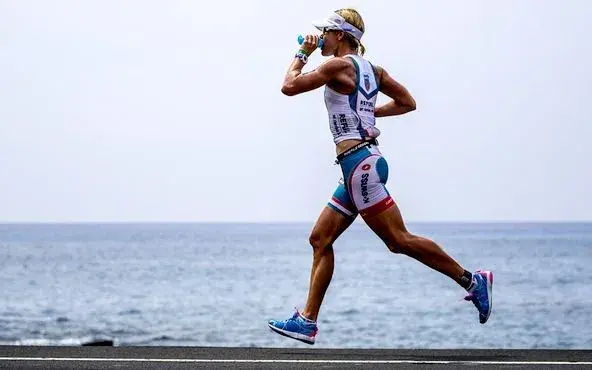
Mirinda Carfrae
The Unrelenting Pace
The Unrelenting Pace: How Mirinda Carfrae Ran Her Way into Triathlon Legend#
The Ghost on the Queen K#
The air on the Queen Ka’ahumanu Highway is a physical presence. It shimmers with heat, thick with humidity and the ghosts of past champions. On October 11, 2014, it was also thick with despair. As Mirinda “Rinny” Carfrae, the defending Ironman World Champion, dismounted her bike after a grueling 112-mile ride, the clock told a brutal story. The leader, a formidable Swiss rookie named Daniela Ryf, was 14 minutes and 30 seconds up the road. In the unforgiving mathematics of Ironman racing, this was an eternity. No woman had ever overcome such a deficit to win in Kona. Carfrae herself had told her coach, Siri Lindley, that anything over ten minutes would be "too much" to bridge. The chasm between her and the front was not just temporal, but psychological.
Yet, for those who had watched her career, this moment of apparent defeat was simply the stage being set. This was Carfrae's natural habitat: the chase. This was the ultimate test of her singular, defining characteristic—an unshakeable belief in her "weapon," a blistering run that had become the most feared in the sport, and an indomitable will forged on the farmlands of Australia. This article traces the journey of Mirinda Carfrae, from an unlikely start to becoming one of triathlon's greatest champions, a legend forged not just by her three Kona crowns, but by the relentless, record-breaking pace with which she hunted them down.
The Girl from the Lettuce Farm#
Mirinda Carfrae’s story does not begin on a manicured running track or in a chlorine-scented pool, but on a five-acre lettuce farm just south of Brisbane, Australia. Born on March 26, 1981, she was one of six children in what she describes as a "very working-class" family. Her early life was defined by a rustic grit, where she learned to be tough by trying to "keep up with my brothers on the farm," folding cartons, and weeding.
Her first athletic love was not triathlon, but basketball. Starting at age 7, the sport consumed her childhood, with weekends spent in stadiums where her mother managed teams for a local club she helped start. She played competitively until she was 16, but a fundamental conflict shadowed her passion. At 5'3", she was, in her words, "always a foot shorter than most of the other girls". As a point guard, her only viable position, she felt she lacked the confidence to truly "stand out in the crowd". This constant struggle against a physical limitation, however, was not a wasted endeavor. The role of an undersized point guard demands tenacity, court vision, and the ability to perform under immense pressure. It was here, on the basketball court, that the psychological bedrock of a future champion was laid. The need to overcompensate and fight for every inch forged a mental resilience that would become her trademark.
Triathlon entered her world by chance. After finishing high school, at age 19, she was doing strength training for the upcoming basketball season when a triathlon coach at the same center noticed her natural running ability. He approached her with a simple question: "You run really well, have you ever thought about being a triathlete?". Intrigued, Carfrae admitted she couldn't swim. The coach’s test was brief and seemingly definitive. She dove in, swam 25 meters, and looked up to see him shake his head and walk away. But for Carfrae, that dismissal was a spark. "Something inside of me was ignited," she recalled, "I was so excited about the possibility of this new challenge".
The transition was swift and decisive. Her basketball coach, though "heartbroken," recognized her potential and bought her first bike, an expense she couldn't afford as a "poor university student". She competed in her first race in late 1999 or early 2000 Incredibly, with no formal background in any of the three disciplines, she made the Australian Junior Elite Team the very next year in 2001. It was a moment she described as "so crazy," yet one that "just felt right, like I was on the right path". Basketball had provided the mental training, but triathlon was the arena where her physical gifts could finally flourish. It felt, to her, like destiny.
Forging the Weapon: The Apprentice Years (1999-2008)#
Carfrae’s ascent was rapid. From 2001 to 2005, she represented Australia in the highly competitive, draft-legal world of International Triathlon Union (ITU) racing, establishing herself as a world-class talent at the junior and U23 levels. She captured silver medals at the ITU U23 World Championships in both 2002 and 2003, proving she could compete with the best.
However, early signs suggested her true potential lay beyond the short-course format. In September 2002, she finished second at the Lake Tinaroo Half Ironman, setting a new run course record in the process. "I just remember feeling more comfortable racing the longer distance," she later wrote, "and from then I knew I would be racing full Ironman at some point in future". This feeling was validated by a victory at the prestigious Nice Long Course Triathlon in 2004 and a silver medal at the ITU Long Course World Championship in 2005.
The transition from ITU to long-course racing was more than a change in distance; it was a profound strategic shift. In the draft-legal format of ITU, powerful cyclists often have their advantage neutralized, leading to a large pack entering the final 10k run together. While Carfrae was an excellent runner, her advantage was diluted in a field of fleet-footed specialists. Long-course, non-draft racing presented a different tactical landscape—one where significant time gaps are created on the bike, forcing weaker cyclists to start the run with massive deficits. Carfrae astutely recognized that this format would weaponize her run. The larger the deficit she faced off the bike, the more devastating her running prowess would become.
The pivotal moment of this era came in 2007, when she stormed to victory at the Ironman 70.3 World Championship in a course-record time. This title was more than just a trophy; it "punched her first ever entry ticket to the Ironman World Championship in Kailua-Kona, Hawaii". What she did next revealed a maturity far beyond her years. Instead of rushing to the sport's hallowed ground, she deferred her entry for two years. "I waited until I felt I was physically and mentally strong enough not only to go the distance but to be seriously competitive," she explained. She would later call this calculated patience her "superpower". It was a decision that set the stage for one of the most dominant debuts in the sport's history.
The Kona Crucible: A Decade of Dominance (2009-2018)#
The Challenger (2009-2011) - The Wellington Era#
When Carfrae finally arrived on the Big Island in 2009, she was a "wide-eyed Ironman rookie" who was immediately swept up in the race-week frenzy and "heralded as the next great hope". The women's race at the time was ruled by one name: Chrissie Wellington, a British athlete who seemed utterly invincible. On race day, Wellington was once again dominant, winning by a staggering 19 minutes and 57 seconds and setting a new overall course record of 8:54:02. But behind her, Carfrae announced her arrival in spectacular fashion. In her first-ever Ironman, she finished second and, in a sign of things to come, shattered Wellington’s own marathon course record with a blistering 2:56:51 run. After the race, her ambition was clear: "It's possible [to beat Chrissie] – but it will take me a while".
The dynamic shifted dramatically in 2010. Just 30 minutes before the starting cannon, Wellington withdrew from the race due to illness. The sudden absence of the reigning champion, Carfrae admitted, "immediately placed more pressure on myself". After the swim and bike, she found herself over 11 minutes behind the leader, Julie Dibens. But on the run, she was untouchable. She unleashed another record-breaking marathon, clocking 2:53:32 to reel in Dibens and claim her first Ironman World Championship title with a final time of 8:58:36. The victory was a monumental achievement, though it came with the quiet asterisk of Wellington's absence.
That asterisk was erased in 2011 in what became one of the most legendary duels in Kona history. Wellington, battling through the pain of injuries from a bike crash just two weeks prior, was on the start line. Both women had subpar swims and came off the bike with significant deficits to the leaders, setting up a head-to-head footrace across the lava fields. Carfrae ran yet another new marathon record of 2:52:09, but an equally heroic Wellington dug deep to post a 2:52:41, holding on to win by a mere two minutes and 49 seconds. For Carfrae, the result was "heartbreaking," not just because of the loss, but because she felt she hadn't raced her best, yet was still within touching distance of "the greatest woman to ever race Ironman".
The Champion (2012-2014) - Forging a Legacy#
After a third-place finish in 2012 due to a nutritional misstep, Carfrae returned in 2013 with renewed focus, having reunited with her coach Siri Lindley mid-year. The result was nothing short of a masterpiece. Eight minutes down to leader Rachel Joyce off the bike, Carfrae produced what Ironman legend Mark Allen would later call "one of the greatest performances in any sport at any time". She flew through the marathon in a jaw-dropping 2:50:38. This was not only a new women's run record, but it was the third-fastest marathon of the entire day, including the professional men's field, and was faster than the run split of the men's champion, Frederik Van Lierde. Her overall finishing time of 8:52:14 finally shattered Wellington’s supposedly untouchable course record, exorcising the "ghost of the unbeatable" and cementing her own place atop the sport.
If 2013 was her masterpiece, 2014 was the performance that defined her legend. It was the race of the "impossible comeback." Facing the historic 14-minute, 30-second deficit to Daniela Ryf, Carfrae began the marathon with a singular, audacious focus. Mile after mile, she chipped away at the lead, a relentless hunter on the Queen K. The palpable tension grew as she picked off the seven women in front of her one by one. She flew past Rachel Joyce and, in the final agonizing miles, overtook Ryf to seize the lead. She crossed the finish line in 9:00:55, propelled by yet another new marathon course record of 2:50:26—a mark that would stand for nine years. This victory solidified her reputation as the sport's ultimate closer and fundamentally altered the calculus of how to win in Kona. She proved that a truly superlative run could overcome what were once considered insurmountable deficits, forcing her rivals to rethink their entire race strategy. As Rachel Joyce noted, when Carfrae is chasing you, "You feel a little powerless because the pace difference is so big".
The Pillar of Consistency#
The narrative of invincibility was broken in 2015. Just three days before the race, Carfrae was hit by a car while on a training ride. Though she started the race, the pain from her injuries forced her to withdraw during the bike leg, ending her remarkable podium streak. In hindsight, she reflected that the incident may have been a "blessing in disguise," as she had been feeling mentally fatigued. Her resilience, however, was on full display the following year. In 2016, she returned to form, battling her way back onto the podium with a hard-fought second-place finish, a testament to her incredible mental fortitude.
Table 1: Mirinda Carfrae's Ironman World Championship Results (2009-2018)
| Year | Final Position | Overall Time | Swim Split | Bike Split | Run Split | Notes |
|---|---|---|---|---|---|---|
| 2009 | 2nd | 9:13:59 | 0:58:45 | 5:14:18 | 2:56:51 | Debut; New Women's Run Record |
| 2010 | 1st | 8:58:36 | 0:55:53 | 5:04:59 | 2:53:32 | First Win; New Women's Run Record |
| 2011 | 2nd | 8:57:57 | 0:57:31 | 5:04:01 | 2:52:09 | New Women's Run Record |
| 2012 | 3rd | 9:21:41 | 1:00:05 | 5:12:18 | 3:05:05 | 9 |
| 2013 | 1st | 8:52:14 | 0:58:50 | 4:58:20 | 2:50:38 | New Overall Course & Run Record |
| 2014 | 1st | 9:00:55 | 1:00:14 | 5:05:48 | 2:50:26 | New Women's Run Record |
| 2015 | DNF | --- | 1:02:30 | --- | --- | Withdrew on bike due to injury |
| 2016 | 2nd | 9:10:30 | 0:56:44 | 5:10:54 | 2:58:20 | 9 |
| 2018 | 5th | 8:50:45 | 0:58:18 | 4:46:05 | 3:01:41 | Post-Partum Return |
The Heart of a Champion: Life Beyond the Finish Line#
Partners in Power & The Coaching Carousel#
Off the course, Carfrae's life became intertwined with the sport in profound ways. In 2009, she met fellow professional triathlete Timothy O'Donnell, and the two would become one of the sport's most beloved power couples. Their shared focus on Kona created a unique household dynamic, and for Carfrae, triathlon truly "gave me my life," including her husband and family.
Equally pivotal was her complex and highly successful coaching relationship with Siri Lindley. A former world champion herself, Lindley recognized Carfrae's raw talent early on and guided her to her first world titles. Their partnership was built on a deep mutual respect and Lindley's passionate, all-in coaching style. However, in 2012, they parted ways. Carfrae sought "new input" and felt she had outgrown the need for immersive training camps, while Lindley preferred a more hands-on approach that geography made difficult. The split was temporary. In mid-2013, Carfrae returned "home" to Lindley's coaching, a reunion that immediately preceded her record-shattering victory in Kona that year, highlighting the powerful synergy between them.
The Motherhood Metamorphosis#
After the 2016 season, Carfrae embarked on a new chapter, taking a year off from racing to start a family. Her daughter, Isabelle ("Izzy"), was born in August 2017 The break was a "welcome adjustment" after 15 years of relentless training schedules. Her return to the sport in 2018 was remarkable. She finished second at Ironman 70.3 Texas in her first race back, a result that surprised even her. That October, just 14 months after giving birth, she finished an incredible 5th at the Ironman World Championship.
Motherhood did not diminish her competitive drive; it refined it. Her motivation, once centered on the internal quest of "seeing what my body is capable of," evolved. She spoke of a profound identity shift: "that was Mirinda Carfrey. now I'm Izzy's mom... the pressure's off but also the pressure's on what can Izzy's mom do". The pain of childbirth, she noted, provided a new psychological benchmark for toughness, making the suffering in a race more manageable and making her "mentally stronger". Her new goal was to "stand on top of the podium being a mom as well as a triathlete". For Carfrae, the so-called "motherhood penalty" became a source of strength, fueling one of the most impressive comebacks of her career.
The Enduring Legacy#
After more than two decades in the sport, Mirinda Carfrae officially announced her retirement in March 2023 The decision solidified while she was in Kona in 2022, supporting her husband. As a spectator, she watched the women's race and had a moment of clarity: "this was amazing but I'm okay with it being over". Her heart, she explained, was no longer fully in the all-consuming demands of professional racing; it was being pulled toward her growing family.
Her legacy is etched in the record books: three Ironman World Championships, one Ironman 70.3 World Championship, seven Kona podiums, and a run record that stood for nearly a decade. But her impact transcends statistics. She was an "icon" who, with her grit and gracious personality, brought new fans to the sport. Her rival and fellow legend Chrissie Wellington offered a powerful tribute: "Thank you so much for racing with such drive, strength, passion, determination and integrity. You brought out the best in me".
Carfrae has not stepped away from the sport she loves. She has seamlessly transitioned into a new chapter as a coach with the TriDot platform and the "Salty Bears" team she co-founded with O'Donnell, an IRONMAN ambassador, and a color commentator for race broadcasts. Her coaching philosophy reflects the wisdom gained over her career, aiming to "coach the whole person – the human being".
The enduring image of Mirinda Carfrae will always be that of a diminutive figure flying along the Queen K Highway, relentlessly closing the gap, running down her rivals and her own limitations. Her career was a masterclass in the power of relentless forward motion—a testament not just to how to win, but to the art of the chase.