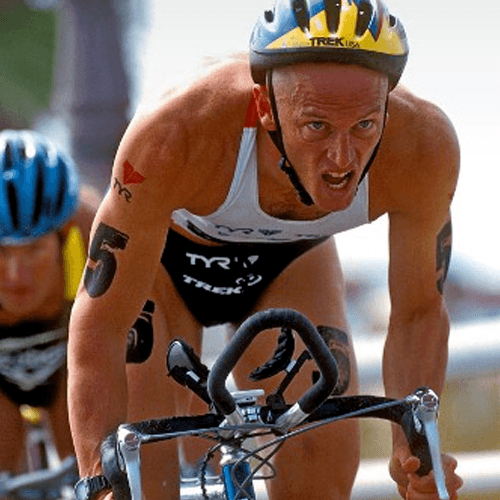
Mike Pigg
Pigg Power
Pigg Power: The Unbreakable Will of the Man Who Changed Triathlon#
The Caribbean sun beat down on St. Croix with unrelenting force, turning the air into a shimmering, suffocating blanket. On the punishing hills of the bike course, one climb stood apart, a stretch of paved road so steep it was known simply and ominously as "the beast," a place that "made grown men cry". For the athletes competing in the inaugural International Triathlon Union (ITU) World Cup in 1991, this was a race defined by suffering. And at the front of the pack, a man who had built a career on his unique capacity for pain was locked in a desperate, lung-searing battle.
Mike Pigg, his face a mask of raw effort, was trading blows with the very royalty of the sport. On one side was Australia's Greg Welch, the reigning 1990 ITU World Champion. On the other, American Mark Allen, the 1989 champion and a man already on his way to becoming a legend. As they thundered towards the finish line, after a brutal 2-kilometer swim, 50-kilometer bike, and 12-kilometer run, the race came down to a final, agonizing sprint. In those last 400 yards, Pigg dug into a reservoir of grit that seemed bottomless, slipping past Welch at the line to win by a single, gasping second.
It was a historic moment, the birth of the ITU World Cup circuit, but it was also the perfect encapsulation of a career. Here was Mike Pigg, an athlete forged not in the polished academies of sport but in the rugged backwoods of Northern California, once again taking on the world's best and winning not with elegant form or god-given speed, but through sheer, unadulterated will. This was "Pigg Power" in its purest form. He was, as fellow professional Chris McCormack ("Macca") would later attest, "the most hard-core racer the sport had ever seen," an athlete who won races out of "sheer heart". The question that echoed from the hills of St. Croix back to the misty roads of his hometown was a simple one: How did a self-described "unspectacular athlete" from McKinleyville, California, become the relentless force who broke the iron grip of triathlon's "Big Four" and forever changed the evolution of the sport?.5
The Humboldt County Crucible#
The story of Mike Pigg does not begin in a hothouse of athletic prodigies but in the quiet, blue-collar community of Arcata, California. His journey into sport was unassuming. At age 10, it was his father, Ervyl Pigg, the former mayor of Arcata and a key figure in getting the Arcata Community Pool built, who persuaded him to join the Mad River Swim Club. At Arcata High, he was a solid, if not spectacular, athlete, running cross-country and track and even playing basketball. He was, by his own admission, an "unspectacular athlete" as a youth, showing flashes of talent in distance running but never appearing destined for the global stage.
The transformation, the unlocking of the world-class engine within, began with a decision born of practicality. While studying engineering at the College of the Redwoods, Pigg started riding his bicycle to and from campus, a 17-mile journey each way. This was no leisurely commute. For Pigg, it became a private laboratory of pain and performance. He pushed himself relentlessly, turning the trip through Eureka into a daily time trial, eventually clocking a blistering 45-minute time, including navigating stoplights. It was on these lonely rides that he discovered his "silver bullet": an immense, raw power on the bike and an even greater capacity to suffer.
The final piece of the puzzle clicked into place in 1983. Watching a television broadcast of the Hawaii Ironman, Pigg saw Dave Scott conquering the lava fields and was captivated. The grueling nature of the event resonated with the high-energy, hard-working personality he was cultivating on his daily commutes. At the age of 21, he made the fateful decision to leave college and dedicate himself to training for the 1985 Ironman, launching a professional career that would span 17 years.
His training ground, Humboldt County, became his greatest asset. In an era when elite triathletes were congregating in hubs like Boulder and San Diego, Pigg remained rooted in the rugged landscape that had shaped him. He described it as a "great place for a triathlete to train," citing the clean air, hilly terrain, and quiet back roads. But the true advantage ran deeper than geography. As
Inside Triathlon writer Timothy Carlson noted, Pigg’s home court was his "secret weapon," a "briar patch" where he developed an "unbelievable training regimen that would wear anybody else out". The relative isolation of Humboldt County demanded a profound level of self-reliance and internal motivation. Without a large group of fellow pros to push him daily, Pigg had to become his own benchmark, his own rival. This environment cultivated the "ravenous appetite for hard work" that would become his trademark and forged a mental toughness that was perhaps unparalleled in the sport. He was an outsider, a product of his environment, and when he finally descended from his Northern California crucible onto the professional circuit, he was unlike anyone they had ever seen.
The Arrival: Unleashing Pigg Power#
Mike Pigg did not ease his way into the professional triathlon scene; he exploded onto it. His 1985 debut at the Hawaii Ironman, the very race that had inspired him just two years prior, was a statement of intent. He finished 7th overall, an astonishing result for a rookie in the sport's most grueling event. That same year, he announced his presence on the shorter-course circuit with a third-place finish at the Bud Light U.S. Triathlon Series (USTS) race in Livermore, California, officially putting the sport's elite on notice.
What truly set Pigg apart was not just his results, but how he achieved them. He brought a new and brutal tactical philosophy to the sport. At the time, the triathlon world was dominated by the "Big Four," a quartet of legends who were, in Mark Allen's words, "pretty fast but steady". Their races were often strategic affairs, with athletes pacing themselves on the swim and bike before unleashing their running prowess to decide the outcome. Pigg shattered that paradigm. His strategy was simple and savage: attack the bike with everything he had. He would "red-line" from the start of the second leg, aiming to build an insurmountable lead and then simply hang on during the run, fighting tenaciously to defend his advantage. The bike, he said, "was my silver bullet... The wider the road the more damage I could do".
Mark Allen recognized the shift immediately. "Mike started a whole different evolution of the sport," he recalled. Pigg’s approach was more than just a personal style; it was an evolutionary pressure that fundamentally altered the competitive landscape. He forced the sport to become faster, more aggressive, and more demanding from start to finish. The era's best runners could no longer afford to simply be competent cyclists; Pigg's relentless attacks meant they had to elevate their biking just to stay in the race. He was a catalyst, a disruptive force who didn't just join the elite ranks—he redefined the very meaning of what it took to be elite.
This raw, aggressive style, combined with his blue-collar work ethic, resonated deeply with fans. He was relatable, seen as "the Arnold Palmer of the sport" for his all-out charging style and connection with the people. This appeal was perfectly captured by the grassroots branding of "Pigg Power." His family would attend races wearing pink "Pigg Power" T-shirts, and he famously emblazoned the slogan on the disc wheels of his bike. It was an authentic reflection of his identity, a rallying cry for an athlete who was rewriting the rules of triathlon through pure force of will.
The Big Fifth: Toppling the Titans of Triathlon#
In the mid-1980s, the world of triathlon was a kingdom ruled by four men: Dave Scott, Mark Allen, Scott Tinley, and Scott Molina. They were known collectively as the "Big Four," an untouchable dynasty that had won seven Ironman World Championships, five Nice Championships, and every USTS National Championship through 1986. They had created an aura of invincibility. Then came Mike Pigg, the "Big Fifth," a man on a mission to "knock off the big four one at a time".
His rise was methodical. He first targeted the USTS circuit, the domain of Scott Molina, a man nicknamed "The Terminator" for his dominance. Pigg steadily chipped away at his reign, with results like a third-place finish behind Molina and Tinley at the 1986 Chicago USTS race signaling his ascent. In time, Pigg would displace Molina as the "king of the USTS Series," a title Molina himself acknowledged.
The intensity of the era was palpable. The 1987 Bermuda Triathlon offered a raw, unfiltered glimpse into the ferocity of these rivalries. Video from the race shows Pigg, Allen, and a precocious 15-year-old Lance Armstrong battling on the bike. The footage is a chaotic symphony of aggression: Pigg yelling at Armstrong for his lane positioning, Armstrong yelling at a media motorcycle to get out of the way, and all of them pushing the limits of the era's loosely defined drafting rules. It was a white-knuckle style of racing, and Pigg was its fiercest practitioner.
The culmination of his quest came at the 1987 USA Pro Nationals in Hilton Head, where he faced the last of the Big Four on his list: Mark Allen. True to form, Pigg built a two-minute lead on the bike. But Allen, one of the greatest runners the sport has ever known, began to hunt him down on the 10k run, erasing a staggering 2 minutes and 30 seconds from the deficit. With half a mile to go, Allen was just 100 yards behind. It was a moment that would have broken most athletes, but Pigg was not most athletes. He "sucked it up," found another gear, and held off the charging legend in a desperate sprint to the finish. It was, Pigg would later say, "one of my biggest grunts ever holding him off at the finish line". The reign of the Big Four was officially over. A new power had arrived.
| Table 1: Mike Pigg: A Legacy of Dominance |
|---|
| Achievement |
| USA Triathlon Hall of Fame |
| ITU World Cup Champion |
| U.S. National Champion |
| USOC Male Triathlete of the Year |
| Ironman World Championship |
| Major Race Victories |
| U.S. Triathlon Series (USTS) |
| Humboldt County Athlete of the Century |
The Pinnacle and The Pain#
Having established himself as a dominant force, Mike Pigg entered the early 1990s at the absolute zenith of his powers. His historic victory at the 1991 St. Croix ITU World Cup was more than just a win; it was a career-defining moment. With a hefty prize purse, a national television audience on ESPN, and a field stacked with the world's best, the race represented a new level of professionalism for the sport. For Pigg, it was one of his "biggest highs," a validation of his status on the global stage. He continued this run of form, being named Triathlete of the Year in both 1988 and 1991 and winning two more ITU World Cups in 1993, cementing his reputation as the world's most consistent and feared competitor.
Yet, for all his dominance in Olympic-distance racing, one prize remained tantalizingly out of reach: the Ironman World Championship in Hawaii. For five consecutive years, from 1985 to 1989, Pigg threw himself at the unforgiving Kona course. His results showed a steady, determined progression: 7th in 1985, 9th in 1986, 4th in 1987, and finally, a heartbreakingly close 2nd place in 1988. That year, he finished behind his great USTS rival, Scott Molina, despite a monumental 4:37:44 bike split that showcased his incredible power. He was on the cusp of conquering triathlon's greatest challenge.
And then, his body, the very instrument of his success, began to betray him. After his 1988 peak, he contracted a severe stomach bacteria that crippled his ability to digest food during races. For an endurance athlete, it was a catastrophic failure of the internal engine. The issue plagued him for four to five years, effectively sabotaging any chance he had of performing at his best in an event as demanding as Ironman. Later in his career, he suffered another devastating blow: a broken foot that required two separate casts after he tried to come back too soon from the initial surgery. The injury sidelined him completely, forcing the constant competitor into the agonizing role of a spectator, an "emotional prison" for a man who validated his existence through racing.
There is a tragic irony to Pigg's Ironman story. His greatest weapon was his unparalleled ability to suffer, to push his body to its absolute physiological limit day after day, year after year. This relentless "red-lining" forged him into a champion. However, that same constant, extreme stress places an enormous strain on the body's immune and digestive systems. While his upward trajectory at Kona proved he was physically and tactically ready to win, the internal breakdown he suffered was not a typical overuse injury of muscle or bone. It was a systemic failure. It is plausible that the very process that made him powerful also made him vulnerable. The engine of his success may have created the conditions for the invisible enemy within to take hold, robbing him of his ultimate goal. He was not beaten by a rival on the lava fields, but by a rebellion of the very body he had pushed to legendary heights.
The Man Behind the Machine#
To understand Mike Pigg's dominance is to understand a mindset in which competition was not an event, but a constant state of being. His peers' anecdotes paint a portrait of a man for whom everything was a contest. Fellow Hall of Famer Scott Tinley recalled how Pigg would turn the most mundane activities into a challenge, from seeing who could get served coffee first to a casual effort at home beer brewing becoming a "serious competitive venture". Triathlete Jimmy Riccitello famously observed Pigg working up a sweat just eating a massive bowl of spaghetti, "little beads dripping off his forehead," a testament to a metabolism that was always firing on all cylinders.
This intensity was most evident in his approach to training. His peak weeks were staggering in their volume: 225 to 300 miles on the bike, 30 to 50 miles of running, and 15,000 to 25,000 yards in the pool. For his rivals, training with him was a brutal experience. "He was extremely competitive," said Mark Allen, who trained with Pigg in Colorado. "Even in training, I felt I was in a competition. Training with some guys you could have a bad day. With Pigg there was never an option to have a bad day".
Yet, Pigg was more than just a brute-force athlete; he was intelligent and adaptable. After the health issues that derailed his Ironman ambitions, he recognized the need for a change. He moved away from his high-carbohydrate diet, where he engaged in "pasta-eating contests" and downed 6,000 calories a day, which left him feeling bloated and lethargic. He began working with kinesiologist Philip Maffetone and adopted a diet that balanced macronutrients in a 40% carbohydrate, 30% protein, 30% fat ratio, similar to the Zone Diet. The change was transformative. Within months, Pigg was breaking course records, feeling more energetic, and burning fat more efficiently. This willingness to embrace new science was key to his longevity and late-career success.
His perspective on the sport's evolution is equally insightful. He was a product of the non-drafting era, where individual strength on the bike was paramount. He acknowledged that the introduction of draft-legal racing in the Olympic distance fundamentally changed the dynamic of the sport. In a moment of candid self-assessment, he admitted, "If you allow drafting then I would get my butt kicked... I could bike but I struggled in the run, if no drafting was the rule, I would do just fine". This honest reflection not only provides a fascinating window into the sport's tactical shifts but also underscores the unique and singular nature of his own non-drafting prowess.
A Champion's Legacy#
On September 15, 2001, after completing a race at Pacific Grove near Monterey, Mike Pigg, then 37, called an end to his remarkable 17-year professional career. The decision was a pragmatic one. "Sponsorship was going backwards, kids were coming in," he explained. "The tunnel was getting narrower and narrower. Time to get out". The birth of his twins, Triston and Chloe, also marked a natural shift in his priorities away from the relentless demands of the pro circuit.
While many elite athletes leverage their fame into high-profile global careers as coaches or commentators, Pigg's path after retirement led him back to where it all began: Humboldt County. His post-career life has been a testament to the blue-collar ethos that defined him as an athlete. He has poured his energy back into the community that forged him, serving as the race director for a local youth triathlon, coaching cross-country and track for grades K through 8, and even serving a term as the chair of the county school board. These choices reveal that his identity as a hard-working, community-oriented individual was not a persona, but his core truth. His definition of a meaningful life was grounded not in the continuation of fame, but in grassroots service.
The sport, however, did not forget its great disruptor. In December 1999, his hometown paper, the Times-Standard, named him the North Coast Athlete of the Century, placing him atop a list of the region's 100 greatest athletes. The ultimate honor came in 2014, when he was inducted into the USA Triathlon Hall of Fame, his place among the legends of the sport officially enshrined.
Mike Pigg's legacy is etched in the evolution of triathlon itself. He was the "Big Fifth," the indomitable force from the north who single-handedly broke the stranglehold of a dynasty. His aggressive, bike-first strategy forced an entire generation of athletes to become stronger, faster, and more complete. He was a champion whose success was born not from innate, untouchable talent, but from a "ravenous appetite for hard work" and an unbreakable will. His journey from an "unspectacular" kid on a bike in Arcata to a Hall of Fame icon is a testament to the power of grit and determination. Yet, his most enduring impact may be the one he is having now, far from the cameras and finish lines, investing in the next generation in the very community that gave the world "Pigg Power."