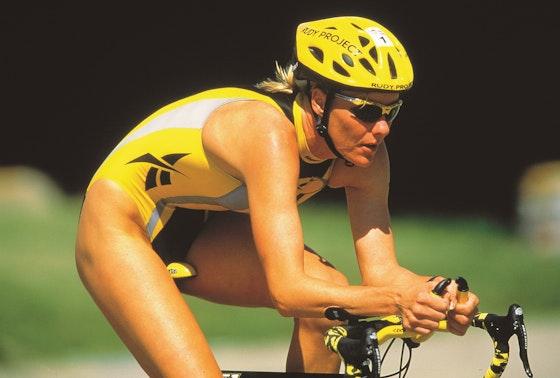
Michellie Jones
The Unconquerable.
The Unconquerable: Michellie Jones and the Art of Redefining Victory#
Introduction: The Complete Triathlete#
There are three finish lines that define the singular career of Michellie Jones. The first is set against the sun-drenched, iconic sails of the Sydney Opera House in 2000, a roaring home crowd witnessing the brutal culmination of triathlon’s Olympic debut. The second lies on the scorched black lava fields of Kailua-Kona, Hawaii, in 2006, the mythical endpoint of sport’s most torturous single-day event, the Ironman World Championship. The third is on the vibrant blue carpet of Fort Copacabana in Rio de Janeiro in 2016, a finish line crossed not for personal glory, but in perfect, tethered synchronicity with another athlete, securing Paralympic gold.
Olympic silver, Ironman gold, Paralympic gold. Each represents the absolute pinnacle of a distinct endurance discipline. That they were all achieved by the same athlete is not just remarkable; it is an anomaly in the world of modern, hyper-specialized sport. Michellie Jones’s career is a sprawling, three-decade epic that has seen her conquer every conceivable format and distance the sport of triathlon has to offer. She has won on the road and off it, in short-course sprints and grueling ultra-endurance marathons, for herself and for others.
Her journey poses a fundamental question about the nature of athletic greatness. In an era that rewards specialization, how did one woman achieve such unparalleled success across every landscape of her sport? The answer lies beyond her staggering list of 175 professional victories or her collection of hall of fame inductions. It is a story of profound adaptability, of a resilience forged not in a high-performance institute but in the dusty paddocks of rural Australia, and of a character that allowed her to redefine the very meaning of victory, not just once, but three times over. This is the story of the complete triathlete.
Part I: The Horse Rider from the Bush#
The foundations of Michellie Jones’s unconquerable spirit were laid long before she ever swam, biked, or ran in competition. Born on September 6, 1969, in Fairfield, New South Wales, she grew up with her twin sister, Gabrielle, in the small country town of Thirlmere. Her childhood was not one of structured athletic development but of rugged outdoor adventure, defined by two powerful, formative influences: her mother and her horses.
Raised by a mother who single-handedly brought up four daughters, Jones witnessed a daily masterclass in resilience and dedication. This environment instilled a deep-seated understanding that determination and hard work were the non-negotiable tools for overcoming any obstacle. It was a lesson in grit learned at the kitchen table, not on a running track. Her other classroom was the stable. Jones’s first competitive passion was equestrianism, a demanding discipline that requires a unique blend of patience, physical strength, and an unwavering work ethic. The daily, often unglamorous, routine of caring for and riding her horses from dawn forged a tolerance for monotony and a capacity for consistent effort that would become the bedrock of her endurance career. This was not a pathway designed by a sporting federation; it was a character forged by circumstance and passion.
While an innate athletic engine was always present—she was a state cross-country champion and had been identified for her talent in race walking—it lacked the right vehicle. The catalyst arrived in 1988, in the form of a simple suggestion from her high school running coach: she should try a triathlon. For Jones, for whom the variety of the three disciplines immediately appealed, it was a revelation. "Even today," she says, "the best part of the sport is that just when you start getting sick of swimming, you get to ride, and just when you get tired of riding, you get to run". This mindset, one that thrives on new challenges, was the key that unlocked her future. Her coach’s belief was a powerful motivating force, captured in his playful words, "Will you remember me when you're famous?". That simple question underscored a belief in her potential that helped fuel a journey no one could have predicted.
Part II: A Decade of Dominance#
Michellie Jones’s entry into the world of professional triathlon in 1990 was not a slow burn; it was an explosion. Within two years of her debut at the ITU World Championship, she had ascended to the absolute pinnacle of the sport, establishing a decade of dominance in short-course racing that remains a benchmark for sustained excellence.
Her breakthrough came with a resounding victory at the 1992 ITU World Championship in Huntsville, with a follow-up win in Manchester in 1993 to claim back-to-back world titles. These victories were not just wins; they were a declaration. Jones was the best in the world, a force defined by a relentless consistency that saw her stand on the ITU World Championship podium a record eight times between 1991 and 2003—collecting two gold, two silver, and four bronze medals in total. Her supremacy extended to the World Cup circuit, where she amassed twelve victories and claimed the overall series championship in both 1998 and 1999. She was equally formidable in the classic non-drafting races of the era, winning the grueling Escape from Alcatraz eight times and the prestigious Chicago Triathlon seven times.
Yet, the most telling indicator of her unique athletic DNA emerged in 1996. While at the peak of her road-based powers, Jones ventured into the rugged, nascent world of off-road triathlon and won the inaugural XTERRA World Championship. This victory, involving a rough open-water swim, a technical mountain bike course, and a punishing trail run, was far more than just another title. It was the foundational proof of her extraordinary adaptability. In an era where athletes typically specialized, Jones demonstrated an innate ability to master any format. This willingness to test herself in a completely different and technically demanding discipline was not a late-career pivot; it was an early and definitive statement of her versatility. The blueprint for a career defined by conquering new frontiers was laid down not in the 2000s, but in the mud and grit of Maui in 1996.
Part III: The Two Seconds in Sydney#
On September 16, 2000, the sport of triathlon stepped onto the world’s biggest stage for the first time, and it did so in Michellie Jones’s backyard. The inaugural Olympic triathlon at the Sydney Games was a moment of immense national pride and crushing personal pressure. As a world champion and a key member of the heavily favored Australian team, Jones carried the hopes of a nation on her shoulders. The atmosphere was, in her words, "phenomenal" and "electric". The emotion of the moment was overwhelming; she recalls crying as she was announced to the massive crowd lining the harbor, a raw acknowledgment of the stakes.
What unfolded was one of the most dramatic finishes in Olympic history. After a grueling 1.5 km swim, 40 km bike ride, and 10 km run, the race came down to a head-to-head battle between Jones and Switzerland’s Brigitte McMahon. In the final, agonizing meters, with the Sydney Opera House as a backdrop, McMahon summoned a final sprint to edge out Jones at the line. The margin of victory was a mere 2.03 seconds. Jones crossed the line in a time of 2:00:42., her split times a testament to a complete performance: 19:43.88 for the swim, 1:05:32. for the cycle, and 35:25.77 for the run.
For many athletes, losing a gold medal by such a slender margin in a home Olympics would be a source of lifelong regret. Yet, Jones’s reaction revealed the core of her psychological strength. She has consistently stated that she was never disappointed, viewing the result with a grace and perspective that is as impressive as the performance itself. "I believe my destiny was silver and not the Gold," she reflected, "and I walked away know I did everything I could on the day". This ability to positively reframe a near-miss into a proud achievement is remarkable on its own. It becomes almost superhuman when considering a fact she rarely mentions: she competed in the biggest race of her life with a broken hip.
That performance in Sydney was more than just a race for a medal; it was the psychological crucible that forged the mindset required for her next great challenge. To perform at that level under immense pressure, while managing a significant injury, and to then process the heart-wrenching result with such equanimity, demonstrated an elite capacity for mental fortitude. Ironman racing, the sport’s ultimate test of endurance, is won and lost not just in the legs and lungs, but in the mind’s ability to manage suffering and overcome dark moments for hours on end. The two seconds in Sydney, while denying her a gold medal, conditioned her with the psychological architecture she would need to endure the agony of the Ironman and conquer its greatest prize.
Part IV: The Queen of Kona#
The disappointment of being overlooked for the 2004 Athens Olympic team, despite winning the test event, could have marked the end of a celebrated career. For Michellie Jones, it was merely the catalyst for her most audacious reinvention. She channeled her frustration into conquering the one discipline she had famously sworn she would never attempt: the Ironman. Her transition to the grueling 2.4-mile swim, 112-mile bike, and 26.2-mile run was not just successful; it was shockingly swift and utterly dominant.
In 2004, she won Ironman Florida in her very first attempt at the distance, signaling her immediate aptitude for long-course racing. The following year, in only her second Ironman, she arrived at the sport’s Mecca—the World Championship in Kona. Despite racing with a broken hip sustained in her preparation, she delivered a stunning performance, finishing second to the legendary six-time champion Natascha Badmann. It was a heroic debut that put the entire long-distance world on notice.
In 2006, she returned to the Big Island of Hawaii not just to compete, but to conquer. In a masterful performance, she dethroned Badmann and crossed the finish line in 9:18:31 to become the Ironman World Champion. At 36 years old, she was, at the time, the oldest first-time winner in the race’s history. The victory was a landmark moment for her nation; she became the first Australian woman ever to win in Kona and only the second Australian overall, following in the footsteps of her fellow Hall of Famer Greg Welch.
Her rapid mastery of the Ironman distance was not simply a product of mental toughness. It was a strategic disruption. The world of long-course racing had long been dominated by "diesel engines"—athletes who built their careers on steady, grinding endurance. Jones arrived with a different weapon: a world-class, high-octane "speed engine" forged over a decade of intense, Olympic-distance racing. Her success demonstrated a new paradigm: it was more efficient to add endurance to a foundation of superior speed than it was for a pure endurance athlete to develop world-class pace. She didn't just adapt to the Ironman; she weaponized her short-course pedigree to overwhelm it, providing a new blueprint for how athletes could transition and dominate across the sport's different worlds.
Part V: A Different Kind of Gold#
After conquering the highest peaks of individual achievement, Michellie Jones discovered her career’s most profound purpose not in winning for herself, but in enabling another to win. Her final, and perhaps greatest, chapter began with a chance introduction to the world of Para-triathlon in 2014 The following year, Australian Para-triathlon head coach Corey Bacon asked her to take on a new role: to serve as the guide for Katie Kelly, a visually impaired athlete diagnosed with Usher syndrome.
The partnership was electric from the start. Having met in person just four days before their first race together in Yokohama, Japan, in May 2015, they won. Their synergy was undeniable, and they quickly became a dominant force, winning the 2015 ITU World Championship in Chicago to secure a spot for Australia at the 2016 Rio Paralympic Games, where Para-triathlon would make its historic debut.
In Rio, on the shores of Fort Copacabana, they delivered a flawless performance. Tethered together in the swim and run, and working in perfect unison on a tandem bicycle, Jones guided Kelly to a resounding victory. They won the gold medal in the PT5 category with a time of 1:12:18, more than a minute clear of their nearest competitors, securing Australia’s first-ever Para-triathlon Paralympic medal. The win made Jones one of a rare few athletes in history to have won medals at both the Olympic and Paralympic Games.
But it is Jones’s reflection on the victory that elevates it beyond a mere athletic achievement. When asked to compare the feeling to her own Olympic silver medal, her response was unequivocal and deeply moving. "Oh, this is better," she stated. "This is so much better because when I think of everything KK (Katie Kelly) has been through... to me this is the best thing that I've ever done". This powerful statement reveals the final, most meaningful evolution in her athletic journey. The role of a guide is the antithesis of an elite competitor; it requires the complete sublimation of one's own ego and race instincts to serve the needs of another. In finding a deeper, more profound sense of victory in shared success than she ever did in individual glory, Jones completed her character arc. Having conquered every mountain for herself, the only frontier left was to help someone else conquer theirs. This selfless act provided the emotional and philosophical capstone to her career, proving that her greatest legacy might not be the medals she won, but the one she helped another to win.
Part VI: The Coach's Wisdom and Enduring Legacy#
Michellie Jones’s enduring impact on triathlon now extends far beyond the finish line. Her transition into coaching was not a retirement plan but a natural continuation of her life’s work, seamlessly blending her decades of elite experience with an innate passion for teaching. A graduate of the University of Wollongong with a Diploma of Teaching, she views coaching as a direct extension of education, driven by a desire to help others set goals and realize their potential. Her coaching philosophy is not a theoretical model; it is a living codification of the hard-won lessons from her own journey.
Her core principles reflect the cornerstones of her success. She preaches consistency over perfection, a belief forged through a 20-year career that saw her stand on a world championship podium eight times. She advocates for
focusing on an athlete's strengths rather than obsessing over weaknesses, a strategy that mirrors her own ability to weaponize her speed in the Ironman. Crucially, she understands that performance barriers are often emotional, not just physical, and her coaching addresses the whole athlete. Her personal motto, "Dream it… Believe it… Live it!", is not just a catchphrase but the very essence of her career.
Today, her legacy is a continuous loop of experience informing mentorship. She remains deeply embedded in the sport as a coach for her own Giddy Up Multisports team, as the head coach for the University of California San Diego Triton triathlon team, and as an IRONMAN U Certified Coach. She continues to race in age-group events, not to prove anything, but out of a pure, unadulterated love for the sport and its community, qualifying for world championships on merit just like every other athlete.
The official accolades serve as the punctuation marks on her storied career. She was an inaugural inductee into the Triathlon Australia Hall of Fame in 2009 and followed that with inductions into the Sport Australia Hall of Fame in 2014 and the ITU Hall of Fame. In 2017, her significant service to the sport was recognized nationally when she was made a Member of the Order of Australia (AM). These honors immortalize her achievements, but her true, living legacy is found on pool decks, bike paths, and running tracks around the world, where the lessons from one of the sport's greatest champions continue to shape its future.
Michellie Jones: A Career of Unmatched Versatility#
| Year | Event | Discipline | Result | Significance |
|---|---|---|---|---|
| 1992 | ITU World Championship | Short-Course | Gold | First major world title. |
| 1993 | ITU World Championship | Short-Course | Gold | Confirmed dominance; back-to-back champion. |
| 1996 | XTERRA World Championship | Off-Road | Gold | Won the inaugural event, proving early versatility. |
| 1998 | ITU World Cup Series | Short-Course | Champion | Season-long consistency against the world's best. |
| 1999 | ITU World Cup Series | Short-Course | Champion | Back-to-back World Cup series winner. |
| 2000 | Sydney Olympic Games | Short-Course | Silver | Historic medal in triathlon's Olympic debut on home soil. |
| 2006 | Ironman World Championship | Long-Course | Gold | First Australian woman to win; conquered the sport's most iconic race. |
| 2016 | Rio Paralympic Games | Para-triathlon (Guide) | Gold | Guided Katie Kelly to victory; an achievement she calls her greatest. |
Conclusion: A Legacy Forged in Every Arena#
To trace the arc of Michellie Jones’s career is to witness an athlete in constant, brilliant evolution. The journey from the horse-crazy girl in the Australian bush to a global icon is remarkable enough. But to have triumphed in every arena the sport has to offer—from the explosive speed of World Championships to the rugged demands of XTERRA, from the searing pressure of the Olympics to the soul-crushing distance of the Ironman—places her in a category of her own.
Her legacy, however, is not defined merely by the unparalleled breadth of her victories. It is defined by her unique capacity to adapt, to endure, and, most importantly, to find new meaning in the act of competition. She showed the world how to win with power and consistency, how to accept a near-miss with grace, how to channel disappointment into reinvention, and finally, how to find the ultimate victory in the success of another. Michellie Jones did not just master one sport; she mastered the art of being a complete athlete, leaving an indelible mark as one of the most versatile, resilient, and inspiring champions of her generation.