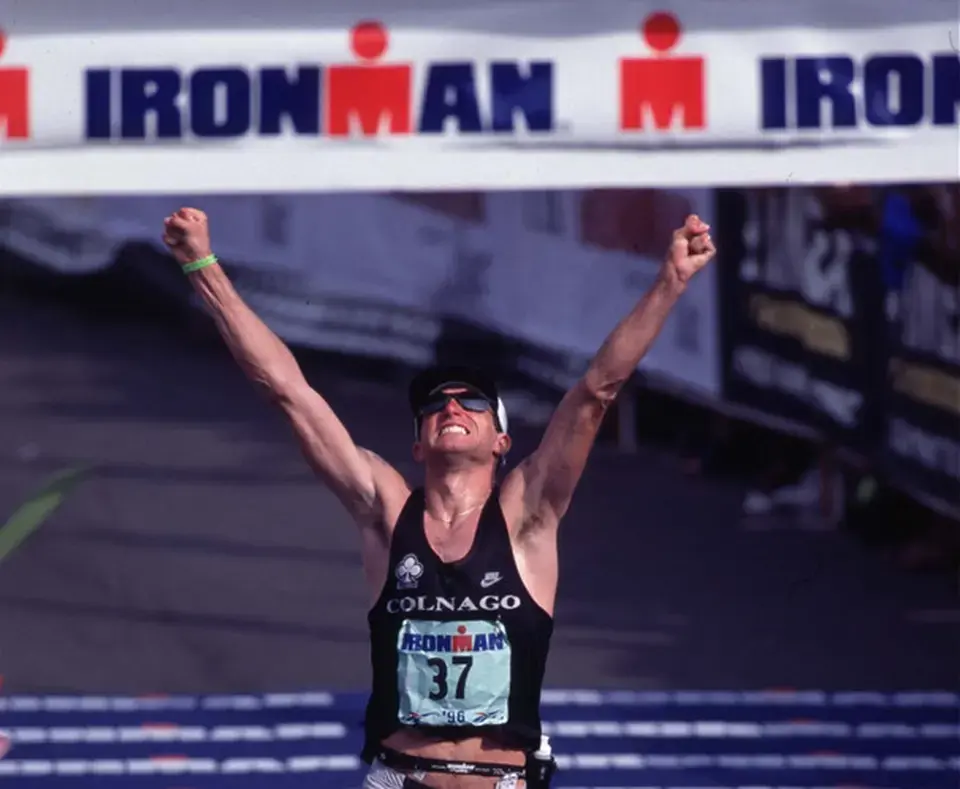
Luc van Lierde
The Flemish Arrow: The Revolutionary Reign of Luc van Lierde.
The Flemish Arrow: The Revolutionary Reign of Luc van Lierde#
Introduction: The Day the Sport Changed#
The air on the Queen Ka’ahumanu Highway is a physical presence. It shimmers above the blacktop, a suffocating blanket of heat and humidity woven from Pacific salt and volcanic rock. For years, this desolate stretch of road in Kailua-Kona, Hawaii, was the exclusive dominion of American titans. The Ironman World Championship, a brutal test of endurance involving a 3.8 km swim, a 180 km bike ride, and a 42.2 km marathon, was their kingdom. Names like Dave Scott and Mark Allen were etched into the lava fields, their six victories apiece forming a dynasty that seemed unbreakable. The sport, born in the USA, was dominated by it.
Then came October 26, 1996.
Out on the course, a relatively unknown Belgian named Luc Van Lierde was methodically dismantling that dynasty. To the American-centric triathlon world, he was a ghost, a "rookie" who had never before attempted the Ironman distance, let alone run a full marathon. He rode not a futuristic, wind-tunnel-tested triathlon machine, but a classic steel Colnago road bike, distinguished only by a set of clip-on aerobars—a visual metaphor for his outsider status. Ahead of him, the powerful German cyclist Thomas Hellriegel, aptly nicknamed "Hell on Wheels," was waging a war of brute force, smashing the bike course record in a bid to build an insurmountable lead.
But as the bike gave way to the run, a different kind of drama unfolded under the punishing Hawaiian sun. The lean, focused Belgian began a relentless pursuit. It was the classic contest: the powerful cyclist against the fleet-footed runner. Yet Van Lierde was more than just a runner; he was a tactician, an engine of pure efficiency. He didn't just catch Hellriegel; he passed him with an authority that belied his inexperience. When he crossed the finish line on Ali’i Drive, he had not only won the race but had obliterated Mark Allen’s supposedly untouchable 1993 course record by more than three minutes, finishing in 8:04:08.
He was the first European man to ever win the Ironman World Championship. The shockwave was immediate. The narrative that he had "come out of nowhere" became a central part of his legend, a dramatic framing that amplified the impact of his victory and cemented it not merely as a great performance, but as a legendary upset. The story of the unknown rookie who toppled an empire was as powerful as the result itself. But this narrative, compelling as it was, was incomplete. The victory was not a fluke; it was the culmination of a disciplined, scientific, and relentless ascent. This was more than just a win; it was a revolution. Who was this man from the medieval city of Bruges, and how did he so completely rewrite the rules of what was thought possible?
Chapter I: Forged in the Canals of Bruges#
The story of Luc Van Lierde begins not on a race course, but in a doctor's office in Bruges. Born on April 14, 1969, in the historic Belgian city of canals and soaring cathedrals, Van Lierde was a child with an "excess of energy". Concerned, his mother sought medical advice. The prescription was simple: sports. One day, his father noticed the local swimming club practicing at the Olympic-size pool, the only one in their hometown, and at the age of ten, Luc was enrolled. He had found his element.
He took to the water with natural talent, embarking on a standout amateur swimming career that would see him become a Belgian national champion in the medley and rise to just shy of the Olympic level. This powerful swimming background would later become a formidable weapon in his triathlon arsenal, often placing him at the front of the race from the very beginning. The early signs of his multi-sport prowess were already evident. Despite a complete lack of formal run training, his immense cardiovascular fitness from swimming allowed him to effortlessly win school cross-country races. It was then that observers first noted he had the perfect build and engine for a triathlete.
His upbringing was defined by a structure and discipline that would become hallmarks of his professional career. At just 14 years old, he was sent to Ghent to live with his swimming coach, Jan Olbrecht, a former Belgian national swimming champion himself. This relationship proved to be foundational. Olbrecht was a proponent of sophisticated, data-driven training methodologies, particularly the use of lactate testing to precisely define training intensities. Immersed in this environment from a young age, Van Lierde developed a deep, intuitive understanding of sports science long before it became mainstream. His success was not merely the product of raw talent, but of talent meticulously honed by a scientific approach. This period was further structured by a compulsory year in the Belgian army at age 17, reinforcing the themes of discipline and self-reliance. He learned to train in solitude, a practice he would maintain throughout his career. "There are no other first-class triathletes here, but that is not a problem," he would later say of his hometown. "I have always trained alone. It is an individual sport, eh?".
Chapter II: The European Ascent (1990-1995)#
The American-centric narrative of Van Lierde as an overnight sensation in 1996 conveniently overlooked a formidable European career that had been building for half a decade. His international debut came in 1990, and the impact was immediate: a fourth-place finish at the World Olympic Distance Triathlon Championships. This was no rookie; this was a world-class athlete making his presence known on a global stage from his very first season.
Over the next five years, he methodically built his reputation across the continent. He was a consistent presence on the podium, ranking among the top ten in the European Championships three times between 1990 and 1995. He was proving his versatility and his toughness, competing at the highest levels in both the shorter, faster Olympic distance and the grueling long-course formats.
The year 1995 was the true turning point, the moment his potential crystallized into undeniable elite status. He claimed two critical silver medals that year. The first was at the European Olympic Distance Championships in Stockholm. The second, and more prophetic, was at the ITU Long Distance World Championships in Nice, France. This performance, in particular, should have served as a clear warning of what was to come. The Nice triathlon, with its punishing bike course scaling the Maritime Alps, was established as one of the world's premier endurance events, designed specifically to rival the Ironman in Hawaii. On this world-championship-caliber stage, against a field that included future Kona rival Peter Reid (who finished third), Van Lierde proved he possessed the strength, endurance, and tactical intelligence for the most demanding races in the sport. While the American triathlon media may have missed the significance of this result, his competitors knew. The man who would shock the world in Kona a year later had already served notice in the mountains of southern France.
Chapter III: The Kona Shockwave (1996)#
If 1995 was Van Lierde’s breakout year, 1996 was the year he achieved perfection. Leading into the Ironman World Championship, for which he had received a wildcard entry, he was arguably the most dominant triathlete on the planet. He had won the European Championships, conquered the prestigious Nice Triathlon, and secured silver medals at both the Olympic Distance World Championships in Cleveland and the ITU Long Distance World Championships in Muncie. He was an Ironman rookie, but he arrived on the Big Island as a seasoned world-beater.
The race on October 26 unfolded like a perfectly scripted drama. True to his pedigree, Van Lierde emerged from the 3.8 km swim in Kailua Bay with the lead pack, clocking a swift 51:36.5 Out on the bike course, the race was immediately defined by the audacious attack of Germany's Thomas Hellriegel. "Hell on Wheels" lived up to his name, unleashing a furious pace that shattered the existing bike course record with a time of 4:24:50, building a substantial lead over the field.
This moment revealed the fundamental difference in strategy that would decide the day. Hellriegel’s approach was one of brute force: build a lead so large on the bike that no one could run him down. Van Lierde’s was a masterclass in calculated effort and energy management, a testament to the physiological principles instilled by his coach, Jan Olbrecht. He rode a powerful but controlled 4:30:44, a time that would have been a top split in any other year, but on this day was nearly six minutes slower than Hellriegel's. He even overcame a three-minute blocking penalty—a rule unfamiliar to him from European racing—that could have derailed his entire race. He was preserving his legs, betting everything on the final discipline.
The marathon, Van Lierde’s first ever, became his canvas. As Hellriegel began to pay the price for his Herculean bike effort, Van Lierde’s pace remained metronomically efficient. The image of the Belgian, focused and relentless, eating into the German’s lead kilometer by kilometer across the desolate, sun-scorched lava fields is one of the most iconic in the sport’s history. He made the pass late in the run, striding away to victory. The final run splits told the entire story of the race: Van Lierde ran a blistering 2:41:48, while Hellriegel faded to a 2:46:55. It was a triumph of pacing over power, of strategy over strength.
His final time of 8:04:08 not only won him the race but broke Mark Allen’s revered course record. In the emotional aftermath, the new champion revealed the man behind the machine, borrowing a spectator’s cell phone at the finish line to call his parents in Belgium, his voice choked with emotion. He had not just won; he had redefined how to win.
Chapter IV: The Untouchable Man (1997)#
Any lingering questions about whether Luc Van Lierde's Kona victory was a singular event were answered with brutal finality in 1997. In a season of utter dominance, he elevated his performance from revolutionary to legendary, cementing his status as the undisputed king of long-distance triathlon. He claimed another world title, winning the ITU Long Distance World Championship in Nice, but it was his performance at Ironman Europe in Roth, Germany, that would echo for a generation.
On a single day in July, Van Lierde produced what many still consider the most perfect iron-distance race ever contested. He crossed the finish line in 7:50:27, becoming the first man to break the 7-hour, 51-minute barrier. The performance was staggering in every dimension. He swam the 3.8 km in 44 minutes, biked the 180 km in 4 hours and 28 minutes, and ran the marathon in a breathtaking 2 hours and 36 minutes. On a day when he led three other men under the elusive eight-hour mark, his performance stood apart as a quantum leap for the sport.
This was more than just a new world record; it was a psychological benchmark that would loom over the sport for more than a decade. The time of 7:50:27 became a near-mythical number, a standard against which all elite male triathletes measured their ultimate potential. That the record stood for 14 years, set on equipment that would be considered primitive by today's standards, is a testament to the sheer physiological brilliance of the athlete at his absolute peak. Mark Allen observed that Van Lierde had "kicked down the door that Germany's Thomas Hellriegel and Jürgen Zack and others had been knocking at for years," signaling the final stage of a trend toward European domination in a sport that was once a purely American invention. With his victory in Hawaii, Van Lierde had changed the sport's geography; with his world record in Roth, he had redrawn its physical limits.
Chapter V: Trial and Triumph (1997-1999)#
At the zenith of his powers, poised to build a Kona dynasty, Van Lierde's career took an abrupt and controversial turn. Just as new, more stringent drug-testing procedures were announced for the Ironman World Championship, he made the sudden decision to withdraw from the 1997 race, unable to defend his title. The official reason, provided by his sponsor, was the necessity of foot surgery to treat a lingering bone infection. The timing, however, was described by observers as "suspect," and rumors of doping—an almost inevitable consequence when a newcomer so thoroughly dominates a world-class field—began to circulate.
Despite the surgery and the cloud of speculation, Van Lierde's achievements were still recognized at home, where he was named both Belgian Sportsman of the Year and Flemish Sports Personality of the Year. He answered his critics not with words, but with performance. His comeback in 1998 was a showcase of resilience. He won his third consecutive ITU Long Distance World Championship title, this time on Sado Island, Japan. He then returned to the lava fields of Kona and, while not victorious, proved he was still among the world's elite, finishing a remarkable second to Canada's Peter Reid. The result set the stage for a new rivalry and a chance at redemption.
That redemption came in 1999. Van Lierde arrived in Hawaii with a singular focus: to reclaim his throne. His performance was a masterclass in controlled dominance. He won his second Ironman World Championship with a time of 8:17:17, outrunning his rival Peter Reid by nearly six minutes. The victory was the ultimate vindication. While his 1996 win was a physical masterpiece and his 1997 record was a display of peak physiology, the 1999 title was a triumph of character. He had overcome major surgery, endured public scrutiny, and stared down a rival who had bested him the year before. To win so decisively under that immense weight of expectation demonstrated a profound mental fortitude. He had completed the narrative arc from shocking phenom to enduring, resilient champion.
Chapter VI: The Long Sunset (2000-2009)#
The turn of the millennium marked the beginning of the second half of Luc Van Lierde's career, a decade defined less by record-shattering dominance and more by the gritty resilience of a veteran champion. He continued to collect significant victories, proving his longevity at the sport's highest level. He won the competitive St. Croix Triathlon in 2000 and claimed back-to-back titles at Ironman Malaysia in 2003 and 2004.
However, this period was also marked by a persistent battle with injuries, most notably a recurring Achilles tendon issue that frequently hampered the running prowess that had been his greatest weapon. His career became a testament to the difficult art of managing physical decline while maintaining a world-class competitive standard.
As the years went on, his motivation began to evolve. A poignant interview revealed a shift from racing for titles to racing for something more personal. He described his eighth-place finish at Kona in 2008 as one of his most special results. His young son, watching the race online from home, had pleaded, "Daddy please finish." Van Lierde fought through the grueling day to ensure that when his son woke up, he would see his father had crossed the line. "Sometimes you need somebody at home you you want to race for," he reflected. "Finishing that race that year might have been as special as any of your wins". It was a moment that humanized the champion, showing his drive now came from family as much as from the pursuit of glory.
He remained a threat in every race he entered until the very end of his career. He secured podium finishes at Ironman Lanzarote in 2007 (2nd) and Ironman 70.3 Antwerp in 2008 (2nd), before capping his two-decade-long professional journey with a final victory at the Vienna City Triathlon in 2009—the same year he would embark on his second act in the sport.
Table 1: Luc van Lierde's Ironman World Championship Record
| Year | Swim Time | Bike Time | Run Time | Overall Time | Final Position |
|---|---|---|---|---|---|
| 1996 | 0:51:36 | 4:30:44 | 2:41:48 | 8:04:08 | 1st |
| 1998 | 0:48:48 | 4:55:11 | 2:47:58 | 8:31:57 | 2nd |
| 1999 | 0:50:38 | 4:41:26 | 2:42:46 | 8:17:17 | 1st |
| 2007 | N/A | N/A | N/A | 8:30:xx | 8th |
| 2008 | N/A | N/A | N/A | N/A | 8th |
Note: Split times for 2007 and 2008 are not fully detailed in the provided materials, but final positions are confirmed.
Chapter VII: The Master's Second Act#
In 2009, after more than 20 years as a professional athlete, Luc Van Lierde formally transitioned from competitor to coach. His entry into coaching was informed by his own formative years in the sport. "When I started in triathlon, there was no such thing as a triathlon coach," he explained. "We had to figure it out ourselves". This necessity of piecing together knowledge from world-class coaches in swimming, cycling, and running gave him a uniquely holistic understanding of the sport, which would become the foundation of his new career.
His coaching journey began with a storybook partnership. He was approached by fellow Belgian Frederik Van Lierde (no relation), a talented professional seeking to reach the next level. The collaboration yielded spectacular results. Under Luc's guidance, Frederik secured a third-place podium finish at the 2012 Ironman World Championship. One year later, in 2013, he guided Frederik to the ultimate prize: the Ironman World Championship title. The achievement was monumental, placing Luc in an elite club of individuals who have won Kona as both an athlete and a coach, and cementing his reputation as a master tactician on and off the course.
Frederik's victory was a direct result of Luc's coaching philosophy, a methodology that represents the synthesis of his entire career. It is a system built on two core pillars: cutting-edge science and hard-won experience. His belief in data is rooted in his early work with Jan Olbrecht, with lactate testing serving as a cornerstone to precisely determine an athlete's training zones. He creates a detailed "athlete's blueprint" for each individual, analyzing physiological markers like
VO2max and psychological profiles to create truly personalized plans. This has evolved into his 3GO coaching app, which uses AI to create dynamic training schedules that adapt to an athlete's performance and external life stressors like work and family.
Yet, his coaching transcends pure data. It is deeply informed by his own journey. As Frederik Van Lierde noted, Luc shares the lessons from his own mistakes, providing invaluable mentorship. His experiences with record-breaking highs, injury-plagued lows, and the psychological pressures of competing at the highest level give him a unique empathy and wisdom. His coaching success is the ultimate validation of his own career; he is not just teaching what he did, but imparting the entirety of what he learned. He has successfully coached a stable of other elite athletes, including Marino Vanhoenacker, Iván Raña, and Michelle Vesterby, further extending his influence.
Conclusion: The Enduring Legacy#
The legacy of Luc Van Lierde is etched across every facet of modern triathlon. He was, first and foremost, the pioneer. The Flemish Arrow was the European trailblazer who shattered the American stranglehold on the Ironman World Championship, kicking down the door for a generation of European champions who would follow, from his rival Thomas Hellriegel to modern-day greats like Jan Frodeno.
He was the record-setter whose performances redefined the limits of human endurance. His Kona course record of 8:04:08 stood for 15 years, while his otherworldly iron-distance world record of 7:50:27 set in Roth remained the benchmark for 14 years. These times became legendary, targets for every elite athlete who followed and a testament to a physiological talent that was years ahead of its time.
He was also the complete triathlete. While his fame is intrinsically linked to the Ironman, his resume is filled with world and European championship medals at shorter distances, showcasing a remarkable versatility that few of his long-distance-focused peers could match.
Finally, he is the master. His seamless and successful transition into coaching, culminating in guiding another athlete to the Kona crown, has solidified his status as one of the sport's most profound thinkers and influential figures. He has shaped the evolution of triathlon from both inside the race course and from the sideline. Luc Van Lierde's career did not end at the finish line; its trajectory continues in the champions he creates and the standards he set, which continue to inspire the sport today.
Table 2: Landmark Achievements and Records
| Year | Achievement | Event/Location | Notable Details |
|---|---|---|---|
| 1995 | Silver Medal | ITU Long Distance World Champs, Nice | Announced his arrival as a world-class long-course threat. |
| 1996 | Winner & Course Record | Ironman World Championship, Hawaii | First European male winner; broke record with a time of 8:04:08. |
| 1996 | Winner | European Triathlon Championship, Szombathely | Demonstrated dominance at multiple distances. |
| 1997 | Winner & World Record | Ironman Europe, Roth | Set an iron-distance world record of 7:50:27 that stood for 14 years. |
| 1997 | Gold Medal | ITU Long Distance World Champs, Nice | Second consecutive world title at this distance. |
| 1998 | Gold Medal | ITU Long Distance World Champs, Sado Island | Third consecutive world title at this distance. |
| 1999 | Winner | Ironman World Championship, Hawaii | Dominant comeback victory after surgery, securing his second Kona crown. |
| 2013 | Coached to Victory | Ironman World Championship, Hawaii | Guided Frederik Van Lierde to the world title, winning as both athlete and coach. |