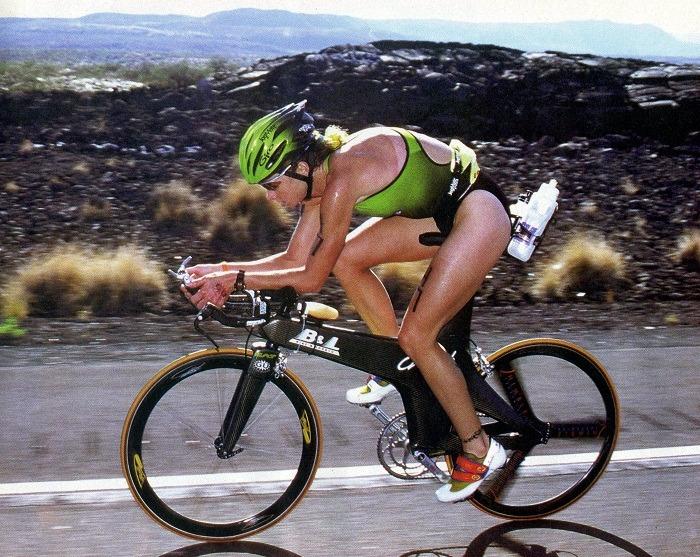
Lori Bowden
The Quiet Dominance: How Lori Bowden Conquered the Ironman World.
The Quiet Dominance: How Lori Bowden Conquered the Ironman World#
Introduction: The Three-Hour Wall#
The Queen Kaʻahumanu Highway in Kailua-Kona, Hawaii, is a place where athletic ambition is scorched into asphalt. On a sweltering October day in 1999, under the force of notorious hurricane-gusts of wind that could blast a cyclist off the road, Canadian triathlete Lori Bowden was running against more than just the heat, the wind, and the finest endurance athletes on the planet. She was running against a ghost, a barrier that had haunted the Ironman World Championship for two decades: the three-hour marathon.
For the women who dared to challenge the grueling 3.8-kilometer swim, 180-kilometer cycle, and 42.2-kilometer run, breaking that mark was the sport’s equivalent of the four-minute mile—a psychological and physiological wall that seemed impenetrable in the brutal conditions of the Big Island. Inside Bowden’s mind, a relentless negotiation was underway. As she described it, the race was a "constant conversation in my head," a battle to "block out the pain and the awareness that you were barely moving". She repeated a mantra to herself, a simple, desperate lie that becomes truth in the crucible of extreme endurance: “I feel good, I feel good”.
That day, the conversation worked. Bowden didn't just win her first Ironman World Championship; she shattered the wall. With a blistering marathon time of 2:59:16, she became the first woman in history to run under three hours in Kona, a performance that redefined the limits of possibility. It was a victory that encapsulated the essence of her career: a quiet, unassuming athlete whose placid exterior concealed a reservoir of mental toughness and a devastating running prowess that would elevate the sport and establish her as one of its all-time greats. This is the story of how Lori Bowden, the accidental Ironman, became a legend.
Section 1: An Ironman by Accident#
Lori Bowden’s journey to the pinnacle of triathlon did not begin with a meticulously planned athletic childhood or the singular focus of a prodigy. It began in a household in Fergus, Ontario, where the grueling sport of triathlon was simply the family pastime. Her parents were dedicated triathletes, and a young Lori spent many weekends watching their races, captivated by the unique energy and atmosphere of the events. This immersion normalized the demanding lifestyle of an endurance athlete, planting a seed that would lie dormant for years. In high school, she naturally gravitated towards distance events, running cross-country, but triathlon remained a weekend hobby, something she did for the challenge and enjoyment.
The Fateful Helmet Incident#
The pivot from casual competitor to Ironman legend came not from a moment of profound inspiration, but from a simple, almost comical, mistake. In 1989, while competing in a qualifying race for the Ontario provincial team, Bowden was disqualified for forgetting to wear her bike helmet. This single lapse in concentration had a life-altering consequence. Faced with a prematurely shortened season, her only option to continue competing was to enter a half-Ironman. Her performance there qualified her for the full Ironman Canada in Penticton, British Columbia. Just like that, an Ironman athlete was born—not through design, but by fluke.
This accidental entry into the world of long-distance racing is more than a quirky anecdote; it serves as a metaphor for her entire career. In an era where athletes are often identified and groomed from a young age, Bowden’s path was defined by serendipity and a resilience to make the most of unexpected turns. She was not on a pre-ordained track to stardom. This makes her subsequent dominance all the more remarkable, as it grew organically from an innate talent and a pure love for the sport rather than a calculated, lifelong pursuit of glory.
From Hobbyist to Contender#
Her initial forays into the sport were characterized by a raw, untrained talent. She later described herself as a "cocky young kid" who didn't believe she had to train seriously for events with such "overwhelming" distances. Despite this casual approach, she placed in the top three of her age group in her very first Ironman Canada in 1989, an achievement that left her "pretty psyched". For years, she was a somewhat "anonymous finisher," happy just to be near the front of the race and in awe of the athletes who were actually winning. This period highlights an immense natural ability, a genetic blessing for endurance that was waiting to be honed by discipline and dedication. The "cocky young kid" who was just happy to compete had no idea she was on the cusp of becoming the very champion she once admired from afar.
Section 2: Forging a Champion in "The Queen's" Court#
The transformation from a gifted amateur to a world-beating professional was catalyzed by a strategic move across the country. In the mid-1990s, Bowden relocated to Victoria, British Columbia, a decision that would fundamentally alter the trajectory of her career. The temperate climate of Victoria allowed her to train year-round, a crucial advantage for an athlete competing in a sport that demands relentless consistency. More importantly, she found herself immersed in a thriving community of elite athletes, including the man who would become her husband and fellow world champion, Peter Reid. This environment professionalized her approach, sharpened her focus, and led to "rapidly improving race results".
Dominance at Ironman Canada#
The first true sign of her arrival as an elite force came in 1997 at Ironman Canada in Penticton. It was a race she and her friends had once laughed about, thinking they would "never finish in the top 50," let alone win. That year, she broke through, claiming her first major Ironman title. This victory was more than a single win; it was the beginning of a dynasty. Bowden would go on to win the event four more times by 2002, a string of five titles that earned her the undisputed moniker, "The Queen of Penticton". Her dominance in Penticton established her as a formidable presence on the Ironman circuit and served as the perfect springboard for her ambitions on the world stage in Hawaii.
The Power Couple#
Her life in Victoria was also defined by her relationship with Peter Reid. Their marriage created one of the sport's most famous "Iron couples," a dynamic duo that represented the pinnacle of Canadian triathlon. Together, they pushed each other in training and celebrated unprecedented joint success. They made history as the first husband-and-wife team to win the same Ironman event, a feat they accomplished first at Ironman Australia in 1999 and then again at Ironman Canada in 2000. Their shared triumphs and life in Victoria made them the public face of Canadian endurance sport, inspiring a generation of athletes and solidifying their home city's reputation as a triathlon mecca.
Section 3: The Kona Streak: A Reign of Unrelenting Consistency#
While victories in Penticton and Australia built her resume, it was on the lava fields of Kona that Lori Bowden forged her legend. The Ironman World Championship is infamous for its brutality and unpredictability; the punishing heat, relentless winds, and sheer distance can derail the ambitions of even the most meticulously prepared champions. Winning there requires a perfect day. What Bowden achieved was something arguably more difficult: a seven-year reign of near-perfection.
The Seven-Year Dynasty (1997-2003)#
From 1997 through 2003, Lori Bowden was an immovable force at the front of the women's race. In seven consecutive appearances at the Ironman World Championship, she never finished lower than third place. This incredible streak included two world titles (1999, 2003), four runner-up finishes (1997, 1998, 2000, 2001), and one third-place finish (2002). This sustained excellence is the bedrock of her legacy. While other legends may have accumulated more total victories, they also experienced "off" years—races where they finished far down the standings or did not finish at all. Bowden's record during her prime shows an almost supernatural ability to manage the race, the conditions, and her own physical and mental state, year after year. This consistency redefines dominance not merely as the capacity to win, but as the unwavering ability to contend for the win every single time, making her an unshakeable presence at the absolute peak of the sport.
| Year | Bowden's Finish | Bowden's Time | Winner | Winner's Time |
|---|---|---|---|---|
| 1997 | 2nd | 9:51:27 | Heather Fuhr (CAN) | 9:31:43 |
| 1998 | 2nd | 9:27:19 | Natascha Badmann (SUI) | 9:24:16 |
| 1999 | 1st | 9:13:02 | - | - |
| 2000 | 2nd | 9:29:05 | Natascha Badmann (SUI) | 9:26:17 |
| 2001 | 2nd | 9:33:20 | Natascha Badmann (SUI) | 9:28:37 |
| 2002 | 3rd | 9:22:27 | Natascha Badmann (SUI) | 9:07:54 |
| 2003 | 1st | 9:11:55 | - | - |
Key Rivalries#
Her time at the top was defined by intense competition with other titans of the sport. Her rivalry with fellow Canadian Heather Fuhr was one of mutual respect. Fuhr, herself an incredible runner, won the World Championship in 1997, the year Bowden's streak began with a second-place finish. Their parallel careers, representing the same nation, created a compelling dynamic that saw them inducted into multiple halls of fame together.
Her primary nemesis in Kona, however, was Natascha Badmann. The Swiss champion, known for her incredible cycling strength and ever-present smile, defeated Bowden for the world title in 2000 and 2001 By the time the 2003 race arrived, Bowden had never beaten the four-time champion on the Big Island, a fact that set the stage for one of the most dramatic showdowns in the race's history.
A Canadian Force#
Bowden's rise coincided with a golden age for Canadian long-distance triathlon. The late 1990s and early 2000s saw Canadian athletes consistently at the top of the standings in Kona. In 1998, for instance, Canadian women placed second (Bowden), fourth, fifth, and seventh, while Peter Reid won the men's race. This national dominance was attributed to a generation of athletes who, like Bowden, excelled in the non-drafting format of Ironman. They were powerful cyclists and phenomenal runners, a combination perfectly suited to the grueling demands of the sport's ultimate test.
Section 4: The 1999 Pinnacle: A Barrier Shattered#
After finishing as the runner-up in both 1997 and 1998, Lori Bowden arrived in Kona for the October 16, 1999, race as a top contender, driven by an intense hunger to finally claim the top step of the podium. Her marathon times on the island had been steadily improving over the years, from 3:12 in 1996 to a personal best of 3:07 in 1998, but she had yet to post the fastest run split of the day. The question was whether she could find another gear to overcome her rivals.
The Race Unfolds#
The race day conditions were classic Kona: brutal. "Horrendous" winds battered the athletes on the bike course, sapping energy and testing resolve. Bowden exited the 3.8-kilometer swim in 1:02:23, placing her 10th among the professional women and giving her a significant deficit to the leaders. On the bike, however, she demonstrated her strength and toughness. While others struggled in the punishing winds, Bowden powered through the 180-kilometer leg to post the fastest bike split of the day at 5:08:30. This dominant ride vaulted her into the lead and set the stage for her historic run.
The Historic Marathon#
Taking to the pavement on what she described as the "super hard" old run course, Bowden executed a tactical and psychological masterpiece. She focused her efforts methodically, trying to "catch up to and pass each girl ahead of me one at a time". The turnaround in the infamous Natural Energy Lab, a desolate and soul-crushing section of the course, was brutal. Seeing her competitors behind her, looking deceptively close, she began to "run scared the rest of the way back to town," a fear that fueled her pace.
Completely unaware of her split times or overall pace, she relied on pure mental grit. She crossed the finish line with a final marathon time of 2:59:16, becoming the first woman in the history of the sport to break the three-hour barrier at the Ironman World Championship. Her run was a staggering ten minutes faster than the next-fastest women, Karen Smyers and Fernanda Keller, who both ran 3:09.2 It was a performance that not only secured her victory but fundamentally changed the perception of what was possible for female athletes in the sport.
The Aftermath#
Bowden's final time of 9:13:02 sealed her first world title. But the victory was more than a personal triumph; it was a landmark achievement that "raised the bar for everyone" and became a new benchmark for all future women's champions. The data from the race tells the story with clinical precision: she overcame a swim deficit with a dominant bike ride and then delivered a run performance that was, at the time, in a class of its own.
| Rank | Athlete | Country | Swim | Bike | Run | Overall Time |
|---|---|---|---|---|---|---|
| 1 | L. Bowden | CAN | 1:02:23 | 5:08:30 | 2:59:16 | 9:13:02 |
| 2 | K. Smyers | USA | 53:03 | 5:15:01 | 3:09:33 | 9:20:40 |
| 3 | F. Keller | BRA | 56:04 | 5:16:33 | 3:09:30 | 9:24:30 |
| 4 | S. Nielsen | USA | 53:02 | 5:16:08 | 3:16:36 | 9:29:23 |
| 5 | B. Zinkand | USA | 54:48 | 5:13:50 | 3:23:42 | 9:34:41 |
Section 5: The 2003 Redemption: A Victory Forged in Fire#
If Bowden's 1999 victory was a testament to her physical prowess, her second world title in 2003 was the ultimate showcase of her mental fortitude. She arrived in Kona that year under a cloud of intense personal turmoil, facing circumstances that would have crippled the focus of most elite athletes.
The Personal Turmoil#
Just one week before the most important race of the year, Bowden's marriage to Peter Reid had ended. This emotional crisis created an incredibly tense and surreal backdrop for the World Championship. The two were still the public faces of Canadian triathlon, and now they would be competing on the same course, at the same time, while navigating the fresh wounds of their separation. The on-course dynamic was charged with emotion. Reid himself later admitted to ESPN that he was fueled by a complex mix of emotions, stating, "Every time I saw her on the course I was mad. There was no way she was going to win and I wasn't". To perform at a world-championship level under such strain is extraordinary. To win requires a level of psychological compartmentalization and resilience that few possess.
The Race Day Battle#
Bowden entered the October 18, 2003, race with a point to prove. She had not won in Kona since her historic 1999 performance and, critically, had never managed to beat her great rival, Natascha Badmann, on the Big Island. The race unfolded into a tense tactical affair. Bowden emerged from the swim in 56:51, placing her seventh among the lead women. She followed with a strong 5:09:00 bike ride, the fourth fastest of the day, which kept her in contention.
The race was decided, as it so often was for Bowden, on the run. The marathon became a dramatic head-to-head battle with Germany's powerful Nina Kraft. In the debilitating heat of the Natural Energy Lab, Kraft began to surge, repeatedly testing Bowden's resolve. In a moment that was broadcast on the first-ever live webcast of the race, audiences watched as Bowden absorbed the attacks and refused to break. She ultimately held Kraft off, pulling away to claim her second World Championship title.
A Historic, Complicated Finish#
Bowden crossed the finish line in 9:11:55, her victory powered by the day's fastest run split of 3:02:10. In a stunning, almost unbelievable turn of events, Peter Reid also won the men's race, taking his third and final world title. They became the first and only separated or married couple to win the Ironman World Championship on the same day. The emotional complexity of the moment was palpable. Race organizers, sensitive to the situation, had to rearrange the traditional awards ceremony to avoid having the estranged couple appear on the podium together. The 2003 victory was not just Bowden's second title; it was the crowning achievement of her mental toughness, a triumph not just over her competitors, but over immense personal adversity.
Section 6: The Bowden Legacy: Speed, Humility, and Hall of Fame#
Lori Bowden’s legacy extends far beyond her two iconic victories in Hawaii. Her career was a masterclass in consistency, speed, and quiet professionalism that left an indelible mark on the sport of triathlon.
A Record of Excellence#
In total, Bowden amassed an incredible 12 Ironman victories worldwide, ranking her among the most prolific winners in the sport's history. Her global dominance included five Ironman Canada titles, three wins at Ironman Australia, and three at Ironman Austria. It was in Austria in 2002 that she delivered one of her most stunning performances, finishing in a time of 8:51:22. This made her one of only a handful of women at the time to have ever broken the elusive nine-hour barrier, a feat she would accomplish three times in her career. She also added a Long Distance Duathlon World Championship title to her credit, showcasing her versatility and strength.
The Quiet Champion#
Despite her ferocious competitiveness on the race course, Bowden was known for her low-key, humble personality. She was never one for bombastic pronouncements or self-promotion. She consistently maintained that the key to her success and longevity in such a punishing sport was simple: "You have to enjoy what you're doing". This philosophy was evident in her demeanor; she was famously fuzzy on her own records and split times, reinforcing the image of an athlete motivated by an intrinsic passion for the lifestyle and the people involved in the sport, rather than by ego or the record books.
A Well-Earned Retirement#
After a brief but successful comeback in 2006, where she placed second at Ironman Austria at the age of 39, Bowden quietly stepped away from the professional circuit. She settled back into life in Canada, focusing on raising her son and remaining an active and positive force in her local community. She has stayed connected to the sport she loves by helping to organize the annual Victoria Goodlife Fitness Marathon, giving back to the running community that supported her for so many years.
Hall of Fame Recognition#
The sport has formally recognized her immense contributions through numerous prestigious honors. Her name is now enshrined in the BC Sports Hall of Fame (2009), the Greater Victoria Sports Hall of Fame (2008), the Triathlon Canada Hall of Fame (2015), and, most fittingly, the Ironman Hall of Fame (2015). Her inductions, often alongside her great Canadian rival Heather Fuhr, serve as the ultimate validation of her career. They cement her status not just as a champion, but as a true pioneer who pushed the boundaries of the sport with a unique combination of grace, grit, and quiet dominance.