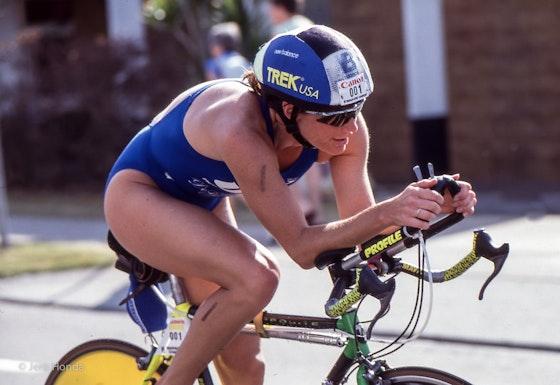
Karen Smyers
The Unbreakable Smyers
The Unbreakable Smyers: A Portrait of Endurance#
Introduction: The Crucible of a Champion#
In the searing heat of the Kona lava fields in October 1999, Karen Smyers was authoring one of the great comeback stories in triathlon. She crossed the finish line of the Hawaiian Ironman World Championship in second place, a triumphant return to the podium after two years of brutal, career-threatening setbacks. The emotional release was palpable, a testament to a will that had refused to break. Yet, as she pushed her body to its absolute limit over 140.6 miles of swimming, biking, and running, she carried a silent, invisible burden. For weeks, she had known that the swollen glands in her neck were not a simple ailment; they were the likely sign of thyroid cancer, a fear that would be confirmed by biopsy shortly after the race.
This single moment—a podium finish at the world’s most grueling endurance event achieved while staring down a life-threatening illness—is the perfect encapsulation of Karen Smyers’s career. It poses a question that transcends sport: what fuels such profound fortitude? For Smyers, endurance was never merely about the physical capacity to cover distance; it was a fundamental approach to life itself, a lens through which she processed triumph and catastrophe with equal grace. Her legacy, therefore, is defined not just by her collection of world titles, but by an unparalleled capacity to absorb and transcend a series of career-ending, and life-altering, calamities. Hers is a story that redefines what it means to be a champion, proving that true strength is measured not by the absence of adversity, but by the courage to face it and continue moving forward.
Chapter 1: The Accidental Pro (1961-1988)#
Karen Smyers’s journey to the pinnacle of triathlon began not with a grand plan, but with a void. Born on September 1, 1961, in Corry, Pennsylvania, and raised in an athletic family of eight children in Wethersfield, Connecticut, competition was in her blood. She joined the town swim team at age eight and became an All-State swimmer in high school. At Princeton University, she was a cornerstone of a dominant swim team that captured three conference championships. Swimming gave her the immense "aerobic capacity and competitive drive" that would later become her trademark.
But after graduating in 1983 with a degree in economics, the structured world of collegiate sports vanished. She took a job at a computer consulting firm and, for the first time, found herself without an athletic purpose. She described feeling the need for an "anchor" in her life, a competitive outlet to channel her energy. The solution arrived through a roommate who was training for a new, burgeoning sport: the triathlon. Intrigued, Smyers entered her first race in 1984, treating it as a simple "hobby". Her equipment was as unassuming as her ambition; she competed on the same bicycle she used for her daily commute to work.
This casual entry into the sport underscores a critical point: her initial motivation was entirely intrinsic. It was a pure love of competition, a need for physical challenge, that drew her in, not a calculated pursuit of a professional career. This foundation of passion would prove to be the inexhaustible wellspring of the resilience she would later need. The shift from amateur to professional was itself an accident. Later in 1984, she entered the Bud Light Series triathlon in Boston as an amateur, where she won her age group and finished second overall. Afterward, she learned that her time would have earned her a $500 prize—a significant sum at the time—if only she had checked the "pro" box on her registration form. The lesson was learned. From 1985 on, she raced as a professional, though she continued to balance her athletic pursuits with her full-time job for another five years, until the computer firm went bankrupt in 1989. This extended period of balancing work and sport demonstrates that her commitment was rooted in a fundamental passion for the lifestyle and the challenge, a more durable motivator than the external validation of prize money or accolades.
Chapter 2: Forging a Legacy (1989-1994)#
The closure of her company in 1989 was the catalyst that launched Karen Smyers into the triathlon stratosphere. Now a full-time professional, she immediately signaled her potential by finishing fourth at the first-ever International Triathlon Union (ITU) World Championships in Avignon, France, announcing her arrival on the global stage. While a promising debut, it was her performance a year later that would etch her name into the sport’s history.
The 1990 ITU World Championship in Orlando, Florida, became a defining set piece for her career. On a brutally hot and humid day, Smyers found herself languishing in fourth place deep into the 10-kilometer run, feeling physically and mentally defeated. As her hopes for a podium finish faded, a voice cut through her fatigue. Fellow elite athlete Scott Molina, watching from the sideline, yelled, "Karen, you gotta want it!". Those five words acted as a trigger, reigniting a fire within her. She began to surge, passing the legendary Erin Baker, and then, in the final half-mile, she caught the two leaders, Joy Hanson and Carol Montgomery, who had long since dismissed her as a threat. She stormed past them in a stunning display of grit, running through the finish line at Disney World’s Magic Kingdom to claim her first world title.
This victory revealed a crucial psychological trait that would define her racing style. She was a reactive competitor, a "hunter" who could access a deeper level of performance when faced with a clear target and an external catalyst. Unlike athletes who dominate from the front, she thrived on the chase. This mentality fueled a period of remarkable dominance. From 1990 to 1995, she was untouchable on American soil, winning six consecutive USA Triathlon Elite National Champion titles. She added a World Cup Series title in 1991 and multiple victories at prestigious races like the St. Croix International Half Ironman.
Despite her success at the Olympic distance, she initially viewed the Ironman as "completely absurd" and an "event for lunatics". Her perspective began to shift after she traveled to Hawaii in 1991 to witness the epic rivalry between Paula Newby-Fraser and Erin Baker firsthand. The intensity of their battle transformed her perception of the event from a mere survival test into a true race. She made her own debut at the Hawaiian Ironman in 1994, approaching it with a mix of trepidation and optimism. Her fourth-place finish, which included the fastest time ever for a female rookie, was a clear sign that she possessed the strength and tenacity to conquer the sport’s ultimate test.
Chapter 3: The Unprecedented Double: The Apex of 1995#
The 1995 season stands as the zenith of Karen Smyers's athletic career, a year in which she achieved a feat of versatility that remains unmatched in the annals of triathlon. She showcased her incredible range by winning a gold medal at the Pan Am Games and securing her sixth consecutive U.S. National title. But it was two races, just five weeks apart, that would cement her legend.
The main event was the Hawaiian Ironman World Championship. The narrative was set for a showdown between Smyers and the undisputed "Queen of Kona," seven-time champion Paula Newby-Fraser. Early in the race, it appeared to be Newby-Fraser’s day. She "destroyed" Smyers on the 112-mile bike leg, building a lead that seemed insurmountable. But the marathon is where Ironman legends are made and broken. Smyers, looking "leaner than ever," began the hunt. She ran with relentless, metronomic precision, chipping away at Newby-Fraser’s advantage minute by minute. The psychological pressure she exerted was immense. Newby-Fraser herself would later admit that Smyers’s relentless pursuit caused her to lose her "focus and my center". In the final, agonizing miles of the run, the unthinkable happened. Newby-Fraser, depleted and overwhelmed, collapsed, unable to continue. Smyers ran past, her face a mask of determination, to claim the Ironman crown.
In the aftermath, Smyers reflected with characteristic humility that the media coverage focused almost entirely on Paula’s dramatic collapse, making her own hard-fought victory feel like an "afterthought". But she would soon author a headline that was entirely her own. Just five weeks after conquering the grueling heat of Kona, she stood on the start line of the ITU Olympic Distance World Championship. In an astonishing display of recovery and adaptability, she won, completing a historic double that no woman has ever replicated.
This achievement was more than just a display of physical prowess; it was a testament to a unique form of athletic intelligence. Ironman and Olympic-distance triathlon are fundamentally different disciplines. The former demands sustained, sub-maximal effort and meticulous pacing over many hours, while the latter requires explosive, red-line intensity from start to finish. The training protocols, race strategies, and psychological approaches are worlds apart. To not only compete but to win both world championships in a five-week span required a mental and strategic adaptability arguably more demanding than the physical challenge itself. It demonstrated an extraordinary capacity for mental code-switching and a deep, intuitive understanding of her own body, proving she was not just one of the fittest athletes in the world, but also one of the smartest.
| Year | Major Athletic Achievement | Significant Life Event / Adversity |
|---|---|---|
| 1989 | 4th, ITU World Championships | Becomes a full-time professional triathlete |
| 1990 | 1st, ITU World Champion; 1st, U.S. National Champion | |
| 1991 | 1st, World Cup Series; 1st, U.S. National Champion | |
| 1992 | 1st, U.S. National Champion | |
| 1993 | 2nd, ITU World Championships; 1st, U.S. National Champion | |
| 1994 | 4th, Ironman World Championship (Rookie); 1st, U.S. National Champion | |
| 1995 | 1st, Ironman World Champion; 1st, ITU World Champion; 1st, Pan Am Games | Achieves historic "double" |
| 1996 | 1st, ITU Long Distance World Champion | |
| 1997 | Freak accident: severed hamstring from storm window | |
| 1998 | Birth of daughter, Jenna; Hit by 18-wheel truck while training | |
| 1999 | 2nd, Ironman World Championship; U.S. Olympic Committee Triathlete of the Year | Diagnosed with thyroid cancer; Broke collarbone in race crash |
| 2000 | Unsuccessful bid for U.S. Olympic Team | Thyroid cancer surgery and radioactive-iodine treatment |
| 2001 | 5th, Ironman World Championship; 1st, U.S. National Champion (7th title) | Remarkable comeback season at age |
| 2005 | 9th, Ironman World Championship | Returns to Top 10 after birth of second child, Casey |
| 2009 | Inducted into inaugural USA Triathlon Hall of Fame |
Chapter 4: The Gauntlet (1997-2000)#
Until 1997, Karen Smyers had led what she called a "charmed career". What followed was a relentless, three-year gauntlet of misfortune that would have ended the career of almost any other athlete. This period reveals that her famed resilience was not a simple, monolithic toughness, but an active, intelligent, and multifaceted strategy for navigating chaos.
The onslaught began in June 1997. After a strong start to the season, a freak household accident brought her momentum to a halt. While changing a storm window at her home in Lincoln, Massachusetts, the window fell and shattered. A large shard of glass sliced deep into her left thigh, severing her hamstring. The injury was horrific, sidelining her for the entire season. Yet, in this devastating setback, Smyers found a silver lining. The forced hiatus from training allowed her and her husband, Michael King, to execute "Plan B". She gave birth to their daughter, Jenna, in May 1998, later noting with pragmatic optimism that being pregnant allowed her to "take rehab nice and slow". This ability to reframe a negative into a constructive path forward was a key tool in her psychological arsenal.
Just as she was mounting her comeback in August 1998, tragedy struck again, this time with violent force. While on a training ride, she was sideswiped by an 18-wheel truck. She was thrown from her bike, suffering six broken ribs, a third-degree separated shoulder, and a collapsed lung. Her training partner left a horrifying message on the couple’s answering machine from the scene of the accident, a recording her husband heard while at home with their infant daughter.
Miraculously, she recovered and put together a stellar 1999 season, culminating in her second-place finish at Kona. But this comeback was shadowed by the discovery of swollen glands in her neck that September. Displaying a fierce capacity for compartmentalization, she made a calculated decision. With her doctor's blessing, she postponed the definitive biopsy until after the Ironman, choosing to "divide and conquer" by focusing on the immediate, controllable challenge of the race before confronting the terrifying unknown of a cancer diagnosis.
After Kona, the biopsy confirmed papillary thyroid carcinoma. The blows kept coming. In her final race of the season in Ixtapa, Mexico, a competitor crashed directly in front of her, causing Smyers to flip over her handlebars. The fall shattered her collarbone and forced her to not finish a race for the first time in her 17-year career. In December 1999, she underwent a six-hour surgery to remove her thyroid. She then threw herself into a gallant but ultimately unsuccessful bid to make the inaugural U.S. Olympic Team for the 2000 Sydney Games, where triathlon would make its debut. Missing out on that dream, she said, felt like being "a high school kid who hadn't been invited to the biggest party of the year". Soon after, she had a second surgery to remove cancerous lymph nodes, followed by radioactive-iodine treatment. Through it all, her humor remained a deliberate psychological shield. She joked in a column that after the treatment, she would be able to "read in bed without a night light". This combination of optimism, compartmentalization, and humor was her active strategy for disarming trauma and maintaining agency in the face of overwhelming adversity.
Chapter 5: The Champion, Redefined (2001-2005)#
Karen Smyers’s return to racing in 2001 was not just a comeback; it was a redefinition of what a champion could be. At age 40, as a mother and a cancer survivor, she competed with a new purpose. Her success was no longer solely for herself; it became a powerful source of inspiration for others. She returned to the racecourse in "impressive fashion," winning five races, including her seventh U.S. National Championship title.
The climax of her return came, fittingly, on the lava fields of Kona at the 2001 Hawaiian Ironman. She finished in fifth place, a remarkable achievement on its own. But the true significance of the performance lay in the details: she was the first master's athlete, male or female, to cross the finish line. Her comeback was complete. She had conquered the sport's toughest race, but more importantly, she had conquered a series of life's most brutal challenges. Her identity had evolved; she was no longer just a world champion triathlete, but a symbol of resilience for cancer survivors, working mothers, and aging athletes everywhere.
She embraced this new role. The media and public attention now focused as much on her personal story of survival as on her race results. She became a sought-after motivational speaker, sharing her journey and her philosophy of perseverance. Her athletic career continued to defy expectations. After taking a second maternity leave for the birth of her son, Casey, she returned to the Hawaiian Ironman in 2005. At 44 years of age, she "amazed onlookers with yet another Top 10 performance," finishing in ninth place. This performance demonstrated a fundamental shift in her relationship with the sport. It had transformed from a vehicle for personal ambition into a platform for expressing resilience and "widening the horizon of what is possible". This new "why" behind her racing fueled her extraordinary longevity and cemented a different, more profound, and more enduring legacy.
Chapter 6: The Enduring Pillar of the Sport#
In the final chapter of her professional career and beyond, Karen Smyers transitioned from a legendary competitor into one of triathlon’s most revered figures—an elder stateswoman and a living link to the sport's pioneering days. She continued to race professionally until the age of 49, competing against generations of athletes who grew up idolizing her. Even into her 50s, she remained a fixture at major events like the Ironman World Championship, her presence a testament to an unquenchable passion for the sport.
The ultimate honor came in 2009 (with the ceremony held in January 2008), when she was inducted into the inaugural class of the USA Triathlon Hall of Fame. The selection was a recognition of a career that had fundamentally shaped the sport. The Hall of Fame citation noted that her historic 1995 double victory was "perhaps the single most remarkable achievement in the sport to date". True to form, Smyers reacted with humility, expressing shock and gratitude for being chosen among so many of the sport's greats.
Her induction was not an endpoint but a formal recognition of a role she already occupied. She became a pillar of the triathlon community, actively shaping its future by passing on the wisdom gained through both triumph and hardship. She has dedicated her post-professional life to giving back, working as a coach to athletes of all abilities, from first-timers to seasoned veterans. As a motivational speaker and through widely viewed TEDx talks like "A Champion's Toolbox" and "Racing While Female," she has shared her story of survival and success, becoming a thought leader on topics of resilience, longevity, and the unique challenges facing female athletes. She also organizes local events like the Lincoln Kids Triathlon, nurturing the next generation. Her legacy is therefore not static—a collection of medals in a display case—but dynamic and ongoing. She has transformed her personal experiences into a public resource, completing a remarkable narrative arc from accidental pro to enduring icon.
Conclusion: The Definition of Endurance#
The record books will remember Karen Smyers for her world championships, her seven national titles, and the unprecedented double of 1995. She is a legend of the sport, a Hall of Famer whose athletic achievements place her in the most elite company. But her true, enduring legacy is one of resilience.
Her life and career provide the ultimate definition of endurance. It is not merely the physical capacity to withstand a 140.6-mile race, a quality many possess. It is the spiritual and psychological fortitude to withstand life’s most brutal collisions—a severed hamstring, an 18-wheel truck, a cancer diagnosis—and to find purpose in the wreckage. It is the strength to not only get back up but to return to the start line and cross the finish line stronger, wiser, and with more to give than before. Karen Smyers’s story is not just one of the greatest in the history of triathlon; it is one of the great, inspirational stories in all of sport.