Julie Moss
The Crawl of Fame: How Julie Moss’s Agony Forged a Legend and Launched a Sport.
The Crawl of Fame: How Julie Moss’s Agony Forged a Legend and Launched a Sport#
Introduction: The Fifteen Feet That Changed Everything#
The light is fading over Kailua-Kona. On Ali'i Drive, the palm trees are silhouettes against a bruised twilight sky. For eleven hours, the February 1982 Ironman World Championship has been a grueling, sun-scorched epic of human endurance. Now, in its final moments, it is transforming into something else entirely: a raw, televised theater of human will. The crowd, which moments before had been a wall of sound, has fallen into a stunned, breathless silence. All eyes, and the unblinking lens of an ABC
Wide World of Sports camera, are fixed on a single, staggering figure.
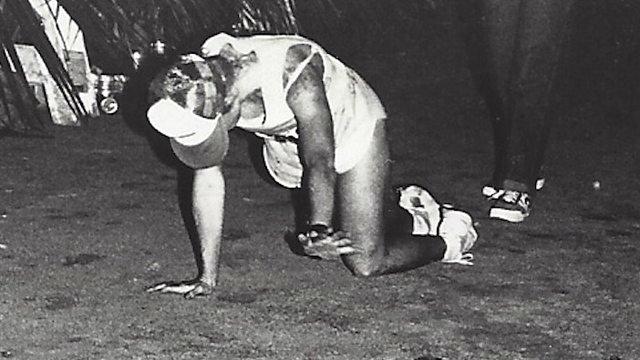
Her name is Julie Moss. She is 23 years old, a kinesiology student from California, and until this very moment, she has been the race’s improbable, triumphant leader. Now, just yards from the finish line, her body has staged a full-scale rebellion. Her legs, having carried her 140 miles, buckle without warning. She collapses onto the hot pavement, a marionette with its strings cut. She tries to stand, her arms pushing against the ground, but her body refuses to obey. She falls again. And again. The scene is one of profound physical failure, a gut-wrenching spectacle of an athlete’s worst nightmare realized. Her body has completely shut down from severe dehydration and exhaustion; she has lost control of her bodily functions, a detail of raw humiliation broadcast to millions.
Then, through the haze of agony and the glare of the television lights, another figure emerges. Kathleen McCartney, who had been 20 minutes behind Moss, runs past, focused and powerful. She is almost oblivious to the drama unfolding on the pavement behind her, so much so that volunteers at the finish have to tell her she has won. For Moss, it is the final, devastating blow. The victory she held for hours has vanished in the final few feet.
But what happens next is the reason this story is still told. Defeated, depleted, and publicly humiliated, Moss makes a decision. If she cannot stand, she will crawl. On her hands and knees, she begins to drag her body across the asphalt, one agonizing inch at a time, for fifteen final feet. It is a primal act of determination, a refusal to surrender to the void.
This moment of collapse should have been a footnote, the story of a dramatic loss. Instead, it became one of the most powerful and iconic moments in the history of sport. It was a moment that transcended the simple binary of winning and losing. It posed a question to the millions watching in their living rooms: How did this visceral display of failure become an enduring symbol of triumph? How did a second-place finish, achieved through utter collapse, transform an unknown student into a global icon, launch a fringe sport into a global phenomenon, and redefine the very meaning of victory? The answer lies not just in the grit of one woman, but in the power of a story, broadcast to the world, that revealed for the first time the profound vulnerability and unbreakable spirit at the heart of human endurance. It turned a competition for superhumans into a deeply relatable human drama, and in doing so, changed everything.
Chapter I: The Unlikely Pilgrim#
Before she was an icon, Julie Moss was, by her own admission, a professional procrastinator and a quintessential California surfer girl. Born in 1958, she was a 23-year-old student at California Polytechnic State University, San Luis Obispo, in 1981, more at home on the waves of the Pacific than on a race course. She had never been a dedicated, competitive athlete and held a certain apathy toward organized sports. Her life was one of youthful freedom, defined by a simple philosophy: "at 23, I said yes way more than I said no to all things in life". It was this spirit of openness, rather than a burning ambition for glory, that set her on the path to Kona.
The impetus was not a desire to win, but a need to graduate. For her senior thesis in exercise physiology, Moss concocted a novel, if audacious, research project: she would study the extreme physiological demands of the Ironman triathlon by participating in it herself. It was an idea that perfectly embodied her university's motto,
Discere Faciendo—"learning by doing". The plan was met with bemusement. She had to convince her skeptical thesis advisor that the race was a legitimate academic endeavor and then persuade her mother to pay the $85 entry fee.
In early 1982, the sport of triathlon was so new, so far on the fringe of the athletic world, that Moss often had to spell out the word for her professors, who had never heard of it. Born in San Diego in 1974 and first staged in Hawaii in 1978, the Ironman was the private obsession of a small, hardened tribe of endurance junkies. There was no prize money, no professional circuit, and no qualification necessary to enter the world championship. It was an obscure challenge, a test of will whispered about in niche athletic circles. As one contemporary observer noted, for most of the 580 competitors who signed up for the February 1982 race, it was simply "an excuse to go to Hawaii when the average temperature in Chicago was 19°".
Moss arrived on the Big Island three and a half weeks before the race with preparation that could best be described as minimalist, and equipment that was comically amateurish. She had run two marathons before, but had "bonked" in both. Her race gear was a hodgepodge of what was available. Her bike was a standard 10-speed commuter she had purchased for around $250.13 For a helmet, she used a bulky skateboarding model, into which she drilled extra holes for ventilation and to lighten the load. She trained in wool shorts and a tank top until another athlete, seeing her, gifted her a proper one-piece suit. This utter lack of experience and sophistication was not a strategic disadvantage; it was, in retrospect, the essential ingredient for the story that was about to unfold. A perfectly trained, meticulously prepared athlete would have known how to pace herself, how to fuel, how to manage the brutal conditions of Kona. She would have likely finished strong, perhaps even won, but she would never have collapsed in such a spectacular, humanizing, and ultimately narrative-altering way. Moss's naivete was not a flaw; it was the prerequisite for her legend. She was not there to execute a perfect race plan; she was there for the experience, a pilgrim venturing into the unknown, armed with little more than youthful courage and academic curiosity.
Chapter II: The Crucible of Kona (February 6, 1982)#
Race day began with a sense of relief. The gun went off, and the nervous energy of the pre-race dissipated into the warm Hawaiian water. "I'm just going to enjoy this day," Moss told herself. She was a strong swimmer, comfortable in the ocean, and emerged from the 2.4-mile swim in fourth or fifth position among the women, well-placed and feeling calm.
On the 112-mile bike ride across the barren lava fields, her confidence grew. To her own astonishment, she began to move up through the field. The race was still a novelty, and her approach was endearingly casual. Her primary nutritional strategy revolved around a Snickers bar she had promised herself at the 25-mile mark, but it melted into a gooey mess in her shorts before she could eat it. Undeterred, she wiped her chocolate-stained hands on her shorts, gave a cheerful "Aloha!" to the ABC camera crew that was now following her, and pedaled on. By the time she finished the bike leg, she had ridden herself into first place, a position so unexpected that it felt almost dreamlike.
The final leg, the 26.2-mile marathon, began with Moss holding a commanding 20-minute lead over her nearest competitor, Kathleen McCartney. For the first 18 miles, the dream held. She was leading the Ironman World Championship. But as the miles wore on under the punishing Hawaiian sun, her body, under-fueled and undertrained for such an extreme effort, began to send out distress signals. By mile 23, the dream was turning into a nightmare. Her vision blurred, her stomach churned, and a terrifying fatigue began to creep into her legs. The unraveling had begun.
The final mile of the race, down the finishing stretch of Ali'i Drive, became one of the most documented and dramatic passages in sports history. It was a slow-motion deconstruction of an athlete at her absolute limit.
Her fluid, confident run slowed to a labored shuffle, then a desperate walk. Her legs, completely depleted of glycogen, began to seize and buckle. She collapsed to the pavement. The crowd watched in horrified silence as she struggled back to her feet, only to fall again. Volunteers rushed to help, but she waved them away, lucid enough to know that any assistance would mean disqualification. "My head knew what was happening from the beginning," she would later recall. "A breakdown was happening from the legs up".
In that vortex of pain and confusion, her worst fear was realized. In her peripheral vision, she saw a flash of color—the rainbow logos on Kathleen McCartney's clean white race kit. McCartney ran past, strong and steady, unaware of the full extent of Moss's collapse as she claimed the victory that had seemed impossible just minutes before. For Moss, the moment was devastating. "I saw my self-worth being dragged across the line by somebody else," she recalled.
In that instant, the athletic ego, which had been "flirting with the cameraman" and feeling like the "'it' girl" just hours earlier, was completely stripped away. The external goal of winning was gone. All that remained was a raw, internal imperative. Initially, she began to crawl simply to hide her humiliation, to stay low to the ground and disappear. But as she moved, something shifted. The act of crawling, born of shame, transformed into an act of pure will. She described an inner voice rising up, one she'd never heard before, the voice of her "inner Wonder Woman". It told her:
So you didn't win. What happened here? You just found a way to tap into a source you didn't know existed.10 For thirty agonizing seconds, she dragged herself over those final fifteen feet. She placed one hand over the finish line, completing the race with a final time of 11:10:09, and then collapsed. The public had just witnessed the complete deconstruction of an athlete, a stripping away of all pretense and performance until only a core of human spirit remained. And it was this, more than any victory, that they would never forget.
Chapter III: The Birth of an Icon#
Had the events of February 6, 1982, transpired in obscurity, they would have become a piece of local race lore, a story told among a small community of triathletes. But they did not. They were captured, edited, and broadcast into millions of American homes by ABC's Wide World of Sports, and it was this act of mediation that transformed Julie Moss from a defeated athlete into a cultural icon. The show's host, the legendary Jim McKay, framed her finish as "the most agonizing moment I've ever seen in sports," and the broadcast became the highest-rated episode of the program's year. The raw, unfiltered footage of her struggle resonated with a mass audience in a way no polished victory ever could. ABC flew her to New York City for interviews, and her story became a national sensation.
The impact on the nascent sport of triathlon was immediate and explosive. The broadcast provided a narrative that was irresistible. As one observer noted, viewers were left thinking, "'What is it about that finish line that is so attractive that this woman would crawl and crap herself to get there?'". The answer, for thousands, was to find out for themselves. Ironman entries, which stood at 580 for the February race, surged to 850 for the second World Championship held that October. The "Moss Effect" was real. She became the reluctant "poster girl" for a new kind of athletic endeavor—one where the definition of victory was expanded to include the simple act of finishing. Her struggle inspired a generation. Among the millions watching was a young collegiate swimmer named Mark Allen, who was so moved by what he saw that he decided to dedicate his life to the sport he would one day dominate.
Yet, the legacy of "The Crawl" is not without its complexities. While universally celebrated as a moment of supreme grit, some analysts and coaches have viewed it as a "pyrrhic victory" for the culture of endurance sports. The indelible image of Moss suffering so profoundly cemented a perception that "mental toughness"—defined as the ability to push through physical challenges for which one is unprepared—was the ultimate athletic virtue. The narrative it promoted was simple: if you are not suffering, you are not trying hard enough. This created a tension within the sport's philosophy, contrasting the "Moss approach" of heroic suffering against the "McCartney approach" of achieving victory through disciplined training, proper nutrition, and intelligent pacing. For some athletes, the goal became to
be a Julie Moss, to seek out that moment of collapse as a badge of honor, sometimes at the expense of sound preparation.
This debate, however, did little to temper her newfound celebrity. Moss was suddenly famous in a way that was entirely new for an endurance athlete. Her fame wasn't built on a long record of dominance, but on a single, unforgettable moment of vulnerability. She was invited to appear on television shows like "Survival of the Fittest" and "Battle of the Superstars" and even worked as a stunt double for actress Penny Marshall in a made-for-TV movie about a woman training for a triathlon. In essence, Julie Moss became the first viral star of endurance sports. Before the internet, before social media, her story was condensed into a single, powerful, and endlessly repeatable media clip. The pattern is now familiar: a visually dramatic, emotionally charged moment is captured and replayed until it becomes a cultural touchstone. Her story proved that in the age of television, the narrative of the struggle could be more powerful, more resonant, and ultimately more marketable than the narrative of a straightforward win—a lesson that has profoundly shaped sports media ever since.
Chapter IV: The Professional and the Power Couple#
The tidal wave of fame that followed Kona swept Julie Moss into a life she had never imagined. Within weeks of the race, she went from being an inexperienced student to a professional triathlete, embarking on a career path that had barely existed before her televised crawl put the sport on the map. For the next eleven years, she lived the life of a traveling pro, competing around the globe as one of the sport's most recognizable faces.
While the 1982 race would forever define her, Moss was determined to prove she was more than a single moment of courageous failure. Her professional career had its share of successes, but one victory stands out as the moment she truly validated herself as an elite competitor. In 1989, at a long-distance race in Nice, France, she went head-to-head with Paula Newby-Fraser, the Zimbabwean athlete known as the "Queen of Kona" and the most dominant woman in the sport's history. Moss won, beating Newby-Fraser in her prime. She would later reflect that this was the day she "finally earned my stripes as a pro".
Her personal life also became intertwined with the sport's elite. Her performance in 1982 had inspired Mark Allen to become a triathlete, and their shared passion eventually led to a relationship and marriage. Together, they became triathlon's first "power couple," a union of the sport's most iconic woman and the man who would become its greatest male champion. The relationship pushed Moss to evolve as an athlete. The free-spirited, intuitive approach of her early days gave way to a more serious, data-driven methodology. Influenced by Allen, she began training with a heart rate monitor and adopted a more structured regimen. However, she also spoke of the immense pressure that came with being married to a perfectionist like Allen, whose standards were relentlessly high. Allen, for his part, has reflected on the immense challenge of balancing his own drive to be the best in the world with the demands of his marriage and sponsorship obligations.
To fully understand Moss's place in the sport's history, it is crucial to view her career in the context of her contemporaries. While Moss was the sport's public face and inspirational soul, the 1980s and 90s were competitively dominated by two titans: Paula Newby-Fraser and Erin Baker of New Zealand. Their fierce rivalry, fueled by political tensions and contrasting personalities, pushed the boundaries of female performance, leading to shattered records and a new level of professionalism. Newby-Fraser would go on to win the Ironman World Championship an astonishing eight times, while Baker claimed two titles and was a relentless force in races around the world. Their legacies were built on a foundation of repeated, dominant victories. Moss's legacy, while equally profound, was built on a different foundation entirely—one of narrative power and human connection.
Table 1: Pioneers of the First Triathlon Boom - A Career Comparison
| Athlete | Key Ironman WC Results | Other Major Victories | Course Records | Key Contribution/Legacy |
|---|---|---|---|---|
| Julie Moss | 2nd (1982) | Won 1989 Nice International Triathlon, defeating Paula Newby-Fraser | N/A | The inspirational icon; her 1982 "Crawl of Fame" was broadcast globally, popularizing the sport and defining its ethos of perseverance. |
| Paula Newby-Fraser | 8x World Champion (1986, '88, '89, '91-'94, '96) | First person to win 20 Ironman competitions | Set Kona course record in 1986 (9:49:14); First woman to break 9 hours in 1992 (8:55:28) | The "Queen of Kona"; established a new standard of competitive dominance and longevity in women's long-course triathlon. |
| Erin Baker | 2x World Champion (1987, 1990); 3x Runner-up | Over 35 professional victories; dominated European circuit | Set Kona course record in 1987 (9:35:25) | A fierce competitor and activist; her rivalry with Newby-Fraser elevated the sport, and she successfully campaigned for equal prize money. |
This comparison highlights the unique nature of Moss's contribution. While Newby-Fraser and Baker defined what it meant to win, Julie Moss defined what it meant to try. Her impact was not measured in titles, but in the number of lives she touched and the way her story gave a fringe sport a universal, human heart.
Chapter V: The Long Arc of an Ironwoman#
After more than a decade as a professional, Julie Moss retired from the elite circuit to focus on a new chapter: motherhood. She and Mark Allen had a son, Mats, and for a time, her life moved away from the relentless cycle of training and racing. Yet, her connection to the sport remained profound. She worked as a commentator for major networks and served as a global ambassador for Ironman, her story a permanent fixture in the sport's mythology.
But the competitive fire was not extinguished; it was merely dormant. In her 50s, Moss staged a remarkable comeback, not as a professional, but as one of the most formidable age-group athletes in the world. Her return was marked by a poignant reunion. In 2012, thirty years after their fateful encounter on Ali'i Drive, she and Kathleen McCartney—now close friends and training partners—returned to Kona to race the World Championship together, bringing their story full circle.
The crowning achievement of her second athletic act came in 2017. At the Ironman North American Championship in Texas, a 58-year-old Julie Moss didn't just win her age group; she completed the grueling 140.6-mile race in a time of 10:46:51. The time was more than 23 minutes
faster than her 23-year-old self had managed in Kona in 1982. This incredible feat was a testament to a lifetime of fitness, but more importantly, to the evolution of knowledge in endurance sports. The naive girl who bonked on Snickers bars had become a master of her craft, embodying the sport's journey from a test of pure grit to a science of performance.
This victory earned her a spot at the 2017 World Championship in Kona, which she intended to be her final race there. However, in a rare misstep, she entered the race with a "cocky" attitude, focused solely on winning her age group, and ended up with a DNF (Did Not Finish) after the bike leg. The woman famous for not quitting had quit. The experience was a humbling lesson. "Quitting was not how I could finish my relationship with Kona," she resolved.
Determined to write a different final chapter, she qualified again and returned in 2018. This time, her mindset was one of grace and gratitude. The race itself was a triumph. She finished third in her competitive 60-64 age group. But the true victory came after she crossed the line. In an emotional scene that perfectly bookended her long journey, she was greeted in the finishing chute by her son, Mats, who had just completed his own first Ironman, and her ex-husband, Mark Allen. The family, forged and sometimes strained by the demands of this sport, was reunited at the finish line that had defined all their lives. Moss's journey demonstrates a complete inversion of her 1982 experience. She began as an unprepared amateur whose legend was born from a spectacular collapse fueled by raw will. She concluded her career as a disciplined, wise, and highly prepared master's athlete whose success was built on knowledge and strategy. In this, her personal arc mirrors the maturation of triathlon itself—from a wild, unpredictable frontier to a sophisticated science of human endurance.
Conclusion: The Enduring Legacy#
More than four decades after her fateful steps—and stumbles—on Ali'i Drive, Julie Moss's legacy endures, not as a static image from the past, but as a living, breathing force within the world of endurance sports. Her story is now immortalized in her own words in her memoir, Crawl of Fame, where she reflects on a life shaped by that single, transformative day and how she found her "greater purpose while lying across the finish line".
The bond forged in the crucible of that 1982 race has also come full circle. The rivalry with Kathleen McCartney, once a source of deep personal anguish for Moss, has blossomed into a profound friendship. Together, they have created the "Iron Icons" speaking series, sharing their intertwined story of competition, resilience, and collaboration—a powerful testament to the connections that sport can forge. Their journey from strangers and rivals to friends and partners is a narrative as compelling as the race itself.
Julie Moss is an inductee into both the Ironman Hall of Fame and the USA Triathlon Hall of Fame, honors that recognize her singular impact on the sport. Her place in history is unique. While other athletes are remembered for their records and their collection of titles, Moss is remembered for a second-place finish. Her legacy is not measured in victories, but in the countless individuals who, after seeing her refuse to quit, were inspired to get off the couch and test their own limits. She proved that the most compelling story in sport is not always about the person who wins, but about the person who endures.
The image of her crawl remains the most iconic in triathlon's history because it speaks to a universal human experience. It is a visual metaphor for those moments in life when standing is impossible, when the goal seems unreachable, and when the only option left is to find a way, any way, to keep moving forward. It was a 30-second act of will that has echoed for a lifetime, a timeless message that the ultimate victory lies not in being the first to cross the line, but in possessing the unwavering courage to simply find a way to cross it at all.