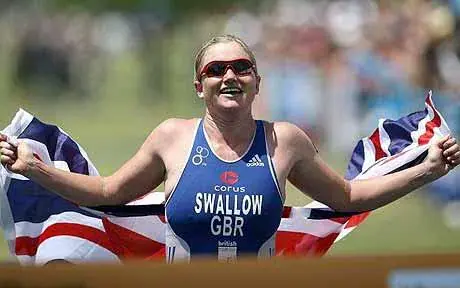
Jodie Cunnama
The Swallow's Endurance: The Grit, Glory, and Grace of Jodie Cunnama.
The Swallow's Endurance: The Grit, Glory, and Grace of Jodie Cunnama#
Introduction: The Comeback Tale is Over#
The sun over Perth, Australia, was relentless. On a blistering October day in 2009, with the temperature climbing to 32 degrees Celsius and punishing winds whipping across the Swan River, the finish line of the ITU Long Distance Triathlon World Championships shimmered in the heat. For most athletes, it was a battle of survival. For Jodie Swallow, it was a coronation. Grasping a Union Jack, she crossed the line not merely as a victor, but as a force of nature, having led the race from the very first stroke of the swim to the final stride of the run. She had not just won; she had dismantled a world-class field, finishing more than eleven minutes ahead of her nearest rival.
The moment was electric, a display of raw power and tactical genius. But for Swallow, its significance ran far deeper than the gold medal placed around her neck. "It feels like a chapter finally concluded," she would later reflect. "It feels like my comeback tale is finally over and now it's time to turn the next page". Those words, spoken in the afterglow of a career-defining triumph, hinted at a preceding narrative of profound struggle. This was not just a win; it was an exorcism. It was the culmination of a nine-year journey through the highest echelons and the darkest depths of elite sport.
Jodie Swallow Cunnama's career is one of the most compelling in the history of triathlon, a two-decade project built on a rare combination of prodigious talent and sheer, bloody-minded grit. Her résumé is formidable: an Olympian, a three-time world champion across two different disciplines, a three-time Ironman champion, and a fifteen-time Ironman 70.3 winner. Yet, to measure her journey by titles alone is to miss the heart of the story. Hers is a legacy defined not only by the trophies on her mantel but by a relentless spirit that saw her overcome near-career-ending injuries, public scrutiny, and deeply personal battles with her own mind and body. It is the story of an athlete who was forced to lose everything to find herself, and in doing so, redefined success entirely on her own terms.
Part I: The Prodigy's Path (1981-2000)#
Born in Brentwood, Essex, on June 23, 1981, Jodie Ann Swallow seemed destined for athletic greatness. From a young age, she was an outlier, a multi-disciplinary talent who collected national school championships in swimming, athletics, and cross-country with remarkable ease. Her parents were her earliest inspiration, ferrying her "here, there and anywhere" she wanted to race. Her prowess in the pool was particularly striking. At just 16 years old, she was already a formidable competitor, winning the 400 metres individual medley title at the ASA National British Championships in 1996 and recording a blistering time of 4:48.6 On the track, she was equally dominant, running a 9:42 for 3 km.
This extraordinary talent, however, was a double-edged sword. To be a national champion in three distinct sports is to carry an immense weight of expectation, both from the outside world and, most acutely, from within. Swallow has spoken candidly about being a "real high-achieving athlete as a child" and feeling "lots of pressure from a very young age". It was during this period of intense focus and burgeoning success that the seeds of a lifelong struggle were sown. She has directly linked the pressures of her early athletic career to the onset of an eating disorder that emerged during puberty, a battle that began well before she ever entered the world of triathlon. The very drive and perfectionism that propelled her to the top of podiums were intrinsically connected to the internal demons she would face for decades. The pressure was not a coincidental side effect of her success; it was a direct byproduct of it.
Her formal entry into triathlon came while she was pursuing a Sports Science degree at the prestigious Loughborough University, a natural convergence of her swimming and running backgrounds. She turned professional in 2000 and her impact was immediate. As a junior athlete in the British Triathlon System, she was a dominant force, winning the national junior titles in both 2000 and 2001, and adding the senior standard distance titles in 2000, 2001, and 2002. Her talent was raw, undeniable, and seemingly limitless. She was on a trajectory aimed squarely at the pinnacle of the sport, but the path ahead would prove to be far more treacherous than anyone could have imagined.
Part II: The Olympic Crucible and the Long Dark (2001-2008)#
Swallow's ascent through the elite ranks was meteoric. Her race strategy was simple and brutal: rely on hard work, natural talent, and an immense capacity to push herself to the absolute limit. This approach yielded phenomenal results in her first two years as a professional, but it also made her perpetually vulnerable to injury. Her target was clear: a spot on Great Britain's triathlon team for the 2004 Summer Olympics in Athens.
The journey to Athens would become the most pivotal and traumatic period of her young career. She secured a spot on the team, but under a cloud of controversy. She was nursing a significant calf tear, and the selectors' decision to choose an injured "rookie" over seasoned veterans sparked fury. Fellow triathlete Leanda Cave, who was overlooked, publicly called the selection a "massive risk," questioning whether Swallow could possibly be fit for the August showpiece. The pressure was immense. Swallow later described the lead-up to the Games as "the worst of my life," a period where she struggled mentally, unable to train effectively and forced to run through constant pain. At the Olympics, the ultimate dream for so many athletes, she finished a distant and disappointing 34th.
For most, the Olympics represents a pinnacle. For Swallow, it was a breaking point. The public controversy, the physical pain, and the crushing weight of underperformance sent her into a tailspin. The four years that followed were a period of deep personal and professional crisis. She has described it in the bleakest of terms, as a "very horrid place" from which she had to stage a comeback. It was a time marked by "personal problems" where she seriously contemplated quitting triathlon altogether. The Olympic dream had devolved into a nightmare, one that stripped her of her confidence and forced a complete, painful re-evaluation of her identity and her relationship with the sport. It took until 2007, under the guidance of a new coach, Livio Salvador, whose "enthusiasm and faith" helped her believe she could recover, for the first glimmers of a comeback to emerge. She had survived the crucible, but the experience had irrevocably changed her.
Part III: The Rebirth in Long Distance (2009-2010)#
After the disillusionment of the post-Athens years and a grueling campaign on the ITU circuit in the lead-up to the 2008 Beijing Olympics, Swallow stood at a crossroads. A "personal email from a friend" served as the catalyst for a monumental shift in her career: she decided to move on and take on long-distance triathlon. It was a deliberate pivot away from the frenetic, draft-legal racing of the Olympic circuit and toward a format that would allow her formidable individual strengths to flourish. This move was more than a strategic change; it was an act of self-determination.
The non-drafting format of long-course racing is the ultimate test of the individual, rewarding athletes who can dictate terms from the front. For an athlete who had felt the sting of team selection politics and the chaos of pack dynamics, it was a form of liberation. Here, her success would depend solely on her own engine. Her frustration with the Olympic-focused funding structure of British Triathlon, which she noted did not support long-distance athletes like herself or Chrissie Wellington, further solidified her choice to forge her own path.
Her arrival on the long-course scene was not merely an entrance; it was an explosion. At the 2009 ITU Long Distance Triathlon World Championships in Perth, she delivered a performance that was both a masterclass and a statement of intent. She "ripped the field to pieces". Emerging from the 3 km swim with a one-minute lead, she systematically crushed the competition on the windy 80 km bike course, extending her advantage to a staggering eight minutes. By the time she crossed the finish line, her margin of victory was over eleven minutes. In her own words, it was the end of her "comeback tale". She was no longer the injured Olympian; she was a world champion.
A year later, she solidified her new status at the 2010 Ironman 70.3 World Championship in Clearwater, Florida. Avenging a DNF from the previous year, she delivered another iconic wire-to-wire victory. Her splits told the story of total domination: a 24:20 swim that gave her an early lead, a powerful 2:16:37 bike, and a race-best 1:21:59 half-marathon that sealed the win in 4:06:28, more than six minutes clear of the field.
Despite this resounding success, her focus was not singular. The dream of a home Olympics still burned, and she viewed her long-course racing as a parallel path, one that could build fitness, confidence, and the financial stability that was often elusive on the ITU circuit, all in service of her ultimate goal for London 2012. She had found a new arena in which to thrive, one where she was in complete control of her own destiny.
Part IV: A Decade of Dominance and a New Home (2011-2017)#
The decade that followed her first two world titles was a showcase of sustained excellence, as Swallow, and later Cunnama, established herself as one of the most formidable and consistent athletes in the sport. Her adopted home of South Africa became her kingdom. At Ironman 70.3 South Africa in Buffalo City, she was simply untouchable, winning the race an incredible seven consecutive times from 2011 to 2017 The race, known for its hot, windy, and hilly course, suited her attritional style perfectly. Her 2016 victory was perhaps the most emphatic, as she broke her own course record with a time of 4:23:29, finishing nearly 20 minutes ahead of the runner-up.
She seamlessly translated this dominance to the full Ironman distance. In 2013, she claimed her first Ironman title in Sweden, breaking the tape with a phenomenal sub-nine-hour time of 8:54:01. She went on to conquer major continental championships, winning the Ironman African Championship on home soil in 2015 and the Ironman Asia-Pacific Championship in Cairns, Australia, in 2016 The Cairns victory was a testament to her toughness; she had entered the race as a late decision after crashing out of the African Championship earlier that year.
The ultimate prize in long-distance triathlon, the Ironman World Championship in Kona, Hawaii, remained a central focus. The race, with its unique environmental and competitive pressures, was one she acknowledged "does not suit me". Yet, her aggressive, front-running race style made her a perennial threat. Her strategy was always to play to her strengths: attack the swim and bike to build an insurmountable lead on the fleet-footed runners. In 2014, this strategy nearly paid off in the grandest fashion. She executed a brilliant race, leading for long periods before ultimately finishing 4th, less than 10 minutes behind the legendary champion Mirinda Carfrae. It was her best-ever result on the Big Island and what she considered her "best shot" at the title.
Woven into the fabric of this athletic peak was her relationship with fellow professional triathlete James Cunnama. Their partnership became a cornerstone of her life, both personally and professionally. They made their home in the beautiful but harsh training environment of Stellenbosch, South Africa. They were a formidable team, though she admitted their training dynamic had its limits: they swam together, where she would push him in the pool, but would argue if they tried to do much more. After the 2016 season, the couple married, officially uniting two of the sport's biggest names.
That same year, she came full circle. Seven years after her first long-distance world title in Perth, she stood atop the podium once more at the 2016 ITU Long Distance Triathlon World Championships in Oklahoma City. In what had become her signature style, it was another flawless, wire-to-wire victory, winning by over seven minutes. It was a fitting capstone to a remarkable period of dominance and, as she noted with a smile, her last major race with "Swallow on my bum".
Table 1: Jodie Swallow/Cunnama: Major Career Achievements
| Year | Achievement |
|---|---|
| 2004 | Olympian, Athens Summer Olympics (34th) |
| 2009 | 1st, ITU Long Distance Triathlon World Championships |
| 2010 | 1st, Ironman 70.3 World Championship |
| 2010 | 1st, Tongyeong ITU Triathlon World Cup |
| 2011-2017 | 7x Consecutive Winner, Ironman 70.3 South Africa |
| 2012 | 3rd, ITU Long Distance Triathlon World Championships |
| 2013 | 1st, Ironman Sweden |
| 2014 | 4th, Ironman World Championship (Kona) |
| 2014 | 2nd, Ironman 70.3 World Championship |
| 2015 | 1st, Ironman African Championship (South Africa) |
| 2016 | 1st, Ironman Asia-Pacific Championship (Cairns) |
| 2016 | 1st, ITU Long Distance Triathlon World Championships |
Part V: The Unseen Race: Acknowledging the Struggle#
Behind the glittering array of world titles and course records lay a parallel race, one fought not on the Queen K Highway or the shores of Buffalo City, but within her own mind. Throughout her career, Jodie Cunnama has spoken with remarkable candor about the personal battles that shaped her journey, offering a rare and powerful glimpse into the vulnerabilities of a world-class athlete.
Her struggle with an eating disorder, which began in her youth under the immense pressure of being a high-achieving child athlete, was a constant companion. She has described it as something "carved in my personality," and has openly wondered if she will "ever have a normal relationship with my body image, even if I have a normal relationship with food". This admission reveals the profound and lasting impact of such struggles, which persist long after athletic performance has been perfected. Her courage in speaking out serves as a crucial lesson for the sport, and her advice to young girls facing similar issues is direct and unequivocal: "you have to be honest with people... it's not worth it and you have to do something about it as soon as you can".
This internal struggle provides a vital psychological lens through which to view her athletic career. She has admitted to suffering from low self-esteem, and that in her early years, her motivation was fueled by having "something desperate to prove — probably more to myself than anyone". This creates a fascinating paradox where her performance was both a symptom of her struggles and the primary salve she used to treat them. The relentless discipline of training and the tangible, black-and-white nature of race results provided a powerful coping mechanism, a "place to direct my anger or passion or whatever I'm feeling".
In this context, her aggressive, front-running race strategy takes on a deeper meaning. It was not just a tactic to win; it was an attempt to exert absolute control in one sphere of her life when other areas felt profoundly uncontrollable. Triathlon, for all the pressure it created, was also the primary tool she used to manage that pressure. Her greatest challenges and her greatest strengths were, and perhaps still are, inextricably linked.
Part VI: The Next Finish Line: Mother, Mentor, Coach (2017-Present)#
In 2017, while still at the peak of her athletic powers, Jodie Cunnama made the decision to step away from full-time professional racing after becoming pregnant with her first child. The transition from elite athlete to mother was profound. She and James would go on to have three children, including twins, a life change that fundamentally shifted their priorities and focus. The family eventually relocated from their long-time base in South Africa back to the UK, beginning a new chapter.
Retirement from racing, however, was not an exit from the sport. Instead, she channeled two decades of experience, triumph, and hard-won wisdom into a second act as a high-performance coach. Through Cunnama Coaching, a venture with her husband James, she began mentoring a new generation of athletes, from professionals like fellow British star Jodie Stimpson to dedicated age-groupers with ambitious goals. She also took on a role as a British Triathlon regional academy coach, preparing aspiring champions aged 14 to 18 for the rigors of elite competition.
Her coaching philosophy is a direct and powerful reflection of her own journey. It is a corrective experience, designed to build the kind of supportive and holistic environment she often had to fight to find for herself. She champions an intuitive, athlete-centered approach, emphasizing the importance of understanding the person behind the performance data. This methodology was heavily influenced by her time with coach Siri Lindley, whom she credits as her most significant female role model. Lindley, she says, "had far more interest in the person, which meant she understood what I needed as an athlete," a style that went against the traditional, prescriptive coaching models she had experienced elsewhere.
Now, Cunnama is paying that lesson forward. She is a vocal advocate for creating more opportunities for female coaches, arguing that visibility and recruitment are crucial for them to flourish and become the role models the sport needs. Her coaching career is not just a job; it is the culmination of her life's work. She is actively building a healthier, more sustainable pathway for the next generation, ensuring they have the kind of mentorship that nurtures both the athlete and the individual.
Conclusion: An Enduring Legacy#
Jodie Cunnama's 20-year project in the world of triathlon is a tapestry woven with threads of brilliant success and profound adversity. The statistics alone are staggering: an Olympian, a three-time World Champion, a three-time Ironman Champion, and the winner of fifteen Ironman 70.3 titles. She was an athlete who raced with her heart, a fierce competitor who could dominate a race from the front and leave the best in the world in her wake.
Yet, her true legacy lies beyond the finish lines and the trophies. It is found in her extraordinary resilience—the ability to pull herself out of a "horrid place" after the Athens Olympics and rebuild her career into something stronger and more authentic. It is found in her courage—the willingness to speak openly and honestly about her vulnerabilities, from eating disorders to low self-esteem, providing a powerful and necessary voice in a sport that often prizes invincibility. And it is found in her evolution—from a prodigious talent driven by a desperate need to prove herself, to a champion, a wife, a mother, and now a mentor committed to passing on her hard-won wisdom.
She is one of triathlon's most complete and compelling figures, an athlete who experienced the dizzying highs of world championship glory and the crushing lows of personal and professional despair. Through it all, she endured. Jodie Cunnama ultimately found her greatest strength not just in winning races, but in navigating the complex, challenging, and beautiful endurance event that is life itself.