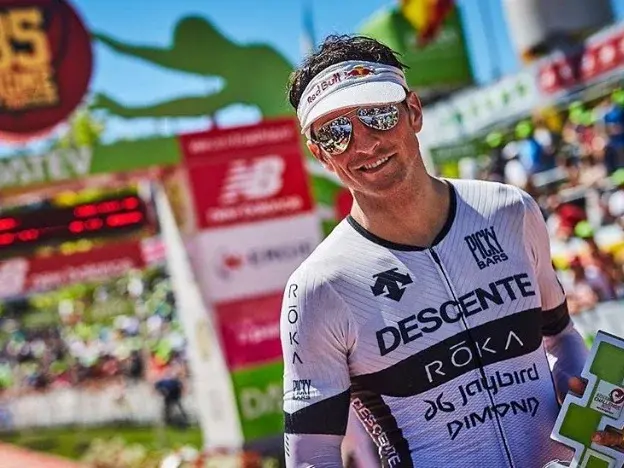
Jesse Thomas
The Accidental Icon: How Jesse Thomas Won Races, Built a Business, and Rewrote the Rules of Being a Pro.
The Accidental Icon: How Jesse Thomas Won Races, Built a Business, and Rewrote the Rules of Being a Pro#
Introduction: The Man in the Cheap Sunglasses#
The air at Lake San Antonio in central California hangs thick with dust, heat, and the unique energy of the Avia Wildflower Triathlon. It’s 2011, and the event, affectionately known as the "Woodstock of Triathlon," is in full swing. The finish line is a chaotic celebration, a festival of endurance where seasoned professionals, legends of the sport, are expected to claim their rightful place on the podium. But as the clock ticks past the four-hour mark, a figure emerges, churning through the final meters with a surprising lead. He’s not one of the familiar faces. He’s wearing a borrowed aero helmet, riding a borrowed bike, and, most curiously, sporting a pair of cheap, drugstore aviator sunglasses.
As he breaks the tape, a shockwave of confusion and surprise ripples through the crowd and the announcer’s booth. The race announcer, tasked with narrating the victory, is stumped. Leaning into the microphone, he voices the question on everyone’s mind: “Who are you?”.
The man was Jesse Thomas, a first-year pro who had entered the race on a whim and slept in a closet the night before. That moment, born of anonymity and sealed with an improbable victory, was the explosive beginning of one of the most unique and beloved careers in modern professional sports. It was the birth of a legend, not just of a champion, but of an everyman who had crashed the elite party and, in doing so, became the sport’s most relatable star. Jesse Thomas’s career would ultimately be defined not just by his impressive collection of titles, but by the improbable, authentic, and multi-faceted journey he took to achieve them. He came to represent a new breed of professional athlete—one who masterfully balanced world-class performance with the gritty realities of entrepreneurship, the profound demands of family, and a candidly human persona, proving that in the modern era, a great story can be as powerful as a gold medal.
Part I: The Runner Who Couldn't Run: A Dream Derailed#
The Stanford Steeplechaser#
Long before he was a triathlete, Jesse Thomas was a runner. It was his first athletic identity, forged on the trails and tracks of his hometown of Bend, Oregon, where he was a state-champion distance runner at Mountain View High School. His talent carried him to one of the most prestigious athletic and academic institutions in the country: Stanford University. There, he wasn't just a participant; he was a force. Competing in the grueling 3,000-meter steeplechase, a race that combines endurance with the technical skill of clearing barriers, Thomas established himself as one of the nation's elite.
In 2001, he became Stanford's first-ever Pac-10 champion in the event, a dramatic victory where he overtook the defending champion after his rival fell over the final barrier. His collegiate career was decorated with accolades: he was an NCAA All-American and, at the U.S. National Championships in 2002, he set a Stanford school record of
8:35.83 that remains untouched. His prowess was not confined to the track. While majoring in Mechanical Engineering, he was a two-time Pacific-10 All-Academic First Team selection, demonstrating from the outset a rare dual aptitude for elite athletics and rigorous intellectual pursuits.
The Olympic Dream and the First Break#
With a trajectory aimed squarely at the highest echelons of the sport, the Olympics were a tangible goal. However, this dream was abruptly cut short. A debilitating injury suffered during the steeplechase trials ended his aspirations and, for all intents and purposes, his elite running career. It was the first of what would become a pattern of devastating setbacks that, paradoxically, would pave the way for his future success. Each apparent end was merely a violent course correction, forcing a reinvention. The loss of his running career was not the end of his athletic life, but the necessary precondition for him to discover another.
The Second Break: A Broken Neck#
Pivoting from the high-impact world of running, Thomas discovered cycling while pursuing his Master's degree in Mechanical Engineering at Stanford. He took to the new sport with the same intensity and natural ability he had shown on the track, progressing so rapidly that he began to entertain the possibility of a professional cycling career. But disaster struck again, this time with even more terrifying consequences. A fall during a ride resulted in a fractured C1 vertebra—a broken neck.
The injury was catastrophic. He spent nine agonizing months confined to a neck brace, his recovery culminating in a surgery to install a permanent plate and four titanium screws to stabilize his spine. This was not a typical sports injury from which one simply rehabilitates and returns. It was a life-altering event that made any future in elite athletics seem impossible. Twice, he had stood on the cusp of a professional athletic career, and twice, it had been violently torn away.
The Corporate Interlude#
Believing his athletic life was definitively over, Thomas did what many bright, ambitious Stanford graduates do: he went to work in the tech industry. For about five years, he immersed himself in the startup world of San Francisco, working as a tech entrepreneur. The life was demanding, with work weeks averaging 60 to 70 hours. He later described this period as a "very one-dimensional life," one that left him with little time or energy for anything outside of work. While he was building a career, he felt a growing sense of imbalance. The passion for athletic pursuit that had defined his identity for so long had been extinguished, replaced by a relentless corporate grind. This deep-seated dissatisfaction planted the seed for his eventual, and seemingly impossible, return to sport.
Part II: The MBA and the Unconventional Path#
A Calculated Risk#
The next major pivot in Jesse Thomas’s life came at a moment of global economic turmoil. He graduated with an MBA from the University of Oregon's prestigious Lundquist College of Business in 2009, directly into the teeth of the Great Recession. It was perhaps the worst possible time to hold a newly minted business degree; companies were laying off MBAs by the thousands, and the traditional corporate paths were all but closed. Faced with a bleak job market, he made a decision that was both pragmatic and audacious. As he later recounted, "I figured if I wasn't going to make any money, I may as well do something I love!". Instead of chasing a non-existent paycheck, he decided to chase a dream: becoming a professional triathlete.
This decision reframed what could have been a curse into a unique opportunity. The economic crisis that slammed the door on a conventional career forced him to consider an unconventional one. His MBA, rather than being a ticket to a corner office, became a different kind of asset. It provided him with a skillset and a safety net that allowed him to take a monumental risk.
The European Catalyst#
The decision to fully commit to triathlon was crystallized during a three-month trip to Europe with his then-girlfriend and fellow Stanford track star, Lauren Fleshman, who is now his wife. This extended break, away from the pressure of a futile job search, served as an incubator for his renewed athletic ambitions. It was a period of reflection that reignited his deep-seated passion for competition and training, solidifying his resolve to pursue triathlon professionally when he returned to the United States.
The Early Grind#
His entry into the world of professional triathlon was anything but glamorous. The sport is notoriously expensive, and prize money is scarce for those not at the absolute peak. This is where his business education became instrumental. Leveraging his MBA and engineering background, he started a small firm, Leap Day Consulting, and took on 10 to 20 hours a week of product and business development consulting work. This income was just enough to survive, funding his grueling 3-to-5-hour daily training sessions. This period highlights a crucial aspect of his journey: he was simultaneously building two careers. He was an athlete in training and an entrepreneur in practice, using the analytical skills from his education to strategically enable the passionate pursuit of his athletic dream. The MBA was not his destination; it was the engine that powered the journey.
Part III: The King of Wildflower and the Birth of a Brand#
The Legendary Debut (2011)#
Jesse Thomas’s professional career was launched in a single, spectacular day that has since become triathlon folklore. His win at the 2011 Wildflower Triathlon was so unexpected that it defied belief. He was a complete unknown, so new to the pro scene that he was assigned bib number 87, the first number after the professional women's field. His preparation was a comedy of errors and resourcefulness: he slept in a closet, raced on a bike borrowed because his own was broken, and wore a helmet loaned to him by fellow pro Matt Lieto. Lacking even a proper pair of sunglasses, he made a last-minute stop at a drugstore to buy a cheap pair of aviators.
He went into the race with modest expectations, hoping only for a top-eight finish to validate his career change. Winning was a shock, not only to the triathlon community but to himself. The image of this unknown athlete crossing the finish line in his drugstore sunglasses, leaving a field of seasoned professionals in his wake, was an indelible moment that instantly created a legend.
The Accidental Brand#
Those aviator sunglasses, purchased for $11.99 at a Walgreens, became his unintentional trademark. In a sport often dominated by expensive, high-tech gear, his quirky, unpretentious look resonated with the age-group athletes who formed the backbone of the triathlon community. It was authentic, relatable, and completely organic. This "accidental" branding was more powerful than any marketing campaign. It perfectly encapsulated his underdog story and created an immediate connection with fans. The symbol became so iconic that the high-performance eyewear company ROKA later collaborated with him, their first pro athlete, to create the "Phantom," a technologically advanced pair of aviators directly inspired by his breakthrough win.
The Wildflower Dynasty (2011-2016)#
If his first victory was a shock, his subsequent performances proved it was no fluke. Thomas didn't just win Wildflower once; he owned it. He went on to win the prestigious and notoriously difficult race six consecutive times, a feat of dominance that cemented his status as a legend of the event. For Thomas, his second victory in 2012 was perhaps the most meaningful. It silenced the critics who had dismissed his first win as a "one-hit wonder" and, more importantly, it proved to himself that he truly belonged at the top of the sport. He would later call it the athletic performance he was most proud of. His reign at Wildflower, a race beloved for its gritty, community-focused, festival atmosphere, was the perfect match for his everyman persona, solidifying his status as a cult hero.
The Wildflower Dynasty: A Six-Year Reign
| Year | Winning Time | Key Fact/Note |
|---|---|---|
| 2011 | 4:04:45 | The Upset: The unknown wins in his debut |
| 2012 | 3:58:59 | The Validation: Proves the first win was no fluke |
| 2013 | 4:02:19 | The Three-peat: Establishes his dominance |
| 2014 | 4:06:13 | Continues the streak against top competition |
| 2015 | 4:10:02 | The fifth consecutive victory |
| 2016 | 4:05:32 | The Six-peat: Cements his legendary status |
Sources: 6
The Parallel Ascent of Picky Bars#
Woven into the fabric of his athletic success is the entrepreneurial journey of Picky Bars. The company was born not in a boardroom, but in his own kitchen out of necessity. The intense training regimen of a professional triathlete required him to consume upwards of 5,000 calories a day, and he found that the highly processed energy bars on the market were wreaking havoc on his digestive system. His wife, Lauren Fleshman, drew on her background in science from Stanford to begin developing homemade energy bars using only real-food ingredients.
The goal was to create a bar that was nutritionally balanced for athletic performance but was also easily digestible and tasted great. Co-founded in 2010 with Fleshman and their friend, fellow professional runner Steph Bruce, "Picky Bars" grew organically. They started by sharing batches with friends and fellow athletes, and the demand quickly outstripped their kitchen's capacity. Thomas, stepping into the role of CEO, built the company's first website and began to scale the operation. This dual identity as a world-class athlete and a startup CEO became a defining characteristic of his career, a constant and demanding balancing act. The two narratives—the underdog athlete and the authentic, needs-based food company—were perfectly intertwined. His athletic persona was the ideal marketing for a product aimed at athletes who were "picky" about what they ate, and his growing legion of fans became the company's first loyal customers.
Part IV: Conquering the Ironman#
From Specialist to Champion#
While Thomas had established himself as one of the world's best at the half-Ironman distance, the full Ironman—a grueling 2.4-mile swim, 112-mile bike, and 26.2-mile run—remained a new frontier. True to form, his debut at the distance was unconventional. In 2015, just two weeks after competing in the 70.3 World Championships, he made the spontaneous decision to race Ironman Wales, an event known for its brutally hilly and challenging course. In his very first attempt at the distance, he won.
The Lanzarote Statement (2016)#
The absolute pinnacle of his Ironman career came in 2016 at Ironman Lanzarote, one of the toughest races on the global circuit. The volcanic, windswept island is known for breaking even the strongest athletes. The competitor to beat that day was Jan Frodeno of Germany, the reigning Ironman World Champion and a man widely considered one of the greatest triathletes of all time.
The race unfolded dramatically. Frodeno exited the swim with the lead, and by the halfway point of the bike leg, Thomas was over five minutes behind. But he remained patient and methodical. He entered the marathon run about three minutes behind the German champion and began a relentless pursuit. Frodeno, known for his running prowess, looked to be on his way to another victory. But Thomas was keeping pace. He cut the gap to just over a minute by the 20-kilometer mark. Then, at 25 kilometers, he made the pass. He didn't just catch the world champion; he broke away, running a blistering 2:46:56 marathon to take a stunning and decisive victory. Beating Jan Frodeno at a major championship was a monumental statement. It was the win that erased any lingering doubts and solidified his place among the absolute elite of long-distance triathlon.
The Kona Crucible#
In stark contrast to the triumphant highs of Wales and Lanzarote, Thomas's experiences at the Ironman World Championship in Kailua-Kona, Hawaii, were a humbling lesson in the brutal reality of the sport's most hallowed race. He competed on the Big Island twice, finishing a respectable 16th in 2016 and 27th in 2017.
It was his candid and raw race report from 2017 that offered the most insight into both the man and the myth of Kona. He detailed the immense effort and personal expense required just to qualify, flying to races in China, Peru, and Lanzarote, and investing in wind tunnel testing to optimize his position. On race day, he executed a solid swim and a strong bike leg, putting himself in contention for a top finish. But the infamous Kona run course, with its oppressive heat and soul-crushing climbs, broke him down. He described feeling smooth for the first 10 miles before his body began to rebel. Cramps seized his muscles, his energy plummeted, and his stomach turned. He wrote of the agonizing moment at mile 15 when the realization hit him that he still had "ELEVEN MILES to go in oppressive heat with a body that wanted nothing more than to stop".
This willingness to share his suffering and disappointment was just as defining as his victories. While Lanzarote showed his capacity for physical dominance, his Kona stories revealed his vulnerability. By publicly documenting his struggles on the sport's biggest stage, he demystified the elite experience and reinforced his connection with the everyday athlete. He was both a giant-killer and a man humbled by the Queen K Highway, and this duality was the very essence of his appeal.
Part V: The "Triathlife" Circus: Work, Play, Love#
The Double-Pro Marriage#
A central pillar of Jesse Thomas's story is his partnership with Lauren Fleshman. They are a true athletic power couple, with both partners having competed at the absolute highest level of their respective sports. Thomas wrote with remarkable candor about the unique challenges of this "double-pro marriage." He acknowledged the inherent selfishness required to be an elite athlete and the constant negotiation needed when both partners are in "primary pursuer" mode.
He famously coined the term "Mr. Fleshman" to describe his alter ego, the "super-supporter" who would put his own training and ambitions on the back burner to fully support Lauren's career, especially during her emotionally charged attempts to make the Olympic team. This concept provided a transparent look into the compromises and sacrifices required to make their partnership work, a reality that resonated deeply with couples everywhere who were trying to balance individual ambitions with shared lives.
The Impact of Fatherhood#
The arrival of their son, Jude, and later their daughter, Zadi, represented another fundamental shift in his life and career. In his columns, he wrote with his signature humor and honesty about the chaotic reality of integrating a "miniature poop machine" into the highly structured life of a professional athlete. He detailed the trade-offs, like sacrificing sleep for family time, and the unexpected lessons in efficiency. He realized that a workout he had previously blocked three hours for—including transition time, socializing, and choosing a water bottle—was, in fact, only a two-hour workout. Fatherhood forced him to become ruthlessly efficient with his time.
The Voice of the Everyman Pro#
Through his long-running "Triathlife" column in Triathlete Magazine and later the "Work, Play, Love" podcast he co-hosted with Fleshman, Thomas cultivated a unique and powerful voice within the sport. His platform was not just for race reports; it was a space for radical transparency. He tackled subjects other pros often avoided: the financial precarity of the sport, the mental burden of pressure and expectation, the absurdities of triathlon culture, and the emotional toll of injury and, eventually, retirement.
While his "everyman" persona may have started accidentally with a pair of cheap sunglasses, it was deliberately and skillfully nurtured through his writing and podcasting. He made a conscious choice to share the unglamorous, messy, and often stressful reality of his "three-ring circus". In doing so, he articulated the very same struggles with balancing work, family, and training that countless age-group athletes faced every day. He became their ultimate representative at the professional level, building a fiercely loyal community that was invested not just in his race results, but in his life.
Conclusion: The Next Finish Line#
The Slow Fade to Retirement#
Jesse Thomas's retirement from professional triathlon, officially announced in May 2020, was not an abrupt end but a gradual transition that had been in motion for nearly two years. His last professional triathlon was Challenge Roth in 2018. There, he had what he called "damn-near the race of his life," achieving all his goals: he finished on the podium in 3rd place, broke the coveted 8-hour barrier with a time of 7:54:38, and ran a 2:44:52 marathon. It was a career day, but it came at a cost. His body, as he described it, was "hanging on by a thread," and he left the race physically, mentally, and emotionally "burnt".
The Confluence of Factors#
His decision to step away was driven by a perfect storm of converging priorities:
- The Physical Toll: After Roth, he took a break and then set his sights on a new goal: qualifying for the Olympic Marathon Trials. He was on track until he broke the navicular bone in his foot during a half marathon, an injury that required a year-long recovery. This was the final physical setback.
- Business Demands: Simultaneously, Picky Bars was facing a "damn-near crisis" with a manufacturing issue that threatened the company's stability. As CEO, his full attention was required to navigate the challenge.
- Family Priorities: Most importantly, the pull of family became paramount. He wanted to be a more present father and husband, to have the energy for rock climbing and wrestling with his son, and to not be "crazy exhausted" all the time. The balance had irrevocably shifted.
Pivoting to "Pro CEO"#
His retirement was not an ending but a deliberate and successful pivot. He declared his new goal was to become a "world-class CEO, husband and dad". He has since fulfilled that ambition with the same drive he once applied to racing. He oversaw the successful acquisition of Picky Bars by Laird Superfood in a $12 million deal and has since taken on a new challenge as the Chief Brand Officer for BranchOut Food, where he is leading their direct-to-consumer strategy.
His legacy in triathlon is multi-faceted. He was, without question, a champion of the highest caliber, a winner of some of the sport's most iconic and challenging races. But his true impact extends far beyond the finish line. He was a storyteller, an entrepreneur, and a pioneer who fundamentally changed the perception of what a professional athlete could be. He built a career, a business, and a global brand on a foundation of grit, humor, and radical transparency. Jesse Thomas proved that you could be a world-beater on Sunday and a relatable, struggling, yet striving human being on Monday, leaving an indelible mark as triathlon's most unlikely and authentic icon.