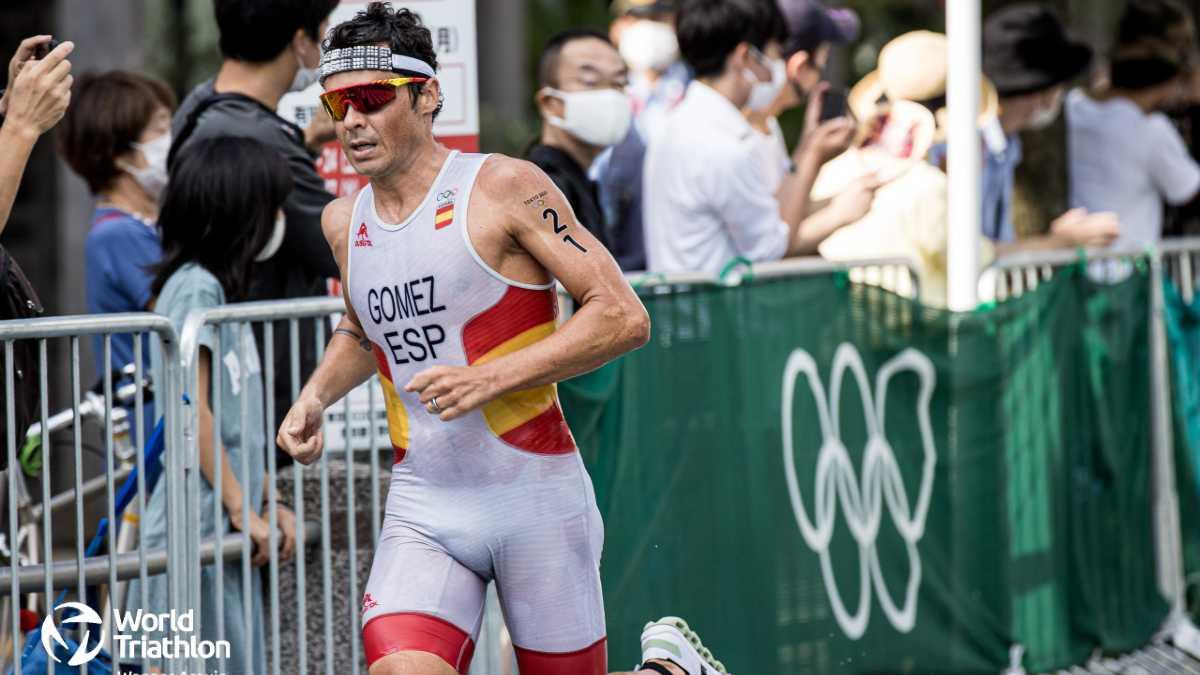
Javier Gomez Noya
Spain’s double Olympic medallist and 5 time World Champion.
The Captain: How Javier Gómez Forged a Legend in the Fires of Adversity and Rivalry#
In September 2024, after twenty-six years of relentless pursuit, Francisco Javier Gómez Noya announced the quiet abdication of his throne. It was not a sudden departure but a considered conclusion from a man who had pushed his body to its absolute limits, achieving a career that, in his own words, "not even in my craziest dreams I could have imagined". For the world of triathlon, it was more than the retirement of a single athlete; it was the closing of a definitive golden era, an epoch he had co-authored with a generation of titans. His was a reign defined not merely by the unprecedented volume of his victories but by the near-insurmountable obstacles he conquered to achieve them.
Gómez leaves the sport as arguably its most complete and decorated champion. His résumé is a staggering testament to dominance across every conceivable distance and discipline of the sport. He is the first and only athlete to have won five International Triathlon Union (ITU) World Championships, including a record three in succession. He is an Olympic silver medalist, a two-time Ironman 70.3 World Champion, an XTERRA (off-road) World Champion, and an ITU Long Distance World Champion. His career statistics—138 starts, 85 podiums, 46 wins—paint a picture of metronomic consistency that may never be matched.
Yet, to understand the true measure of the man known as "El Capitán," one must look beyond the numbers. His legend was forged in the crucibles of a career-threatening medical diagnosis and a historic rivalry that elevated the sport to new heights. Upon news of his retirement, it was his greatest adversary, Alistair Brownlee, who perhaps best encapsulated his impact: "Congratulations on an amazing career, Javi. I'm grateful for the countless battles we had, you constantly pushed those you raced to be better". It was a sentiment that acknowledged a fundamental truth: the greatness of Javier Gómez was symbiotic, shaped and sharpened by the very forces that stood in his way.
| Year | Championship Title | Discipline / Distance |
|---|---|---|
| 2003 | ITU World Champion | U23 Olympic |
| 2008 | ITU World Champion | Elite Olympic |
| 2010 | ITU World Champion | Elite Olympic (Series) |
| 2012 | Olympic Silver Medallist | Elite Olympic |
| 2012 | XTERRA World Champion | Off-Road Triathlon |
| 2013 | ITU World Champion | Elite Olympic (Series) |
| 2014 | ITU World Champion | Elite Olympic (Series) |
| 2014 | Ironman 70.3 World Champion | Middle Distance |
| 2015 | ITU World Champion | Elite Olympic (Series) |
| 2017 | Ironman 70.3 World Champion | Middle Distance |
| 2019 | ITU World Champion | Long Distance |
I. The Crucible: A Fight for a Heartbeat#
The story of Javier Gómez begins not in Spain, but in Basel, Switzerland, where he was born in 1983 to Spanish immigrant parents. At just three months old, his family returned to their native Galicia, the rugged, verdant corner of northwestern Spain that would become his home and training ground. A keen swimmer and footballer in his youth, he discovered triathlon in 1998 at the age of 15, and his ascent was immediate and startling. His natural talent was so profound that he was soon winning nearly every race he entered in his category, his powerful swim and metronomic run marking him as a prodigy.
But just as his path to glory seemed preordained, it was almost permanently blocked. In late 1999, during a routine medical screening, doctors from Spain's Higher Sports Council (Consejo Superior de Deportes, or CSD) detected a cardiac anomaly, an "abnormal heart valve". The diagnosis was a potential death sentence for his nascent career. The CSD, citing concerns for his safety, withdrew his international license, triggering a protracted and agonizing six-year battle that would test his resolve far more than any race ever could.
For a young athlete on the cusp of greatness, it was a uniquely cruel form of purgatory. He was not sidelined by injury, but by bureaucracy. His own body felt strong, yet he was barred from competition, at times both at home and abroad. The dispute cost him a place on the Spanish team for the 2004 Olympic Games in Athens, a dream deferred by a panel's decision. Lesser men would have surrendered. Gómez, however, possessed a quiet, unyielding stubbornness. Supported by his family and a team of world-renowned cardiologists, including a prestigious English physician who vouched for his fitness to compete, he fought relentlessly to prove the CSD wrong.
In November 2003, his license was provisionally restored. What happened next would become the foundational moment of his career, a defiant announcement of his indomitable will. With just three weeks of proper training and still far from peak condition, the 20-year-old Gómez flew to Queenstown, New Zealand, for the U23 World Championships. He won. The victory was more than a medal; it was validation. It was proof that his heart was strong enough and, more importantly, that his mind was unbreakable.
Even then, the fight was not over. The CSD revoked his license again in 2005 before it was finally and permanently restored in early 2006. This prolonged crucible forged the mental fortitude that would become his greatest weapon. He learned, as he would later reflect, to "control only what he could" and to believe in himself when others doubted. When he returned to the elite circuit for good, he carried with him a powerful motivation: "I knew that I had to show the others 'Hey! I am here and I am stronger than ever'". The years spent fighting for his career had given him a perspective his rivals lacked. The physical pain of a two-hour triathlon was nothing compared to the psychological anguish of having his dream unjustly denied. He had already won the hardest race of his life.
II. The Brownlee Wars: Forging a Legend in the Crucible of Rivalry#
When Javier Gómez was finally free to compete without restriction, he entered an elite triathlon world on the verge of a seismic shift. That shift had a name: Brownlee. The arrival of British brothers Alistair and Jonny Brownlee heralded a new, brutally aggressive era in short-course racing. Their era and Gómez's would become inextricably linked, producing what many consider "the greatest rivalry the sport has ever seen over the Olympic distance".
Before the Brownlees, draft-legal racing could often be a strategic affair—a hard swim and a tactical, pack-riding bike, all setting up a decisive 10-kilometer footrace. Alistair, in particular, shattered that paradigm. He raced with a singular, ferocious intent: to inflict maximum pain from the starting horn. He turned every race into a war of attrition, attacking on the bike "like there's no tomorrow and still able to run a 29min flat". He fundamentally changed the game.
This new reality forced Gómez to evolve. No longer could he rely solely on his powerful, metronomic run to reel in the leaders. He had to "upgrade his game". He transformed himself from a phenomenal runner into a complete triathlete, a tactical master who could handle bike breakaways, push the pace in the water, and, crucially, win a shoulder-to-shoulder sprint down the blue carpet. Their rivalry was not merely a competition; it was an engine of innovation. As Gómez himself would later admit, Alistair "pushed me to my limits and, thanks to that, I reached my highest level".
The apex of their shared history came on August 7, 2012, in London's Hyde Park. The men's Olympic triathlon was the most anticipated race in the sport's history, a showdown on home soil for the Brownlees against their formidable Spanish rival. In front of a raucous crowd of over 300,000, the race unfolded like a Shakespearean drama. Alistair, in a display of sheer aerobic power, executed his race plan to perfection, pushing a relentless pace on the run to break the field. Jonny, despite incurring a 15-second penalty for a transition infringement, showed immense grit to hang on for a medal.
And in between them was Gómez. After the heartbreak of Beijing in 2008, where he finished a gut-wrenching fourth, just eight seconds from the podium, London was his moment of redemption. He fought valiantly, the only athlete capable of staying anywhere near Alistair's blistering pace. He crossed the line 11 seconds behind the elder Brownlee to claim a hard-won silver medal. The resulting podium was one of the most iconic images in triathlon history: Alistair, Gómez, and Jonny. The Spaniard had split the brothers, denying them a family one-two but cementing his place alongside them at the pinnacle of the sport. The rivalry had pushed them all to a higher plane, and on that day in London, the world saw the result.
III. The Drive for Five: A Study in Unmatched Consistency#
While the Olympics provided moments of high drama, it was in the season-long grind of the ITU World Championship Series that Javier Gómez built his legacy of unmatched consistency. The series format, which replaced the one-day championship in 2009, rewards not just brilliance on a single day but sustained excellence over an entire year. No one mastered it like Gómez. His record five world titles were not won in the same manner; each was a masterclass in a different facet of competitive greatness, showcasing his remarkable evolution as an athlete.
2008 - The First Ascent (Vancouver)#
Before the series format, the world champion was crowned in a single, winner-take-all race. In 2008, in Vancouver, Gómez claimed his first elite world title. Coming off a silver medal the previous year, this commanding victory over New Zealand's Bevan Docherty confirmed his standing as the world number one and set the stage for his Olympic debut in Beijing. It was a win built on raw, undeniable power.
2010 - The Tactical Masterclass (Budapest Grand Final)#
His second world title, and first in the new series format, was a testament to his strategic intelligence. Entering the Grand Final in Budapest, Gómez trailed Germany's Jan Frodeno in the overall standings. The race itself became a dramatic duel with Alistair Brownlee, who was returning from injury. For the entire 10-kilometer run, the two rivals ran side-by-side. In the final meters, Brownlee kicked away to win the race. But Gómez, by securing second place, knew he had done enough. With Frodeno finishing a distant 41st, Gómez had won the war. He had let his rival win the battle to secure the ultimate prize, demonstrating a tactical maturity that complemented his physical gifts.
2013 - The Sprint for Redemption (London Grand Final)#
A year after the Olympics, the Grand Final returned to Hyde Park, setting up another epic showdown. The season had boiled down to a direct, winner-take-all affair between Gómez and Jonny Brownlee. With an injured Alistair reduced to a hobbling spectator, the two ran neck-and-neck for the entire 10k. As they hit the blue carpet, Brownlee made his move, but Gómez responded, overhauling him in the final few meters to win the race, and the world title, by a single second. It was a moment of sweet redemption on the very course where he had taken Olympic silver, a victory of pure sprint speed and tactical perfection.
2014 - The Year of Dominance (Edmonton Grand Final)#
The 2014 season was a display of absolute dominance. Gómez won the first three races of the year and added a fourth victory in Chicago, making him virtually untouchable. The Grand Final in Edmonton became a tactical exercise. Alistair Brownlee, out of contention for the overall title, broke away on the bike and comfortably won the race. Gómez, however, had his eyes on the bigger prize. His primary goal was to shadow Jonny Brownlee, his only remaining rival for the series crown. He did so expertly, finishing third in the race, one place ahead of Jonny, to comfortably secure his fourth world title. It was a win born not of aggression, but of masterful control.
2015 - The Historic Fifth (Chicago Grand Final)#
His final short-course world title was his most historic. In Chicago, Gómez cemented his place as the most successful athlete in the sport's history. The race was another thrilling duel with a compatriot, the rising star Mario Mola. The two Spaniards ran together until the final 100 meters, where Mola's explosive kick earned him the race victory. But Gómez's second-place finish was more than enough to secure his record-breaking fifth world title, and his third in a row—a feat of sustained excellence never seen before. "I think I will need some time," he said afterward, "and maybe some years, to understand what I've done".
IV. The Human Chameleon: Master of All Terrains#
What elevates Javier Gómez from a short-course legend to arguably the greatest all-around triathlete in history is his unparalleled versatility. Described as a "human chameleon," he possessed the unique ability to adapt and dominate across any distance, any terrain, and any format the sport could offer. His collection of world titles outside the traditional ITU circuit is a testament to a fundamental mastery of swimming, cycling, and running that transcended specialization.
His first foray into this multifaceted dominance came just a month after his emotional silver medal at the London Olympics. In October 2012, Gómez traveled to Maui, Hawaii, for the XTERRA World Championship. In his first-ever attempt at the grueling off-road format, which replaces road cycling and running with mountain biking and trail running, he won. It was a stunning display of raw athleticism and technical skill that hinted at the breadth of his capabilities.
He then turned his attention to long-course racing, specifically the Ironman 70.3 (half-Ironman) distance. In 2014, he achieved what many consider one of the most remarkable feats in endurance sports history. On August 31, he secured his fourth ITU world title in Edmonton. Just seven days later, on September 7, he stood on the start line of the Ironman 70.3 World Championship in Mont-Tremblant, Canada. The race pitted him against the best long-course specialists in the world, including the formidable German Jan Frodeno. After exiting the bike with Frodeno, Gómez unleashed a blistering 1:09:27 half-marathon to run away with his first 70.3 world title. Winning two different world championships, requiring vastly different physiological systems, in the span of a single week, was a feat that defied modern sports science.
He proved it was no fluke by winning the title again in 2017 in Chattanooga, Tennessee. This victory was a showcase of his tenacity. After a conservative bike leg, he entered the run with a daunting four-minute deficit to the leader, American Ben Kanute. With methodical precision, Gómez hunted him down, unleashing a race-best 1:10:30 run on a punishingly hilly course to claim his second 70.3 crown.
In 2019, he added the final piece to his collection. On home soil in his beloved Pontevedra, he triumphed at the ITU Long Distance World Championships, a victory that marked his tenth overall world title. Spurred on by a passionate home crowd chanting his name, he delivered a dominant performance, cementing his status as a national hero. This ability to win world titles in draft-legal, non-drafting, off-road, middle-distance, and long-distance formats proves that his talent was not system-dependent. It was rooted in a pure, transferable, and fundamentally superior swim-bike-run engine, making his case as the greatest of all time an undeniable one.
V. The Unconquered Summit: An Olympic Odyssey#
For all his relentless success in world championship competition, the Olympic Games remained a source of both his greatest triumph and his most profound heartbreak. The one major prize that ultimately eluded his grasp—a gold medal—adds a poignant and deeply humanizing layer to his story. His Olympic odyssey is a powerful counterpoint to his World Series dominance, highlighting the unique allure and exquisite cruelty of the five-ring circus, where four years of meticulous preparation can be validated or vaporized in a single afternoon.
His journey began with an absence. In 2004, the ongoing controversy over his heart condition kept him from the Athens Games, a dream stolen by bureaucracy before he could even step on the course.
In 2008, he arrived in Beijing as a pre-race favorite, the newly crowned world champion. But the brutal heat and a furious closing sprint saw him finish a painful fourth, just eight seconds shy of the bronze medal won by Bevan Docherty. It was a lesson in the fine margins of Olympic competition.
London 2012 was his zenith. The silver medal he won in the epic Hyde Park showdown with the Brownlee brothers was a monumental achievement, a moment of hard-earned redemption that remains a career highlight. It was the culmination of years of work and a testament to his ability to perform on the biggest stage.
The greatest heartbreak was yet to come. Leading into the 2016 Rio Olympics, Gómez was arguably at the peak of his powers. He was the reigning three-time world champion and had won the Olympic test event on the challenging Rio course the previous year, making him a prime favorite for gold. Then, just one month before the Games, disaster struck. During a routine training ride near his home, he had what he described as a "silly crash, no faster than 15km/h". The fall resulted in a displaced fracture of the radial head in his left arm, an injury that required immediate surgery. The dream was over. "As you can imagine, this is a really tough time," he wrote in a devastating statement. "It's a goal I have been working for over many years... Like many times I've tasted the sweetest face of sport, now I have to deal with the more bitter".
He made one final attempt at Tokyo 2020, held in 2021. At 38, he was an elder statesman of the sport. He raced with his characteristic grit but finished 25th, acknowledging that he was past his peak for the explosive demands of Olympic-distance racing.
His Olympic story does not diminish his legacy; it enriches it. It underscores the difference between the World Championship Series, a format that rewards the most consistent athlete over a season, and the Olympics, which rewards the best athlete on one specific, often luck-influenced, day. Gómez mastered the former. His five world titles are the true measure of his sustained dominance, free from the vagaries of Olympic fate.
Conclusion: The Captain's Next Chapter#
The announcement of Javier Gómez's retirement in the autumn of 2024 brought the curtain down on one of the most illustrious careers in the history of endurance sports. The tributes that poured in from rivals, fans, and federations spoke to a legacy built not only on an unparalleled collection of trophies but also on resilience, sportsmanship, and a quiet dignity that earned him universal respect. The mutual admiration evident in the exchanges between him and Alistair Brownlee upon their respective retirements captured the essence of an era defined by fierce competition and profound respect.
Yet, for Gómez, the end of his professional racing career marked not a departure from the sport, but a transition. In a move that brought his journey full circle in the most powerful way imaginable, just weeks after his retirement, the Spanish Triathlon Federation appointed him as the coach of the national team, tasked with leading the next generation toward the Los Angeles 2028 Olympics.
The appointment completes a perfect narrative arc. The young athlete who once had to fight his own country's sporting authorities for the right to compete is now the man entrusted with its future. The outsider has become the ultimate insider, his wisdom and experience now the foundation upon which Spain will build its next Olympic dreams. "This sport has given me everything for more than 20 years," Gómez said upon accepting the role. "It is time to work with the same enthusiasm and intensity to help current and future generations reach their full potential".
He has already begun this work in earnest, establishing the national team's new base in his hometown of Pontevedra, a hands-on approach to mentorship. His legacy, therefore, will not be confined to the record books or highlight reels of his own victories. It will live on in the athletes he now guides. The man they call "El Capitán" has completed his own legendary voyage. Now, he stands on the shore, ready to teach a new fleet how to navigate the currents.