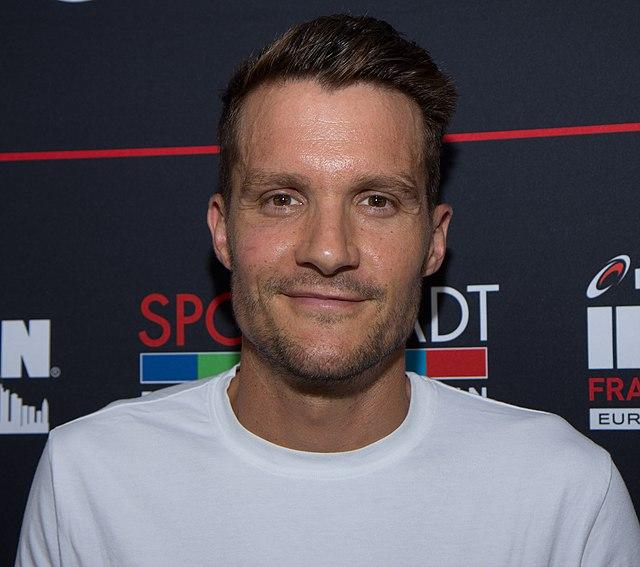
Jan Frodeno
From Beijing gold to Kona dominance.
The Unlikely Rise and Indisputable Legacy of Jan Frodeno#
I. The Formative Years: From Surfer to Olympic Contender#
1.1. A Young Man's Ambition Forged in the Surf#
Born on August 18, 1981, in Cologne, Germany, Jan Frodeno's athletic career began in an unexpected part of the world and in a different sport altogether. From 1992 to 2004, his childhood and early adolescence unfolded in Cape Town, South Africa, where his passion was initially centered around surfing. At the age of 15, on the advice of his mother, he learned to swim, a decision that would prove to be the critical first step on his path to becoming a global icon.
His true athletic calling emerged while watching the Sydney 2000 Olympic Games, where he discovered triathlon. He described being genuinely "drawn" to the sport, motivated by an innate desire to push himself to the limit rather than being forced into it. This deep-seated ambition propelled a radical early decision. After competing in his first triathlons in South Africa, he sold his bike to purchase a plane ticket to Europe, determined to race in the German triathlon league. His bold gamble paid off immediately. After a successful season, he earned a spot on the U-23 national side, which allowed him to return to Germany for subsequent European summers to train and compete. By 2002, he had qualified for the senior German national team and was training at the Olympic Training Centre in Saarbrücken, fully committing himself to the sport. His unwavering resolve was further hardened by a silver medal at the 2004 U-23 world championships, which confirmed his single-minded focus on turning professional.
1.2. The Beijing Breakthrough: A Shock to the System#
Prior to the 2008 Summer Olympics in Beijing, Jan Frodeno was a solid, if not dominant, presence on the ITU short-course circuit. While he had secured a bronze medal in 2005 and a team silver in 2006, his best individual result had been a sixth-place finish at the 2007 World Championships. Crucially, he had never won a single ITU World Cup race. This context makes his eventual victory at the 2008 Olympic Games all the more astonishing, as the triathlon world was collectively stunned by his performance. He was an outsider, while the pre-race favorite was the 2008 World Champion, Javier Gómez, and the field included former champions like Simon Whitfield.
The Beijing course was designed to be technical and hilly, which produced a thrilling, unpredictable race where the lead changed hands more than a dozen times. In a high-stakes finale, four triathletes were still contending for the lead with only 250 meters remaining. It was in this dramatic moment that Frodeno unleashed a blistering sprint, out-dueling the seasoned 2000 Olympic champion, Simon Whitfield, to seize the gold medal. The victory came fittingly on the day after his twenty-seventh birthday.
A detailed examination of the race's raw data underscores the magnitude of his effort. Frodeno completed the swim in 18:14 and the bike in 59:01 and the run in 30:46 to win with a total time of 1:48:53..8 His run split was the fastest of any of the top runners on the day, enabling his final surge. This performance, which seemed to appear from nowhere, was more than just a single victory; it was a career-defining moment that provided him with the ultimate launchpad. By claiming the highest honor in the sport's short-course discipline, he was freed from the constraints of having to prove himself in that arena and could set his sights on new, ambitious goals.
1.3. Navigating the Post-Olympic Short-Course Circuit#
Following his Olympic triumph, Frodeno continued to perform at an elite level on the short-course circuit. He finished a remarkable fourth overall in the World Championship Triathlon Series in both 2009 and 2010. However, a nagging injury prevented him from securing the overall title in 2010, foreshadowing the physical toll the sport would take. At the 2012 London Olympics, he returned to compete but finished in sixth place, a respectable but less spectacular result than his previous Olympic performance. He concluded this chapter of his career in 2013 on a high note, winning a gold medal as part of the German team at the mixed relay world championships in Hamburg. This deliberate and final short-course victory set the stage for a dramatic shift.
II. The Reinvention of a Champion#
2.1. The Strategic Shift and a Bold Contradiction#
The transition to long-distance triathlon was a pivotal moment for Jan Frodeno, defined by a powerful change in perspective. In a striking contradiction to his later career, he had once stated that long-distance triathlons were typically for "people who failed to thrive on the shorter distances". This earlier perspective highlights his deep-seated belief that the true pinnacle of the sport lay in the explosive, tactical racing of the Olympic discipline. However, having conquered the short-course world, he made the profound decision to pivot and master the endurance-focused long-course events.
This strategic pivot yielded immediate dividends. In 2013, he finished second at the Ironman 70.3 European Championships. The following year, he secured his first Ironman 70.3 win at the Asia-Pacific Championship in Auckland. His true potential on the longer course was revealed when he made his full-length Ironman debut in 2014, securing a third-place finish at the Ironman European Championship and a podium spot at his first-ever Ironman World Championship in Kona. The shift from short-course to long-course racing was not a sign of retreat but a calculated masterstroke that perfectly aligned his unique physical attributes—his towering height of 6 feet 4 inches and svelte weight of 76 kg—with the demands of an endurance sport. This ability to redefine success on his own terms, converting a tactical shift into a career-defining strength, is a hallmark of his enduring legacy.
2.2. A New Training Philosophy for a New Distance#
Frodeno's physical transformation into an Ironman champion was the direct result of a radical overhaul of his training philosophy. In the ITU years, he and his peers believed the race was won on the run, leading to a focus on high-mileage running and "all-out" sprint work on the track with intervals as short as 20 to 150 meters. For Ironman, this approach was completely abandoned. The biggest change was a significant increase in bike volume; his weekly mileage nearly doubled from 350-400 km for Olympic distances to 650-700 km for Ironman.
The emphasis shifted from high-intensity, short-duration efforts to "short rest intervals" focused on accumulating a large volume of work at a consistent, slower race pace. For running, his weekly mileage decreased from 120-130 km to a more manageable 100 km, and he now rarely performs intervals shorter than 1,000 meters. The mental game also evolved, with his coach, Dan Lorang, asserting that mindset accounts for 80% of the equation for success. Frodeno's core belief is that the sport never gets easier, only faster, and that the true challenge lies in having the "perseverance to endure and to fight hard from the bad point to get to the next good point". He learned to break down the daunting distance into smaller, more manageable "chunks" and use visualization techniques to stay grounded during races. This ability to master the psychological suffering of Ironman racing, a skill he refined over time, is a critical and often unseen variable that elevates his performance above his peers.
III. The Pinnacle: The Kona Crown and World Records#
3.1. The Road to the Double Crown (2015)#
The year 2015 marked the culmination of Frodeno's reinvention, a season that saw him achieve a unique and historic double victory. His year was flawless, with five races and five victories, including a win at the Ironman 70.3 World Championship that solidified his dominance at the middle distance. However, the defining moment was his first victory at the Ironman World Championship in Kona, Hawaii. With a 50:50 swim, a 4:27:27 bike, and a 2:52:21 marathon, he finished in a winning time of 8:14:40. With this victory, he became the first athlete, male or female, to win both an Olympic gold medal and an Ironman World Championship title, a feat that has remained a benchmark of excellence ever since.
3.2. The Title Defense and the German Sweep (2016)#
In 2016, Frodeno returned to Kona to successfully defend his title, a feat that only a handful of athletes had ever accomplished. With a 48:02 swim, he was among the first out of the water, and he pushed the pace throughout the bike leg. He entered the marathon with a lead over a group of top contenders, and while his countryman Sebastian Kienle kept pace for the early miles, Frodeno gradually broke away. His 2:45:34 marathon cemented a winning time of 8:06:30. This victory was not only a personal triumph but a landmark moment for German triathlon, as he led an all-German podium sweep alongside Kienle and Patrick Lange.
| Year | Champion | Time |
|---|---|---|
| 1982 | Dave Scott (USA) | 9:08:23 |
| 1983 | Dave Scott (USA) | 9:05:57 |
| 1984 | Dave Scott (USA) | 8:54:20 |
| 1985 | Scott Tinley (USA) | 8:50:54 |
| 1986 | Dave Scott (USA) | 8:28:37 |
| 1987 | Dave Scott (USA) | 8:34:13 |
| 1988 | Scott Tinley (USA) | 8:37:31 |
| 1989 | Mark Allen (USA) | 8:09:15 |
| 1990 | Mark Allen (USA) | 8:28:17 |
| 1991 | Mark Allen (USA) | 8:18:32 |
| 1992 | Mark Allen (USA) | 8:09:08 |
| 1993 | Mark Allen (USA) | 8:07:45 |
| 1994 | Greg Welch (AUS) | 8:20:13 |
| 1995 | Mark Allen (USA) | 8:20:34 |
| 1996 | Luc Van Lierde (BEL) | 8:04:08 |
| 1997 | Thomas Hellriegel (GER) | 8:33:01 |
| 1998 | Peter Reid (CAN) | 8:24:20 |
| 1999 | Luc Van Lierde (BEL) | 8:17:17 |
| 2000 | Peter Reid (CAN) | 8:21:01 |
| 2001 | Tim DeBoom (USA) | 8:31:18 |
| 2002 | Tim DeBoom (USA) | 8:29:56 |
| 2004 | Normann Stadler (GER) | 8:33:29 |
| 2006 | Normann Stadler (GER) | 8:11:56 |
| 2007 | Chris McCormack (AUS) | 8:15:30 |
| 2008 | Craig Alexander (AUS) | 8:17:45 |
| 2009 | Craig Alexander (AUS) | 8:20:21 |
| 2010 | Chris McCormack (AUS) | 8:10:37 |
| 2011 | Craig Alexander (AUS) | 8:03:56 |
| 2012 | Pete Jacobs (AUS) | 8:18:37 |
| 2013 | Frederik Van Lierde (BEL) | 8:12:29 |
| 2014 | Sebastian Kienle (GER) | 8:14:18 |
| 2015 | Jan Frodeno (GER) | 8:14:40 |
| 2016 | Jan Frodeno (GER) | 8:06:30 |
| 2017 | Patrick Lange (GER) | 8:01:40 |
| 2018 | Patrick Lange (GER) | 7:52:39 |
| 2019 | Jan Frodeno (GER) | 7:51:13 |
Note: Table lists male Ironman World Championship winners since 1982. German champions are highlighted in bold to show the national dynasty.
3.3. The World Record Crusader#
Frodeno's career was defined not only by victories but also by a relentless quest to push the boundaries of human performance. His success at Kona was merely the launchpad for a parallel pursuit of the iron-distance world record. At Challenge Roth in July 2016, just three months before his second Kona title, he delivered a masterclass in efficiency, smashing the previous world record by more than 5 minutes to set a new mark of 7:35:39. His splits—a 45:22 swim, a 4:09:22 bike, and a 2:40:35 marathon—were a demonstration of his complete command over the distance.
His desire for perfection culminated in the high-stakes "Tri Battle Royale" in July 2021 The event was a purpose-built, two-man race against rival Lionel Sanders on a course optimized for speed. The rivalry, which had its humorous beginnings in an Instagram spat over who was the bigger "coffee snob," had evolved into a contest of athletic supremacy. For Frodeno, it was an opportunity to reaffirm his position, while for Sanders, it was the "opportunity of a lifetime" to face off against "the greatest of all time". Despite inclement weather and a fall in transition, Frodeno crossed the finish line in an astonishing time of 7:27:53, lowering his own world record and once again proving his dominance. The competitive dynamic of these head-to-head moments was instrumental in pushing both athletes to transcend previous limits and produce historic results.
3.4. The Comeback: Kona 2019#
The years between 2016 and 2019 were marked by significant adversity for Frodeno. A hip stress fracture forced him to withdraw from the 2018 Ironman World Championship, and an injury-impacted run in 2017 meant he finished far down the field. He was forced to watch his countryman, Patrick Lange, claim two consecutive Kona titles and break the mythical 8-hour barrier. This period of setback fueled his desire for a powerful return.
In 2019, Frodeno arrived in Kona with a point to prove. He and fellow German Sebastian Kienle, along with American Tim O'Donnell, were the main contenders. Frodeno began with a strong swim of 47:31, just three seconds behind the leader. He then delivered a stellar 4:16:03 bike split, establishing a commanding position. Despite being 38 years old, he had the fastest marathon of the day. He ran to a new course record of 7:51:13, which was almost 90 seconds faster than Lange's previous mark and made him only the third man to finish Kona in under 8 hours. The victory secured his third Kona crown, completing a remarkable hat-trick of titles that came after years of injury-plagued seasons.
| Race | Swim | Bike | Run | Total Time |
|---|---|---|---|---|
| 2008 Olympics | 0:18:14 | 0:59:01 | 0:30:46 | 1:48:53 |
| 2015 Kona | 0:50:50 | 4:27:27 | 2:52:21 | 8:14:40 |
| 2016 Kona | 0:48:02 | 4:29:00 | 2:45:34 | 8:06:30 |
| 2016 Roth World Record | 0:45:22 | 4:09:22 | 2:40:35 | 7:35:39 |
| 2019 Kona | 0:47:31 | 4:16:03 | 2:44:xx | 7:51:13 |
| 2021 Tri Battle Royale | 0:45:58 | 3:55:22 | 2:44:20 | 7:27:53 |
Note: Run split for 2019 Kona is not explicitly listed, but the total time and other splits confirm it was approximately 2 hours, 44 minutes.
IV. The Final Chapter and an Enduring Legacy#
4.1. The Final Seasons and Enduring Resilience#
The final seasons of Frodeno's career were an exercise in resilience against the mounting toll of his sport. A small partial tear of his Achilles tendon forced him to miss the 2021 Ironman World Championship in St. George and later the 2022 event in Kona. His return in 2023, after a "20 month stretch of injury," was a testament to his determination. He delivered an impressive performance at the PTO US Open in Milwaukee, securing his first win in two years in a strong field.
His final professional race took place in September 2023 at the Ironman World Championships in Nice, France. Despite a tough race, he finished 24th. The finish line was a celebration of his career, as he was greeted by fans and the announcer's poignant words: "Jan Frodeno, you are an Ironman". This final race was not about the result, but about celebrating a legendary career and bringing a fitting end to his 23 years as a professional triathlete.
4.2. The G.O.A.T. and Key Rivalries#
The argument for Jan Frodeno as the "Greatest of All Time" is built on a cumulative resume that no other triathlete has been able to match. His accomplishments span the full spectrum of the sport: he is an Olympic gold medalist, a three-time Ironman World Champion, and a two-time world record holder over the long distance. His ability to excel at both the tactical, draft-legal Olympic distance and the brutal, solo-effort Ironman distance demonstrates a versatility that is virtually unmatched in the sport's history. The fact that he achieved these milestones while also winning two Ironman 70.3 World Championships and battling significant injuries only adds to the narrative of his enduring excellence.
Throughout his career, his rivals were instrumental in pushing him to new heights. His early duels with Javier Gómez and the Brownlee brothers on the short-course circuit prepared him for the intense competition of the Ironman world. In his long-course career, rivalries with fellow Germans Sebastian Kienle and Patrick Lange—as well as the high-profile, head-to-head battles with Lionel Sanders—were crucial. These rivalries were not just contests for the podium; they were catalysts for performance, pushing him to deliver the record-breaking, career-defining victories that now form the core of his legacy.
4.3. The Future of a Champion#
In announcing his retirement, Frodeno offered a rare and candid reflection on the immense personal cost of competing at the highest level. He stated that the "wild egoism that's needed to put down 40-hour training weeks and shut off everything else" was beginning to fade. This admission underscores that even for the most dominant athletes, the relentless pursuit of perfection is not sustainable forever.
As a father of two, he looks forward to spending more time with his family. His wife, Emma Snowsill, is also a former professional triathlete and the 2008 women's Olympic gold medalist, adding a unique chapter to their shared story. While his professional career has concluded, Frodeno's connection to the sport remains unbreakable. He plans to remain a part of the triathlon community as a coach, a sport enthusiast, and even an occasional racer, ensuring his influence will be felt for years to come.
Table 1: The G.O.A.T. Resume: A Chronology of Major Victories & Records
| Achievement | Year | Location |
|---|---|---|
| ITU U-23 World Championships Silver | 2004 | Madeira, Portugal |
| ITU Triathlon World Cup Bronze | 2005 | Beijing, China |
| ITU Mixed Relay World Championships Gold | 2013 | Hamburg, Germany |
| Ironman 70.3 Asia-Pacific Championship Win | 2014 | Auckland, New Zealand |
| Ironman World Championship Debut Bronze | 2014 | Kona, Hawaii |
| Ironman 70.3 World Championships Win | 2015 | Zell am See, Austria |
| Ironman World Championship Win | 2015 | Kona, Hawaii |
| World Record (Long Distance) | 2016 | Challenge Roth, Germany |
| Ironman World Championship Win | 2016 | Kona, Hawaii |
| Ironman 70.3 World Championships Win | 2018 | Port Elizabeth, South Africa |
| Ironman World Championship Win | 2019 | Kona, Hawaii |
| World Record (Long Distance) | 2021 | Tri Battle Royale, Germany |
| PTO US Open Win | 2023 | Milwaukee, USA |