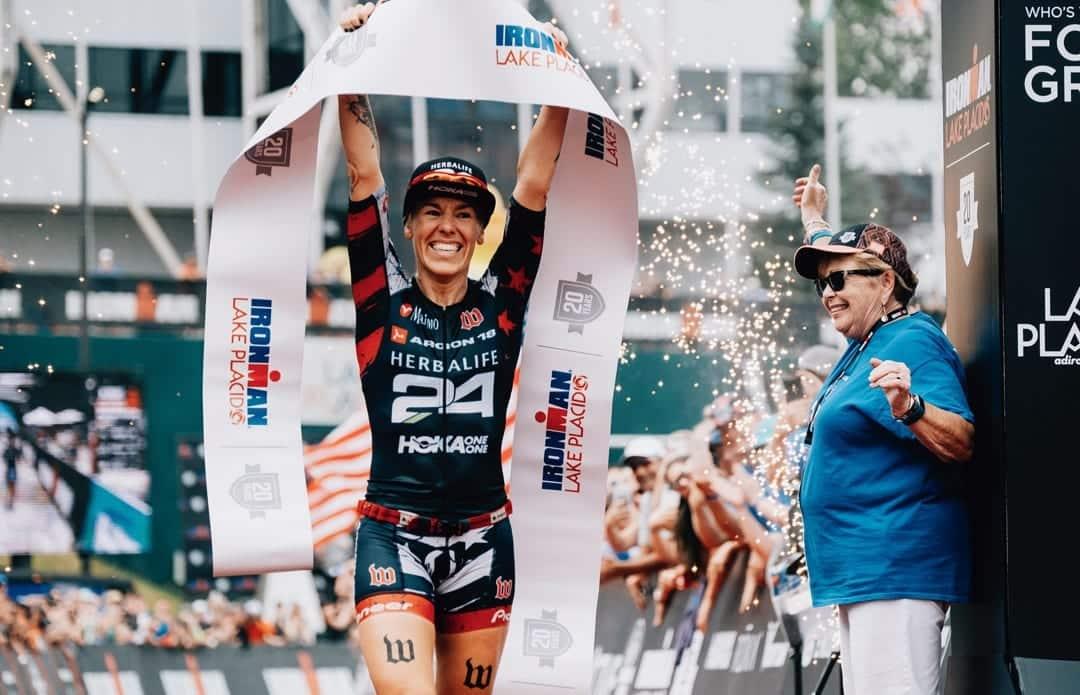
Heather Jackson
The Unbound Athlete: The Three Lives of Heather Jackson.
The Unbound Athlete: The Three Lives of Heather Jackson#
Introduction: A New Kind of Finish Line#
The final miles of the Unbound XL, a grueling 358-mile odyssey through the flint hills of Kansas, are a place of profound suffering. For Heather Jackson, they were a crucible. Caked in mud, body screaming in protest, she was so exhausted she could no longer hold her own head up. The cheers from shorter-distance racers crossing her path were the only fuel left in a tank that had run dry miles ago. Yet, she pushed on. When she finally crossed the finish line, she had not just survived; she had conquered. Her time of 20 hours, 57 minutes, and 57 seconds didn't just win the women's race; it obliterated the previous course record by nearly an hour and a half and placed her eighth overall, ahead of most of the men's field.
This victory, in what is considered the "Kona of gravel racing," was more than a singular triumph; it was the definitive statement of a third athletic life. Jackson’s career is not a linear progression but a series of deliberate, courageous reinventions. She has reached the pinnacle of multiple sports, only to willingly step away and seek mastery in entirely new, arguably harder, disciplines. Her journey poses a fundamental question: What psychological and physical traits allow an elite athlete to abandon a world she has mastered for the terrifying uncertainty of a new beginning? This is not a story of retirement, but of metamorphosis. It is the story of a hockey player’s grit, a triathlete’s engine, and an adventurer’s spirit, all connected by a simple, yet profound, personal mantra that has guided each audacious leap: "What are you waiting for?".
Part I: The Scrapper on Ice (1990s - 2006)#
The Foundation of Grit#
The origins of Heather Jackson’s relentless drive can be traced to Exeter, New Hampshire, and a "blue-collar, hard-working family". Her athletic journey began at age six, not on a track or in a pool, but on an ice rink, playing hockey with the boys. This early immersion in a physically demanding, male-dominated environment forged a foundation of toughness and a fierce competitive fire that would become her trademark.
Attending the prestigious Phillips Exeter Academy, Jackson excelled as a multi-sport athlete, focusing on both ice hockey and soccer. Though she harbored ambitions to play both at the collegiate level, she ultimately chose to concentrate on hockey, accepting a place at Princeton University to play for their Division I women's team.
Princeton Tiger#
At Princeton, Jackson’s leadership and tenacity were immediately apparent. Over a decorated four-year career, she served as a two-time team captain and established herself as a key player for the Tigers. In 126 games, she amassed 89 points from 30 goals and 59 assists. Her sophomore season was a statistical standout, with 30 points, and in her senior year, she was instrumental in leading the team to a second-place ECAC finish and the program's first-ever appearance in the NCAA tournament. Her style of play was a direct reflection of her character. She described herself not as the most skilled player, but as "probably one of the scrappiest and hardest working," a player valued for her heart and her understanding of teamwork.
This identity, forged in the collaborative and combative world of a team sport, seems paradoxical given her later success in the solitary realm of long-distance triathlon. An athlete whose ethos was built around the "teamwork in the locker room" would find her greatest triumphs in a sport where, for over eight hours, she could rely only on herself. The transition required a profound psychological shift. The transferable assets were her grit and work ethic, but their application had to evolve. Her "team" became her support network—her husband, coach, and sponsors—but on race day, the performance was hers and hers alone.
The Olympic Dream Deferred#
Throughout her collegiate career, Jackson’s ultimate ambition was to play hockey in the Olympics. She excelled enough to earn a spot on the U22 national team and spent summers training with the US National Team program in Lake Placid. The dream came to a head in the lead-up to the 2006 Torino Games. She was invited to the initial camp of 40 candidates vying for a spot on the 22-person roster. However, when the squad was cut to 30, her name was not on the list. This moment of "failure," the end of a lifelong dream, became the crucial catalyst for everything that followed. With limited professional options for female hockey players, a chapter of her life had definitively closed, forcing her to look for a new path.
Part II: The Accidental Triathlete (2006 - 2009)#
A Post-Collegiate Crossroads#
After graduating from Princeton in 2006 with a degree in Political Science and East Asian Studies, Jackson found herself at a crossroads. The structure and singular focus of her athletic life had vanished. Seeking a new experience, she moved to Chiang Mai, Thailand, in 2007 to teach English at a private school—a decision driven by a desire for life experience, not athletic ambition.
It was in Thailand that serendipity intervened. She befriended a group of people who were training for Ironman Malaysia and, on something of a whim, decided to join them. Her preparation was minimal. Having never been a swimmer, she had to learn the stroke from scratch as an adult. Her first Ironman was, in her words, more of an "adventure race" than a competition. She was nearly last out of the water and walked most of the marathon, an effort that left her body aching for a long time afterward. Yet, despite the pain, a seed had been planted.
Return to the States & The Budding Amateur#
Returning to the United States later in 2007, Jackson took a position teaching 9th-grade world history at the Harker School in San Jose, California. It was here that her casual interest in triathlon began to crystallize into a serious pursuit. She joined Team Alcis, a local group of elite age-group triathletes, and started training with more structure.
Her ascent as an amateur was meteoric. She competed in Ironman Lake Placid in 2007, finishing 10th in her age group and qualifying for her first Ironman World Championship. The following year, while still working full-time as a teacher, she returned to the Big Island of Hawaii for the 2008 Ironman World Championship. This time, she didn't just compete; she won, becoming the 18-24 amateur age-group world champion. This victory was the undeniable signal of her world-class potential. Her immediate success, particularly on the bike where she was already posting splits comparable to professionals, pointed to a powerful athletic engine forged over nearly two decades on the ice. The explosive power and cardiovascular fitness demanded by hockey had created a formidable base. While the swim remained a technical liability, her raw power, transferred from one sport to another, gave her a monumental head start.
Part III: Forging a Pro, Building a Brand (2009 - 2011)#
The Leap of Faith#
In June 2009, Heather Jackson stood at another crossroads. She was a world champion amateur triathlete but also a full-time teacher with a stable career. The pivotal push came from Sean Watkins, a figure in the triathlon industry whom she had met in 2008 Watkins, who would later become her husband, saw her immense potential and convinced her to take a monumental leap of faith: quit her teaching job and pursue triathlon professionally. It was a move from the secure to the uncertain, a bet on her own talent and grit.
The "Wattie" Factor and the Birth of Wattie Ink.#
Sean "Wattie" Watkins was more than just a partner and coach; he was a visionary. His interest was piqued when Jackson, still an amateur, dropped him on a group ride. He recognized her raw power and provided the support system she needed to thrive. Simultaneously, Watkins was embarking on his own venture. In 2009, he left a steady job at
Triathlete Magazine to found Wattie Ink., an apparel company born from a desire to disrupt the sport's conservative aesthetic. With just $250, he envisioned a brand inspired by the counter-cultures of skateboarding and music, one that would allow athletes to stand out.
Jackson became the brand's first and most vital ambassador. Her professional identity and the identity of Wattie Ink. grew in tandem. Initially skeptical, she chose to "Rock the W" instead of taking sponsorship money from more established companies. By 2012, the company was just the two of them, her race results serving as the brand's primary marketing. Her aggressive racing style, vibrant custom kits, and growing collection of tattoos perfectly embodied the edgy, unconventional ethos Wattie was building. This was not a typical sponsorship; it was a co-creation. An anecdote from the 2014 Panama 70.3 race perfectly illustrates their all-in partnership: with her first official race kit missing sponsor logos, Wattie borrowed a machine from a neighboring screen printer and hand-pressed them on himself, only for them to start peeling off by race day. This symbiotic rise created a powerful feedback loop: her success gave the brand authenticity, and the brand's distinctive look amplified her personality, helping make her one of the most recognizable and popular athletes on the circuit.
Part IV: The Ascent: From Contender to Champion (2010 - 2014)#
Announcing Her Arrival#
Jackson's transition to the professional ranks was swift and impactful. She announced her arrival among the sport's elite at the 2010 Timberman 70.3. In a stacked field, she finished third with a time of 4:26:08, behind only the legendary Chrissie Wellington and Angela Naeth. This performance was no fluke; she backed it up later that year with a fifth-place finish at the IRONMAN 70.3 World Championship, proving she belonged on the biggest stages.
A true breakthrough moment came at the 2011 Ironman 70.3 Oceanside. After emerging from the swim with her typical deficit, Jackson unleashed a ferocious, race-best bike split of 2:29:56 to seize the lead on the run. She held off the reigning Kona champion and one of the sport's greatest runners, Mirinda Carfrae, until the final mile. Carfrae ultimately caught her, winning by a mere 10 seconds, but the statement was made. In her post-race interview, Carfrae delivered a prophetic endorsement: "Heather showed today she's a force to be reckoned with at 70.3, and IRONMAN if she chooses”.
Dominance and Progression#
From that point on, Jackson was not just a contender; she was a dominant force. She amassed a string of victories at some of the sport's most iconic races, including four wins at the notoriously tough Wildflower Triathlon (2012, 2013, 2014, and 2018), setting a new course record of 4:26:29 during her 2012 victory. In 2013, she added another prestigious title to her resume with a win at the Escape from Alcatraz Triathlon.
Her methodical climb up the ranks was most evident in her performances at the IRONMAN 70.3 World Championships. Each year, she moved closer to the top step of the podium, a clear demonstration of her relentless improvement and unwavering focus.
| Year | Finishing Place |
|---|---|
| 2010 | 5th |
| 2011 | 4th |
| 2012 | 3rd |
| 2013 | 2nd |
Data Sources: 6
This steady, year-over-year progression showcased her evolution from a raw talent into one of the most consistent and formidable middle-distance triathletes in the world.
Part V: The Queen K Crusade (2014 - 2022)#
The Full-Distance Debut#
As Mirinda Carfrae had predicted, Jackson eventually turned her attention to the full Ironman distance. Her debut came in November 2014 at Ironman Arizona, where she finished an impressive third. The race was a brutal introduction to the demands of the 140.6-mile distance. "I expected it to be hard, but that was ridiculous," she said afterward, joking, "Maybe I'll stick to 70.3s!". Despite the humor, the performance signaled her readiness for a new challenge: the Ironman World Championship in Kona.
The Kona Campaign#
For the next eight years, Jackson's career was defined by a singular obsession: winning on the Big Island. She quickly established herself as one of the most consistent contenders in the women's field, recording a remarkable four top-five finishes at Kona.
Her podium breakthrough came in 2016. With a finishing time of 9:11:32, she secured third place behind two of the sport's all-time greats, Daniela Ryf and Mirinda Carfrae. The achievement was a landmark moment for American triathlon, as Jackson became the first American woman to stand on the Kona podium in a decade.
Setback and Redemption (2018)#
After finishing 5th, 3rd, and 4th in consecutive years, Jackson entered the 2018 Ironman World Championship as a favorite to win. The race, however, ended in a "disappointing" 14th place finish, an outcome she later attributed to overtraining and inadequate rest. For an athlete so singularly focused on one day, it was a crushing blow.
This five-week period between her Kona disappointment and her next race encapsulates the essence of her athletic character. Instead of ending her season, she immediately signed up for Ironman Arizona just five weeks later, stating, "I didn't want to end 2018 like that. I needed to redeem myself". In Arizona, she didn't just redeem herself; she delivered the performance of her life. She won the race in a blistering time of 8:39:18, shattering her personal best by over 20 minutes and setting a new American record for the Ironman distance. This stunning comeback was not just a victory but a ferocious response to failure, revealing that for Jackson, setbacks often serve as the most potent fuel for motivation.
| Year | Swim | Bike | Run | Overall Time | Place |
|---|---|---|---|---|---|
| 2015 | 1:04:36 | 5:04:43 | 3:07:53 | 9:21:45 | 5th |
| 2016 | 58:56 | 5:00:31 | 3:07:48 | 9:11:32 | 3rd |
| 2017 | 57:58 | 4:53:54 | 3:06:19 | 9:02:29 | 4th |
| 2018 | 58:18 | 4:44:45 | 3:21:56 | 9:09:16 | 14th |
| 2019 | 59:12 | 4:46:45 | 3:04:17 | 8:54:44 | 5th |
| 2022 | 1:04:45 | 4:56:00 | 3:16:50 | 9:22:16 | 16th |
Data Sources: 6
Part VI: The Second Act: Answering the Call of the Dirt (2020 - Present)#
The Pandemic Pivot#
The COVID-19 pandemic and the subsequent global shutdown served as an unexpected catalyst for the next phase of Jackson's career. With pools closed and the race calendar decimated—including the cancellation of the Kona world championships in both 2020 and 2021—the rigid, highly regimented structure of her life was broken.
This forced pause opened the door to exploration. She and Wattie spent months in 2020 camping in their van in Patagonia, Arizona, riding "endless dirt roads" on their gravel bikes. This period was not about hitting power targets or logging structured intervals; it was about rediscovering the pure joy and adventure of riding. "From March 2020 until June was really when I fell in love with gravel," she recalled.
The Final Chapter in Kona#
This newfound passion for off-road adventure stood in stark contrast to her feelings about the triathlon grind. The relentless pursuit of Kona had started to feel "a bit boring," like the "same old same old". The repeated cancellations left her feeling "pissed" and frustrated, as if she were missing out on a world of other exciting events she wanted to try while still in her prime. When the Ironman World Championship finally returned in 2022, it was with a sense of finality. For Jackson, it was a "farewell tour," a conscious and deliberate closing of a major chapter in her life.
This transition was not just a career change but a deliberate return to the intrinsic motivations that first drew her to endurance sports. Her first Ironman was an "adventure," and her greatest successes came on courses that were "scary challenges" that fired her up. The new world of off-road racing offered a return to that feeling of unpredictability and exploration, a reclamation of her original "why" after years of chasing a single, all-consuming result.
A New Beginning#
Jackson wasted no time in her pivot to the dirt. Just two weeks after her final Kona race in October 2022, she lined up for the Big Sugar gravel race. The very next weekend, she competed in her first 100-mile ultramarathon, the Javelina Jundred, where she finished an incredible fifth.
Her success in these new disciplines has been as immediate and dominant as her initial foray into triathlon. She has since won the Javelina 100 Mile (2023), taken second at the Black Canyon 100k (2023), and claimed numerous gravel victories, culminating in her record-shattering performance at Unbound XL. Her athletic prowess, it turns out, was never confined to one sport; it was about the engine and the mindset that powered it.
Conclusion: What Are You Waiting For?#
From the ice rinks of New Hampshire to the podium in Kona to the muddy finish line in Kansas, Heather Jackson's career has been a study in evolution. The common thread connecting the scrappy hockey player, the relentless triathlete, and the unbound off-road champion is not a specific discipline, but a mindset forged in grit, fueled by resilience, and defined by an insatiable hunger for a new challenge. With a resume that includes six Ironman titles, 16 half-Ironman victories, and four top-five finishes at the sport's most prestigious championship, her place in triathlon history is secure.
Yet, her ultimate legacy may not be the titles, but the powerful demonstration that an athletic career can have multiple, distinct, and equally successful acts. She provides a compelling blueprint for longevity through courageous reinvention. Her journey is a testament to her personal philosophy, one encapsulated in a simple question she often poses to herself and others: "What are you waiting for?". It is a challenge to look beyond the comfort of routine, to embrace the fear of the unknown, and to seek out the "true and intense feelings of being alive" that await on the other side of a new start line. It is a call to adventure that transcends sport, reminding us that the most exciting paths are often the ones we have yet to travel.