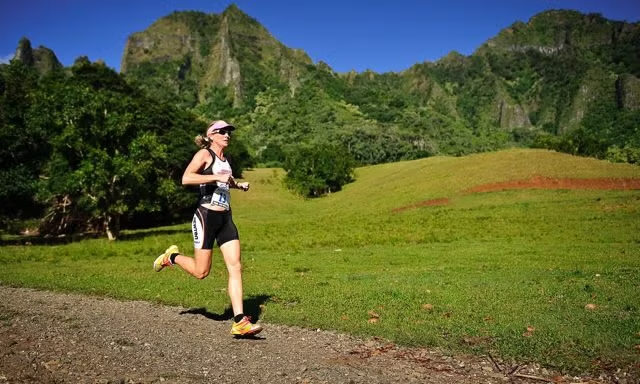
Heather Fuhr
The Quiet Storm: How Heather Fuhr Ran Her Way into Triathlon History.
The Quiet Storm: How Heather Fuhr Ran Her Way into Triathlon History#
The air on the Queen Kaʻahumanu Highway is a physical presence. It rises from the black lava fields in shimmering waves, a suffocating blanket of heat and humidity that clings to the skin and sears the lungs. On this stretch of asphalt, dreams are forged in suffering and champions are revealed. On October 18, 1997, during the Ironman World Championship, the triathlon world was watching the established titans of the sport, waiting for the familiar narrative to unfold. They were looking for the legends, the athletes who had already carved their names into the history of this punishing race.
But through the heat haze, another figure was emerging. She was not a spectacle of explosive power, but a study in relentless, metronomic efficiency. Her cadence was a quiet, steady rhythm against the vast, silent landscape—the sound of an athlete hunting. This was Heather Fuhr, and she was running. For the competitors ahead of her, the sound of her approaching footsteps was the harbinger of an inevitable conclusion. This was the day that a quiet Canadian runner, forged in the prairie winds and hardened by years of patient effort, would unleash a storm on the sport’s biggest stage.
Her victory in Kona that day was far more than a single race won. It was the culmination of a decade of unassuming work, a testament to the devastating power of a single, perfectly honed weapon—her run—and a moment so profound it would be remembered as a symbolic changing of the guard. It was the moment Heather Fuhr, the quiet storm, ran her way into triathlon history.
The Accidental Champion: From the Canadian Prairies to the Pacific#
The journey of a world champion rarely begins with the admission, "I couldn't swim." Yet, for Heather Fuhr, born January 19, 1968, in Edmonton, Alberta, this was the fundamental truth of her entry into triathlon. Her athletic origins were not in the sun-drenched triathlon hotbeds of California or Australia, but on the windswept Canadian prairies. Growing up just outside Edmonton, she played "every sport imaginable" before her natural talent for endurance led her to focus on running in high school and later at the University of Alberta, where she competed in cross country and track. Triathlon was not her world; it belonged to her high school sweetheart, Roch Frey, a competitive swimmer she had met in Stony Plain.
Fuhr’s introduction to the sport was as a spectator, a supporting role she played with what she described as a "morbid sense of curiosity for this 'crazy' triathlon thing". The idea of competing herself seemed impossible. "Initially, it didn't enter my world as a possibility," she reflected. "(For one, I couldn't swim!)". This single, glaring weakness could have been a permanent barrier. Instead, it became the crucible in which her legendary career was forged. Because she knew she would almost always start the run at a disadvantage, she was forced to cultivate a running ability that was not merely good, but transcendent. Her entire racing identity—the patient hunter, the relentless closer—was born from the necessity of overcoming this initial deficit.
When she finally took the plunge in 1988, it was not with visions of glory but for the simple sake of a challenge. She entered the sport during what she called a "revolutionary time," as icons like Paula Newby-Fraser, Mark Allen, and Dave Scott were pushing the boundaries of human endurance. Fuhr became a "sponge," quietly soaking in the innovations in training, equipment, and nutrition that were transforming the sport. Supported by her lifelong partnership with Frey, who would become a renowned triathlon coach himself, she began a journey that seemed improbable. This humble beginning, rooted in overcoming a fundamental obstacle, makes her eventual rise all the more remarkable. It demystifies the aura of the elite athlete, suggesting that greatness can be built not just from innate, all-around talent, but from the relentless perfection of a single strength and the dogged determination to improve upon a weakness. Her own advice to beginners years later would echo this origin story: "Use whatever equipment you have... and just enjoy the experience".
Forging the Weapon: The Long Road to Mastery (1991-1996)#
Heather Fuhr did not burst onto the professional triathlon scene; she endured her way into it. Her career in the early 1990s was a masterclass in patience and perseverance, a slow and steady accumulation of experience that mirrored her signature racing style. Her results at early ITU World Championships were respectable but not world-beating, finishing 29th in 1992 and 24th in 1993, underscoring that she was not an overnight sensation. Her journey was a long-term investment, a gradual forging of the physical and mental weapons she would one day unleash.
The lava fields of Kona, Hawaii, became her ultimate classroom. Her first race at the Ironman World Championship in 1991 was the beginning of a long and often humbling apprenticeship. The island demands respect, and Fuhr paid her dues year after year. She would race in Kona seven times before her breakthrough victory, a fact she later noted was the same number of attempts it took legends Mark Allen and Greg Welch to claim their first titles. This long courtship with the sport’s most iconic race was not a series of failures but a methodical process of learning—understanding the heat, the wind, and the immense psychological toll of the course. As she herself stated, "It took me 10 years to build up to the Ironman". This decade-long build was a testament to a deep-seated patience that defined her athletic character.
A crucial turning point came in 1994 with her first major victory at Ironman Japan. This win was more than just a notch on her belt; it was the validation that her process was working. It proved, to herself and the world, that she possessed the formula to win at the sport's most grueling distance. It was the first of what would become a staggering 15 Ironman titles, a total that places her second only to the legendary Paula Newby-Fraser on the all-time win list.
During these formative years, she perfected her signature "run-down" strategy. While never the fastest swimmer, she was exceptionally strong on the bike and possessed a devastating run. Time and again, she would emerge from the water with a deficit, use the 112-mile bike ride to move into contention, and then, once her running shoes were on, she would begin to hunt. For her competitors, the sight of Fuhr coming off the bike was a cause for anxiety. They knew the quiet, unassuming Canadian was coming for them, and that the race was far from over. This methodical, relentless approach became her calling card, instilling a sense of dread in race leaders and a sense of inevitability for spectators.
The Queen's Gambit: The 1997 Kona Coronation#
By the start of the 1997 season, after six attempts at the Kona crown, Heather Fuhr understood that physical talent alone was not enough to win on the Big Island. She knew she "needed to do something different". In a move of profound humility and strategic genius, she sought guidance from the one person who knew the secrets of the island better than anyone: her rival and the reigning "Queen of Kona," Paula Newby-Fraser. Newby-Fraser, an eight-time world champion, took Fuhr under her wing without hesitation, becoming a true mentor and friend. She taught Fuhr not just about training, but about how to be a "true professional in every sense of the word". Crucially, she instilled in Fuhr a new philosophy: to "embrace the island and feed off the power that was so obviously present," rather than fight against its unforgiving nature. Fuhr entered the 1997 race week with "the most ideal preparation possible, and with a newfound respect for the island". This mental and strategic evolution was the final piece of the championship puzzle.
Race day on October 18, 1997, was a brutal test of will. The infamous hoʻomumuku crosswinds howled across the lava fields, with "strong and steady headwinds averaging 30 mph" slowing the bike leg to a crawl. The cloudless sky and temperatures in the low 90s created the slowest race conditions in a decade, a day designed to break athletes. But these were precisely the conditions where Fuhr, renowned for her ability to handle the heat, would thrive.
The race unfolded according to her classic script. She exited the swim in 1:01:47, in eighth place and well behind the leaders. On the bike, she was immense. Her 5:23:11 split was the second-fastest of the day, allowing her to reel in most of her competition and enter the second transition poised to strike. Then, she began to run. What followed was one of the most dominant marathon performances in Kona history. Fuhr unleashed a blistering 3:06:45 run, the fastest of the day by an enormous margin. It was nearly 15 minutes faster than any other woman in the top five, a stunning display of power and endurance in the crushing heat. One by one, she ran down the leaders: Wendy Ingraham, fellow Canadian Lori Bowden, Fernanda Keller, and Sian Welch.
The race’s emotional and symbolic climax occurred on the lonely stretch of the Queen K Highway. As Fuhr closed in on her mentor, Paula Newby-Fraser, the moment became something more than a simple pass for the lead. It was a "changing of the guard," a passing of the torch from one great champion to the next. Newby-Fraser, seeing her protégée about to realize her dream, offered words of encouragement as Fuhr went by. Fuhr later reflected that she felt she was racing for more than just herself, but as a "tribute to my mentor and friend, Paula". She moved into the lead just before entering the notorious Natural Energy Lab and never looked back. The run down Aliʻi Drive was a "surreal moment," the culmination of seven years of toil on this sacred ground. She crossed the finish line in 9:31:43, a world champion at last. Her victory was not just a physical feat; it was a triumph of strategy, humility, and the powerful, unique bond between two of the sport's greatest rivals.
The Canadian Reign: A Dynasty of Dominance (1998-2005)#
Winning the Ironman World Championship in 1997 was not the culmination of Heather Fuhr’s career; it was the catalyst. With the pressure of the ultimate prize lifted, she entered a period of sustained dominance, cementing her status as one of the sport's all-time greats. Over the next decade, she became a global force, collecting Ironman titles with remarkable consistency. Her resume expanded to include four victories at Ironman Japan, two in Brazil, and wins in Switzerland, Germany, and California. When she finally stepped away from professional racing, she had amassed 15 full Ironman championships, a number surpassed only by her mentor, Paula Newby-Fraser.
Nowhere was her dominance more apparent than at Ironman USA in Lake Placid, New York. On one of the toughest and hilliest courses on the Ironman circuit, Fuhr was peerless. She claimed the inaugural title in 1999 and went on to win the race an astonishing five times, with additional victories in 2001, 2002, 2003, and 2005. Her 2001 victory, in a time of 9:31:11, was a masterclass in controlling a difficult race. Her repeated success in the Adirondack Mountains demonstrated a physical and mental fortitude that few could match, making her the undisputed "Queen of Lake Placid."
Fuhr’s success was a central part of a larger story: the golden era of Canadian long-distance triathlon. She, along with fellow Canadians Lori Bowden and Lisa Bentley, formed a formidable trio that consistently featured at the top of international podiums. They were respected rivals who pushed each other to greater heights. Their dynamic was on full display at Kona, where Fuhr topped Bowden for the win in 1997, and Bowden returned the favor to claim her own world title in 1999 Lisa Bentley described the spirit of the era perfectly: "We weren't superstars, we were just Canadian kids around the same age, pretty like-minded". This shared journey and friendly rivalry elevated Canadian triathlon to global prominence and inspired a generation of athletes back home. It was fitting, then, that Fuhr and Bowden, whose careers were so deeply intertwined, were inducted into the Ironman Hall of Fame together in 2015, a final, formal recognition of their shared reign.
| Year | Event | Country | Winning Time |
|---|---|---|---|
| 1997 | Ironman World Championship | USA | 9:31:43 |
| 1998 | Ironman Switzerland | Switzerland | 9:34:36 |
| 1999 | Ironman USA Lake Placid | USA | 9:51:38 |
| 2000 | Ironman Japan | Japan | 9:37:31 |
| 2001 | Ironman USA Lake Placid | USA | 9:31:11 |
| 2002 | Ironman USA Lake Placid | USA | 9:43:12 |
| 2002 | Ironman Austria | Austria | 8:51:22 |
| 2003 | Ironman USA Lake Placid | USA | 9:51:55 |
| 2003 | Ironman Brazil | Brazil | 9:19:40 |
| 2004 | Ironman Japan | Japan | 9:41:22 |
| 2005 | Ironman USA Lake Placid | USA | 9:45:06 |
Note: The table above lists 11 of her 15 Ironman victories for which specific event data was readily available in the provided materials. Other known victories include additional wins in Japan and Brazil, and wins in Germany and California.
The Final Lap and a New Course: Life Beyond the Finish Line#
For many elite athletes, retirement is a difficult, often abrupt, end. For Heather Fuhr, it was a characteristically graceful and deliberate transition. Her final race at the Ironman World Championship in 2006 was not a reluctant farewell but a conscious choice made on her own terms. She vividly recalled a moment out on the bike course when a profound sense of peace and finality washed over her. "It became clear to me... that I had given every bit of my soul that I could," she explained. "Physically I probably could have done it, but mentally I wasn't willing to put my body through that anymore". She stepped away from the sport with a sense of accomplishment, at peace with her decision and with no regrets or "what ifs".
Her competitive fire, however, was not extinguished. It simply found a new course. Fuhr began to "dabble" in ultra-trail running, and her version of dabbling was to dominate. She won the Catalina Marathon, breaking the women's course record. At the Ridgecrest 50K, she finished second overall and shattered the course record previously held by the legendary ultrarunner Ann Trason. This successful transition to a new discipline was a powerful affirmation of her pure love for endurance sport and proof that her otherworldly running talent was not confined to paved roads.
The sport she had given so much to formally recognized her contributions in 2015. In a single year, she was inducted into both the Triathlon Canada Hall of Fame and, alongside her great friend and rival Lori Bowden, the Ironman Hall of Fame. "It is an incredible honor to be recognized," Fuhr said. "Ironman has always been a huge part of my life and I am very grateful for every opportunity that it has presented".
Today, her journey has come full circle. The woman who first approached the sport as a curious spectator is now a vital custodian of its legacy. Instead of being on the race course, she is "behind the scenes," working to elevate the experience for the next generation of athletes. As the VIP and Professional Athlete Services Manager for World Championship Events for Ironman, she leverages two decades of elite experience to ensure the sport continues to thrive. This seamless evolution from competitor to administrator represents the complete lifecycle of an athlete's devotion to their sport, a rare and graceful transition that solidifies her enduring place in the Ironman family.
The Enduring Footprint#
To measure Heather Fuhr’s career solely by its impressive statistics—15 Ironman titles, a World Championship, a place in two Halls of Fame—is to miss the essence of her legacy. Her impact on the sport of triathlon is defined less by the accolades she collected and more by the quiet dignity and relentless spirit with which she competed. She was the unassuming champion, a "class act" universally respected by her peers for her grace and humility. The iconic image of Paula Newby-Fraser cheering Fuhr on as she passed her for the lead in Kona is perhaps the greatest testament to her character; she was so genuinely admired that even her fiercest rivals were thrilled to witness her success.
Her story is ultimately a powerful narrative of grit. She was the runner who willed herself to become a swimmer, the athlete who patiently endured seven attempts before conquering Kona, and the quiet Canadian who, through sheer force of will, ran down the best in the world. She embodied the idea that limitations are not barriers but catalysts, and that success is a product of methodical, long-term dedication.
The image of Heather Fuhr is that of her relentless, rhythmic footsteps on the black asphalt of the Queen K Highway. Those footsteps no longer echo in the lava fields, but their imprint on the sport is indelible. They represent the steady, quiet, and powerful cadence of a remarkable career—a career that proved a storm doesn't have to be loud to change the landscape forever.