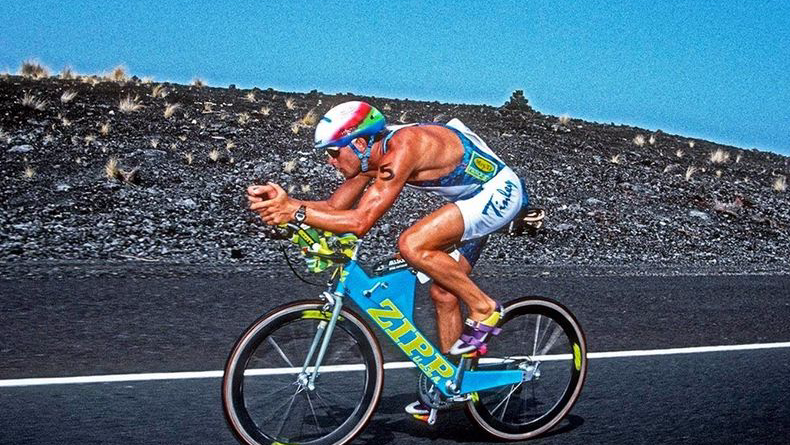
Greg Welch
The Unbreakable Heart
The Unbreakable Heart: The Grand Slam Glory and Enduring Grit of Greg Welch#
Introduction: The Finish Line That Was a Starting Gun#
The sun beats down on the Queen Kaʻahumanu Highway with a merciless, shimmering intensity. For the athletes of the 1999 Ironman World Championship, this stretch of blacktop north of Kailua-Kona is a familiar purgatory, a place where champions are forged and dreams dissolve into the heat haze. On this October day, Greg Welch, one of the most decorated and beloved figures in the sport, is deep inside that inferno. But something is terribly wrong.
Two miles into the 2.4-mile swim, he had stopped dead in the water, gasping for air, convinced he was having an asthma attack. He waited five minutes for the feeling to pass before pressing on. On the bike, the sensation returned, a terrifying flutter in his chest, a wave of dizziness that blurred his vision. He would later count a dozen separate "attacks" during the 112-mile ride. Each time, the champion’s instinct—and the simple embarrassment of quitting—pushed him forward. He described the feeling in stark terms: "…lightheaded, it's hard to see, I was short of breath, it's a horrible feeling". Ignoring the profound discomfort, he started the marathon. The attacks came again, three more times, yet he kept running.
In an act of near-superhuman will, Greg Welch crossed the finish line in 11th place. His run split was a blistering 2 hours, 46 minutes, and 51 seconds—a world-class time under any circumstances, let alone these. For the spectators, it was another gutsy performance from the tenacious Australian. In reality, it was the last time he would ever race as a professional. This finish line was not an ending; it was the public’s first glimpse of a private war his body was waging against itself, a race for survival that would come to define his legacy far more than any victory.
The profound irony of that day would only become clear later. The extraordinary cardiovascular engine he had built over a decade and a half of relentless training, the very thing that powered him to the pinnacle of his sport, was also what kept him alive. His physician, Dr. Emily Scott, would later state that a person with a less-trained heart, subjected to the same episode where his pulse surged to over 300 beats per minute, "would have passed out and probably died". His greatest strength had masked his greatest vulnerability. That 11th-place finish in 1999 serves as a powerful anchor to his story, forcing a re-examination of every prior victory through the lens of this hidden fragility, making his achievements seem all the more miraculous and his journey more tragically, inspiringly human.
Chapter I: The Making of an Aussie Battler (1964-1988)#
Gregory John Welch was born in 1964 in Campsie, a working-class suburb of Sydney, Australia. His entry into the world of endurance sports was not born of grand ambition but of youthful pragmatism. At 14, he took up cross-country running for a simple reason: he discovered he "could get out of school days doing something he really loved". He was a former surf lifesaving champion, possessing a natural athleticism, but the punishing, multi-disciplinary world of triathlon was not yet on his radar.
The catalyst arrived in 1984, when his friend, Richie Walker, invited him to watch a local triathlon. Welch was immediately captivated, instantly "hooked" on the spectacle of human endurance. But this moment of inspiration was soon shadowed by a tragedy that would echo through Welch's life with haunting prescience. Six months before his death, Walker suffered a cardiac arrest and had a pacemaker inserted. He passed away in 1986, just three days after his 21st birthday. The loss of the friend who introduced him to the sport, to a heart condition, would become a poignant and deeply personal piece of foreshadowing for the battle Welch himself would one day face.
Welch’s own start in the sport was inauspicious. In his debut at a local Olympic-distance event in 1985, he finished "in the rear of the field". His swimming was a particular liability. His coach, Roch Frey, famously and colorfully described Welch's technique as if he "had a bag of bricks tied to his ankles". True to the "Aussie battler" spirit, Welch did not accept this weakness. He responded with a punishing work ethic, a defining characteristic of his career. He forced himself to train in the fastest swimming lane, even though he couldn't keep up, believing it was the only way he would ever improve. This approach—of intentionally placing himself in a position of struggle against superior athletes to elevate his own performance—would become a metaphor for his entire career. His resilience was tested early on when a serious cycling accident in 1988 sidelined him for an entire year, an initial trial by fire that only hardened his resolve. He was not a natural, born with flawless technique; he was a self-made champion, forged through grit and an unyielding will to overcome his own limitations.
Chapter II: The Ascent of a Versatile Champion (1989-1993)#
By the end of the decade, Welch's relentless work ethic began to pay dividends on the global stage. His major breakthrough came at the 1989 Ironman World Championship in Kona, Hawaii. While the world was transfixed by the legendary "Iron War"—the epic duel between Mark Allen and Dave Scott, who finished just 58 seconds apart—a relatively unknown, pint-sized Australian announced his arrival by capturing a stunning third-place finish.
The following year, 1990, marked his true coronation. In his first year as a professional, Welch traveled to Orlando, Florida, for the second-ever ITU Triathlon World Championships. Competing against a field of established stars, he claimed his first world title, leading an all-Australian podium sweep with Brad Beven in second and Stephen Foster in third. He had also beaten legends of the sport like Great Britain's Simon Lessing and American powerhouse Mike Pigg, signaling the arrival of a new, formidable force in short-course racing.
What set Welch apart was not just his talent, but his incredible range. He possessed a rare ability to compete at the highest level across all distances and disciplines. In 1993, with his sights firmly set on winning the Ironman in Kona, he undertook a unique and audacious preparation strategy. Just two weeks before the world’s most grueling endurance event, he flew to Arlington, Texas, to compete in the ITU Duathlon World Championships—a punishing run-bike-run format—and won. The victory confirmed he was in the form of his life, a master of both speed and endurance.
Then, fate intervened with cruel randomness. Just two days after being crowned Duathlon World Champion, Welch was cycling home from a swim workout when he was struck head-on by a car. The crash left him with a broken knee, shattering his dream of winning Kona that year. It was a devastating blow. At the absolute peak of his powers, he was brought down not by a competitor, but by a freak accident. This setback, however, only set the stage for one of the sport's great redemption stories, transforming his 1994 campaign from a simple race into a quest for the title that had been stolen from him.
His career was already becoming one of historic versatility, a fact codified by an achievement that remains unique in the annals of the sport: "The Grand Slam."
Table 1: Greg Welch's "Grand Slam" World Championships
| Year | Championship Title | Discipline | Location |
|---|---|---|---|
| 1990 | ITU Triathlon World Championships | Triathlon (Olympic Distance) | Orlando, USA |
| 1993 | ITU Duathlon World Championships | Duathlon (Run-Bike-Run) | Arlington, USA |
| 1994 | Ironman World Championship | Triathlon (Ironman Distance) | Kona, USA |
| 1996 | ITU Long Distance World Championships | Triathlon (Long Distance) | Muncie, USA |
Chapter III: The King of Kona (1994)#
After the heartbreak of 1993, Greg Welch returned to Hawaii in 1994 a changed man. He shed his famously "happy-go-lucky" demeanor for a new, profound seriousness. His wife, fellow professional triathlete Sian Welch, observed the transformation firsthand. "Greg kind of became like you [Mark Allen]," she later recalled. "He just shut the world out and conserved every bit of energy he could. He was like a monk that week before the race!". This focused, almost spiritual approach would prove to be the missing ingredient.
From the cannon blast at Kailua Pier, Welch executed a tactical masterpiece. He emerged from the water with a swim time of 50:22, the fastest among the top ten contenders, immediately signaling his aggressive intent. On the bike, the race reached a critical juncture. German powerhouse Jürgen Zack and American Ken Glah launched a blistering breakaway with 35 miles still to go. Welch was tempted to chase, but then came one of the most pivotal moments in Ironman history. His chief rival, the legendary six-time champion Dave Scott, who was making a comeback at age 40, yelled a piece of unsolicited, yet invaluable, advice across the lava fields. Scott warned Welch the pace was too fast, shouting, "Greg, Greg, Greg… the race is here. Don’t worry about that, the $25,000 cheque is back here". In a remarkable display of race intelligence and maturity, Welch trusted the wisdom of his greatest competitor. He let the leaders go, conserved his energy, and rode his own race.
The decision paid off magnificently. Welch began the marathon with fresh legs and systematically worked his way to the front. The race for the crown became a two-man duel: the Australian redemption-seeker against the aging lion making one last charge. The final showdown was destined for the race’s most notorious section, the Natural Energy Laboratory of Hawaii Authority, better known as the Energy Lab. It was a place Scott considered his personal domain. "This race always comes down to the Energy Lab and this is where I am at my best," Scott had said at the pre-race press conference. As they descended into the sweltering bowl, Scott mounted his attack, closing the gap to a mere 12 seconds. The tension was immense. In the NBC broadcast car, Mark Allen watched as his old rival seemed poised for a seventh title. But in the defining moment of the race, Welch turned, saw Scott looming just steps away, and instead of cracking, he found another gear. He "lit the afterburners," pulling away from Scott with decisive power. He had beaten the master in his own sanctum.
Greg Welch crossed the finish line with a time of 8:20:27, collapsing in a wave of emotion and exhaustion. He had done it. He became the first non-American male to ever win the Ironman World Championship, breaking a 15-year streak of American dominance. "Kona was the biggest highlight of my life," he would later say. The victory was a watershed moment for the sport, a groundbreaking achievement that, in his own words, "opened the floodgates for Macca [Chris McCormack], Crowie [Craig Alexander] and Pete Jacobs," the next generation of Australian champions. His win was not a fluke; as his consistent top placings in Kona demonstrate, it was the hard-earned culmination of years spent battling at the very front of the sport's most demanding race.
Table 2: Greg Welch's Ironman World Championship Record (Kona)
| Year | Place | Swim | Bike | Run | Overall Time |
|---|---|---|---|---|---|
| 1989 | 3 | 0:51:39 | 4:43:43 | 2:56:53 | 8:32:16 |
| 1990 | 5 | 0:51:51 | 4:52:20 | 3:01:56 | 8:46:07 |
| 1991 | 2 | 0:51:02 | 4:45:21 | 2:48:10 | 8:24:34 |
| 1992 | 6 | 0:49:32 | 4:37:20 | 3:00:01 | 8:26:53 |
| 1994 | 1 | 0:50:22 | 4:41:07 | 2:48:58 | 8:20:27 |
| 1995 | 4 | 0:51:47 | 4:46:31 | 2:50:56 | 8:29:14 |
| 1996 | 3 | 0:51:23 | 4:35:43 | 2:51:51 | 8:18:57 |
| 1999 | 11 | 0:54:28 | 4:53:19 | 2:46:51 | 8:40:50 |
Chapter IV: The Cruelest Turn (1999-2003)#
Following his harrowing 11th-place finish at Kona in 1999, Greg Welch received the news that would end his career and change his life forever. He was diagnosed with ventricular tachycardia (V-Tach), a rare and life-threatening heart arrhythmia where the ventricles beat so fast the heart is unable to pump blood sufficiently. The diagnosis forced his immediate retirement from the sport that he said "has been my whole life". Further investigation revealed a hereditary link; his father had suffered from a similar condition, reframing the narrative from one of an athlete who had simply pushed his body past its limits to that of a man confronting an inescapable genetic fate.
The timing could not have been more devastating. Welch was at the peak of his short-course powers, winning World Cup events and holding a world ranking of No. 7 at the end of 1999. He had worked assiduously with other athletes and sporting organizations to get triathlon included in the Olympic Games. The culmination of that effort was to be the sport's debut at the 2000 Sydney Olympics. The stage was set for Welch's finest hour: a chance to win the first-ever Olympic triathlon gold medal in front of hundreds of thousands of cheering fans in his home city. It was more than a missed race; it was the theft of a destiny he had helped to create.
What followed was not a victory lap, but a long and arduous road back to a normal life. Between 2001 and 2003, Welch endured an unbelievable nine open-heart surgeries to stabilize his condition. The ordeal took a profound toll not just on him, but on his family. His wife Sian, an accomplished professional triathlete in her own right, put her own career on hold. "I hardly trained," she recalled. "I couldn't even get on my bike because (Greg) wasn't with me". It was a period of immense uncertainty and fear, a battle fought not on the race course but in hospital rooms and recovery wards.
Conclusion: The Enduring Voice of Triathlon#
Before his career was cut short, Greg Welch had one more piece of history to make. In 1996, he traveled to Muncie, Indiana, and won the ITU Long Distance World Championship, defeating a field that included future Ironman legends Luc Van Lierde and Spencer Smith. With that victory, he officially completed his "Grand Slam"—a collection of four world titles across four different disciplines and distances that cemented his legacy as arguably the most versatile endurance athlete the world has ever seen.
Refusing to be defined by his illness, Welch channeled his boundless energy and passion into a new career. He has become one of the most recognizable and beloved voices in the sport, serving as an expert commentator for IRONMAN, the Professional Triathletes Organisation (PTO), and World Triathlon. His "articulate enthusiasm" and firsthand knowledge have made him a powerful ambassador, bringing the sport to life for millions of viewers. While some viewers have critiqued his commentary for occasional inaccuracies or a lack of technical depth, his infectious passion provides an emotional connection that a more clinical analyst could never replicate. Alongside his media work, he has maintained a long-standing relationship with Oakley, where he works in global sports marketing, a partnership that dates back to his racing days in 1991.
His contributions have been widely recognized. He has been inducted into every major hall of fame in the sport, including the IRONMAN Hall of Fame, the ITU Hall of Fame, and, in a rare honor for a triathlete, the Sport Australia Hall of Fame. Yet despite the stolen dream of Olympic gold and the years of painful surgeries, he maintains a perspective of profound gratitude. It is a viewpoint perfectly encapsulated in his own words. When asked about his journey, he simply says: "Who's the luckiest man in the world? It isn't 'Willy Wonka and the Chocolate Factory.' It's me".
In the end, Greg Welch’s greatest victory was not won on the lava fields of Kona, but in the decades that followed—a victory of spirit over circumstance. His heart may have been his greatest physical vulnerability, but his unbreakable spirit has made him the enduring heart of the sport he loves. He redefined what it means to win, trading a potential gold medal for the wisdom that comes from surviving the ultimate test. It is this triumph of gratitude over bitterness that solidifies his status not just as a great champion, but as a true legend of life.