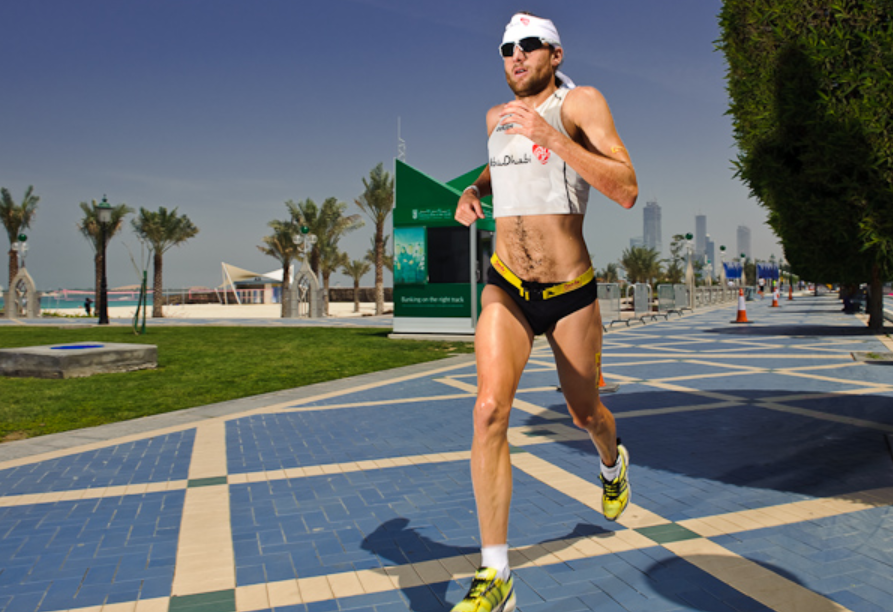
Faris Al-Sultan
The Sultan of Sweat: The Enduring Reign of Faris Al-Sultan.
The Sultan of Sweat: The Enduring Reign of Faris Al-Sultan#
Introduction: The Unmistakable Silhouette#
There is an image seared into the memory of long-course triathlon, a recurring vision from the sun-scorched lava fields of Kailua-Kona. It is the silhouette of a man running, not with the compact, metronomic efficiency of a modern super-athlete, but with a loping, almost languid gait. His long strides eat up the asphalt of the Queen Ka'ahumanu Highway, his arms loose and relaxed in a motion described simply as "looping". He is clad not in the compressive, wind-tunnel-tested skinsuits of his rivals, but in a minimalist, almost defiant uniform: a simple half-singlet and a Speedo, a throwback to a grittier, less-polished era of the sport. This is Faris Al-Sultan, "The Sultan of Sweat," an iconoclast in a sport obsessed with conformity and marginal gains.
To define Faris Al-Sultan merely by his 2005 Ironman World Championship victory is to miss the essence of the man. His story is not just one of athletic triumph, but of a profound and unique character who carved his own path through the world of endurance sports. He was the scholar who chose suffering, the quiet intellectual from Munich who abandoned a Master's degree in Arabic literature to pursue the brutal, physical poetry of the Ironman. He was the humble champion in an age of escalating bravado, and a master tactician whose legacy is defined as much by his formidable mind as by his incredible muscle. His journey raises a compelling question: How did this quiet academic, a man of dual German-Iraqi heritage with an unconventional style and a fiercely independent spirit, conquer the world's toughest endurance race and then, in a remarkable second act, reinvent himself to shape its very future?
Chapter I: The Munich Maverick: Forging a Different Kind of Athlete#
A Confluence of Cultures#
Faris Al-Sultan’s unique disposition was forged in the crucible of a multicultural upbringing. Born on January 21, 1978, in Munich, Germany, he was the son of a German mother, Lydia, and an Iraqi father, Talib, who had immigrated to Germany in 1958 and established a translation agency. This confluence of cultures—the structured discipline of post-war Germany and the patient, enduring spirit of the Middle East—created a worldview that would become his greatest athletic asset. Al-Sultan himself acknowledged this synthesis, noting how he drew upon his "German work ethic" for the relentless demands of training, while embracing the "Arabic virtues" of patience and generosity, which he found "more helpful in every day life".
This was not merely a biographical footnote; it was the psychological bedrock of his success. The sport of Ironman triathlon is a paradox, demanding both the rigid, data-driven discipline to train for thousands of hours and the deep well of patience required to endure an eight-hour race where a single moment of haste can lead to ruin. His German side provided the engine for the former, the methodical drive to build the physical capacity. His Arabic side, as he saw it, provided the wisdom for the latter, the mental fortitude to manage the inevitable "dark moments" on the race course and to execute a strategy over a timescale that breaks most athletes. This internal cultural balance gave him a uniquely complete psychological toolkit, allowing him to be both a disciplined engine and a patient strategist—a combination that many of his more single-minded rivals lacked.
The Scholar's Path Diverted#
Before he was a triathlete, Al-Sultan was a scholar. He attended high school in Munich/Moosach and later enrolled at the prestigious Ludwig Maximilian University of Munich, where he was pursuing a Master's degree in Arabic language, literature, and history. This was a serious academic path, one that suggested a life of letters and intellectual inquiry. However, a different calling began to emerge. Having started as a collegiate swimmer, he found himself drawn to the nascent sport of triathlon. His potential was so evident that after one race, two professional triathletes who had finished behind him urged him not to waste his talent, a moment that proved pivotal. He ultimately made the profound decision to drop out of his graduate program to dedicate himself fully to the sport.
This choice was not an admission of academic failure but a conscious pivot towards a different, more visceral form of self-discovery. The intellectual foundation he had built, however, never left him. Instead, he channeled the analytical rigor of a scholar into his new pursuit. For much of his career, Al-Sultan was famously self-coached, a rarity at the elite level. This approach demanded constant research, self-analysis, and the dispassionate assessment of data—the very skills honed in graduate school. His athletic career became, in essence, a physical thesis on the outer limits of human endurance, meticulously researched and personally tested.
The Spark and the Start#
The initial spark for Al-Sultan's triathlon journey came from a German pioneer of the sport, Thomas Hellriegel, whose gritty performances in the 1990s inspired a generation of German athletes. After his first triathlon in 1996, Al-Sultan quickly escalated his ambitions. In 1997, at just 19 years old, he made a decision that would define his character: for his first-ever Ironman, he chose not a flat, forgiving course, but the notoriously brutal Ironman Lanzarote. Known for its punishing winds and relentless hills, it is a race that breaks seasoned professionals. For a teenager to choose it as a debut was an act of audacious self-challenge. He finished in a respectable 10:33, but more importantly, he had passed his own trial by fire.
This early choice revealed a core element of his personality: a belief that the value of an endeavor lies in the magnitude of its difficulty. He was not seeking an easy entry into the sport but the ultimate test from the very beginning. This mindset—that the struggle itself is the point—would become a recurring theme throughout his career. It explained his affinity for the brutal conditions of Kona and his later assertion that he treasured his hard-fought third-place finish in 2006 even more than his dominant victory in 2005, simply because the fight had been harder.
Chapter II: Forging a Champion on the Lava Fields (1999-2004)#
Faris Al-Sultan’s ascent to the pinnacle of long-course triathlon was not a sudden, explosive arrival but a methodical and patient apprenticeship. His classroom was the Ironman World Championship course in Kona, a place that demands respect and punishes hubris. He made his debut on the Big Island in 1999, beginning a multi-year process of learning the unique nuances of the race. Each attempt was a data-gathering exercise, a chapter in his ongoing study of the event and his own physical and mental limits.
His progression was steady and telling. After finishing 27th in 2000, he returned in 2003 to claim a strong 7th place, demonstrating he could compete with the world's best. The real breakthrough, however, came in 2004. In a performance that announced his arrival as a genuine threat for the crown, Al-Sultan finished on the podium in 3rd place. This was not the result of a lucky day but the culmination of years of methodical preparation. While other athletes might burst onto the scene with a spectacular performance only to fade, Al-Sultan’s rise was incremental. He was patiently building a base of physiological adaptation to the oppressive heat and humidity while mastering the tactical complexities of the race.
This patient, analytical progression was the hallmark of his scholar-athlete approach. Each race was a field study, providing crucial information that he would analyze and incorporate into his self-designed training and racing protocols. The 2004 podium finish was more than just a great result; it was the final validation of his methods. It was the moment the student became a master, armed with the knowledge and, crucially, the confidence that he now possessed all the necessary components to win. He had transformed himself from a contender into a believer.
Chapter III: The Crowning in Kona (October 15, 2005)#
The 2005 Ironman World Championship was the ultimate expression of Faris Al-Sultan’s craft. It was a race won not through brute force in a single discipline, but through a flawless, eight-hour exhibition of tactical intelligence, energy management, and unwavering resolve. While much of the pre-race attention was focused on the defending champion and fellow German, the powerful cyclist Normann Stadler, Al-Sultan entered the race quietly confident in the plan he had spent years perfecting.
His strategy was to control the race from the front, a bold tactic in a field of world-class athletes. "I do not like to fight with other people for positions and prefer to have the highway for myself," he would later say of his approach. He set the tone immediately with an excellent 49:54 swim, exiting the waters of Kailua Bay in third place, among the leaders and well ahead of many key rivals.
It was on the bike, however, that his tactical masterpiece truly unfolded. Just 14 minutes into the 112-mile ride along the Queen K Highway, Al-Sultan surged to the front. It was a lead he would not relinquish for the rest of the day. This was a rare "tape-to-tape" performance of pure dominance, where he was at the head of the race for over seven hours, his nose in the wind the entire time. While Stadler, the pre-race favorite, was forced to withdraw after suffering flat tires, Al-Sultan was already firmly in command of the race, his victory a product of his own strength, not the misfortune of others.
A post-race analysis of his power data reveals a race that was intellectually crafted. He averaged a strong 283 watts for his 4:25:24 bike split, but the pacing was key. Having learned from previous years, he rode more conservatively on the outbound leg, averaging 309 watts to the turnaround point at Hawi. On the notoriously difficult return leg into the headwinds, his power dropped slightly to an average of 268.5 watts, a clear indication that he was meticulously managing his effort to preserve his legs for the marathon. He was not trying to break the bike course record; he was trying to win the Ironman.
Starting the run with a significant lead, Al-Sultan delivered a solid and controlled 2:54:51 marathon. He crossed the finish line on Ali'i Drive with an overall time of 8:14:17, more than five minutes ahead of runner-up Cameron Brown. As he broke the tape, hoisting a Bavarian flag over his head, he cemented his place in history. His victory was the culmination of his long apprenticeship—a triumph of intellect and discipline as much as physical endurance. He had beaten the world's best not by overpowering them, but by out-thinking them.
Chapter IV: The Weight of the Crown (2006-2014)#
Becoming a world champion brings with it a new kind of pressure, a weight that can crush even the strongest athletes. Faris Al-Sultan’s response to this pressure in the years following his Kona victory revealed more about his character than the win itself. He returned to Hawaii in 2006 as the defending champion, a target on his back for the first time. In a grueling race, he fought his way to a 3rd place finish behind the new champion, Normann Stadler. For Al-Sultan, this performance held a special significance. He has stated that he treasures this third-place finish "more than my win," because of the intense fight it required. This perspective offers a rare window into the mind of an elite athlete. For Al-Sultan, the ultimate prize was not the title but the struggle. The 2005 victory was the flawless execution of a plan; the 2006 podium was a testament to his grit and resilience under fire, a deeper and more satisfying test of character.
The subsequent years were a mix of formidable highs and frustrating lows. The lowest point came at the 2007 World Championships, when a sudden case of gastroenteritis on race morning forced him to withdraw—a decision he called "one of the hardest of my life". He also battled a series of nagging injuries and issues with his bike setup that led to a decline in his normally consistent run and swim speed.
Despite these setbacks, Al-Sultan remained a dominant force in the sport for nearly another decade. He was a perennial contender who could win on any course, at any time. He racked up an impressive string of Ironman titles around the globe, including victories at Ironman Malaysia (2008), the inaugural Ironman Regensburg in his home state of Bavaria (2010), the prestigious Ironman European Championship in Frankfurt (2011), Ironman Austria (2012), and a triumphant return to the site of his first Ironman, winning at Lanzarote in 2013. His consistency at the World Championships was also remarkable; in addition to his podium finishes, he placed in the top 10 nine times over his career, including four separate 10th-place finishes.
During this period, Al-Sultan also demonstrated a forward-thinking vision for the sport's professionalization. He was an instrumental figure in the formation of the Abu Dhabi Triathlon Team, an initiative aimed at creating a recognizable, professional team with a clear corporate identity, allowing athletes to focus more on their sport and less on the business of securing individual sponsorships. This project not only provided him with a new competitive focus but also showcased his desire to elevate the professionalism and popularity of the sport he loved.
| Year | Race | Result | Finishing Time |
|---|---|---|---|
| 2004 | Ironman World Championship | 3rd | 8:45:14 |
| 2005 | Ironman Arizona | 1st | - |
| 2005 | Ironman World Championship | 1st | 8:14:17 |
| 2006 | Ironman World Championship | 3rd | 8:19:04 |
| 2008 | Ironman Malaysia | 1st | 8:34:42 |
| 2010 | Ironman Regensburg | 1st | 8:13:37 |
| 2011 | Ironman European Championship (Frankfurt) | 1st | 8:13:50 |
| 2012 | Ironman Austria | 1st | 8:11:31 |
| 2013 | Ironman Lanzarote | 1st | 8:42:40 |
Chapter V: The Final Finish Line (2015)#
An elite athletic career rarely ends in a blaze of glory; more often, it is a slow fade, a gradual recognition that the body and mind can no longer meet the self-imposed demands of greatness. For Faris Al-Sultan, the decision to retire was a characteristically self-aware and pragmatic one, what he described as a "constant development" rather than a single, dramatic event.
In the final years of his career, the scales began to tip. He found himself "struggling more with the injuries than actually training," a frustrating cycle for any athlete. The mental toll was just as significant. "The most important thing is your brain," he explained. "If you're mentally no longer there to really be there 100 percent, then it's hard". Life outside the sport was also changing. The birth of his son in April 2014 brought new priorities and joys, making the singular focus required for professional triathlon more challenging to maintain.
The definitive moment came on May 16, 2015, at Ironman Texas. During the bike leg, he began to feel pain in his glutes and hamstrings and made the difficult decision to pull out of the race. It was the culmination of years of struggle, the final piece of evidence he needed. "Yesterday I realized that, 'OK, I've had so many bad races, and I can't stand having one more bad race,'" he said in an interview shortly after. It was an act of profound self-respect. Al-Sultan held himself to the highest standard, and the idea of simply competing without being a true contender was unsatisfying. He stated that while he was still physically capable of being a solid professional—able to "be first pack in the water, ride 280 watts and run 3:00 at any Ironman"—that level of performance was "not satisfying to me any more". His retirement was an act of integrity, a choice to step away on his own terms rather than become a shadow of the champion he had been.
Chapter VI: The Sultan as Svengali: A New Reign in Coaching#
For many great athletes, the transition to a post-competitive life is fraught with uncertainty. For Faris Al-Sultan, it was a seamless and stunningly successful pivot to a new role: the master tactician behind another generation of champions. He became most famous for his coaching partnership with fellow German Patrick Lange, guiding him to two Ironman World Championship titles in 2017 and 2018, along with a third-place finish in 2016.
Their relationship, which began in 2015 shortly after Al-Sultan’s retirement, was built on mutual respect and a shared philosophy. Al-Sultan’s coaching style was as unconventional as his racing attire. He acted less as a technical instructor and more as an "advisor and someone who structured his training". Recognizing that Lange was already an experienced and intelligent athlete, Al-Sultan provided a framework for success, not a rigid set of commands. He famously employed a feel-based approach, shunning an over-reliance on power meters and data, instead encouraging Lange to aim for feelings like "speedy" during intervals. He used a form of reverse psychology to build Lange’s confidence, reportedly telling him at the outset, "If you want me to coach you to win Kona, I'm the wrong guy," to impress upon him the magnitude of the work required.
This success was a direct extension of Al-Sultan’s own career as a scholar-athlete. Having spent two decades deconstructing the sport for himself, he was uniquely positioned to architect a winning strategy for another. His "anti-trainer" methodology was not a rejection of science but a reflection of a deeper, more intuitive understanding of racing that transcends spreadsheets. He taught Lange how to think like a champion, imparting the same strategic patience and race-day wisdom that had defined his own victory in 2005. For Lange, Al-Sultan was more than a coach; he was a "childhood hero" on the sideline, a source of immense confidence and inspiration.
Their incredibly successful partnership concluded in 2019, a mutual decision driven by Al-Sultan’s growing responsibilities as the head coach for the elite team of the German Triathlon Federation (DTU). In this role, he continues to shape the future of the sport, applying his vast knowledge to develop the next generation of German talent, with a particular focus on reviving the nation's success in short-course, draft-legal racing.
Conclusion: The Enduring Legacy#
The image of Faris Al-Sultan in his Speedo, loping along the Queen K Highway, remains one of triathlon’s most iconic. In retrospect, that unconventional appearance was the perfect visual metaphor for his entire career: authentic, self-assured, and focused on substance over style. He was an athlete who raced and lived on his own terms, guided by an internal compass of intellectual curiosity and fierce integrity.
Al-Sultan stands as a crucial transitional figure in the history of his sport. He was a bridge between eras. He won his world title on a simple aluminum bicycle, a testament to old-school grit and a powerful engine, yet he was among the first to meticulously analyze his own power data, foreshadowing the scientific precision of the modern era. He embodied the toughness of the sport's pioneers while possessing the analytical mind that would define its future.
His legacy, therefore, is not confined to that single, glorious victory in Kona. It is a dual legacy of performance and mentorship. He is the champion who mastered the sport's most difficult puzzle and then, with equal brilliance, taught its secrets to his successor. He will be remembered, as he once hoped, as a "fair sportsman and a tough athlete," but his influence runs deeper. He will be remembered as the Sultan who won the crown and then showed others how to win theirs, leaving an indelible mark as one of triathlon's great minds.