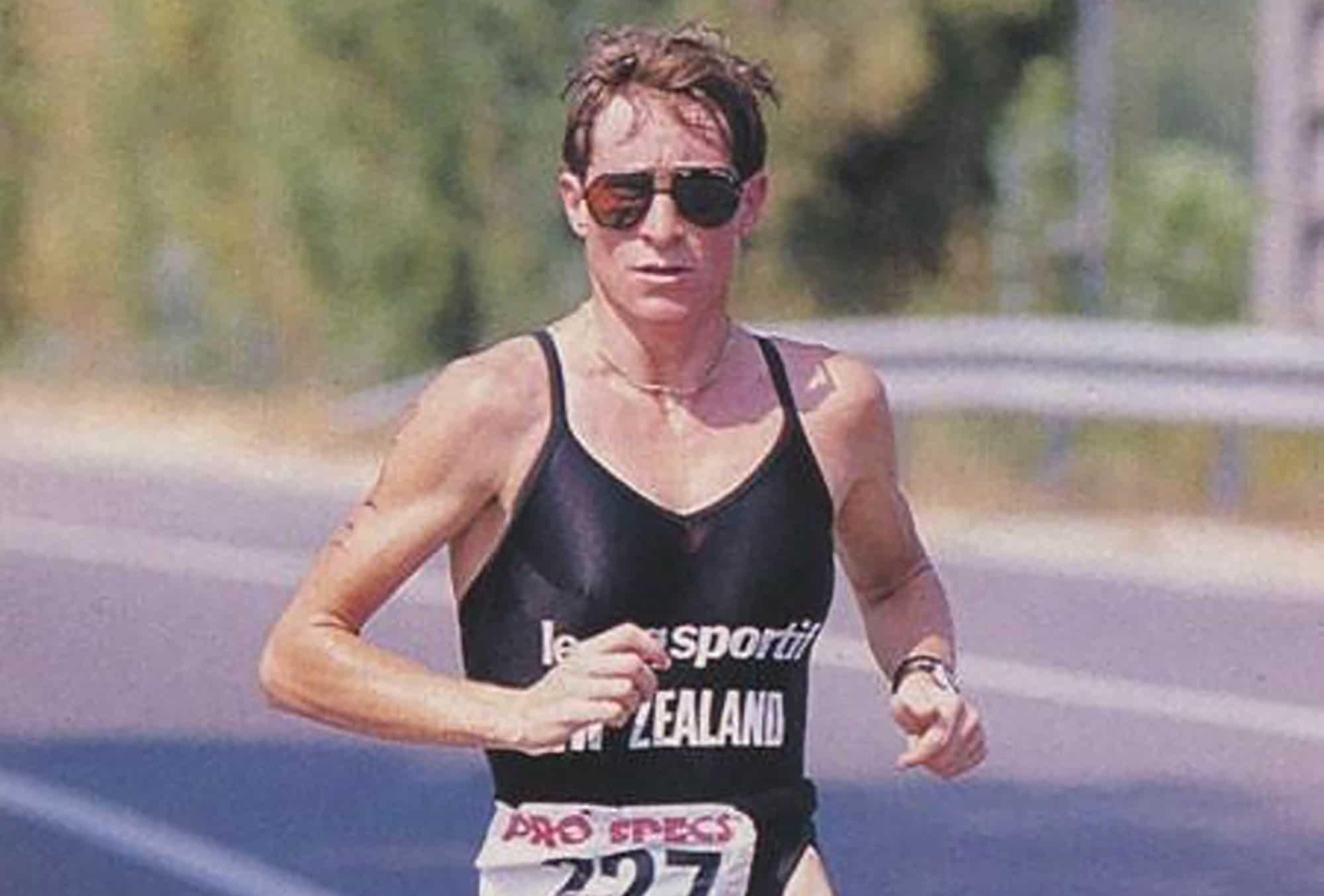
Erin Baker
The Iron Maverick
The Iron Maverick: The Uncompromising Reign of Erin Baker#
The Gnawing Champion#
The road in Almere, Amsterdam, was a frozen ribbon of misery in 1985. During the first Ironman Triathlon European Championship, a ferocious 23-year-old from New Zealand, Erin Baker, was not just leading the women's race; she was ahead of all but a handful of the best male athletes, driving knuckles-first through the atrocious conditions. Then, 120 kilometers into the bike leg, disaster struck. A tire punctured. On a normal day, it would be a frustrating delay. On this day, it was a crisis. Her hands were frozen to the bone, numb and useless, unable to summon the fine motor skills needed to pry the hard rubber from the wheel rim.
As her coach, John Hellemans, watched the drama unfold on a café television, he saw a well-meaning bystander rush to help, only for Baker to fend him off with a swinging bike pump, knowing any outside assistance meant disqualification. Minutes ticked by. The race was slipping away. Then, in a moment of primal will that would come to define her, Baker did the unthinkable. She sunk her teeth into the tire and, with sheer desperation, gnawed it from the wheel. She got back on the bike, resumed her pursuit, and nine hours and 26 minutes after the starting gun, she won.
This single, visceral act is the perfect metaphor for the career of Erin Baker. It was raw, unconventional, and ferociously determined. It embodied the gritty, untamed spirit of triathlon in its formative years and a competitor who simply refused to lose. To understand Erin Baker is to understand that she was prepared to do whatever it took to win, on the race course and off it.
Forged in Fairness - The Making of a Rebel#
Early Life in Kaiapoi#
Born on May 23, 1961, in Kaiapoi, New Zealand, Erin Margaret Baker was forged in a household brimming with energy and principle. She was one of eight children—seven of them red-headed—in a vibrant, progressive, working-class family where sport was a daily ritual. Athleticism was in the Baker DNA; her sisters included Philippa, a Halberg award-winning rower, and Kathy and Maureen, who both won national titles in swimming and aerobics.
Her character was shaped by the strong values of her parents. Her mother, Mary, was a "very strong woman," and her father an "incredibly supportive man," and together they instilled in their children a profound sense of justice and fairness. From this foundation grew the outspoken advocate who would later challenge the sport's establishment. "I was instilled at an early age to be outspoken and to stand up for what I believed in," Baker would later reflect.
Her athletic talent was as natural as her rebellious streak. At her mother's suggestion, she began running competitively at age 15 and showed immediate, startling ability. In one of her first cross-country races, her mother waited anxiously at the finish line, assuming Erin had done poorly, only to discover she had missed her daughter crossing the line in first place a quarter of an hour earlier. This singular focus and drive made her ill-suited for team sports, where she would grow frustrated with teammates who couldn't match her intensity and effort.
The 1981 Springbok Tour: A Defining Conviction#
That innate sense of justice found its cause in 1981. New Zealand was torn apart by protests against the South African "Springbok" rugby team's tour during the height of apartheid. Baker, then a young woman, threw herself into the movement, participating in non-violent actions like sit-ins and blocking roads. Her activism, however, escalated, leading to an arrest and a conviction for "throwing explosive devices" during a protest.
This conviction was not a minor footnote; it was a pivotal event that would profoundly shape the trajectory of her athletic career. The criminal record led to a five-year ban from entering the United States, effectively barring her from the sport's most prestigious and lucrative circuit. This forced her to flee to Australia and forge her career on the European and Australian circuits, building a formidable, almost mythical, reputation from afar. When the ban was finally lifted in 1986, it set the stage for a dramatic entrance onto the American scene, unleashing years of pent-up competitive energy and directly fueling the intensity of her rivalry with the sport's established stars. The protest and its consequences had inadvertently authored the entire narrative of her international career.
An Explosive Debut (1984-1985)#
An Accidental Triathlete#
Baker did not find triathlon; it found her. Around the age of 21, while working as a radiographer in Australia, she began biking and running to and from work, primarily to save money. Living near Sydney's Royal National Parks, where a local triathlon was being held, she entered on a whim in 1984.
Her debut was a harbinger of the gritty determination to come. Immediately after the start, her bike seat broke, forcing her to ride the entire 40 km cycle leg standing up. Against all odds, she won. This victory, followed by wins at Noosa and a second place at Coral Coast, announced the arrival of a raw, unconventional, and undeniable talent.
With just a few races under her belt, her ambition crystallized. She made a bold cold call to coach John Hellemans and declared, "I am Erin Baker, and I want to be world champion one day in this sport". It was an audacious statement in a fledgling sport that did not yet have a formal world championship structure, but it was a testament to her unwavering self-belief. She returned to New Zealand to dedicate herself to full-time training.
The 10-Hour Barrier Shattered#
Her first major test came on April 20, 1985, at the Toohey's International Ironman in Foster Tuncurry, New South Wales. It was her first attempt at the grueling distance: a 4 km swim, 180 km bike, and 42.4 km run. She dominated the race, winning by an astounding 40 minutes. More significantly, she became the first woman in history to break the 10-hour barrier for an Ironman-distance event, a monumental achievement that sent shockwaves through the sport. The prize money was life-changing, equivalent to a year's salary, and solidified her path as a professional.
Her training philosophy was as maverick as her personality. Largely self-coached, she rejected complex methodologies for a simple, brutalist approach. "I was self-trained. I just trained as much as my body would handle, and that was a shit load," she stated. Her preparation for that first Ironman was astonishingly naive yet brutally effective. "I knew there was a 180km bike, so I would do two of them each week in training, and there was a marathon run, so I would do that each week," she recalled. "I knew nothing better". This lack of formal coaching, in a sport where training science was still in its infancy, became a hidden strength. Free from preconceived notions of overtraining, she relied purely on her body's feedback. Her remarkable natural durability—"I never got injured so I would often do more" 6—allowed her to absorb a volume of training that would have broken most athletes. This created a massive fitness differential, explaining her dominant, front-running style and the huge margins by which she often won. She was, in essence, discovering the outer limits of endurance by listening to her own uniquely resilient physiology.
A Reign of Dominance and Defiance (1985-1989)#
Conquering the World#
With her career launched, Baker embarked on a period of relentless global dominance. She claimed the World Middle-Distance Championship in Nice, France in 1985 and again in 1988, with a controversial disqualification marring her win there in 1986. She added world short course titles in 1987 and 1988, proving her versatility across all formats.
The pinnacle of the sport, however, was the Ironman World Championship in Kona, Hawaii. After being forced to pull out of the 1986 race due to illness—her only DNF up to that point—she returned in 1987 with a singular focus. In a brilliant display of determination on the run, she systematically "ground down the lead" of her rivals, including the Puntous sisters and Paula Newby-Fraser. She won her first Kona crown and shattered the course record with a time of 9:35:25. Her performance was a masterclass in endurance, with splits of 57:42 for the swim, 5:26:34 for the bike, and 3:11:08 for the run.
Table 1: Erin Baker: A Championship Career
| Year | Championship Title | Location/Event | Distance |
|---|---|---|---|
| 1985 | World Champion | Nice, France | Middle |
| 1987 | World Champion | Ironman Hawaii | Ironman |
| 1987 | World Champion | Perth, Australia | Short Course |
| 1988 | World Champion | Nice, France | Middle |
| 1988 | World Champion | Canada | Olympic |
| 1989 | World Champion | Avignon, France | ITU Olympic |
| 1990 | World Champion | Ironman Hawaii | Ironman |
| 1990 | Commonwealth Games Champion | Auckland, NZ | Demonstration |
| 1991 | World Champion | Cathedral City, USA | Duathlon |
Sources: 6
Avignon 1989: The Showdown#
As her collection of titles grew, so did her voice. Baker became increasingly incensed by the gender inequality in the sport's prize purses. She famously protested at the Hawaii Ironman, where the men's winner received a car and the women's winner received nothing. She was willing to put her principles before profit, boycotting races that refused to offer equal rewards, often to her own financial detriment.
This fight came to a head at the inaugural International Triathlon Union (ITU) World Championship in Avignon, France, in 1989. On the course, she was supreme, winning the race to become the first-ever official ITU World Champion and cementing her status as the undisputed best in the world. But her most important victory came off the course. Upon discovering that the prize money for men was greater than for women, she confronted the powerful ITU President, Les McDonald. She "doggedly demanded" he fix the disparity, going "toe-to-toe" with him in a campaign that quickly gained the support of male pros, who recognized that the women put in equal work. Her stand was successful. McDonald relented, and equal prize money was established—a landmark achievement that would become a bedrock principle of the sport.
Her career demonstrates a clear link between athletic success and effective activism. Her overwhelming dominance gave her a public profile and leverage that other athletes lacked. She explicitly understood this power, later stating, "I saw the podium as a privilege and a platform to create change". Her victory in Avignon was not just a race win; it was the ultimate validation of her platform, making her a figure too powerful for the establishment to ignore. Her legs won the race, but her voice, amplified by that victory, won the fight for equality.
The Iron War: Baker vs. Newby-Fraser#
A Rivalry Forged in Conflict#
No rivalry defined women's triathlon in the late 1980s and early 1990s more than the fierce battles between Erin Baker and Paula Newby-Fraser. It was more than a sporting contest; it was a clash of personalities, styles, and politics. On one side was Baker, the fiery, outspoken Kiwi activist. On the other was Newby-Fraser, the more reserved athlete from Zimbabwe who, despite her family's own anti-apartheid stance, was seen by Baker as a representative of a sanctioned regime. Baker's motivation was explicitly political: "whupping the ass of the top South Africa triathlete would get some attention back in South Africa," she said.
Their psychological approaches were polar opposites. Baker was confrontational and poured her energy outward, admitting she almost had to "dehumanize her competition to race well". Newby-Fraser was more inwardly focused, drawing strength from a quiet, intense determination. This clash of fire and ice pushed both women to their limits, leading to a series of record-breaking performances that changed the sport forever.
The Kona Duels#
Their rivalry played out on the lava fields of Kona in a series of epic duels:
- 1987: Baker claims her first title, shattering Newby-Fraser's record from the previous year. Newby-Fraser finishes third, a loss that she said showed her "what was possible" in terms of running the entire marathon without walking.
- 1988: Stung by the 1987 defeat, Newby-Fraser returns with a vengeance. She demolishes the field and sets a stunning new record of 9:01:01. Baker finishes in second place, more than eleven minutes behind.
- 1990: This was Baker's year. After a dominant victory over Newby-Fraser at Ironman Canada, she carried that momentum to Kona. She delivered a flawless performance, out-swimming, out-biking, and out-running her rival to claim her second World Championship in 9:13:42, over six minutes ahead of Newby-Fraser. Her splits were a testament to her all-around strength: a 56:37 swim, a 5:12:52 bike, and a blistering 3:04:13 run.
- 1991 & 1993: The tide turned again. Newby-Fraser reasserted her dominance, taking victory in their next two Kona showdowns, with Baker finishing as the runner-up on both occasions. The 1993 race was so emotionally and physically draining that Newby-Fraser considered retirement afterward, remarking, "I don't know if I can do this again".
The fluctuating outcomes of their races suggest that while their physical abilities were closely matched, the ultimate difference-maker was psychological. As fellow legend Mark Allen observed, victory often went to "the one who seemed to have the headspace just right on the day". In 1987 and 1990, Baker's aggressive energy and political fire gave her the edge. In other years, Newby-Fraser's intense internal drive to respond to defeat proved stronger. Their rivalry was a fascinating case study in sports psychology, where mental fortitude, not just physical preparation, dictated the outcome of the world's most grueling race. Despite the on-course animosity, both later acknowledged a "genuine mutual respect for each other's abilities, tenacity and work ethic".
The Final Lap and a New Course (1994-Present)#
Retirement on Her Own Terms#
In 1994, at the height of her powers, Erin Baker walked away from professional triathlon. The decision was as clinical and decisive as her racing style. Her husband, fellow triathlete Scott Molina, whom she married in 1990, had advised her that athletes leave the sport in one of two ways: they retire, or they are forced out by injury. Baker was determined not to be the latter. "I was over it, I had done enough of it, I'd had a great life," she said. "I was done. It was on to the next thing".
She never dwelled on her past athletic glories, quickly moving on to the next chapter of her life: raising a family with Molina and pursuing a new career. Today, she lives in Christchurch and is the managing director of Orthomed, a company that supplies hip replacement solutions.
The Political Arena#
It seemed a natural transition for one of sport's most vocal figures to enter politics. Baker was elected as a councillor on the Christchurch City Council, representing the Ferrymead Ward. However, her tenure was turbulent. Her direct, uncompromising nature, a great asset on the race course, created friction in the collaborative world of local government. She caused significant tension by publicly calling her council colleagues "fat, lazy and greedy," which led to calls for her resignation. She eventually resigned in January 2004, later describing the experience as "the worst part of my life" and the one thing she would never choose to do again.
Her political career serves as a fascinating epilogue, highlighting a central paradox of her character. The very traits that made her a transcendent athlete—an "alarmingly straightforward" nature, a black-and-white view of justice, and an unwillingness to compromise—were the same traits that made her ill-suited for the nuanced, consensus-driven world of politics. As an athlete, she could impose her will on a race course and bend it to her singular vision. In the council chambers, that same approach created alienation. Her experience in politics does not diminish her athletic greatness; rather, it illuminates it, showing how her unique, uncompromising mindset was perfectly adapted for the solitary pursuit of victory but incompatible with a very different kind of arena.
The Uncompromising Legacy#
Erin Baker's career statistics are staggering. She finished with a record of 104 wins from 121 triathlons entered—a win rate of nearly 90%.6 She won nine Ironman titles, including four in New Zealand, and world championships across every conceivable distance, from sprint to Ironman to duathlon. Her dominance was so absolute that
Triathlete magazine named her "Triathlete of the Decade," concluding, "We've stopped trying to figure Erin out, we just accept her as the best female triathlete that ever lived".
Her legacy, however, is twofold. She was not only a champion who set the performance standard for a generation but also a trailblazing activist who fought for and established the bedrock of gender pay equity that the sport now takes for granted. She was a pioneer who paved the way for women in triathlon, rejecting the notion that it was a man's world.
A cascade of honors affirms her enduring impact on the sport:
- New Zealand Sportsperson of the Year (1989)
- Member of the Order of the British Empire (MBE) (1993)
- New Zealand Sports Hall of Fame (1995)
- International Triathlon Union (ITU) Hall of Fame (inaugural class, 2014)
- IRONMAN Hall of Fame (2018)
Erin Baker was the ultimate maverick. She never asked for permission, never backed down from a fight, and never compromised her principles. She bent a young sport to her ferocious will, and in doing so, changed it forever, leaving an indelible legacy of both breathtaking victories and hard-won justice.