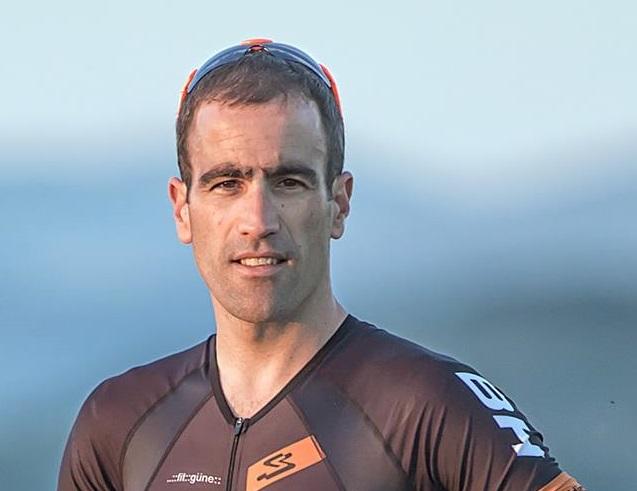
Eneko Llanos
The Quiet Kaiser: The Thirty-Year Reign of Eneko Llanos.
The Quiet Kaiser: The Thirty-Year Reign of Eneko Llanos#
Introduction: The King in His Castle#
On July 14, 2019, the streets of Vitoria-Gasteiz, the proud capital of Spain's Basque Country, were electric. This was not the familiar, sun-scorched lava fields of Kona, Hawaii, the traditional proving ground for the world's greatest long-distance triathletes. This was home. And for the city's native son, Eneko Llanos, it was the setting for a coronation thirty years in the making. As he ran through the city center, the roar of the crowd was a physical force, a wave of recognition for a local hero who had carried their flag to every corner of the globe.
At 42 years old, an age when most of his contemporaries had long since retired, Llanos was putting on a masterclass at the inaugural Ironman Vitoria-Gasteiz. He was not just competing; he was dominating. He crossed the finish line in a staggering 7:55:16, a new personal best and a time that would be competitive on any course in the world. But the numbers on the clock were secondary to the emotion of the moment. "It was difficult to control the emotions today," Llanos would later admit, "because you get to the city center, and all the people cheering, and you get very emotional... it's difficult to run when you almost want to cry".
This victory was more than a late-career triumph; it was the "award to more than 25 years of PRO career". It was a deeply personal achievement that re-contextualized a lifetime of global accolades—Olympic appearances, World Championship titles, and a heart-wrenching podium finish in Hawaii—through the intimate lens of local identity. To understand the magnitude of that day in Vitoria, one must understand the journey that began on those same Basque roads, a journey that saw a quiet, versatile athlete become one of triathlon's most enduring and respected figures.
Part I: The Brothers Llanos and the Basque Beginnings#
Eneko Llanos Burguera was born on November 30, 1976, in Vitoria-Gasteiz, a city nestled in the heart of the Basque Country. His name, Eneko, is a traditional Basque name, a fitting start for a man whose career would become inextricably linked with his regional identity. From a young age, he was immersed in sports, from Basque pelota to mountaineering, but his path to triathlon was paved by his older brother, Héctor.
Héctor was already competing in the nascent sport, and a young Eneko would tag along, cheering from the sidelines. "I'm sure that if Hector hadn't started with Triathlon, I wouldn't be where I'm now," Eneko has stated. "The one who opened the door for me was my brother". Inspired, Eneko competed in his first duathlon in late 1992 and, by 1993, was racing on the local Basque circuit alongside his brother.
The Llanos brothers' shared passion did more than launch Eneko's career; it helped ignite a professional triathlon culture in their hometown. Héctor, a professional for 21 years himself, and Eneko are widely regarded as the figures who "took the needed step to make this sport professional" in Vitoria, elevating its profile from a niche hobby to a serious athletic pursuit. Their parallel progression created a unique dynamic of familial support and friendly rivalry that pushed both to greater heights.
By 1995, Eneko's talent was undeniable. He won the Spanish Triathlon Championship in the Junior category and was already competing in elite World Cup events, signaling his decision to dedicate himself professionally to the sport. That same year, he and Héctor made another life-altering decision, adopting an ovo-lacto vegetarian diet—a choice they believe became one of the "secrets" to their remarkable performance and longevity in a grueling sport.
Part II: Chasing the Five Rings (1995-2004)#
With the foundation of his career firmly set in the Basque Country, Llanos turned his attention to the global stage. From 1995 onward, his singular focus was the pinnacle of short-course racing: the Olympic Games. Triathlon was set to make its debut at the Sydney 2000 Games, and Llanos poured his energy into the draft-legal, high-speed format of the ITU World Cup circuit. Representing the Spanish National Team, he ground out a series of top-ten finishes that secured him the ranking points needed to achieve his "great dream" of becoming an Olympian.
At the Sydney 2000 Olympics, amidst the iconic backdrop of the Sydney Opera House, Llanos finished a respectable 23rd with a time of 1:50:48..15 Four years later, he proved his consistency by qualifying for the 2004 Athens Games, a spot he earned after a strong season highlighted by a silver medal at the European Championships in Valencia. On the notoriously difficult Athens course, he improved his position, finishing 20th with a time of 1:54:52..15
These two Olympic campaigns were more than just entries on a resume; they were a crucible that forged a key weapon in his athletic arsenal. The decade spent racing at the highest level of ITU competition instilled in him a world-class running pedigree. The blistering pace of a draft-legal 10 km run is a unique skill, and it was this raw foot speed, honed against the fastest runners in the sport, that would later give him a decisive edge when he transitioned to longer distances. While many of his future Ironman rivals came to the sport with a dominant swim or bike, Llanos arrived with a runner's kick that would become his calling card.
Part III: The All-Terrain Champion (2002-2009)#
While chasing his Olympic ambitions, Llanos began to explore the outer limits of his athletic versatility, embarking on a period of multi-disciplinary dominance that remains one of the most remarkable in the sport's history. He proved he was not just a short-course specialist but a true all-terrain athlete, capable of excelling on pavement, dirt, and over punishing distances.
His first foray outside the ITU circuit was into the rugged, unpredictable world of off-road triathlon. He quickly found a second home in the XTERRA World Championships in Maui, a brutal test of mountain biking skill and raw power. Between 2002 and 2009, he was a constant presence on the podium, winning the coveted world title three times in 2003, 2004, and 2009. His 2004 victory was a showcase of his well-rounded talent; he posted the fifth-fastest swim, the fastest bike split, and the third-fastest run to defend his title. His third win in 2009 was a testament to his resilience, coming just two weeks after a crushing disappointment at the Ironman World Championship. In that race, he emerged from the water with the leaders, held his own in a tight pack on the bike, and then unleashed his superior run to claim the title, once again demonstrating his mental fortitude.
Simultaneously, he was proving his mettle over longer distances. In 2003, the same year as his first XTERRA world title, he also won the ITU Long Distance World Championship in Ibiza. This period, particularly from 2003 to 2004, represents an extraordinary peak. In those two years, he won two different world championships in two different disciplines (long-distance and off-road) while also competing in the Olympic Games and winning a silver medal at the European Championships. While many great triathletes build their legacies through specialization, Llanos built his by mastering the sport in all its forms, a feat of versatility that few have ever matched.
| Discipline | Key Achievements & Years |
|---|---|
| Olympic Distance | 2x Olympian (Sydney 2000 - 23rd; Athens 2004 - 20th); 2004 European Championship Silver Medalist |
| XTERRA (Off-Road) | 3x World Champion (2003, 2004, 2009); 2x World Championship Runner-Up (2002, 2005) |
| ITU Long Distance | 2003 World Champion (Ibiza); 2010 European Champion; 2012 World Championship Runner-Up (Vitoria-Gasteiz) |
| Ironman | 2nd, Ironman World Championship (2008); 3x Top-10 Finishes at Kona; Multiple Victories including Ironman Lanzarote (2007, 2010), Texas (2011), Arizona (2011, 2018), Melbourne (2013), Frankfurt (2013), Vitoria-Gasteiz (2019) |
Part IV: The Queen K and the Energy Lab (2005-2008)#
After the 2004 Athens Olympics, Llanos made the definitive leap to the sport's most iconic and grueling challenge: the Ironman. His initial forays into the distance were, in his own words, "not very promising," a common experience for athletes adjusting to the immense nutritional and pacing demands of the 140.6-mile journey. However, his world-class engine and relentless work ethic ensured a swift adaptation.
By 2006, he had cracked the code for the Ironman World Championship in Kona, Hawaii, securing a brilliant 5th place finish. In 2007, he claimed his first major Ironman title at Lanzarote, a race he considers a special moment in his career, and followed it with a 7th place in Kona. The 2008 season marked his arrival as a true titan of the sport. He engaged in fierce duels with legend Chris "Macca" McCormack at the Wildflower Triathlon and Ironman Germany, finishing a close second in both. Heading into the World Championship, his name was mentioned among the top pre-race favorites, alongside McCormack, defending champion Craig "Crowie" Alexander, and cycling powerhouse Normann Stadler.
The 2008 race in Kona played out like a Shakespearean drama for Llanos. He executed a near-perfect race, remaining at the front through the 2.4-mile swim and the brutal 112-mile bike ride along the Queen Ka'ahumanu Highway. While other strong cyclists faded under the pressure of the run, Llanos held firm, his Olympic-honed running form carrying him into the lead. The Ironman crown was within his grasp. But Kona is a cruel master. In the race's final, decisive miles, within the suffocating heat of the infamous Natural Energy Laboratory of Hawaii Authority (the "Energy Lab"), Craig Alexander made his move. Having paced the bike more conservatively, Alexander had more in his legs for the final push, overtaking a fading Llanos to claim the title.
Llanos finished second, his time of 8:20:50 just over two minutes shy of glory. He would later call it the greatest result of his career, a testament to the monumental effort. Yet, the result was a paradox. It was his crowning achievement, proof that he belonged among the absolute elite. But it also exposed a tactical vulnerability. His strategy of leveraging his bike strength had brought him to the brink of victory, but it left him unable to answer the final, decisive question posed by a smarter, more patient racer. It was a painful lesson that would shadow his subsequent attempts to conquer the island.
Part V: The Scott Revolution (2009-2013)#
The near-miss in 2008 was followed by a period of frustration. A 14th place finish at Kona in 2009 was a deep disappointment. The subsequent years were marred by setbacks that tested his resolve: a DNF (Did Not Finish) in Kona in 2011 due to crippling gastric problems, and another DNF in 2012 after suffering two flat tires and a crash on the bike course. The man who had come so close to the summit was struggling to find his footing.
Recognizing that something needed to change, Llanos made a bold, career-altering decision in late 2012. He sought the guidance of Dave Scott, the legendary six-time Ironman World Champion and one of the sport's most revered coaching minds. Scott conducted a thorough diagnosis and identified what he called "glaring weaknesses." It was not a lack of endurance, but a deficit in top-end power and efficiency. Scott noted that Llanos's
VO2 output on the bike was low and that he was "not very economical at sub threshold run pace," the very issue that had likely cost him the 2008 title.
The solution was a revolution in Llanos's training philosophy. After a decade with his previous coach, he humbly embraced a new regimen that was "more intense and much more specific". Scott moved away from a purely volume-based approach and implemented highly targeted, high-intensity workouts designed to elevate Llanos's power at threshold. Bike sessions now included punishing short intervals, like 8 repetitions of 3 minutes at maximum effort, and workouts that forced him to vary his gearing and cadence to improve muscle activation and efficiency. The goal was to re-engineer his athletic engine, making it more powerful and, crucially, more economical.
The results in 2013 were nothing short of breathtaking. Llanos emerged as a renewed and more formidable athlete. He began the year by winning the stacked Ironman Asia-Pacific Championship in Melbourne. He then traveled to Germany for the Ironman European Championship in Frankfurt. There, he delivered one of the signature performances of his career, winning the prestigious title and breaking the eight-hour barrier for the second time, finishing in 7:59:58. The victory was sealed with a devastatingly fast 2:44:12 marathon, a clear demonstration that his new, more efficient engine allowed him to come off the bike with more firepower than ever before. In the span of six months, the Llanos-Scott partnership had transformed him from a struggling veteran into the undisputed best long-distance triathlete in the world.
Part VI: The Long Sunset and a Hero's Welcome (2014-2023)#
The spectacular resurgence of 2013 ushered in the final, extended chapter of Eneko Llanos's professional career, a period defined by remarkable longevity and a continued search for peak performance. He remained a formidable competitor on the global circuit, securing another top-10 finish at the Ironman World Championship with a 7th place in 2015.
However, as he entered his late 30s and early 40s, he faced new challenges. The gastric issues that had plagued him in 2011 became a more persistent problem, a common struggle for aging endurance athletes. Ever the adaptable professional, he experimented with a radical nutritional change, adopting a Low-Carb, High-Fat (LCHF) diet. For Llanos, a committed lacto-ovo vegetarian, the strategy proved unsustainable, leading to diminished power and low mood, and he eventually returned to his trusted high-carbohydrate approach. The experience was a powerful lesson in the highly individualized nature of sports science, but it also underscored his unwavering commitment to exploring every possible avenue for improvement.
This final era of his career found its emotional zenith back where it all began. His victory at the 2019 Ironman Vitoria-Gasteiz was the perfect bookend to his competitive journey. That year, he was the most veteran professional on the Kona start list, a testament to his incredible durability.
In 2023, at the age of 46, Eneko Llanos officially retired from professional racing. Fittingly, his final race was the Zarauzko Triathlon, the very same event where he had competed as a teenager decades earlier. But retirement was merely a transition. "I will be a triathlete forever," he wrote. "Triathlon will still be my life". He now dedicates his time to his family as a father of two, to his community as a firefighter, and to the next generation of athletes as a coach, running the E-Tri Eskola triathlon school with his wife, fellow triathlete Ruth Brito, a project they started back in 2010.
Conclusion: A Legacy of Endurance#
Eneko Llanos's legacy in triathlon cannot be measured solely by his extensive list of victories. His career, described as nothing short of "legendary," is a testament to the virtues of versatility, resilience, and quiet determination. He is the rare athlete who reached the pinnacle of the sport in its varied forms: competing in two Olympic Games, winning three XTERRA World Championships, an ITU Long Distance World Championship, and multiple Ironman titles across the globe.
He will be remembered as the man who came agonizingly close to conquering Kona in 2008, a performance he still regards as his best. But perhaps more importantly, he will be remembered for how he responded to that setback and the struggles that followed—by humbly reinventing himself, embracing a new philosophy, and returning stronger than ever.
In Spain, and especially in his native Basque Country, he is a pioneer who helped professionalize the sport and inspire a generation of triathletes. His journey came full circle with that magical day in Vitoria, a hometown hero celebrated by his people. Now, as a coach and mentor, his influence continues, shaping the future of the sport he has dedicated his life to. His career was not a single, explosive peak but a long, sustained reign—a thirty-year masterclass in the art of endurance. He is the Quiet Kaiser, and his legacy is as enduring as the races he so gracefully conquered.