Dean Harper
The Long Run: Dean Harper's Four-Decade Triathlon Odyssey.
The Long Run: Dean Harper's Four-Decade Triathlon Odyssey#
Introduction: The Coach on the Pool Deck#
The air at the Spieker Aquatics Complex at the University of California, Berkeley, is thick with the scent of chlorine and the percussive sound of water churning. On the pool deck, a lean figure with the quiet intensity of a lifelong athlete watches over the controlled chaos. This is Dean Harper, a man whose presence here connects the raw, untamed origins of triathlon with its modern, institutional future. To the student-athletes of Cal Tri, he is simply "Coach," the architect of multiple national championships and the 2018 Cal Club Sports Coach of the Year. His guiding principle, repeated often, is "consistent hard work over time"—a motto that perfectly distills his own remarkable journey.
To see Harper in this environment—mentoring, strategizing, shaping the next generation—is to see the final, and perhaps most meaningful, act of a four-decade odyssey. He is a living bridge between two vastly different eras of the sport. Before collegiate triathlon was a structured national competition, before carbon fiber bikes and GPS watches, Harper was there. He was a pioneer in a sport that was, in the early 1980s, "crudely cobbled up," a fringe pursuit for a handful of hardy souls. He raced alongside the gods of the sport's genesis, graced the cover of its first magazine, and won its most iconic inaugural events. Yet, unlike many of his contemporaries who have faded into history, Harper remains a central, shaping force. His story is not merely that of a champion who retired, but of an athlete who navigated a full and complex life—building a legal career, raising a family—while keeping the flame of his passion alive, ultimately returning to the sport not just as a competitor, but as a mentor. To understand Dean Harper is to understand the evolution of triathlon itself, from a grassroots phenomenon into the global community it is today. How did a man who stood at the very dawn of the sport manage to remain so profoundly relevant for forty years? The answer lies in a journey of four distinct, yet interconnected, lives.
I. The Accidental Champion: A Law Student's Calling (1980-1981)#
The story begins not on a sun-drenched Hawaiian lava field, but in front of a television screen in 1980. Dean Harper, preparing to start his studies at Hastings Law School in San Francisco, was captivated by the broadcast of Dave Scott's first victory at the Hawaiian Ironman on ABC's Wide World of Sports. That spectacle, combined with a 10-page
Sports Illustrated article on the 1979 race, was the spark that ignited a national obsession and planted a seed in the young law student's mind. He knew, then and there, that he wanted to participate in a triathlon.
This decision reveals a foundational pragmatism that would guide Harper throughout his life. He did not abandon his planned career path for a reckless dive into a sport with no established professional circuit or financial future. Instead, he pursued both ambitions in parallel, a calculated, dual-track approach that set him apart from many of his peers. His primary path was law; triathlon was the passionate calling he pursued in the margins. This foresight would prove critical, providing him with the stability to make major life transitions on his own terms, without regret.
In August 1981, after completing his first grueling year of law school, Harper entered the third annual Lodi Triathlon. The event was a perfect microcosm of the sport's early, anarchic charm. The distances were non-standard—a 5K trail run, a 5-mile bike, and a 1,000-yard swim in a small lake. Organization was minimal; athletes on bikes blew "through stop signs and stop lights with no police protection". Amidst this chaos, Harper discovered his natural talent. He took the lead on the bike and held it to the finish, winning the very first race he ever entered. The prize was a simple trophy mug, which he still uses for spare change more than three decades later. That victory was all it took. He was, in his own words, "hooked". His wife, Mary Ann, would later reflect that it was the "beginning of my lifelong love affair with the sport of triathlon".
Harper immediately dove headfirst into the burgeoning Northern California triathlon scene, an area he argues was the sport's "first mecca". In an era before the internet, he found events by meticulously combing through
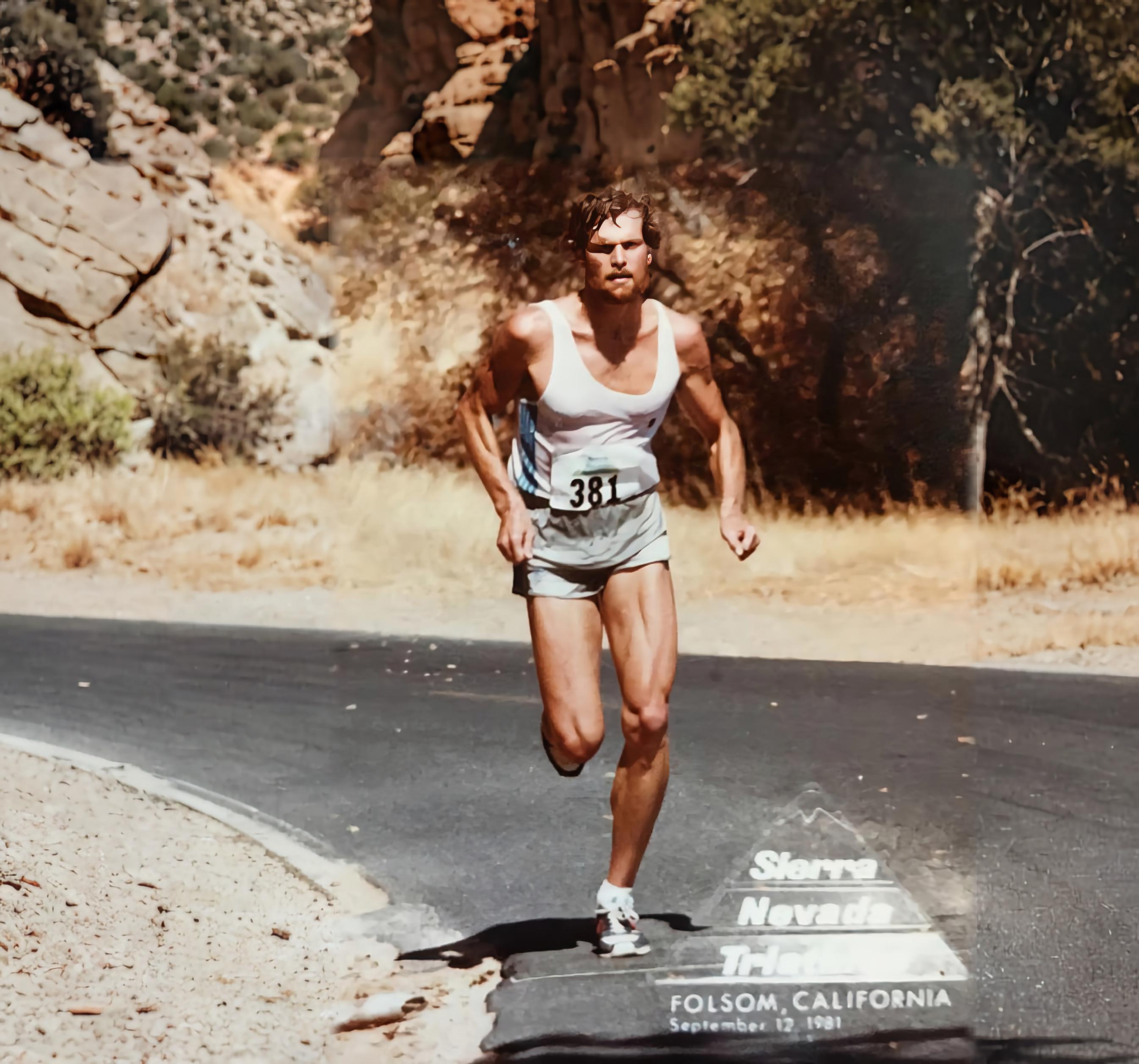
City Sports, a free San Francisco-based magazine that was the go-to source for local endurance athletes. The races were brutal tests of will. At the Sierra Nevada Triathlon in 1981, he battled future legend Scott Molina, finishing third in a tight race where the top three were separated by just 80 seconds. Later that year, in November, he competed in the first-ever Escape from Alcatraz triathlon. The water in the San Francisco Bay dropped to a frigid 55 degrees Fahrenheit. Despite being a strong collegiate swimmer, Harper succumbed to severe hypothermia, passing out on the beach after the swim and again a half-mile into the bike course. In a testament to his sheer grit, he managed to recover and finish second. These early experiences, forged in the cold waters and on the rugged trails of Northern California, shaped the tough, resilient athlete who was about to step onto the world stage.
II. Racing in the Shadow of the Big Four (1982-1986)#
Between 1982 and 1986, while still balancing the demands of his legal education and burgeoning career, Dean Harper established himself as a professional triathlete of the highest caliber. This was the sport's golden era, defined by a Mount Rushmore of athletes who would become known as the "Big Four": Dave Scott, Mark Allen, Scott Molina, and Scott Tinley. Harper was not just a contemporary of these legends; he was their peer, training with them, racing against them, and consistently challenging them at the finish line.
His career during this period was defined by a remarkable series of "firsts" that etched his name into the foundational history of the sport. In 1982, the U.S. Triathlon Series (USTS) launched its first West Coast circuit, a pivotal moment that helped professionalize the sport. Harper won the entire series, becoming its first-ever champion. The following year, 1983, was a banner year. He won the inaugural Wildflower Triathlon, an event that would grow into one of the most beloved and iconic races on the global calendar. He would prove his mastery of the grueling course by winning it again in 1986. Also in 1983, he captured the title at the first-ever USAT Long Course National Championships. His prowess was undeniable, and his status as a leading face of the new sport was cemented when he was chosen for the cover of the very first issue of
Tri-Athlete Magazine in May 1983.
While the Big Four often captured the top headlines, particularly at the Ironman World Championship, Harper was consistently in the conversation. He was described by triathlon historians as being "about as close as you could get to being one of the Big Four without being named Scott or Mark". His performance at the October 1982 Ironman in Hawaii validates this assessment. In a field stacked with the sport's titans, Harper finished 9th with a time of 10:07:55. His individual splits were world-class: his 53:30 swim was the third-fastest of the day, and his 3:27:19 marathon was the fourth-fastest. He finished just behind Scott Molina (4th) and ahead of another legend, Ferdy Massimino (10th).
These professional battles were built on a foundation of personal connection and shared hardship. Scott Molina, one of the Big Four, fondly recalled the spartan early days, road-tripping eight hours with Harper from Northern California to a race in Los Angeles. With no discretionary income, they could only afford a single night in a motel and planned to drive straight back after the awards ceremony. Harper also shared a competitive history with Dave Scott, having raced against him in swimming and water polo in college before they became triathlon pioneers. This camaraderie defined an era where the lines between rivals and training partners were often blurred, all of them united in the shared project of inventing a professional sport from scratch.
Table 1: Dean Harper - Key Professional Victories & Results (1982-1986)#
To quantify his standing among the sport's elite, his key results from this formative period are summarized below. These victories are not just wins, but foundational moments in the history of several of triathlon's most enduring events.
| Year | Event | Result/Significance |
|---|---|---|
| 1982 | USTS West Coast Triathlon Series | 1st Place (Overall Series Winner in its inaugural year) |
| 1982 | Ironman World Championship (October) | 9th Place (Finished among the sport's legends in a stacked field) |
| 1983 | Wildflower Triathlon | 1st Place (Winner of the first-ever Wildflower) |
| 1983 | USAT Long Course National Championships | 1st Place (Winner of the inaugural championship) |
| 1985 | Donner Lake Triathlon | 1st Place (Tied for the overall title) |
| 1986 | Wildflower Triathlon | 1st Place (Second victory at the iconic race) |
III. A Different Finish Line: Law, Family, and a Seventeen-Year Hiatus (1987-2002)#
In 1987, at a time when many professional athletes are just hitting their peak, Dean Harper made a decision that was both surprising and perfectly consistent with the pragmatic approach he had taken from the beginning. He stepped away from the professional circuit. His reasoning, shared in a 2003 CNN interview, was devoid of athletic drama; it was a matter of life's priorities. "I got married, had the first child on way and couldn't afford to support a family on my triathlon salary," he explained. The dual-track path he had forged had reached a junction, and he chose the stability of his legal career and the promise of his growing family.
This period, which stretched for nearly 17 years, should not be mistaken for a typical retirement. It was less an ending and more a long-term periodization strategy, a conscious shift in focus that allowed him to build another life while keeping the core of his athletic identity intact. He fully invested in his legal career, becoming a partner at the law firm Bowles & Verna LLP in Walnut Creek, California, where he practices to this day. He and his wife, Mary Ann Wickes, raised their three children, coaching their sports teams and building a life far removed from the spartan existence of a professional triathlete.
Yet, the connection to the sport never severed. He competed only a few times over the next 15 years, but his passion remained. In a small but telling detail, he "never gave up his subscription to Triathlete Magazine," a symbolic link to the world he had helped create. More importantly, he maintained a remarkable level of physical fitness. While he was no longer logging the epic training weeks required of a pro, he made a point to get in an hour of aerobic activity nearly every day. This was not the obsessive training of a competitor, but the disciplined routine of a man who understood the value of a physical foundation. He maintained the engine, even if he wasn't racing. This quiet, seventeen-year period of consistency was the critical investment that would yield astonishing returns. It ensured that when he did decide to return to competition, he wasn't starting from scratch. He was simply reigniting a fire that had been carefully banked, never allowed to go out.
IV. The Second Coming: A New Era of Dominance (2003-2010)#
When Dean Harper returned to competitive triathlon in 2003, it was not as a nostalgic veteran taking a victory lap. It was as a focused, fiercely competitive athlete embarking on a second, distinct, and arguably just as dominant, career. Over the next eight years, he competed in approximately 80 races, redefining what was possible for an age-group athlete and establishing himself as one of the best in the world.
His return was nothing short of explosive. He was ranked by USA Triathlon as the top male athlete in his age group in the entire country on three separate occasions. His dominance was so complete that at one point he held an incredible 10 Tri-California age group records at the region's most iconic races, including Alcatraz, Pacific Grove, and his old stomping ground, Wildflower.
The true measure of his second act, however, came on the national and world stage. He wasn't just winning local races; he was winning the most prestigious championships available to an amateur athlete. In 2004, he won his age group at the U.S. Long Course National Championships. In 2005, he conquered Ironman Arizona, winning his division. In 2008, he claimed the U.S. Short Course National title. That same year, he returned to the sport's ultimate proving ground—the Ironman World Championship in Hawaii—and finished third in his age group, a remarkable podium finish 26 years after his top-10 result as a professional. The pinnacle of his age-group career arrived in 2009 on the Gold Coast of Australia, where he stood atop the podium as the ITU Short Course World Champion for the 55-59 age group. This second peak was not a comeback; it was a reconquering.
Table 2: Dean Harper - Selected National & World Age-Group Championships (2004-2009)#
The following table highlights the world-class level of Harper's achievements during his second competitive era, demonstrating a return not for participation, but for dominance at the highest echelons of age-group racing.
| Year | Event | Age Group | Result |
|---|---|---|---|
| 2004 | U.S. Long Course National Championships | 50-54 | 1st Place |
| 2005 | Ironman Arizona | 50-54 | 1st Place |
| 2008 | U.S. Short Course National Championships | 55-59 | 1st Place |
| 2008 | Ironman World Championship (Hawaii) | 55-59 | 3rd Place |
| 2009 | ITU Short Course World Championships | 55-59 | 1st Place |
V. The Final Act: Building a Legacy (2013-Present)#
In 2013, Dean Harper embarked on the third and most enduring chapter of his triathlon life, transitioning from competitor to mentor as the Head Coach of the Cal Triathlon team. In this role, he has synthesized a lifetime of experience—as a pioneer, a professional, a lawyer, a father, and an age-group champion—into a coaching philosophy that has cultivated one of the nation's premier collegiate club programs. His ultimate legacy is now being written not through his own race results, but through the hundreds of young athletes he guides.
Under his leadership, Cal Tri has become a perennial powerhouse, winning several national championships and consistently competing with better-funded varsity programs. His success is built on the principle of "consistent hard work over time," a motto that reflects the discipline of his own career. He has created a program that is both highly competitive and profoundly inclusive, welcoming athletes of all backgrounds and abilities. This approach mirrors his broader vision for the sport's future. While he supports the NCAA's involvement in triathlon for the scholarship opportunities it provides, he remains a passionate advocate for the club system, believing its inclusivity is the true engine for the sport's growth. "The club program is so much more inclusive," he stated, "and if USA Triathlon pumped half the money into the club effort nationwide we'd have 1,000 more athletes at club nationals".
His influence is perhaps most evident within his own family, creating a self-perpetuating legacy of athletic excellence. All three of his children became Division I swimmers, a testament to the athletic environment he and his wife fostered. Two of them, Shelley and Greg, went on to star for his Cal Tri team. Both were formidable competitors who repeatedly posted the fastest swim splits at the Collegiate Club National Championships. The impact on his son, Greg, was particularly profound. In an interview, Greg recalled his childhood ambition: "I want to be an Olympic swimmer or a professional triathlete, and if I don't make it in sports, I want to be a lawyer." He added, "I mean that's what my dad does. He was a triathlete, and then he was an attorney". This direct transmission of values—of balancing elite athletic ambition with a demanding professional life—is the clearest evidence of Harper's legacy. He has transitioned from being a participant in the sport's history to an architect of its future, embedding the principles of his own success into the next generation.
Conclusion: More Than a Pioneer#
To label Dean Harper simply as a "pioneer" is to capture only the first chapter of an epic four-decade narrative. His journey represents a rare and remarkable arc of sustained excellence and reinvention. He was the pragmatic Pioneer who balanced law school with the raw, untested world of early triathlon. He became the elite Professional, racing shoulder-to-shoulder with the Big Four and winning the sport's inaugural championships. After a deliberate, seventeen-year hiatus to build a career and family, he re-emerged as the dominant Age-Grouper, conquering national and world championships with the focus of an athlete in his prime. And now, he thrives as the Mentor, building a powerhouse collegiate program and passing his wisdom to a new generation, including his own children.
Few athletes in any sport have successfully navigated so many distinct roles at such a high level. Harper's story challenges the conventional narrative of an athletic career as a single, linear peak. His was a life of multiple summits, each reached through a combination of immense talent, strategic pragmatism, and an unwavering, lifelong passion for the sport. His legacy is not just in the trophies he won or the records he set, but in the example he provides of a life lived fully within sport, adapting and evolving across the decades.
The image of Dean Harper on the pool deck at Berkeley is where his story both begins and culminates. The young athletes in the water may know him simply as "Coach," the steady hand guiding their ambitions. But they are being mentored by a man who is the living embodiment of their sport's entire, incredible history—a history he did not just witness, but one he helped write from the very first page.