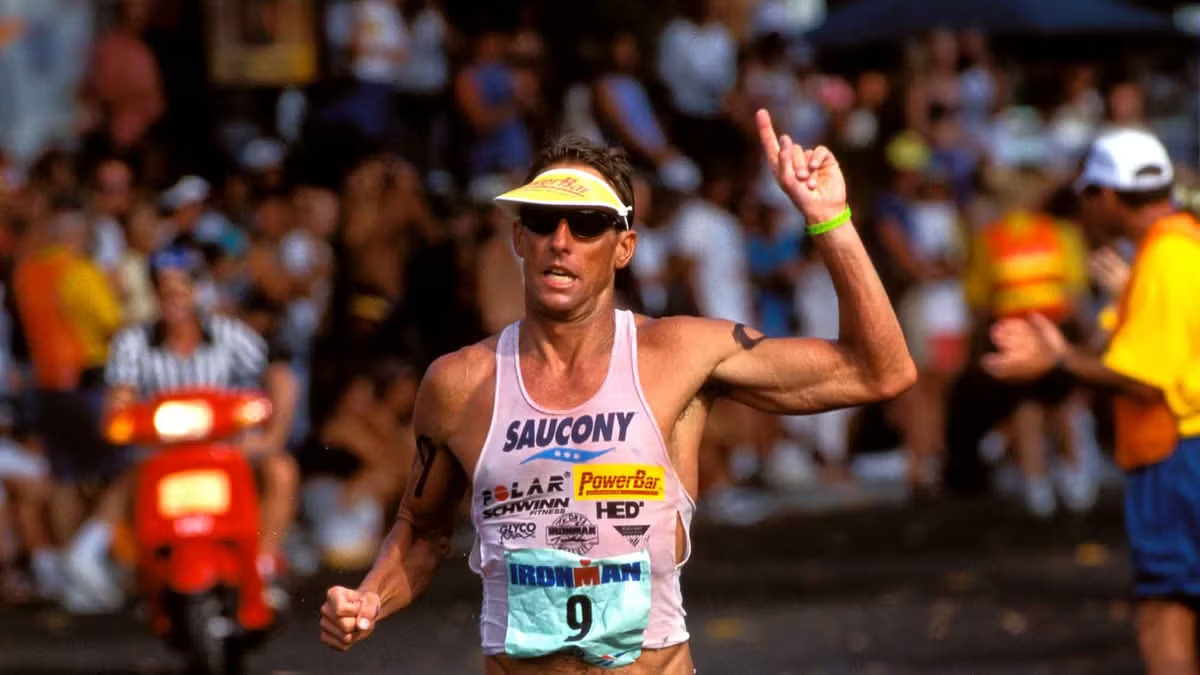
Dave Scott
The Man.
The Man Who Forged the Ironman: The Enduring Legacy of Dave Scott#
Introduction: The Ghost of Kona (October 1994)#
The air on the Kona coast in October is a physical presence. It’s a suffocating blanket of heat and humidity, radiating off the black, petrified seas of lava that flank the Queen Kaahumanu Highway. In 1994, the air was thicker still, charged with a nervous, electric energy that had little to do with the weather. The world’s best triathletes, men and women in their physical prime, milled near the start line of the Ironman World Championship, but the whispers in the crowd, the buzz among the press, and the anxious glances from the pros were all directed at one man: a ghost from another era. He was 40 years old, but he didn't look it. Seven years had passed since his last victory here, and five since his last appearance—an epic, soul-baring loss in a race that had since entered the realm of myth. Yet here he was, Dave Scott, looking unnervingly fit.
To the uninitiated, he was a curiosity. To the faithful, his return was a pilgrimage. The lines at the pre-race expo stretched around the block, full of people seeking an audience not just with a champion, but with an icon. One man, Jim, stood patiently, a jagged red scar traversing his face from hairline to chin. When he finally reached the front, Scott, ever inquisitive, asked what brought him to Kona. The man wasn't racing, nor was any family member. He was there for one reason. "I'm sure you don't remember," Jim began, "but I was in a car accident four years ago... You called me three times while I was in the hospital to see how I was doing. You have no idea what that meant to me. I vowed right then that if you ever raced again in Hawaii, I would be here... to watch you race".
This was the mystique of Dave Scott. He was more than a collection of victories; he was woven into the personal histories of those who followed the sport. His return posed the ultimate questions, both for himself and for the triathlon world. Why come back now? After years away, "fully absorbed in his family duties" following the birth of his two sons, what was left to prove?4 Could a 40-year-old body withstand the rigors of a race that had grown faster and more ferocious in his absence? The man who would ultimately duel with him that day, Australia’s Greg Welch, knew Scott was a "tough nut," a legend, but even he couldn't anticipate the force of will that was about to be unleashed on the course. Scott's comeback was not merely another race. It was a test against time itself, a challenge to a new generation of champions, and a deeply personal quest to answer a question that had lingered since his last battle on these lava fields: Was he still "The Man"?
This return to the sport's greatest stage was not just an athletic endeavor; it was a profound reassertion of identity. Having stepped away to embrace his role as a father, this race represented a public and private reclamation of the core of his being: the ultimate competitor. The motivation was not financial, as prize purses were still modest by modern standards. Nor was it to pad a resume, for he was already the most decorated champion in the event's history. The drive was internal. It stemmed from a "deep internal faith" in his own capabilities and a need to "maximize my capability emotionally and physically". This comeback would prove that his relevance was not confined to a single decade. It would become a defining act of his career, embodying the very ethos of the Ironman—to test oneself against the perceived limits of human potential, in this case, the inexorable limit of age.
Part I: The Making of "The Man" (1954-1980)#
The Davis Crucible#
Before he was the master of the lava fields, Dave Scott was forged in the heat and hard work of Davis, California. Born in 1954, his athletic genesis was not in the lonely disciplines of swimming, cycling, or running, but in the chaotic, combative world of team sports. He played football and basketball in middle school, but it was in the swimming pool where his destiny began to take shape, not as a graceful swimmer, but as a dominant water polo player at Davis High School and later at the University of California, Davis.
It was in the water polo arena that Scott cultivated the immense capacity for work and the tolerance for pain that would become his trademark. The training regimen was relentless. His mother, Dorothy, recalled the punishing schedule: "The water polo team would swim in the morning, drill at noon and then scrimmage at night. We were going hard six hours a day". In between, Scott was in the weight room, lifting. This background built a different kind of athlete. While his swimming technique was, by his own admission, "rough" and like a "loose chainsaw," it was brutally effective in the turbulent environment of open water, a skill that would serve him well. He possessed an innate "athletic fire" and what he wryly called a "deranged psyche," an internal engine that allowed him to constantly push his own limits without the need for external motivation. This combination of explosive power, bottomless endurance, and mental toughness, honed in the physical crucible of water polo, made him uniquely suited for the nascent, untamed sport that was quietly emerging in the Pacific.
The Birth of a Sport and Scott's Entry#
In the late 1970s, the Ironman was little more than a peculiar challenge born from a barroom debate among U.S. Navy personnel in Hawaii: who were the fittest athletes—swimmers, cyclists, or runners?10 On February 18, 1978, Commander John Collins and his wife Judy staged the first Hawaiian Iron Man Triathlon, combining three of the island's toughest endurance races—the 2.4-mile Waikiki Roughwater Swim, the 112-mile Around-Oahu Bike Race, and the 26.2-mile Honolulu Marathon—into one grueling event. It was an obscure, fringe affair, a test of pure survival for the 15 souls who attempted it.
Scott, already a two-time winner of the Waikiki Roughwater Swim, first learned of the event from a Sports Illustrated article. When Collins handed him a flyer, Scott’s initial reaction captured the sheer absurdity of the challenge at the time: "I looked at it and saw a 2.4-mile swim, 112-mile bike and 26.2-mile run and turned to him and said, 'That's a long three days'". The seed, however, was planted. His first taste of the multi-sport format came in November 1976 at a chaotic, unnamed event in San Francisco. He won, and his prize was a turkey. It was an inauspicious but prophetic start.
The 1980 Revolution#
When Dave Scott arrived on the start line of the third-ever Ironman in 1980, the event was still an amateur suffer-fest. The previous winning time was over 11 hours. Scott didn't just participate; he detonated a bomb in the heart of the endurance world. He finished in 9:24:33, shattering the previous record by nearly two hours. He won the swim and never saw another competitor for the rest of the day.
This performance, captured for the first time by the cameras of ABC's "Wide World of Sports," was a watershed moment. In a single day, Scott’s time and aggressive approach fundamentally altered the perception of the event. It was no longer simply a test of endurance to be survived; it was a race to be won. He introduced speed, strategy, and a professional mindset to a sport that had, until that point, been defined by its amateur ethos of pure grit. The man from Davis had arrived, and in doing so, he had given the Ironman its competitive soul. His success demonstrated that there was no single prescribed path to triathlon greatness; his all-around toughness and massive aerobic engine, products of his water polo background, proved more valuable than pure specialization, a lesson that would shape the development of the sport for decades to come.
Part II: The Six-Day Reign (1982-1987)#
Following his revolutionary debut, Dave Scott embarked on an era of dominance that would cement his legend. Over the next seven years, he would claim the Ironman crown five more times, establishing a dynasty on the lava fields of Kona and, in the process, architecting the blueprint for modern triathlon training. Yet, this period of unparalleled success was also marked by a profound paradox: he achieved his greatest triumphs while adhering to a nutritional philosophy he would later describe as debilitating.
A Dynasty in Kona#
Scott's reign was defined by six victories at the Ironman World Championship: 1980, 1982 (October), 1983, 1984, 1986, and 1987 Each win was a chapter in his evolving legend, but two races in particular showcase the depth of his competitive character.
The 1983 race stands as a testament to his mental fortitude. He arrived in Kona with his fitness having fallen off during the final two months of preparation. Knowing he was not at his physical peak, he resolved that the only path to victory was to "extract the highest level of psychological fortitude". He went out hard from the start, building a 7-minute lead over rival Scott Tinley by the 14-mile mark of the marathon. But then, his body began to fail. His lead evaporated, shrinking to just two minutes with two miles to go. In the final, agonizing 400 meters, with his vision blurring and his body shutting down, he barely hung on to win by a mere 33 seconds. It was a victory won not with the legs, but with the mind, proving he could prevail even when physically vulnerable.
If 1983 was a display of grit, 1986 was a demonstration of sheer power. After sitting out the 1985 race, Scott returned with a vengeance. He decimated the field and the course record, finishing in 8:28:37 and slashing more than 22 minutes from the previous best time set by Tinley. This performance was a powerful reassertion of his dominance, resetting the benchmark for what was considered possible in the sport.
The Architect of Modern Training#
While his race results were making headlines, Scott's true revolution was happening behind the scenes in his training. In an era when most endurance athletes believed that more miles equaled better results, Scott was a pioneer of a more nuanced, scientific approach. He rejected what he called the "license to go slow," the trap of logging endless, moderately paced aerobic miles. Instead, he championed the integration of high-intensity training (HIIT) and threshold work to optimize efficiency and build speed. His "Swing Pacing" run workouts, which involved alternating between efforts above and below lactate threshold, were designed to teach the body how to handle the rigors of race pace and were years ahead of their time.
Even more unconventional was his obsession with strength training. At a time when lifting weights was considered anathema to endurance performance, Scott saw it as his fourth discipline. He was in the gym four times a week, performing a combination of Olympic and powerlifting exercises. He possessed a sophisticated understanding of biomechanics, believing that superior core and gluteal strength could compensate for his "unsightly" and mechanically inefficient running form. This holistic approach—blending volume with intensity and endurance with power—was a radical departure from the norm and laid the foundation for the multi-faceted training programs used by elite triathletes today.
The Nutritional Paradox#
The most confounding aspect of Scott's dominant era was his diet. In the early 1980s, he fell under the influence of low-fat diet guru Nathan Pritikin and adopted an extreme high-carbohydrate, low-fat regimen, with fat constituting only about 10% of his total caloric intake. He took this to fanatical lengths, even rinsing his cottage cheese to reduce its fat content further.
He has since described this nearly 10-year period as a "crazy, crazy period" that left him with "massive fluctuations in my psychological state" and days where he was "so lethargic I could barely move". He now believes he was effectively "poisoning" himself with the sheer volume of carbohydrates he was consuming. This creates a stunning contradiction: the greatest Ironman of his generation achieved his most iconic victories while fueling his body with a diet he now considers "not sustainable, and is very, very, very unhealthy".
This reality dramatically amplifies the magnitude of his raw physical talent and unparalleled mental toughness. His dominance was achieved in spite of, not because of, his nutrition. The clear implication is that his revolutionary training methods were so potent and his willpower so immense that they were able to override the significant physiological handicap of a deeply flawed diet. It raises a compelling question: if his training was decades ahead of its time, how much faster could he have been with optimal fueling? His ultimate potential may have been even greater than the historic records he set. This makes him a more complex and fascinating figure—a brilliant innovator in training who was simultaneously a product of the flawed nutritional science of his era, a living case study in the evolution of sports science.
Table 1: Dave Scott's Ironman World Championship Career Record
| YEAR | RACE | POSITION | SWIM | BIKE | RUN | RESULT | |
|---|---|---|---|---|---|---|---|
| 2001 | Ironman World Championship, Kona, Hawaii, USA | DNF | --- | --- | --- | DNF | |
| 1996 | Ironman World Championship, Kona, Hawaii, USA | 5th | --- | --- | --- | 8:28:31 | |
| 1994 | Ironman World Championship, Kona, Hawaii, USA | 2nd | --- | --- | --- | 8:24:32 | |
| 1989 | Ironman World Championship, Kona, Hawaii, USA | 2nd | --- | --- | --- | 8:10:13 | |
| 1988 | Ironman World Championship, Kona, Hawaii, USA | DNC | --- | --- | --- | --- | |
| 1987 | Ironman World Championship, Kona, Hawaii, USA | 1st | --- | --- | --- | 8:34:13 | |
| 1986 | Ironman World Championship, Kona, Hawaii, USA | 1st | --- | --- | --- | 8:28:37 | |
| 1985 | Ironman World Championship, Kona, Hawaii, USA | DNC | --- | --- | --- | --- | |
| 1984 | Ironman World Championship, Kona, Hawaii, USA | 1st | --- | --- | --- | 8:54:20 | |
| 1983 | Ironman World Championship, Kona, Hawaii, USA | 1st | --- | --- | --- | 9:05:57 | |
| 1982 | Ironman World Championship, Kona, Hawaii, USA | 1st | --- | --- | --- | 9:08:23 | |
| 1982 | Ironman World Championship, Kona, Hawaii, USA | 2nd | --- | --- | --- | 9:14:41 | |
| 1981 | Ironman World Championship, Kona, Hawaii, USA | DNC | --- | --- | --- | --- | |
| 1980 | Ironman World Championship, Oahu, Hawaii, USA | 1st | --- | --- | --- | 9:24:33 | |
| Source: 8 | |||||||
| (Note: In 1982, The Ironman World Championship was moved from a February to October fixture, and therefore took place twice that year. Scott was second in the February race and won in October.) |
Part III: The Iron War (1989)#
Great champions are defined not just by their wins, but by their rivals. For Dave Scott, that rival was Mark Allen. Their decade-long battle culminated on October 14, 1989, in a race that transcended sport. It was a clash of titans, a duel of opposing philosophies, and a human drama of such intensity that it became known simply as the "Iron War." It was the day triathlon came of age, cementing itself in the public consciousness not just as a test of endurance, but as a theater for one of the greatest rivalries in athletic history.
Act I: The Unstoppable Force Meets the Immovable Object#
By 1989, the dynamic between the two men was firmly established. Scott was the immovable object, the six-time king of Kona, a man who seemed invincible on the Big Island. Allen was the irresistible force, a supremely gifted athlete who had beaten Scott in races all over the world but had failed in five attempts to conquer him in Hawaii. He was the best in the sport never to have won the one race that mattered most.
Their rivalry was amplified by their profoundly different approaches to life and sport. Scott was the quintessential "hard-core, work-til-you-puke pain junkie who trains alone," a pragmatist who believed in out-suffering the competition. Allen was his antithesis, a "New Age spiritual type" who meditated, favored alternative medicine, and embraced the camaraderie of training with friends. This ideological schism gave their physical battle a deeper, more compelling dimension. They were, as author Matt Fitzgerald wrote, "like two ravenous tigers fighting over a kill".
The psychological stakes were immense. Allen was haunted by his "Kona curse," a series of frustrating defeats that led many to believe he simply wasn't cut out for the pressures of the championship race. Scott, for his part, carried the weight of his own legend. His motivation was deeply personal and complex; he wrestled with depression, and the brutal, solitary training for Ironman was a necessary anchor that stabilized his emotional world. Despite his history of dominance over Allen, he harbored a quiet premonition that 1989 would be different, that the stars were finally aligning for his rival.
Act II: The Greatest Race Ever Run#
The race itself unfolded like a perfectly scripted drama. For nearly eight hours, the two men were inseparable, locked in a silent, grueling battle across the island.
- The Swim: They exited the 2.4-mile swim together, with Allen shadowing Scott's every move, at times close enough to tap his toes.
- The Bike: Out on the Queen K Highway, Scott took the lead, setting a punishing pace in an attempt to break Allen. But Allen refused to yield. For 112 miles, they rode within the legal drafting zone of one another, an invisible cord connecting them as they pulled away from the rest of the field.
- The Marathon: They began the 26.2-mile run side-by-side, and for the next two and a half hours, neither would give an inch. They ran at a blistering, world-record pace that Allen would later call "insanity". The silence between them was profound, broken only by the rhythmic sound of their footfalls on the asphalt. It was a duel of subtle shifts in power: Scott appeared stronger on the descents, while Allen held a slight advantage on the climbs. For 24 miles, they were locked in a stalemate, their nearest competitor more than three miles behind.
- The Decisive Moment: The break finally came on the last significant climb of the course, a section of road near mile 24 that has since been immortalized as "Mark and Dave Hill". As they approached an aid station at the bottom of the hill, Allen made his move. While Scott reached for a final cup of fluid, Allen surged. In a matter of seconds, he opened a gap. The elastic that had bound them together for eight straight hours had finally snapped.
Act III: The Aftermath#
Allen crossed the finish line in 8:09:15, the victor by a mere 58 seconds. Both men had utterly destroyed the old course record. Scott's finishing time of 8:10:13 was a staggering 18 minutes faster than his own previous best, a performance that would have won any other Ironman in history with ease, yet on this day, it was only good enough for second place. The race marked a symbolic passing of the torch. For Allen, it was the cathartic victory that broke his Kona curse and launched his own dynasty of six world titles.
The Iron War was more than a race; it became the sport's foundational myth. The archetypal conflict—the established king versus the worthy challenger, the pragmatist versus the spiritualist—created a narrative of such power that it resonated far beyond the triathlon community. Broadcast to a global audience, the human drama of their rivalry elevated Ironman from a niche endurance event into a mainstream spectacle. This single race gave the sport its soul, providing a story that was both epic in scale and deeply human, a story that continues to be told more than three decades later.
Part IV: The Second Act (1994-1996)#
While the Iron War may have signaled the end of his reign as the undisputed king of Kona, it was not the end of Dave Scott's story. His return to the sport in the mid-1990s, after a five-year hiatus, would forge a new and arguably more influential chapter of his legacy. His performances at ages 40 and 42 were not just remarkable athletic feats; they fundamentally redefined the concept of an athlete's prime, establishing a new benchmark for longevity that would inspire a generation of competitors.
The 1994 Comeback#
When Scott stood on the start line in 1994, he was an enigma. He had spent the previous five years focused on his young family, and while his training had been strong, there were many unknowns. The race that unfolded was a stunning display of his enduring class. He rode with the lead pack on the bike, matching the younger Greg Welch pedal stroke for pedal stroke on the climbs and flats. Deep into the marathon, he was just 11 seconds behind the lead.
Welch ultimately pulled away in the final miles, but Scott crossed the finish line in second place with a time of 8:24:32, just four minutes behind the winner. In the context of elite endurance sports in the mid-1990s, this performance was nothing short of a "revolutionary feat". At a time when 40 was considered well past an athlete's prime, Scott had not just competed; he had contended for the overall victory against professionals who were in their twenties. He single-handedly demonstrated that age was not the barrier it was widely believed to be.
The 1996 Encore#
Two years later, at the age of 42, Scott returned for an encore performance that was, in its own way, just as astonishing. He had a difficult bike ride and entered the second transition far behind the leaders. A respectable finish seemed to be the best he could hope for. But then he began to run. Unleashing a stunning 2:45:20 marathon—the second-fastest run split of the entire day—he methodically ran his way through the field, moving all the way up to a 5th place overall finish.
His final competitive foray at Kona came in 2001 at the age of 47. A DNF due to back problems brought a quiet end to his racing career on the Big Island, but his legacy was already secure.
These performances in 1994 and 1996 were arguably more impactful on the ethos of triathlon than some of his six victories. They were not about adding another title to his collection; they were a demonstration of possibility. Scott proved that the principles of intelligent, intense training and unwavering mental fortitude could overcome the conventional wisdom about aging. In doing so, he became the ultimate embodiment of the age-group athlete's dream. His "Second Act" created a powerful new narrative for the sport, one centered on the ideals of lifelong fitness and competitive longevity. This narrative remains a cornerstone of triathlon's global appeal today, a testament to a champion who didn't just win races, but expanded the very timeline of what was considered possible for an endurance athlete.
Part V: The Elder Statesman#
Dave Scott's transition from competitor to coach was not a retirement but a transference of his core identity. The same relentless drive, analytical mind, and all-consuming passion that defined his racing career are now channeled into guiding the next generation of athletes. His legacy today is not a static historical record preserved in trophies and record books; it is a living, evolving entity, propagated through the athletes he coaches and the innovative philosophies he continues to develop.
The Coach#
Scott’s passion for coaching predates his professional career. He began teaching the "tough" kids to swim at age 15 and, while still in college, founded the Davis Aquatic Masters program, which grew from eight swimmers to 400 under his leadership. This innate desire to teach and motivate has become the central focus of his post-racing life.
Today, through his company, Dave Scott, Inc., and his base in Boulder, Colorado, he is one of the most respected and sought-after coaches in the world. His clientele ranges from novice age-groupers to a veritable who's who of triathlon royalty, including world champions like Chrissie Wellington, Craig Alexander, Eneko Llanos, and Rachel Joyce. His coaching methodology is a direct extension and refinement of the principles that guided his own success. It is a systematic, progressive approach grounded in exercise physiology, with a heavy emphasis on high-intensity training, meticulous injury prevention, and the integration of strength work as a foundational element of endurance. He is not a figurehead coach; he is deeply, personally involved, analyzing his athletes' blood tests to identify deficiencies and creating customized nutrition and fueling plans. He is still solving the puzzle of human performance, but now the subjects are his athletes.
The Evolved Thinker (Nutrition)#
Perhaps the most telling aspect of Scott's evolution is his complete reversal on nutrition. The man who won six world titles on a high-carbohydrate diet is now one of its most vocal critics. He warns athletes against high-carb and vegan diets, citing concerns over systemic inflammation, inadequate protein for recovery, and a deficiency in crucial nutrients like iron and bioavailable Omega-3 fatty acids.
In a remarkable philosophical shift, he has become a fervent advocate for a high-fat, ketogenic diet. He now consumes a diet consisting of approximately 60% healthy fats, 20-25% protein, and a small remainder of fiber-rich carbohydrates. He touts the benefits of training the body to burn fat as its primary fuel source and incorporates healthy fats like coconut oil into nearly everything he eats. This willingness to completely abandon the nutritional dogma of his championship years demonstrates that he is not bound by his own history. Instead, he continues to learn, adapt, and refine his approach based on evolving science and personal experience—the hallmark of a great coach, not just a great athlete.
Personal Reflections and Health#
Though he no longer races professionally, the competitive fire has not been extinguished. "In my mind I race every day of my life!" he has stated, a testament to the intensity that still drives him. He has also been candid about the long-term physical toll of his career. He has dealt with a heart arrhythmia (atrial fibrillation) that has reduced his workout capacity and has openly speculated that his past high-carb diet may have been a contributing factor to these later heart issues. In 2024, he revealed he was undergoing open-heart surgery, another significant health challenge for the seemingly invincible champion. These struggles offer a poignant reminder of the extreme physiological stresses endured by elite athletes and add another layer of complexity to his life story. Through his coaching, his evolving philosophies, and his candid reflections on his own journey, Dave Scott continues to shape the sport he helped create.
Conclusion: The Architect's Imprint#
To measure the legacy of Dave Scott solely by his six Ironman World Championship titles would be to miss the point entirely. His name is etched in the Ironman Hall of Fame not just as its first inductee, but as a "progenitor of the sport". He did not merely participate in the history of triathlon; he was its primary architect. His influence rests on four foundational pillars that transformed a fringe challenge into a global sporting phenomenon.
First, he brought professionalism to the Ironman. His 1980 victory, shattering the record and broadcast to the world, single-handedly converted the event from a test of survival into a competitive race, demanding strategy, speed, and a dedicated mindset.
Second, he was a pioneer of training innovation. In an era dominated by a "more is better" philosophy, Scott introduced a scientific approach, championing the integration of high-intensity intervals and strength training into endurance sport—concepts that are now fundamental tenets of modern coaching.
Third, he gave the sport its defining narrative. The epic "Iron War" with Mark Allen was more than a race; it was a clash of personalities and philosophies that created the sport's foundational myth. This compelling human drama captured the imagination of a global audience, giving the Ironman a soul beyond the physical hardship.
Finally, he redefined longevity. His stunning comebacks in 1994 and 1996, finishing second at age 40 and fifth at age 42, expanded the boundaries of what was thought possible for an aging athlete. He became a symbol of enduring excellence, inspiring millions of age-group athletes to pursue their own potential long past their conventional prime.
Today, as a world-renowned coach, his DNA is woven into the fabric of modern triathlon, his knowledge and intensity passed down to a new generation of champions. Dave Scott's relentless drive, analytical mind, and indomitable will forged the very identity of the Ironman, leaving an imprint on the sport that remains as indelible as the lava fields of Kona themselves.