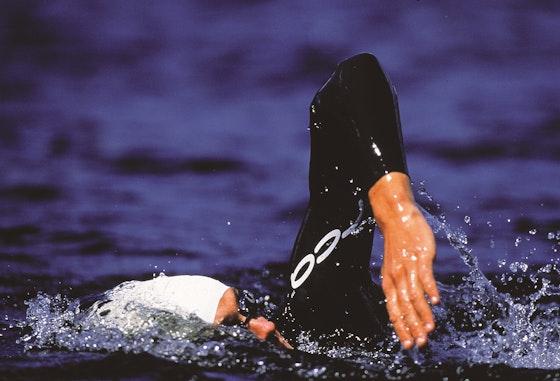
Craig Walton
The Tasmanian Devil: How Craig Walton's All-or-Nothing Fury Reshaped Triathlon.
The Tasmanian Devil: How Craig Walton's All-or-Nothing Fury Reshaped Triathlon#
I. Introduction: The Ghost at the Front#
There was a ghost that haunted triathlon in the late 1990s and early 2000s. It was not a specter of the past, but a phantom of the immediate future, a vision of what was to come just minutes up the road. The ghost was a six-foot-two Australian, a "mountain of a man" from the rugged island of Tasmania, and his name was Craig Walton. To watch him race in his prime was to witness a singular, brutalist spectacle. The chaos of the mass swim start would resolve into a familiar image: one lone figure, churning through the water, emerging onto the timing mat with a 30-second lead already carved from the world’s best. Then came the bike, and the true performance began. It was not a race of tactics or conservation; it was a 40-kilometer time trial of raw, defiant power. Head down, legs pumping like pistons, Walton would systematically, relentlessly, stretch his advantage, transforming the gap into a chasm. Behind him, panic would ripple through the chasing peloton, a frantic collection of elite athletes reduced to screaming at one another, "Take a turn! Take a turn! We got to shut him down!".
This was the essence of Craig Walton: a revolutionary force who, through sheer will and an uncompromising strategy of absolute aggression, fundamentally changed the tactical landscape of professional triathlon. His career was a masterclass in racing from the front, a doctrine of pain inflicted upon himself and his rivals in equal measure. He was an individualist in a sport that, with the advent of draft-legal racing for the Olympics, was increasingly rewarding pack dynamics and collective strategy. Walton’s physical separation from the pack was a perfect metaphor for his philosophical separation from conventional wisdom. He chose to rely on his own overwhelming power rather than the nuanced chess match of the peloton.
His legacy, therefore, cannot be measured solely by the impressive list of titles he accumulated. It is more accurately defined by the way he forced his competitors, and the sport itself, to evolve. He was the catalyst, the brutal litmus test that exposed any weakness. To beat Craig Walton, you could not simply be a fleet-footed runner waiting for the final 10 kilometers; you had to become a complete triathlete, capable of withstanding the hurricane of his swim-bike assault just to earn the right to challenge him on the run. This is the story of the man who raced as a ghost at the front—from his rugged Tasmanian origins and his forging under a legendary coach, through the agonizing near-misses at the sport’s biggest events, to the physical toll of his methods and his ultimate, profound fulfillment as one of the world’s most respected coaches.
II. Forged in the Antipodes: The Making of a Champion#
Every force of nature has an origin point. For Craig Walton, it was Ulverstone, a town on the northern coast of Tasmania, where he was born on October 10, 1975. While the specific details of his early life remain largely private, his identity as a "proud Tasmanian" speaks volumes. The island state, known for its wild, untamed landscapes and resilient people, seems a fitting crucible for an athlete whose racing style was defined by rugged individualism and a near-limitless capacity for hard work. He was an athlete defined not by his backstory, but by his actions, and those actions began to make noise on the mainland when he burst onto the elite scene in 1993 By the latter half of the decade, fellow athletes recalled how he "jumped on the scene as a junior," a prodigious talent whose raw power was immediately apparent.
That raw power found its form and its philosophy under the tutelage of the iconoclastic and notoriously demanding coach, Brett Sutton. Training with Sutton in the 1990s was an immersion into an extreme ideology of performance. The central tenet was a relentless pursuit of leanness, a philosophy Walton later recalled with stark clarity: "In his opinion, lean was too fat, skinny wasn't skinny enough and, put simply, the leanest you could get while maintaining the workload was optimal". For a young, impressionable athlete, the proof was in the results Sutton's stable was producing, and Walton initially embraced the doctrine. "I have to admit, I found that the leaner I got, the faster I went," he said. "It just seemed so simple".
This period, however, introduced the central conflict that would shadow Walton's entire athletic development. His natural physique was that of a power athlete, standing 187 cm (6'2") and weighing 78 kg. This frame was a gift for generating wattage on the bike and pulling through the water, but it was not the build of a classic, lightweight runner. His effort to conform to Sutton's ideal was an attempt to mitigate his perceived weakness—the run—by becoming a more conventional, wiry triathlete. Yet, this came at a cost, a sacrifice of his greatest weapon. It was Sutton himself who later identified this Faustian bargain. As Walton's form see-sawed, the two would butt heads. "He'd explain that 'I can run a minute faster at this weight'," Sutton recalled, "to which I'd counter 'but you ride three minutes slower'".
This dialogue was a microcosm of the strategic dilemma of Walton's career: should he be a slightly compromised version of the typical champion, or the absolute best version of himself, even if that version came with a clear vulnerability? The tension was between shoring up his run and unleashing his overwhelming bike strength. That Sutton, despite this strategic friction, would later call Walton "the best all-round triathlete I've ever seen" adds a fascinating layer of complexity. It suggests that Sutton saw in Walton a complete athletic specimen whose true potential lay not in conforming to a mold, but in weaponizing his unique and formidable strengths. Ultimately, Walton's career would become the definitive, thrilling answer to that debate.
III. The Walton Doctrine: A Symphony of Pain#
Craig Walton did not simply participate in triathlons; he dictated their terms. His race strategy, a brutal two-act play of dominance in the water and on the road, became known as the Walton Doctrine. It was built on an "unbeatable" and "dynamic" swim/bike combination that was the key element to all his success. He weaponized the first two disciplines to systematically dismantle his opponents, not just physically but psychologically. The race against Craig Walton began the moment the starting gun fired, and for many, it was effectively over before they had even laced up their running shoes.
The approach was devastatingly simple in its design and crushingly difficult in its execution. He would exit the swim with a lead, often close to a minute, and then mount his bike with the sole intention of breaking the will of the chase pack. Brett Sutton’s description of the scene remains the most vivid: a lone Walton disappearing up the road while a peloton of 30 of the world's best athletes descended into disorganized chaos, their pre-race strategies shredded by the sheer force of the man they were trying to catch. By the time he entered the second transition, he had often built an insurmountable lead, turning the 10 km run into a victory lap.
This strategy found its purest expression in the non-drafting format, where the collaborative power of a peloton was nullified. In these races, it was athlete against athlete, engine against engine, and Walton’s was simply bigger and more powerful than anyone else's. Nowhere was this more evident than at the iconic Noosa Triathlon on Queensland’s Sunshine Coast. The race became his personal fiefdom, an event he made his own by winning it a record six times between 1997 and 2007. His performance there in 2003 was a quintessential demonstration of the Walton Doctrine. He exited the 1.5 km swim with a nearly one-minute lead, then proceeded to ride away from a world-class field that included New Zealand's Hamish Carter. He recorded the day's fastest bike split, was clocked at an astonishing 102 kph on a downhill descent, and entered the final transition with a nearly four-minute advantage. Despite a world-class run from Carter, Walton savored the victory, strolling down the finish chute to claim his third Noosa title.
His sustained dominance at this single event, one of the most prestigious on the global circuit, stands as the ultimate testament to the power of his method when unleashed in its ideal environment.
Craig Walton's Reign at the Noosa Triathlon#
| Year | Winning Time |
|---|---|
| 1997 | 1:44:13 |
| 2002 | 1:46:38 |
| 2003 | 1:44:50 |
| 2004 | 1:47:05 |
| 2006 | 1:47:46 |
| 2007 | 1:48:46 |
IV. The Agony and the Ecstasy: Chasing the Crown Jewels#
Armed with his formidable strategy, Craig Walton became one of the most feared athletes on the world stage throughout the late 1990s and early 2000s. His career was a tapestry of dominant victories, punctuated by dramatic, often heartbreaking, pursuits of the sport’s biggest prizes. He won six ITU World Cup races, a tally that ranks him among the all-time greats, and is one of only six men to have won a World Cup title in four consecutive years. His victories spanned the globe, from Tiszaujvaros, Hungary in 1997 and 2002 to Corner Brook, Canada in 2000, cementing his status as a truly international force. He also claimed a silver medal at the 1998 Goodwill Games and was a four-time Australian champion.
The year 2000 represented the apex of his powers and the crucible of his career. He arrived at the ITU World Championships in Perth as a top contender and delivered a classic Walton performance to secure the bronze medal. But the defining moment of that year, and perhaps his entire racing life, came a few months earlier at the Sydney Olympics. As triathlon made its full-medal debut on the Olympic stage, Walton had the opportunity to execute his signature style in front of a massive home crowd. He did not disappoint. He led the race from the outset, a solitary Australian figure battling against the world. The experience was profound. "To lead that race in Sydney for as long as I did, to have the thousands of fans cheering you on, is something I will never forget," he recalled. "There is no greater honour than flying the flag for Australia". But the draft-legal format ultimately worked against him. The chase pack, full of elite runners, worked together to reel him in. He was eventually caught and faded to 27th place. In this single race, the heroic and tragic elements of his career converged: a performance of immense power and courage that created an unforgettable spectacle, yet one that ultimately fell short of the podium.
This pattern—Walton setting a blistering pace only to be hunted down by supreme runners—defined his great rivalries. His clashes with fellow Australian Greg Bennett during the 2007 Life Time Fitness Triathlon Series in the United States were the stuff of legend. At the Chicago Triathlon, Bennett found himself 2 minutes and 30 seconds behind Walton off the bike and had to unleash a desperate, all-out sprint. "I remember running as fast as I could, like at the playground, and I was a maniac," Bennett said. He caught Walton in the final mile to win by just 12 seconds. Weeks later in Los Angeles, the drama repeated. Walton built a 3:30 lead on the bike. Bennett again threw caution to the wind, catching his rival with only 300 meters to go in a dramatic sprint finish, winning by a mere six seconds. Walton forced his rivals to dig deeper than they ever thought possible. He was the author of the race's narrative, the protagonist whose actions dictated the entire plot, even when he was denied the final victory. His presence guaranteed a compelling story, proving that in sport,
how you race can leave a more indelible mark than the final result.
V. The Body's Betrayal and the End of an Era#
A career spent on the absolute ragged edge of physical exertion inevitably exacts a price. Craig Walton’s all-or-nothing approach, while spectacular, was brutally punishing, and eventually, his body began to push back. At one point in his career, he was forced into a medically mandated layoff after battling both chronic fatigue and glandular fever, ailments often associated with profound overexertion. His immense tolerance for pain and his warrior mentality were legendary, perhaps best exemplified by an incident at the St. Anthony's Triathlon where, having forgotten his cycling shoes, he simply did the bike leg in his running shoes. He won the race but inflicted serious damage on his hamstrings in the process—a perfect encapsulation of his toughness and, perhaps, a disregard for self-preservation that made his career both brilliant and finite.
In March 2008, at the age of 32, Walton announced his retirement from the sport. His decision was not born of a single injury, but from a deeper, more fundamental shift. "As a lot of retired Sports people say, you instinctively know when it is time to retire," he explained. "While I still enjoy training and staying fit and active, I have simply lost the desire to race". For an athlete whose entire identity was built on an uncompromising standard, the inability to maintain that level was untenable. "I have always raced to win, and anything less, I am not happy with," he stated. "Considering I am not 100 percent committed, it is best that I walk away". He could not, or would not, adapt to a different style of racing—perhaps more tactical, less dominant, but still competitive. He chose to walk away as the apex predator he had always been, rather than fade into the pack.
Yet, the fire was not completely extinguished. In 2010, the triathlon world was stunned when Walton, then 34, announced a comeback. The motivations were complex and deeply personal. The return to the rigors of training was partly a reaction to his recent breakup with his fiancée and star coaching protégé, Emma Snowsill. But a much larger driver was what he called "unfinished business as a competitor". It was one last attempt to see if the dominant force of old still existed within him. He targeted the Noosa Triathlon, the site of his greatest triumphs, setting up a compelling showdown with the race's new king, Courtney Atkinson. Though his comeback was ultimately short-lived, it was a poignant final chapter. It confirmed that Walton's competitive identity was inextricably linked to his ability to dictate and dominate. When he could no longer be the ghost at the front, he chose to become a master behind the scenes.
VI. The Master's Eye: From Athlete to Architect#
Craig Walton’s transition from elite athlete to world-class coach was not merely a career change; it was a profound evolution. The raw, explosive power that defined his racing was refined into a sharp, strategic intelligence, making him one of the most successful and sought-after coaches in the sport. He took the hard-won, often painful, lessons from his own career and synthesized them into a winning formula for a new generation of champions. He effectively became the architect of success he may have wished for as an athlete.
His coaching prowess was immediately evident. He guided his then-partner, Emma Snowsill, to one of the most dominant stretches in the sport's history, including three World Championship titles, a Commonwealth Games Gold Medal, and the crowning achievement of Olympic Gold at the 2008 Beijing Games. He proved this was no fluke by subsequently coaching another Australian star, Emma Moffatt, to the 2009 World Championship series title. His remarkable success was formally recognized that same year when he was named the Australian Institute of Sport (AIS) Coach of the Year, a prestigious honor that solidified his status as a master tactician.
In 2018, Walton took on a new challenge, accepting the role of head coach for the triathlon program at Bond University on the Gold Coast. There, he unveiled an ambitious blueprint that revealed the full scope of his coaching philosophy. His vision was clear and direct: "to create the ultimate training environment for any triathlete in Australia if not the world," with one singular, overarching goal. "I want to create gold medals at the Olympics," he stated. "That is what I'm working towards, it's my whole focus".
His approach, however, goes far beyond simple athletic training. He described his program as a "one-stop shop," designed to create an elite pathway that supports athletes holistically. Having lived the life of a young athlete, he demonstrated a deep understanding of the pressures they face. "I understand what the kids go through with school and then studying at University or working while they are training," he said. "That's the hardest part and the biggest gap we can fill". This reveals the mind of an architect, not just a drill sergeant. He is not merely building stronger athletes; he is constructing a sustainable system for high performance, mentoring both athletes and other coaches within the program. His success in coaching athletes with different physiological profiles and strengths to the absolute pinnacle of the sport demonstrates a strategic nuance that has become the hallmark of his second, and arguably even more impactful, career.
VII. Legacy: The Man Who Made Them Run Faster#
To measure the legacy of Craig Walton is to look beyond the impressive columns of wins and podiums. His place in the annals of triathlon history is secured not just by what he achieved, but by the indelible way in which he achieved it. His true impact lies in the "catalyst effect" of his career: he was the disruptive force who fundamentally altered the requirements for success at the elite level. Before Walton consistently applied his suffocating pressure from the start, a gifted runner could afford to bide their time, to merely survive the swim and bike before unleashing their primary weapon. Walton made that strategy obsolete. He forced an entire generation of the world's best to evolve. To contend for a victory in a race with Craig Walton on the start line, you had to become powerful in the water and relentless on the bike, simply to have a chance. He did not just raise the bar; he changed the very dimensions of the arena.
The sport has formally recognized this immense contribution. In 2015, he was inducted into the Tasmanian Sporting Hall of Fame, a fitting honor from his home state. A year later, he received the sport's highest honor in his home country, being inducted into the Triathlon Australia Hall of Fame with the designation of "Legend of the Sport". These accolades validate a career that was as influential as it was successful.
In the end, the enduring image of Craig Walton is that of the ghost at the front, a solitary figure in a world of pain, daring the best to catch him. Other athletes may have collected more Olympic medals or stood atop more world championship podiums, but few can claim to have so dramatically and defiantly shaped the nature of the contest itself. His career was a testament to the power of a singular vision, executed with a relentless and unforgettable fury. He was the man who made everyone else run faster, and in doing so, he became a legend.