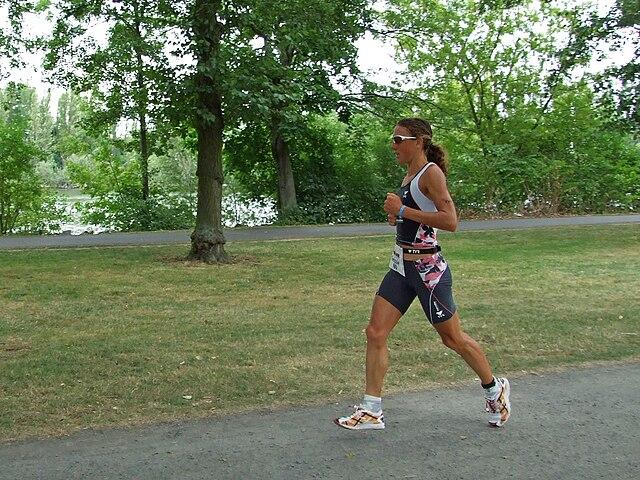
Chrissie Wellington
USA’s first Olympic triathlon gold—precision pacing and icy patience.
The Accidental Champion: How Chrissie Wellington Redefined the Limits of Endurance#
Introduction: The Unlikely Queen of Kona#
The Hawaiian heat radiates from the black asphalt of the Queen Ka’ahumanu Highway, a shimmering, malevolent force. For the athletes of the Ironman World Championship, this is the final crucible—a marathon run on legs already brutalized by a 2.4-mile ocean swim and a 112-mile bike ride through volcanic crosswinds. On this particular Saturday in October 2011, one figure runs not with the fluid grace of a champion at the peak of her powers, but with the gritted-teeth determination of a survivor. Her body is a roadmap of recent trauma: deep contusions ache in her hip and shoulder, and vast swathes of her leg are covered in the angry red and purple of road rash, the legacy of a violent bike crash just two weeks prior. This is Chrissie Wellington, the three-time defending champion, and she is in a world of pain. She is not leading; in fact, she started the run with a seemingly insurmountable 22-minute deficit. Yet, she runs on, propelled by something beyond muscle and sinew.
This moment, in the agonizing final miles of her fourth and final Kona victory, is the perfect encapsulation of her entire, improbable career. It was not her fastest or most statistically dominant performance, but it was her most defining. It was a triumph not of physical superiority, but of an indomitable, almost frightening, will. The victory proved what the triathlon world had been witnessing for five years: that Chrissie Wellington’s greatest weapon was not her formidable physiology, but a mind forged in crucibles far from the lava fields of Hawaii. Her career poses a compelling question: How did a British civil servant with a Master’s in Development Economics, a woman who only turned professional at the age of 30, become arguably the greatest female endurance athlete the world has ever seen?.8
Her path was not a carefully curated ascent through junior ranks and elite development squads. It was a winding, unconventional journey that led from the corridors of British government to the remote, high-altitude trails of the Himalayas. It was a career born from adversity—a serious road accident that pushed her toward a new sport—and defined by a relentless refusal to accept perceived limitations. To understand the champion who crossed the finish line in 2011 is to understand the global citizen who arrived in Nepal years earlier, the accidental amateur who shocked herself by winning a world title, and the philosopher-athlete who lived by a simple, powerful creed: never, ever look back and wonder, "what if?". This is the story of a life lived, in her own words, "without limits".
The 2011 victory was not an anomaly; it was the ultimate expression of her character. While her earlier wins were displays of raw power, this final triumph was a masterclass in resilience. The data shows she was physically compromised, battling infection and immense pain from the crash. Her pre-athletic life was similarly defined by navigating challenges far removed from sport, from complex international development policy to managing sanitation projects in conflict-affected regions of Nepal. Even her entry into triathlon was a direct consequence of overcoming a previous setback—a car crash in 2003 that ended her marathon ambitions and forced her to pivot. A clear pattern emerges when these events are connected: Wellington’s most significant moments are not born from perfect preparation but from her extraordinary response to imperfect, often adverse, conditions. Her legacy, therefore, is not merely about the act of winning, but the
manner in which she won. The 2011 race serves as the perfect narrative frame, distilling her entire philosophy of finding opportunity in adversity into one epic, unforgettable performance.
Part I: The Road Less Travelled: A Global Citizen in the Making#
An Academically Driven Youth#
Long before she was known as the "Chrissinator," Christine Ann Wellington was a driven, determined young woman from a small village in Norfolk, England, but her ambitions were academic, not athletic. Born in Bury St Edmunds, Suffolk, she grew up channeling her innate competitiveness into her studies. While she was a sporty child, participating in swimming, hockey, and netball, she never reached an elite county standard. At the University of Birmingham, where she would earn a first-class honours degree in geography, she captained the university swim team, but sport remained secondary to her academic goals and a vibrant social life. The typical narrative of a future world champion—one of early prodigy, singular focus, and relentless junior competition—simply does not apply. Her path was destined to be different.
The World as a Classroom#
Upon graduating in 1998, Wellington deferred a law contract and embarked on a two-year journey around the world, a period she describes as profoundly transformative. Visiting Africa, Australia, New Zealand, and Asia, she was confronted with the vast scale of global inequality and poverty. This experience, she explains, "opened her eyes to the many problems that exist in the world, but also to the opportunity for positive change". The trip fundamentally altered her life's trajectory. The path of corporate law no longer held the same appeal; it was replaced by a burgeoning passion to contribute to something larger than herself. She returned to the UK not to become a lawyer, but to pursue a Master's degree in Development Economics at the University of Manchester, which she completed with distinction.
The Policy Advisor#
Her first career was a direct manifestation of this newfound purpose. She joined the UK's Department for Environment, Food and Rural Affairs (DEFRA) as a policy advisor on international development. This was not a placeholder job; it was her dream job. At DEFRA, she was immersed in high-stakes global policy, working on the UK's negotiating team for the World Summit on Sustainable Development and contributing to policies on water, sanitation, and post-conflict environmental reconstruction. The role required intellectual rigor, meticulous preparation, and a deep-seated drive—the very same traits that would later underpin her athletic dominance. She was, in essence, training to be a champion, just not in a way anyone, least of all herself, could have predicted.
Forged in the Himalayas#
In September 2004, seeking hands-on experience, Wellington took a 16-month sabbatical from her government post to work in Nepal for the non-governmental organization Rural Reconstruction Nepal (RRN). Based in Kathmandu, she managed a community-led total sanitation project in Salyan, a district deeply affected by the ongoing Maoist insurgency. The work was demanding and often dangerous, requiring immense personal courage and a profound commitment to her mission.
It was in the thin air of the Himalayas that the seeds of her athletic future were unknowingly sown. Every morning before work, she would join a group of local and foreign cyclists for a ride on her mountain bike through the rugged countryside surrounding the city. This was not structured training; it was an act of joy, exploration, and stress relief. Yet, in these daily rituals, she was building a formidable endurance engine. The high altitude of the Kathmandu Valley, situated at around 1,500 meters, served as a natural form of altitude training, enhancing her body's oxygen-carrying capacity. Her friends from that time recall her extraordinary discipline; she never missed a ride, even when suffering from the stomach bugs that were a regular part of life there. This period, she later reflected, was where she gained her enduring physical and psychological strength.
Her time in Nepal functioned as an unintentional but perfect high-performance laboratory. Elite athletes travel to specialized camps to gain the physiological benefits of altitude training and work with sports psychologists to build mental resilience. Wellington experienced a more potent, organic version of both simultaneously. The daily cycling provided the physical adaptation of altitude exposure. Meanwhile, the immense stress and logistical challenges of managing a development project in a conflict zone forged a level of mental fortitude that cannot be taught in a classroom or a therapist's office. She was not an athlete in training; she was a development worker trying to make a difference under extreme pressure. This synthesis of high-altitude physical stress and high-stakes psychological stress created a unique foundation. It helps explain the almost incomprehensible speed of her later rise in the world of triathlon. She didn't enter the sport as a novice; she arrived with a world-class engine and a battle-hardened mind, built not on a track, but in the mountains of Nepal.
Part II: A Serendipitous Collision with Destiny#
The Reluctant Runner#
Upon her return to the UK, Wellington's initial motivation for exercise was prosaic: she started running to lose weight gained during her travels. With no real understanding of training principles or proper gear, she simply went out and ran, enjoying the mental release it provided from her studies and work. In 2002, on a whim, she decided to enter the London Marathon. Training "hard for it, but again not in a knowledgeable way," she was shocked to finish in a remarkable time of 3 hours and 8 minutes. More importantly, she was surprised by how much she enjoyed the challenge. The experience lit a competitive fire, and she joined a running club with the legendary coach Frank Horwill, setting her sights on a sub-three-hour marathon the following year.
The Crash and the Pivot#
Destiny, however, intervened in the form of a car that struck her while she was cycling to work in March 2003 The accident left her unable to run, derailing her marathon goal. It was this moment of adversity that proved to be the critical turning point in her athletic life. To maintain fitness, she returned to the pool, rediscovering her love for swimming. It was then that a friend made a casual suggestion: "Why don't you try a triathlon?".
Her first forays into the sport in 2004 were far from auspicious. She competed as a novice using borrowed kit, including a third-hand Peugeot road bike with old-fashioned toe clips and an oversized, ill-fitting wetsuit. While she managed respectable third and fourth-place finishes in a couple of Olympic-distance races, she recalled, "I didn't set the world on fire". The experiment was soon paused for her life-changing sabbatical in Nepal.
The World Championship that Changed Everything#
When she returned from Nepal in 2006, her first attempt at a triathlon was a disaster. The borrowed wetsuit was so large that it filled with water, causing her to sink, and she had to be rescued from the swim. Unfazed, she entered another race. This time, it went better—so much better, in fact, that she qualified to represent Great Britain as an age-group athlete at the 2006 ITU Amateur World Championships in Lausanne, Switzerland.
The decision to compete was significant. She was back in her demanding full-time job at DEFRA. For ten weeks, she juggled the intense pressures of her career with a rigorous training schedule, getting a coach for the first time. On race day in Lausanne, to her own profound astonishment, she won the 25-29 age-group world title, cruising to victory by over seven minutes.
The "What If?" Decision#
The victory in Lausanne presented her with a terrifying and exhilarating crossroads. At 30 years old, with a successful and fulfilling career in international development, she was faced with an almost ludicrous proposition: should she abandon it all for the precarious, uncertain life of a professional triathlete?.6 The decision-making process was guided by a core tenet of her personal philosophy, a deep-seated fear of regret. As she later explained, "I never want to look back and think 'what if'". The thought of not exploring this untapped talent was more frightening than the risk of failure.
The choice was a leap of faith, a conscious decision to step off the well-trodden path and embrace the unknown. In January 2007, she traveled to Switzerland to meet the enigmatic and renowned Australian coach, Brett Sutton. The meeting was decisive. Within five days, she had resigned from her job. In February, she was on a plane to Sutton's elite training camp in Thailand, her old life packed away, her new one about to begin. Her career was not the product of a grand design, but of a chain reaction of accidents and adversities. A desire to lose weight led to marathon running. A car crash ended that, forcing a pivot to triathlon. A disastrous race didn't deter her, and an unexpected victory forced a life-altering choice. Her entire professional existence was contingent on her response to these seemingly random or negative events, reinforcing the theme that her greatness was forged not by planning, but by an unparalleled ability to adapt and persevere.
Part III: The Reign of the 'Chrissinator': An Era of Unprecedented Dominance (2007-2011)#
2007: The Rookie Upset#
Wellington's first year as a professional triathlete was a whirlwind. Under the notoriously demanding tutelage of Brett Sutton, she was thrown into the deep end. She notched early victories in shorter, Olympic-distance races in Bangkok and Subic Bay before taking on her first Ironman-distance event in Korea in August 2007 In brutally hot conditions, she dominated the race, winning by an astonishing 50 minutes and securing a qualification spot for the Ironman World Championship in Kona, Hawaii, just a few months later.
She arrived on the Big Island of Hawaii as a complete unknown. She was so new to the professional scene that she bought her race-day tankini at the merchandise expo and competed with a broken pedal held together with glue. On October 13, 2007, she delivered what is still widely considered the "biggest upset in Ironman Hawaii history". In her very first attempt at the world's most prestigious triathlon, the 30-year-old rookie stunned the sport. She finished the grueling course in a time of 9 hours, 8 minutes, and 45 seconds. Her victory was sealed with a devastatingly fast marathon of 2 hours, 59 minutes, and 58 seconds, making her the first British athlete, male or female, ever to win the coveted title. The unknown civil servant had become the queen of triathlon overnight.
2008: Proving It Was No Fluke#
If 2007 was a fairy tale, 2008 was a statement. Wellington set out to prove her victory was not a fluke, and she did so with ruthless efficiency. Her season was a showcase of dominance, with victories at Ironman Australia, Ironman Frankfurt (the European Championship), and the ITU Long Distance World Championship in the Netherlands.
She returned to Kona that October with the weight of expectation on her shoulders. The race provided a dramatic test of her composure. During the bike leg, while in the lead, she suffered a flat tire. In a remarkable act of sportsmanship that she said "epitomises everything great about the Ironman," her rival Rebekah Keat stopped and gave her a spare CO2 canister. The incident cost her precious minutes, but she remained calm, methodically clawing back the lost time. Once on the run, she was untouchable. She stormed through the marathon in 2 hours, 57 minutes, and 44 seconds—a new women's run course record—to secure her second consecutive world title in a time of 9 hours, 6 minutes, and 23 seconds. Any doubts about her legitimacy were emphatically silenced. She was not a one-hit wonder; she was the new, undisputed ruler of the sport.
2009: The Record Breaker#
By 2009, the question was no longer if Chrissie Wellington would win, but by how much. Her third consecutive victory in Kona was a performance of such staggering power that it elevated her from a champion to a legend. The target was not just the win, but Paula Newby-Fraser's 17-year-old course record of 8:55:28, a mark considered by many to be untouchable. On a typically hot and windy day, Wellington systematically dismantled the course and the competition. She crossed the finish line in 8 hours, 54 minutes, and 2 seconds, shattering the long-standing record and finishing nearly 20 minutes ahead of her nearest competitor. The victory made her one of only three women to win the title in three consecutive years, cementing her place in the pantheon of the sport's all-time greats.
The Roth Revolution#
While Kona was the site of her championship crowns, it was at a race in the small Bavarian town of Roth, Germany, that she truly redefined the limits of human endurance. Challenge Roth, an iron-distance race renowned for its fast course and incredible spectator support, became her personal laboratory for breaking world records. She raced there three times and broke the iron-distance world record three times.
- July 2009: She finished in 8:31:59, smashing the previous world best by nearly 14 minutes.
- July 2010: She returned and lowered her own record, clocking an incredible 8:19:13.
- July 2011: In her most spectacular performance, she took another minute off her record, finishing in 8:18:13. This time included a blistering 2:44:35 marathon and was so fast that it would remain the world record for 12 years. These performances were not just wins; they were paradigm shifts, fundamentally altering the perception of what was possible for a female athlete.
2010: A Forced Pause#
Wellington's seemingly unstoppable momentum came to an abrupt halt in October 2010. On the eve of the Ironman World Championship, where she was the overwhelming favorite to win a fourth consecutive title, she was struck down by a severe bacterial infection. Unable to even make it to the start line, she was forced to withdraw. The moment was a stark reminder of her human vulnerability and a devastating blow after a year of perfect preparation. However, she refused to let her fitness go to waste. A month later, she channeled her frustration into a commanding performance at Ironman Arizona, setting a new official Ironman-branded world record of 8:36:13. The DNS (Did Not Start) in Kona was a crucial setback that only served to fuel her fire, setting the stage for the most dramatic comeback in the sport's history.
| Year | Overall Time | Swim Split | Bike Split | Run Split | Significance |
|---|---|---|---|---|---|
| 2007 | 9:08:45 | 58:09 | 5:06:15 | 2:59:58 | Rookie victory; biggest upset in Kona history. |
| 2008 | 9:06:23 | 56:20 | 5:08:15 | 2:57:44 | Back-to-back win; new women's run course record. |
| 2009 | 8:54:02 | 54:31 | 4:52:07 | 3:03:06 | Shattered 17-year-old course record. |
| 2011 | 8:55:08 | 1:01:03 | 4:56:53 | 2:52:41 | Won despite severe injuries; new women's run course record. |
Part IV: Forged in Fire: The Legend of the 2011 Victory#
The Crash#
Two weeks before the 2011 Ironman World Championship, Chrissie Wellington was, in the words of her coach, six-time champion Dave Scott, "the most fit she had ever been". She had just set her still-standing world record at Roth and was primed for a historic comeback in Kona. Then, on a Sunday morning during her last long ride near her training base in Boulder, Colorado, disaster struck. While navigating a familiar turn, her front tire flatted, sending her crashing hard to the pavement.
The Damage#
The immediate aftermath was a blur of pain and fear. X-rays revealed no broken bones, but the soft tissue damage was severe. She had deep contusions on her hip and shoulder and massive, weeping patches of road rash down her thigh and leg. Worse, the wounds became infected. Just ten days before the race, her leg swelled to double its normal size, and she was unable to put any weight on it. She was put on a course of antibiotics, shivering on a couch as her body battled the infection.
The Doubt and the Decision#
The physical trauma was matched by the emotional turmoil. The carefully constructed peak of her physical fitness had been shattered. Her training plan was abandoned; the new goal was simply to heal. The situation grew more dire upon arrival in Kona. During a test swim, she developed a sharp pain in her chest that grew progressively worse, feeling like she was "being stabbed with a needle". Fearing broken ribs or even a pulmonary embolism, she was rushed back to the hospital for more tests, which thankfully came back negative. Doctors suspected a torn pectoral muscle. Five days before the race, she was in so much pain that her boyfriend had to lift her out of the pool after a mere 1-kilometer swim.
The prospect of starting, let alone competing, seemed remote. It was in these dark moments that Wellington made a crucial mental shift. She reframed her definition of success. Victory was no longer about winning; it was about having the courage to stand on the start line and face the challenge, no matter the outcome. "If I have to walk or if I have to bike really slowly," she resolved, "that's going to be just as inspiring as a victory because people will see me trying to overcome my injuries".
Race Day: A Battle of Attrition#
On race morning, she made the courageous decision to start. The race that followed was not a display of dominance, but a masterclass in suffering and resilience.
- The Swim: The 2.4-mile swim was an exercise in pain management. Unable to pull with her full strength due to her chest injury, she limped through the water in 1 hour, 1 minute, and 3 seconds—a time significantly slower than her usual and one that left her far behind the lead pack.
- The Bike: On the 112-mile bike ride, she fought through searing pain in her hip and back, which had been exacerbated by the crash. She slowly, painstakingly, began to reel in some of her competitors, but she was hemorrhaging time to the leaders. When she finally reached the transition to the run, she was in sixth place, a staggering 22 minutes behind the leader, Julie Dibens.
- The Run: What happened next is the stuff of Ironman legend. Wellington embarked on a marathon fueled by pure, unadulterated grit. Ignoring the pain, she began to hunt down the women ahead of her one by one. Her coach Dave Scott later described her running form as "unsightly" and "ghastly," a testament to the physical compensation she was making for her injuries. But it was brutally effective. She caught Leanda Cave at mile 12. She overtook Caroline Steffen at the entrance to the infamous Energy Lab, the hottest and most desolate part of the course, to take the lead. She crossed the finish line in a total time of 8:55:08. Her marathon split of 2:52:41 was, incredibly, a new women's run course record. She had not just won; she had produced the most courageous and hard-fought victory of her career.
This victory fundamentally redefined the concept of dominance in her career. Her earlier wins were exhibitions of physical supremacy, of an athlete so powerful she seemed to be competing in a different category. The 2011 win was different. She was not the strongest athlete on the course that day; she was arguably one of the most broken. Yet she won. This performance revealed that her true invincibility lay not in her muscles or her cardiovascular system, but in her mind. It was a triumph of mental fortitude over physical reality. The race transformed her from a physical phenomenon into an enduring legend of resilience, proving that her dominance was, at its core, a function of her unbreakable will.
Part V: A Life Beyond the Finish Line: The Champion as Catalyst#
Retiring at the Pinnacle#
In January 2012, just three months after her epic victory in Kona, Chrissie Wellington announced she would be taking a sabbatical from Ironman racing. Later that year, she made the decision official: she was retiring from the sport. The news shocked the triathlon world. She was at the absolute zenith of her powers, having just delivered her most heroic performance. Furthermore, she retired with a perfect, unblemished record: thirteen starts in iron-distance races, thirteen victories.
Her decision was a conscious and deliberate choice to reclaim her life from the singular focus required of a champion. "Racing cannot always be the axis around which my life revolves," she explained. "It should not be an end in itself—never the be all and end all of my life. Never define me". She was choosing to step away not because her body was failing, but because her spirit was calling her toward other challenges and a richer, more varied existence.
The parkrun Revolution#
Wellington seamlessly transitioned from athlete to advocate, channeling her formidable energy into promoting health and wellbeing on a global scale. She became the Global Head of Health and Wellbeing for parkrun, the charity that organizes free, weekly, timed 5k runs in communities around the world. Her impact was immediate and profound. She was a driving force behind the creation and expansion of the junior parkrun series, aimed at getting children active. She also pioneered the charity's work in prisons and custodial estates and was instrumental in developing the "parkrun practice" initiative, which connects the events with local medical practices as a form of social prescribing. She was no longer just inspiring people through her athletic feats; she was building the infrastructure to facilitate mass participation in physical activity, directly addressing health inequalities on a systemic level.
Advocate and Trailblazer#
Her work extended beyond community fitness. True to her trailblazing nature, she became a powerful voice for gender equality in sport. In 2014, she was a founding member of Le Tour Entier, a pressure group that included professional cyclists Marianne Vos and Emma Pooley. Their successful campaign, which garnered nearly 100,000 petition signatures, pressured the organizers of the Tour de France to establish a women's race, leading to the creation of La Course by Le Tour de France. It was a landmark victory for women's cycling, and Wellington was at the forefront of the fight. She has also remained deeply connected to her roots in international development, actively supporting charities like Girls Education Nepal, which works to empower young women in the country that shaped her own journey.
Author and Inspirer#
Wellington also found a new medium for her message: the written word. In 2012, she published her bestselling autobiography, A Life Without Limits: A World Champion's Journey.14 The book was a raw and honest account of her life, detailing not only her triumphs but also her struggles, including with eating disorders. In 2017, she followed up with
To the Finish Line: A World Champion Triathlete's Guide to Your Perfect Race, a practical guide to training and racing that distilled her hard-won knowledge for amateur athletes. Through her writing, she sought to demystify her success and provide a vehicle for "conveying some really important messages, to inspire and encourage people to take a chance, to defy what’s possible".
Observing the three distinct phases of her public life—pre-athletic, athletic, and post-athletic—reveals a remarkable consistency of purpose. Her first career was in international development, focused on creating positive change and addressing global inequalities. Her athletic career, while an end in itself, also provided her with a powerful global platform, which she immediately began to use to raise awareness for these same causes. Her post-retirement career, with its focus on parkrun's mission of health equity and her advocacy for gender equality, is a direct and amplified continuation of that original mission. This reveals that "athlete" was never her core identity. Her core identity has always been that of a catalyst for positive change. Triathlon was simply the most potent vehicle she found to enact that identity on a global stage, a platform she built with sweat and grit, and one she continues to use with passion and purpose.
Conclusion: The Enduring Legacy of a Life Without Limits#
To see Chrissie Wellington cross the finish line in Kona in 2011, a warrior's grimace momentarily replacing her trademark smile, is to witness the culmination of an extraordinary journey. Her path from a driven but unexceptional young athlete to a government policy advisor, from a development worker in the Himalayas to the most dominant triathlete of her generation, and finally to a global advocate for health and equality, is a powerful testament to her own life philosophy. It is a story that defies convention and redefines the very nature of a champion's journey.
While her four Ironman World Championship titles, her undefeated record, and her staggering world records at Challenge Roth are etched in the annals of sporting history, her true legacy is more profound and far-reaching. She fundamentally altered the blueprint for what a world-class athlete could be. She proved that the path to the pinnacle of sport does not have to be a linear, pre-ordained trajectory starting in childhood. It can be a winding road, full of detours, setbacks, and serendipitous discoveries. She demonstrated that a life rich with intellectual curiosity, global awareness, and a deep sense of purpose is not a distraction from athletic excellence, but a powerful fuel for it.
More than anything, Chrissie Wellington's career was a living embodiment of the power of the mind. She showed that the most formidable barriers are not physical, but psychological, and that the greatest motivation often comes from a purpose larger than oneself. Her story is a powerful reminder that our potential is not a fixed point, but a constantly shifting horizon that expands every time we dare to push toward it. In her own words, "our limits may not be where we think they are. And, even when we think we've finally reached them, the next time we go there exploring we often find that they've moved again". Chrissie Wellington's greatest achievement was not simply winning thirteen iron-distance races, but in showing the world, through her extraordinary example, what it truly means to live a life without limits.