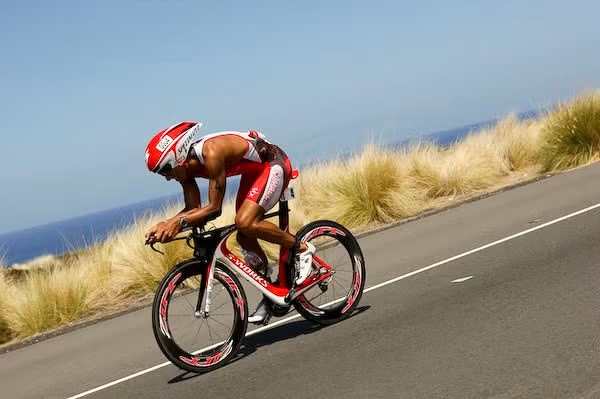
Chris McCormack
The Macca Doctrine.
The Macca Doctrine: The Man Who Wrote the Playbook for Modern Triathlon#
The King's Gambit in Kona#
The Queen Kaʻahumanu Highway shimmers, a black ribbon laid across a hellscape of jagged, sun-baked lava rock. For nearly eight hours, it has been an anvil, and the men running upon it have been hammered into shapes of pure suffering. It is October 9, 2010, the final stages of the Ironman World Championship in Kailua-Kona, Hawaii, and the race has been distilled to its essence: two men, locked in a desperate, agonizing duel.
One is Chris McCormack, the 37-year-old Australian veteran, a former king of this race who many believed was past his prime. The other is Andreas Raelert, a German newcomer four years his junior, the ascendant European champion, relentless and seemingly unbreakable. For miles, they have run shoulder to shoulder, a silent, brutal conversation conducted in footfalls and ragged breaths. McCormack had entered the marathon with a lead, the product of a masterful tactical alliance on the bike designed to neutralize his countryman and two-time defending champion, Craig Alexander. But Raelert had been relentless, slowly, inexorably closing the gap.
With just 5 kilometers remaining, after more than 221 kilometers of swimming and cycling, Raelert finally draws level. This is the moment of truth, the point where most athletes would turn inward, conserving every shred of physical and mental energy for the final, decisive blow. McCormack does the opposite. In a move of staggering audacity, a piece of pure sporting theater, he turns to his rival. "Andreas, best of luck," he says, his voice steady despite the torment. "No matter what happens here, you're a champion. May the best man win".
It was not a concession; it was a declaration. It was the starting gun for a 5,000-meter war, the final gambit from a man who had always viewed the race course as a chessboard. This single moment was a perfect distillation of the man they call "Macca." It was tactical, cerebral, supremely confident, and masterfully performed for the world's cameras. He would go on to win that day, surging after the final aid station to claim his second Ironman world title in what was immediately hailed as an "Iron War for the 21st century".
Yet, to define Chris McCormack by his four world championships, his 200-plus race wins, or even this iconic victory, is to miss the point entirely. His true legacy is not etched solely on trophies but imprinted on the very fabric of modern professional endurance sports. His career was a calculated campaign, a two-decade-long project to build not just a champion, but an empire. He pioneered a revolutionary fusion of athletic genius, intellectual rigor learned in the world of finance, and an innate entrepreneurial spirit that created a new blueprint for what a professional athlete could be. He was the athlete as CEO, the competitor as brand manager, the champion as a media entity. This is the story of the Macca Doctrine—the playbook that changed the game.
The Banker Who Rebelled#
The Prodigy's Dilemma#
Long before he was a global icon, Chris McCormack was a hyperactive kid from southern Sydney with a prodigious, almost uncontainable, athletic talent. Born on April 4, 1973, he excelled at everything he tried, from the team sports of soccer and rugby in primary school to the solitary grind of running. At Kirrawee High School, his talent was undeniable. He won numerous Australian athletic and cross country titles and was honored with the NSW Sporting Blue, an award for the best athlete in the state. He placed 5th and 7th in consecutive Australian Schools cross country championships, marking him as a runner of national caliber.
Yet, this raw talent presented a conflict within the McCormack household. While Chris was drawn to the purity of competition, his parents were steadfast in their belief that education must come first. They pushed him to focus on his studies over a premature leap into the uncertain world of professional sports, a common parental refrain that, in this case, would have profound and unforeseen consequences.
An Unlikely Education#
Heeding his parents' advice, McCormack channeled his athletic prowess into securing his academic future. He earned a sports scholarship to the prestigious University of New South Wales, one of Australia's top institutions. But instead of pursuing a degree in sports science or a related field, he enrolled in the Commerce program, opting to major in Finance and Accounting. He found an affinity for the clear, binary nature of the subjects. "You are either right or wrong," he later reflected. "I loved it". While at university, he raced his first triathlon, and the success was immediate; he won two Australian Junior Triathlon titles and placed a respectable 4th at the Junior World Championships in 1993, a result marred only by a premature celebration that cost him a silver medal.
Upon graduating with a credit average in October 1995, he did what was expected of him. He took a job in finance, working as a banker in funds management with Bankers Trust. He had a great job, a degree from a top university, and a view of Sydney Harbour. By all conventional metrics, he was a success. And he was miserable. The structured, predictable world of finance chafed against the chaotic, competitive energy that had defined him. The dream of professional sport, deferred but not extinguished, burned brighter than ever.
The parental insistence on a formal education, which could easily be framed as an early obstacle to his athletic calling, was paradoxically the most critical ingredient in his eventual, transcendent success. It was not merely a safety net; it was the forging of his greatest weapon. The principles of finance, accounting, and market strategy he learned were not forgotten. They were absorbed, ready to be deployed in a different arena. This education forced him to develop a strategic, business-oriented mindset that was utterly unique among his peers.
The Leap of Faith#
In 1996, the rebellion finally happened. McCormack quit his banking job, a decision his father was not initially excited about. He sold his belongings, took the money he had saved, and bought a one-way ticket to Europe. He was betting everything on himself. This was not just a rejection of the corporate ladder; it was the first major investment in a new startup, a company of one: "Macca." He was not just going to be an athlete; he was going to be the CEO of his own career, applying the lessons learned in university lecture halls to the brutal marketplace of professional sport. The banker was gone, but the banker's mind remained, ready to build an empire.
The Unstoppable Force: Conquering the World#
A Blistering Debut#
McCormack's arrival in Europe in 1996 was less a debut and more a detonation. Racing for the French-based Tricastan Triathlon Team, he unleashed years of pent-up ambition on the unsuspecting professional circuit. His first season was a whirlwind of dominance. He won nine events, an incredible feat for a rookie. His breakthrough moment came at the ITU World Cup in Drummondville, Canada. As a wild-card entry in his first-ever elite ITU race, he stunned the field with a victory, establishing himself as a rising talent and a force to be reckoned with. By the end of his debut professional season, he had rocketed to a world ranking of number 9, a remarkable ascent that served as a mere prelude to what was to come.
The Historic "Double"#
If 1996 was his arrival, 1997 was his coronation. McCormack put together one of the most dominant seasons in the history of the sport. He recorded six top-10 finishes in World Cup races and delivered commanding performances on the notoriously tough French Grand Prix circuit. The season culminated in Perth, Western Australia, at the ITU Triathlon World Championships. On home soil, he delivered a masterful performance, completing the 1.5 km swim, 40 km bike, and 10 km run in a time of 1:48:29 to become the World Champion.
But he wasn't finished. His consistency and victories throughout the year also secured him the overall 1997 ITU Triathlon World Cup Series title. In doing so, he achieved something unprecedented: he became the first male triathlete in history to win the World Championship and the World Cup Series in the same year, while also holding the world number 1 ranking. This historic "double" was not just a collection of victories; it was a statement of absolute supremacy. He was, without question, the undisputed king of short-course triathlon. He would remain the world's number one ranked triathlete for more than 26 months in total, a testament to his sustained excellence.
Forging the Persona#
This period of unassailable dominance provided the perfect crucible for McCormack to forge the public identity that would become as much a part of his legacy as his race results. He was no longer just Chris McCormack, the talented kid from Sydney. He was "Macca," a global brand. He rose through the ranks as a winner and a fan favorite, known for his trademark mix of quick wit, piercing intelligence, and the athletic ability to back up any claim he made. He was articulate, charismatic, and unafraid to be perceived as brash or cocky, a mindset he consciously cultivated. He understood that professional sport was a performance, both on and off the course. This carefully constructed persona—confident, outspoken, and fiercely intelligent—became a key part of his psychological toolkit and the foundation of the commercial empire he was just beginning to build.
A Champion Scorned: The Olympic Fire#
The Controversy#
In the late 1990s, the entire sport of triathlon was building towards a single, seismic event: its debut as a medal sport at the 2000 Olympic Games in Sydney. For an Australian athlete at the peak of his powers, it was the ultimate dream—a chance to win a historic gold medal on home soil. By any objective measure, Chris McCormack should have been on that team. He was the world number 3, the highest-ranked Australian athlete on the planet. Yet, in a decision that stunned the triathlon world and fundamentally altered the course of his career, the Australian selectors left him off the team.
The official reasons remain a matter of federation politics and debate, but for McCormack, the result was a deep and personal sting. It was a rejection by his own country at the moment of his sport's greatest mainstream visibility. The snub, however, did not break him. Instead, it ignited a fire that would fuel the next, and perhaps most dominant, phase of his short-course career.
The American Campaign#
McCormack's response to the Olympic rejection was not to retreat but to attack. He left Australia and relocated to the United States, strategically shifting his focus from the ITU World Cup circuit, with its federation-controlled pathways, to the lucrative and media-rich American racing scene. What followed was not merely a series of races, but a calculated and vengeful conquest. For three consecutive years—2000, 2001, and 2002—he was an unstoppable force, embarking on a legendary undefeated streak of 33 consecutive race wins.
This winning streak was far more than simple athletic revenge; it was a masterful business and public relations campaign. The Olympic snub had effectively made him a free agent, severing his reliance on the Australian federation. He now had to build his own platform, and he did so by constructing an irresistible narrative: the wronged champion seeking justice through sheer, undeniable performance. This story captivated the American audience, the sport's largest and most important market. He didn't just win; he dominated, creating an aura of invincibility that attracted major US sponsors and laid the financial groundwork for his entire future. The "revenge tour" was, in effect, the most successful marketing campaign of his career.
A Statement of Dominance#
He systematically dismantled the American circuit, capturing nearly every major short-course title on the calendar. He won the Escape From Alcatraz Triathlon four times, with his first victory in 1998 seen as a "changing of the guard" within Australian racing. He triumphed at Mrs. T's Chicago Triathlon, the San Diego International Triathlon, and the New York City International Triathlon. In 2001, he became the first triathlete in a decade to capture the prestigious US Triple Crown.
Each victory was another meticulously delivered message to the selectors back home. The pinnacle of this campaign came at the 2001 Goodwill Games, where he defeated a field of the top 30 athletes in the world, making his disapproval of the Olympic decision unequivocally clear through his performance. His dominance was so complete that in 2001 he was named Global Triathlete of the Year and became the only triathlete in history to hold both the USA Professional Championship Title and the USA Sprint Course Title in the same season. Though he was eventually selected to represent Australia at the 2002 Commonwealth Games in Manchester, where he finished 5th, the message had been sent. He had proven he was the best in the world, on his own terms.
Cracking the Code: The Humbling of a Champion#
The New Frontier#
By 2002, Chris McCormack had conquered the world of short-course triathlon. He had won the World Championship, the World Cup Series, and dominated the American circuit. The only frontier left was the sport's ultimate test: the Ironman. In a decision that "shook the sport," he announced he was shifting his focus to long-course racing. The move was a significant gamble. He was considered a favorite for the 2004 Athens Olympics, but ongoing disputes with his national federation, coupled with a strong push from his new American sponsor base, catalyzed the change. His journey into the world of Ironman began, characteristically, with a resounding victory. In his debut at the distance, he won Ironman Australia, the first of five consecutive titles he would claim at that event. The win created an illusion of an easy transition, a belief that his short-course engine would simply overpower the longer distance.
That illusion was about to be shattered on the lava fields of Hawaii.
The Kona Meltdowns#
McCormack arrived at the Ironman World Championship in Kona in 2002 with the same brash confidence and aggressive tactics that had served him so well. He famously declared, "I'm here to win". After a tough swim, he took the lead on the bike and built a significant gap of eight minutes over his nearest competitors. Victory seemed inevitable. But the Big Island is a cruel and unforgiving beast. Not far into the 26.2-mile marathon, his body staged a violent rebellion. His legs began to cramp severely, and he was forced to watch as his rivals passed him by. Mentally strong but physically broken, a frustrated McCormack dropped out of the race.
It was the beginning of a long and humbling education. He returned in 2003, only to finish a dismal 59th. In 2004, he failed to finish again. The man who had seemed invincible for years was being systematically dismantled by a single race.
Deconstructing the Athlete#
The failures forced a complete and painful re-evaluation. McCormack realized that Kona presented a challenge unlike any other. It was not just a physical test; it was a psychological and emotional one. He later described it as a "completely foreign pain," an "emotional fatigue" that creeps up and exposes any weakness in one's character. His "bulletproof" system of training hard and delivering a big punch on race day was useless here. The race could not be beaten by brute force; it had to be solved like a complex puzzle.
He began a desperate search for answers, adopting a new, cerebral approach. He learned to "embrace the suck," to accept the inevitable moments of suffering not as a sign of failure, but as a necessary part of the process. His quest for a solution led him to the most unlikely of places. To combat the debilitating cramps that had plagued him in the heat and humidity, a friend suggested he speak to someone from the world of bodybuilding. Initially reluctant, McCormack eventually met with the owner of a bodybuilding nutrition company and learned how bodybuilders managed to prevent cramping while severely dehydrated on stage by storing key nutrients and minerals in their muscles. He applied these principles to his own strategy, a critical breakthrough that would finally help him crack the Kona code.
The journey from brash rookie to seasoned contender was a grueling, multi-year process of trial, error, and immense perseverance. His progression was not a straight line but a series of painful lessons that slowly forged him into the athlete he needed to be to win in Hawaii.
| Year | Result | Key Lesson / Turning Point |
|---|---|---|
| 2002 | DNF | Aggressive short-course tactics fail; body cramps and shuts down. The "bulletproof" system is broken. 3 |
| 2003 | 59th | A humbling realization of the depth of the Kona challenge. 1 |
| 2004 | DNF | The nadir. A complete re-evaluation of training, nutrition, and mental strategy is required. 3 |
| 2005 | 6th | Breakthrough. Finishes with the fastest run split of the day, proving he has the physical engine if he can solve the puzzle. 1 |
| 2006 | 2nd | Engages in a fierce duel with Normann Stadler, losing by only 71 seconds. Proves he can contend for the win. 1 |
The Masterpiece: Two Days in Paradise#
2007 - Shaking the Monkey#
By 2007, Chris McCormack had paid his dues. He had been humbled, he had learned, and he was ready. The narrative for that year's Ironman World Championship was pre-written, fueled by one of the sport's most intense rivalries. The previous year, he had lost to Germany's Normann Stadler by a mere 71 seconds. In the aftermath, Stadler accused McCormack of drafting on the bike, igniting a public and often bitter war of words that simmered for a full year. The 2007 race was billed as a showdown: the brash Australian challenger against the powerful German champion.
The race, however, did not follow the script. While McCormack executed a masterful, controlled race, it was Stadler who cracked under the pressure and the punishing conditions. The defending champion began throwing up during the bike leg and was eventually forced to withdraw, needing medical attention. With his primary rival out of the picture, McCormack shifted his focus, methodically working his way through the field. He unleashed a blistering 2:42 marathon in the scorching heat, a run that finally carried him down Ali'i Drive to his first Ironman World Championship title with a winning time of 8:15:34. After five years of frustration, he had finally solved the puzzle and shaken the monkey off his back.
2010 - The Tactical Masterclass#
If the 2007 victory was about perseverance, his 2010 win was his "self-proclaimed masterpiece," a triumph of strategy, mental fortitude, and sheer racing intellect. By then, a new king reigned in Kona: fellow Australian Craig Alexander, a phenomenal runner who had won in 2008 and 2009 McCormack, now 37, knew he couldn't beat Alexander in a pure footrace. So, he changed the game.
He approached other strong cyclists before the race, convincing them to work together in a tactical alliance. The goal was simple: push the pace so hard on the 112-mile bike leg that Alexander's devastating run speed would be neutralized. The plan worked to perfection. The alliance created a significant gap, leaving Alexander with too much ground to make up on the run. However, it left McCormack with a new problem: the powerful German, Andreas Raelert, who had stayed with the lead pack.
What followed was the epic marathon duel that would enter triathlon lore. The two ran side-by-side, matching each other stride for stride, until Raelert finally caught McCormack with just 5 kilometers to go. It was here that McCormack delivered his famous piece of psychological theater, wishing Raelert luck before launching his final, decisive attack. He crossed the finish line in 8:10:37, collapsing in a wave of emotion, having secured his second world title against a younger, stronger runner through superior tactics and an indomitable will. He later called it his best performance in Hawaii, a victory achieved when he was "old and at the end of his game".
In these victories, a deeper truth about McCormack's approach becomes clear. He did not just participate in races; he actively constructed narratives around them. He understood that sport is fundamentally entertainment, and great entertainment requires compelling storylines with heroes, villains, and high drama. The public feud with Stadler transformed the 2007 race from a simple athletic contest into a personal grudge match. The tactical alliance against Alexander in 2010 introduced elements of strategy and intrigue. His words to Raelert were a live performance of sportsmanship and mental warfare. McCormack was, in effect, the showrunner of his own career. He recognized that the value of the sport—and his brand within it—was directly tied to its entertainment value. By creating these narratives, he made the races more compelling for fans and media, which in turn amplified his own marketability and cemented his status as one of the sport's most fascinating figures. He was selling a story, and the world was buying it.
The Athlete as an Empire#
The CEO of 'Macca Inc.'#
While Chris McCormack's rivals were focused solely on their swim, bike, and run splits, he was operating on a different level. Armed with his degree in finance and accounting, he broke the traditional athlete mold by treating his career not as a series of races, but as a business—a startup he called "Macca Incorporated (MINC)". For 20 years, in a move that was revolutionary for its time, he acted as his own CEO. He was involved in every commercial and athletic planning decision, viewing his on-course performance as the "product" and his off-course activities as the marketing, sales, and strategic planning departments. While other athletes outsourced their careers to agents and coaches, McCormack took control, building a team that he employed and managed to execute his vision.
The Art of the Deal#
This business-first mindset fundamentally changed his approach to sponsorship. He sought deep partnerships, not shallow endorsements. The most telling example is his relationship with Under Armour. In 2004, he approached the company when it was known almost exclusively as a brand for American football. He wasn't looking for a simple endorsement deal; he had identified a business problem. He was struggling with heat and humidity in Kona, and he believed Under Armour's technical apparel could provide an athletic solution. He flew to their headquarters in Baltimore and worked with them for five days to develop a racing kit that he believed could help him win.
This approach—presenting himself as a partner who could help a company innovate and grow—was transformative. He secured some of the biggest deals in triathlon history and, in his own words, "reshaped the marketplace for multisport athletes by setting a new price for the world's best". His value was undeniable.
Forbes Magazine noted his astounding 20-to-1 return on investment for his sponsors, making him one of the most profitable and iconic athletes for any company to partner with.
The Bestselling Doctrine#
In 2011, McCormack codified his philosophy in his New York Times bestselling book, I'm Here to Win.7 The book was far more than a simple memoir of his racing career. It was a manifesto, a playbook that laid bare his strategies for peak performance in both sport and life. The book detailed his journey, his training methods, and, most importantly, the mental frameworks he used to overcome adversity and achieve his goals. It became an essential tool in cementing the "Macca" brand, positioning him as a global thought leader in high performance and extending his influence far beyond the niche world of triathlon.
The Power of the Persona#
Underpinning this entire commercial enterprise was the persona he had so carefully cultivated. His brashness and "smack-talk" were not just for show; they were strategic assets. His quick wit, intelligence, and outspoken nature made him a media magnet and a fan favorite. While other athletes gave canned, predictable interviews, McCormack provided compelling content. This platform amplified his voice and, by extension, the value he could offer his sponsors. Kevin Plank, the founder of Under Armour, captured this perfectly: "When you are an underdog but you behave like a champion, the latter always certainly becomes the reality. Macca is the living metaphor of a champion's attitude shaping his world".
The Architect: Building the Future of the Sport#
The Final World Title#
Even as he was building his business empire, McCormack's athletic career continued to flourish with remarkable longevity. In 2012, at the age of 39, he returned to the ITU circuit to compete in the Long Distance World Championships. He won, securing his fourth major world title and becoming the oldest world champion in the history of the sport. The victory was a final, emphatic demonstration of his incredible range and versatility, the only male athlete to have won world titles at the short-course (Olympic), Ironman, and long-course distances. He officially retired in 2013 after this final triumph, but his work was just beginning.
The Post-Race Pivot#
McCormack's transition from athlete to entrepreneur was seamless because, in truth, he had been both all along. He immediately applied his energy and business acumen to new ventures. He took on the role of Executive Chairman for Thanyapura, a US$125-million sports and wellness resort in Phuket, Thailand, transforming it into a mecca for sport in Asia and spearheading the development of Thailand's first United World College on the site. He then founded the MANA Sports and Entertainment Group, a boutique agency designed to connect investors with sports clients, managing everything from professional teams like Bahrain Endurance 13 to advising royal families on their sporting acquisitions.
Super League Triathlon: The Disruption#
His most ambitious and impactful post-racing venture, however, has been the co-founding of Super League Triathlon (now rebranded as supertri) in 2017 Alongside entrepreneurs Michael D'hulst and Leonid Boguslavsky, McCormack set out to revolutionize the sport he had once dominated. Super League is the ultimate expression of the Macca Doctrine. He identified a weakness in the market: traditional triathlon formats were often long and difficult for a mainstream audience to watch. His solution was to create a disruptive product: a series of short, fast, and unpredictable race formats held on tight, spectator-friendly courses.
Crucially, the entire enterprise is built on the same principles he applied to his own career. It is athlete-first, designed to create stars and compelling characters that fans can follow. It is telegenic, commercially driven, and built for a modern media landscape. Super League is the institutionalization of his personal philosophy. It is the logical endpoint for an athlete who always saw sport as both a passion and a business.
His legacy, therefore, is not confined to his medals or records. While other great champions are remembered for their performances within the existing systems of their sports, McCormack's legacy is the creation of a new system entirely. He pioneered and popularized a new archetype: the "Athlete-CEO," a professional who takes complete ownership of their destiny by mastering the business of their sport as proficiently as the sport itself. This model has had a profound ripple effect, influencing how a new generation of athletes approaches branding, media, and entrepreneurship. He didn't just play the game; he fundamentally changed how it is played.
The Enduring Doctrine#
To trace the arc of Chris McCormack's career is to witness the evolution of the modern professional athlete. He began as a gifted runner from Sydney, channeled his ambition through the disciplined world of finance, and emerged as a global force who conquered every meaningful title his sport had to offer. Yet his story is not merely one of athletic achievement. It is a masterclass in strategy, branding, and relentless self-belief.
His impact is threefold. First, he is an athletic legend of unparalleled range, the only man to capture world championships at every significant distance—short course, Ironman, and long course—a feat that solidifies his claim as the most complete triathlete in history. Second, he was a marketing pioneer. He transformed himself into "Macca," a global brand, and in doing so, created a new commercial model for the athlete as an entrepreneur, a CEO of their own enterprise who dictates terms and builds lasting, symbiotic partnerships. Finally, he has become a visionary architect, using his post-racing career to build new institutions like Super League Triathlon that are actively shaping the future of the sport for the next generation.
These three threads are woven together by a single, unifying philosophy: the Macca Doctrine. It is a doctrine built on the conviction that you must believe in a result before you can see it. It is a belief in applying intellectual rigor to physical challenges, in understanding that the mind is the ultimate weapon. It is a philosophy of strategic aggression, of embracing ego as a tool, and of understanding that in the modern world, sport is not just competition—it is entertainment. Chris McCormack's greatest victory was not won on the Queen K Highway or any other race course. It was in proving, decisively and irrevocably, that an athlete could be the master of their own universe, both on and off the field of play.