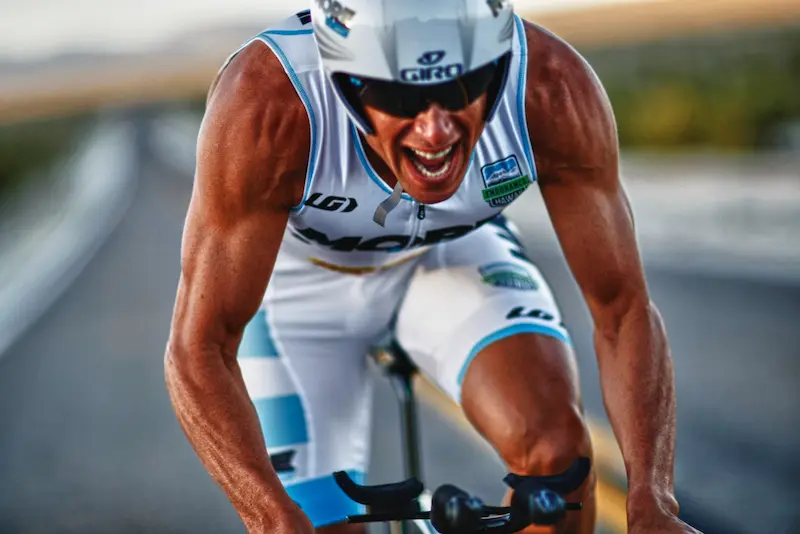
Chris Lieto
The People's Champion: The Unconquered Will of Chris Lieto.
The People's Champion: The Unconquered Will of Chris Lieto#
Introduction: The Longest Five Miles#
The Queen Kaʻahumanu Highway in Kailua-Kona, Hawaii, is a place of brutal truths. It is a black ribbon of asphalt laid across ancient lava fields, a landscape that offers no shade and no sympathy. Under the October sun, heat radiates from the ground in shimmering waves, and the air is thick with a humidity that suffocates. For triathletes, this is the final crucible of the Ironman World Championship, the place where dreams are either realized or vaporized.
In 2009, Chris Lieto was running through this inferno, leading the most important race of his life. For more than seven hours, he had executed his plan to near perfection. A blistering 4-hour, 25-minute, and 11-second bike split—the fastest of the day—had given him a substantial lead over the field. He was out front, alone, just as he had always designed it. This was the Lieto strategy in its purest form: build a lead so immense on the 112-mile bike that no one, not even the sport's greatest runners, could catch him on the marathon.
But behind him, a ghost was on the hunt. Craig "Crowie" Alexander, the defending champion and one of the most formidable runners the sport had ever seen, was methodically, relentlessly, closing the gap. At mile 18, Lieto was still in command, but the time splits coming from the roadside were ominous. The calculations were a form of torture. "I was doing some calculations in my head," Lieto would later recall. "I thought, my god, this may turn out to be a sprint finish again".
His body was screaming. The heat was intensifying, and his quads were burning with a searing pain. He was running through stretches where his body, unaccustomed to such a slow, agonizing pace, felt like it was taking a beating. Then, at mile 21, the ghost materialized. Alexander drew alongside, his stride still fluid, his purpose absolute. He didn't linger. He passed Lieto and pushed up the hill, a decisive, soul-crushing move.
Yet, even in that moment of despair, Lieto refused to break. "I didn't give up when he came by," he said. "I figured there's a chance that he may hit a rough patch again, so I didn't give up. I stayed on top of him. I was waiting for him to falter, and he didn't". He fought all the way to the finish line on Aliʻi Drive, crossing in second place. His final time was a personal best 8 hours, 22 minutes, and 56 seconds—just 2 minutes and 35 seconds behind Alexander.
That single race was the perfect microcosm of Chris Lieto's career. It was a brilliant, audacious performance defined by overwhelming strength on the bike, a valiant fight on the run, and a result that was both a triumph of spirit and an agonizing near-miss. It was not the story of a man who failed to win, but the ultimate expression of an athlete who dared to race on his own terms, forging a legacy not with a title, but with the sheer, unconquered will he displayed on the lava fields.
Chapter I: A Champion by Chance#
Unlike the majority of professional triathletes who build their aerobic engines over a lifetime of running, swimming, or cycling, Chris Lieto’s athletic origins lie in the explosive, anaerobic chaos of a swimming pool. Growing up in Danville, California, his focus was on collegiate water polo at Long Beach State University, a sport demanding power, core strength, and tactical aggression—not the metronomic endurance of a long-distance racer. This unconventional foundation would, in retrospect, prove to be both his greatest asset and his most persistent challenge.
His entry into triathlon was not the result of a long-held ambition but a moment of sudden, life-altering inspiration. In 1997, he was watching the Hawaii Ironman Triathlon World Championship on television, mesmerized by the spectacle of human endurance against the stark Hawaiian landscape. Something clicked. He decided then and there to try a triathlon. What happened next was a clear indication of an extraordinary, latent talent. Without a background in the sport, Lieto entered his first-ever triathlon and, remarkably, won it.
This prodigious debut set him on a trajectory that was as swift as it was unlikely. The power he had developed in the pool translated with astonishing efficiency to the bike, giving him a natural weapon that few could match. Within three years of that first victory, in 2000, he turned professional. Just three years after that, in 2003, he found himself on the starting line in Kona, competing in the very championship that had sparked his imagination. He finished 13th, a stunning result for a relative newcomer.
Lieto’s athletic history shaped his entire approach to the sport. His lack of a traditional endurance background meant he had to learn the nuances of pacing and nutrition on the fly, particularly for the marathon, a discipline that mercilessly exposes any weakness in an athlete's aerobic foundation. However, it also meant he arrived in the sport unburdened by the preconceived limits or accumulated fatigue of a youth spent logging thousands of miles. His power-based physiology from water polo made him a natural cyclist, capable of generating immense wattage. He was a power athlete who had to learn endurance, not the other way around. This unique combination forced him to develop a tactical identity that was as distinct as it was thrilling: he would turn the bike leg into a race of its own, betting everything on his singular, overwhelming strength.
Chapter II: Forging the Hammer#
As Chris Lieto established himself in the professional ranks, he honed his cycling prowess into a formidable weapon. His racing identity became synonymous with one of the most exciting tactics in triathlon: go to the front on the bike, push a pace no one else can sustain, and dare the field to catch you. He wasn't just a participant; he was an agent of chaos, a man who single-handedly dictated the terms of the race.
His strategy yielded significant victories that cemented his status as one of the sport's elite. He claimed titles at Ironman Wisconsin in 2002, Ironman Canada in 2005, and Ironman Japan in 2006. But it was the manner of these wins that built his legend. His victories were often punctuated by shattered bike course records. At Ironman Canada in 2005, he posted a blistering bike split of 4 hours, 25 minutes, and 26 seconds, a new record for the course. He repeated the feat at Ironman Japan in 2006, again setting a new bike course record. He wasn't just winning; he was making a statement with every pedal stroke.
This all-or-nothing approach was a direct reflection of his personal philosophy. "I am not in this race to make a top five or a top three," Lieto stated unequivocally. "I'm in it to win". This mindset defined him as a racer who would rather risk a spectacular collapse in the pursuit of first place than play it safe for a spot on the podium. It was a high-stakes gamble every time he lined up, a quality that endeared him to fans who craved dramatic, fearless racing.
His dominance on two wheels was not merely a product of raw talent. It was meticulously refined. Lieto was dedicated to finding every possible advantage, spending countless hours in the wind tunnel with sponsors like Trek to dial in his aerodynamic position. He understood that in a sport of inches and seconds, focusing on the "small things" was what produced big results.
However, the path was not without its moments of doubt. After a disappointing season in 2005, Lieto made an unconventional decision for a professional athlete in his prime: he returned to work as a mortgage broker. This was not an admission of defeat but a crucial psychological recalibration. "It helped me balance the time and focus I put into triathlon," he explained. "It allows me to be a little more relaxed in my preparation for a race". By stepping away from the all-consuming pressure of the sport, he found a new perspective. This mental reset proved to be a catalyst. The years that followed this brief return to a "normal job" would be the most successful of his career, culminating in his steady ascent to the top of the podium in Kona. He had learned that sometimes, the key to going faster is knowing when to slow down.
Chapter III: The Ghosts of the Queen K#
The Ironman World Championship in Kona is more than a race; it is a puzzle that every professional triathlete spends a career trying to solve. For Chris Lieto, it became an obsession. His journey on the Big Island was a multi-year saga of incremental gains, frustrating setbacks, and the relentless honing of his strategy against the unforgiving landscape and the world's best athletes.
His progression was methodical and clear. After his 13th-place debut in 2003, he began to climb the ranks. In 2006, he finished 9th, claiming the title of top American. The following year, in 2007, he moved up to 6th place. That 2007 race was a perfect illustration of his fearless mentality. After coming off the bike, he found himself running alongside the formidable Chris McCormack. A more prudent athlete might have settled into a conservative pace to secure a top-five finish. Lieto, however, surged to the lead, attempting to break one of the sport's best runners. He stayed with McCormack for a long stretch before the audacious pace took its toll, and he faded to 6th. It was a gamble that didn't pay off with a win, but it solidified his reputation as a man who would always race for the victory, no matter the odds.
Resilience became a hallmark of his Kona quest. He endured difficult years, including an 18th-place finish in 2005 and a particularly frustrating race in 2008, when a mysterious virus or the island's volcanic smog ("vog") left him completely off form, forcing him to walk parts of the marathon on his way to a 23rd-place finish. Yet, just six weeks after that disappointment, he silenced any doubters by taking a strong second place at Ironman Arizona, proving his fitness was still world-class.
Lieto knew that to conquer Kona, he had to address the acknowledged weak link in his armor: the run. He committed himself to becoming a more complete triathlete, a quest that led him to train with one of America's greatest distance runners, marathoner Ryan Hall. They trained together in Mammoth Lakes, California, with Lieto absorbing the environment and encouragement from Hall's elite crew. This was a clear signal of his unwavering dedication to solving the Kona puzzle.
Underpinning this entire journey was a constant, private battle with his own body. Plagued by chronic foot and ankle issues stemming from an old injury, Lieto had to be meticulous about managing his health. This struggle influenced every aspect of his training and racing, and even led to a close collaboration with his sponsor, K-Swiss, where he provided direct input into the design of their running shoes, seeking a solution to his own persistent problems. His pursuit of the Kona crown was not just a test of strategy and fitness, but a daily exercise in managing pain and overcoming physical limitations.
The following table provides a quantitative look at his persistent and evolving journey at the Ironman World Championship, a testament to a decade spent chasing a singular, elusive goal.
| Year | Overall Place | Swim Time | Bike Time | Run Time | Overall Time | Notes |
|---|---|---|---|---|---|---|
| 2003 | 13th | 54:02 | 4:45:00 | 3:21:40 | 9:05:07 | Strong debut in the professional field. |
| 2005 | 18th | 54:40 | 4:39:56 | 3:28:43 | 9:07:37 | A difficult year leading to a professional reset. |
| 2006 | 9th | 54:11 | 4:30:16 | 3:10:53 | 8:39:41 | Top American finisher. |
| 2007 | 6th | 53:42 | 4:32:46 | 3:06:56 | 8:37:41 | Gambled for the lead on the run before fading. |
| 2008 | 18th | 51:38 | 4:34:57 | 3:54:57 | 9:26:01 | Suffered from illness/vog effects during the race. |
| 2009 | 2nd | 51:07 | 4:25:11 | 3:02:35 | 8:22:56 | Career-best performance; fastest bike split of the day. |
| 2010 | 11th | 51:49 | 4:32:20 | 3:06:58 | 8:35:28 | Finished as the first American despite GI issues. |
Chapter IV: The Duel in the Sun#
Every great athlete's career is defined, in part, by their rivals. For Chris Lieto, that rival was Craig "Crowie" Alexander. Their battles represented a classic clash of styles that captivated the triathlon world for years. It was the quintessential matchup: the sport's most dominant cyclist versus its most relentless runner, a tactical and psychological war waged on the most demanding courses in the world.
The rivalry was a study in contrasts. Lieto's strategy was one of brute force and front-running audacity. Alexander's was one of patience, precision, and a finishing kick that could erase seemingly insurmountable deficits. Their duels became a recurring, real-time experiment answering a fundamental question in Ironman racing: could a massive lead built on the bike withstand the pressure of a world-class marathoner?
One of their most iconic encounters came not in Kona, but at the 2009 Boise Ironman 70.3. The race played out as a perfect distillation of their dynamic. Lieto, seeking a rematch after a hot and frustrating race against Alexander at Honu 70.3, executed his game plan perfectly on the bike. He built a lead of over five minutes heading into the run. But Alexander, as always, began the hunt. For miles, Lieto held him off, but in the final, agonizing stretch, Alexander unleashed a furious kick. "He caught me with maybe 20 meters to go," Lieto recounted. "I tried to put it in another gear but my legs were so full of lactic acid, I almost fell over at the finish". The experience left Lieto with a crucial piece of tactical wisdom: "I don’t want to be in a sprint finish with Crowie at Kona".
That lesson hung over their ultimate showdown at the Ironman World Championship later that year. The 2009 Kona race was their rivalry played out on the grandest stage. Lieto knew he needed a massive buffer off the bike; Alexander knew he had to stay within striking distance. Lieto delivered one of the great bike rides in Kona history, a 4:25:11 split that gave him a significant lead. For 21 miles of the marathon, the strategy held. But Alexander's running form, even under extreme fatigue, was a model of efficiency. Video analysis of the moment he passed Lieto reveals the subtle but critical differences: Alexander maintained a higher cadence and a more stable core, while Lieto's form showed the inevitable signs of muscular breakdown from his Herculean effort on the bike.
Years later, the intensity of their rivalry has softened into a deep, mutual respect. Lieto has hosted Alexander on his podcast, and they've reflected on their epic battles. Lieto acknowledges that he was "runner up to 2 of his World Championships both with close finishes," a testament to how closely matched they were, despite their different strengths. Their rivalry was compelling not because of any personal animosity, but because it represented a philosophical debate over the best way to win an Ironman. Each race was a tactical chess match, and their duels created one of the most memorable eras in the history of the sport.
Chapter V: More Than a Race#
For an elite athlete, life can become a narrow pursuit of personal excellence, a world defined by training logs, power outputs, and finish times. But for Chris Lieto, a chance observation during a routine pre-race bike ride would profoundly alter his perspective and redefine his purpose. This moment of awakening led to the creation of his foundation, More Than Sport, and marked a crucial pivot from a quest for personal victory to a mission of collective good.
The genesis of the foundation occurred in Mexico, where Lieto was preparing for a major race. Like many professional athletes, he was staying in a beautiful, all-inclusive resort, a bubble of comfort and convenience. One morning, he went out for a ride to check the course. Just a few miles from the resort's manicured grounds, something caught his eye. He saw several young children playing in the trees along the road. Peering deeper, he was confronted with a shocking reality: an entire village of people was living in makeshift homes constructed from flimsy cardboard boxes and scraps of wood.
The contrast was overwhelming. "As a husband and a father, my heart broke for those people," Lieto said. He was struck by the thought of the thousands of athletes and tourists who fly into these beautiful locations, spend a great deal of money, and remain completely oblivious to the desperation existing just beyond the hotel gates. This realization sparked a powerful question: "The grounds we race on belong to a people in need. Instead of ignoring the problem, why not use sport as a vehicle for change?".
That question became a call to action. From that moment, More Than Sport was born. Lieto created the non-profit with a simple but profound mission: to mobilize the athletic community to give back to the communities that host their events, ensuring that each race leaves a lasting, positive impact. The idea was to transform the self-focused nature of racing into an opportunity for service.
The foundation quickly put this philosophy into practice. At a race in Panama, More Than Sport partnered with the organization Homes of Hope to build houses for local families in need. At other events, including the Island House Invitational Triathlon and in Kona, they organized projects to build and donate bicycles to children in local schools. The foundation became a platform for athletes and participants to connect with the local communities, turning race weekends into opportunities for meaningful contribution. For Chris Lieto, this was the beginning of a fundamental shift in his identity. He was discovering a purpose that transcended any finish line, redefining what it meant to be a champion.
Chapter VI: The Second Act: Entrepreneur, Mentor, Father#
When the time came for Chris Lieto to quietly step away from the relentless demands of full-time professional racing, he did not simply retire; he repurposed. The same discipline, passion, and analytical mindset that defined his athletic career were seamlessly translated into new ventures in business, mentorship, and, most importantly, family life. His second act is not a departure from his first, but a maturation of it.
As an entrepreneur, Lieto drew directly from his experiences as an athlete. He founded the nutrition company Base Performance out of a personal need for "solid foundational health supplements" that he felt were missing from the market. The company's philosophy was built on the concept of "base health," focusing on products that support the body's foundation rather than providing a temporary fix. This was a direct application of the lessons he learned about the importance of nutrition and recovery in achieving peak performance. The company grew successfully under his leadership and was eventually acquired in 2017 Similarly, his long-standing struggles with foot injuries led to a deep collaboration with K-Swiss. He was brought on to help develop their running shoe line, providing invaluable real-world feedback to create a product that could withstand the rigors of elite triathlon.
Lieto also transitioned from a competitor to an elder statesman and mentor within the sport. He began coaching, developing a philosophy that extends beyond physical workouts to encompass the emotional, spiritual, and relational aspects of an athlete's life. He also launched "The Chris Lieto Podcast," a platform where he shares his own journey and engages in deep conversations with other world-class athletes like his old rival, Craig Alexander. Through these channels, he continues to contribute his wealth of knowledge and experience to the triathlon community.
His exit from the professional circuit was characteristically understated. There was no grand farewell tour. Instead, as nagging injuries persisted and his priorities shifted, he made the decision to re-evaluate and focus on what mattered most. He and his wife, Karis, had settled full-time in Kailua-Kona, Hawaii, raising their son, Kaiden, and daughter, Kayah, in the very town that had been the backdrop for his greatest athletic dramas. His life is now guided by the cornerstones of faith, family, and a pursuit of balance—principles he had begun to discover during his racing career and which now form the foundation of his life. He successfully navigated the difficult transition that challenges so many elite athletes, proving that the end of a racing career can be the beginning of an even richer journey.
Conclusion: The Legacy on Ali'i Drive#
The finish line on Aliʻi Drive in Kona has witnessed the full spectrum of Chris Lieto's journey. In 2009, it was the place of his greatest and most heartbreaking performance, where a five-year-old Kaiden Lieto greeted his exhausted father, a man who had just come agonizingly close to being crowned champion of the world. "I thought my dad was the coolest in the world and I wanted to be like him," Kaiden would later say.
Fifteen years later, in 2024, the roles were powerfully reversed. This time, it was Chris Lieto anxiously waiting at that same finish line. He was no longer the competitor but the father, watching as his son, Kaiden, completed his own first Ironman World Championship. Throughout the day, Chris had followed his son's progress, riding a motorized bike to get ahead on the run course, offering encouragement and tactical advice as Kaiden battled his own demons in the Energy Lab. When Kaiden crossed the line, having overcome not only the grueling 140.6-mile course but also a life-threatening brain surgery in the preceding months, his father was there to greet him with a hug. The torch had been passed.
This full-circle moment encapsulates the true nature of Chris Lieto's legacy. He may never have broken the tape first in Kona, but his impact on the sport and the lives he has touched represents a far more profound victory. His legacy is etched in the memory of every fan who was captivated by his fearless, front-running style—a willingness to risk everything for the win that made every race he entered an unmissable event. It is found in the communities in Mexico and Panama, where his "More Than Sport" foundation built homes and provided hope, demonstrating that an athletic career could be a powerful platform for positive change.
And now, it is found at the finish line on Aliʻi Drive, in his role as a father guiding his son along the same hallowed ground where he once battled for glory. Chris Lieto’s story is a testament to the idea that the ultimate prize isn't always a title or a trophy. The ultimate prize is a life of passion, purpose, and family, forged in the crucible of the world's toughest race. He may not have conquered the top step of the podium in Kona, but he conquered something far more meaningful: he built a life that is, in every sense, more than a race.