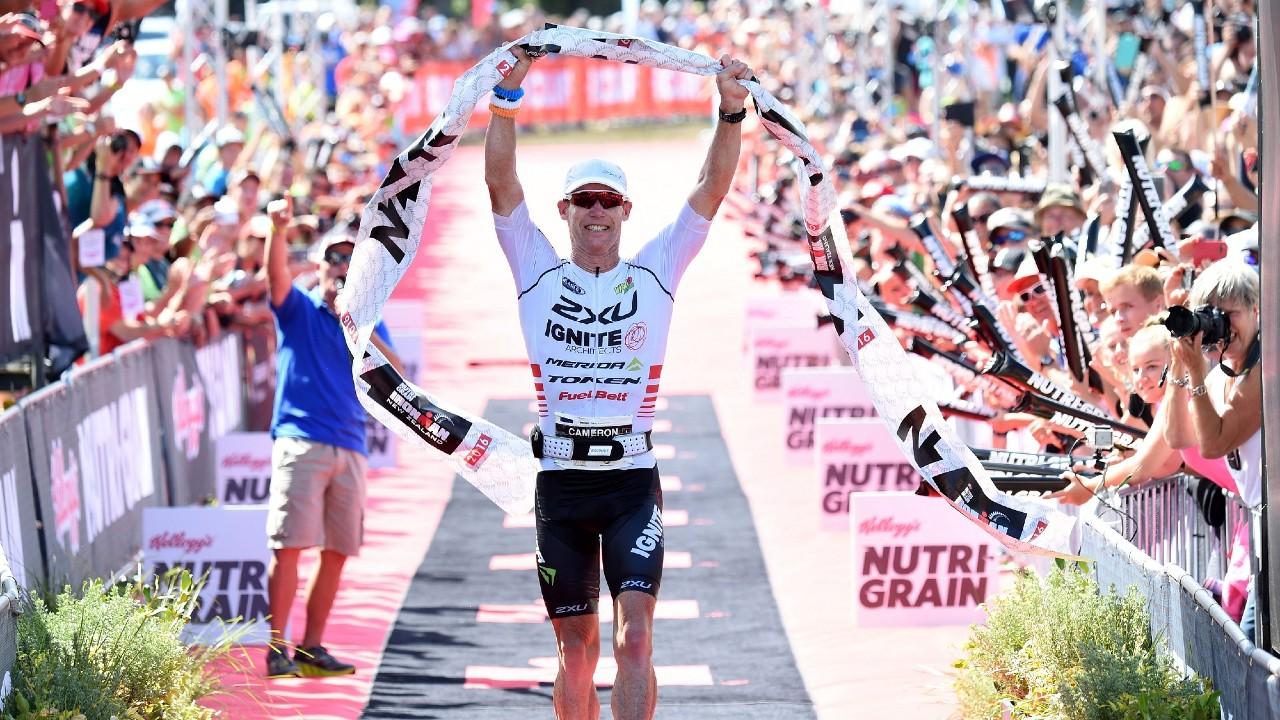
Cam Brown
The Long Finish Line: Charting the Unparalleled Legacy of Cameron Brown.
The Long Finish Line: Charting the Unparalleled Legacy of Cameron Brown#
Introduction: The Final Haka#
The finish line at the 2023 Nutri-Grain Ironman New Zealand in Taupō was electric, charged with more than the usual cocktail of exhaustion and elation. Through the roaring corridor of spectators, a familiar figure emerged. At 50 years old, Cameron Brown was completing his 25th and final professional race on the course that had become synonymous with his name. The fatigue was etched deep into his features, but so was a quiet, unyielding determination that had defined his career for over three decades. He crossed the line in 8:42:15, securing an astonishing seventh place among a field of athletes young enough to be his sons.
What followed was not the typical send-off for a retiring athlete. As he was greeted by his wife, Jenny, the emotion of the moment was palpable. Race Director Wayne Reardon presented him with a pounamu, a sacred Maori greenstone, a tangible symbol of respect and connection to the land he had conquered so many times. Then, a powerful, guttural cry cut through the air. A haka erupted, a tribute of immense cultural significance, performed in honor of the man who had given so much to the sport in New Zealand. This was not merely a celebration of records; it was a profound acknowledgment of a legacy. The haka, an expression of community, strength, and the culmination of a great journey, perfectly mirrored Brown's career. It underscored that his impact was not measured solely by his 12 Ironman New Zealand titles or his four podium finishes in Kona, but by the deep, symbiotic relationship he had forged with the event and its people. He had not just raced in Taupō; he had become part of its very identity. How did this unassuming athlete from Auckland, known for his quiet humility, build a 35-year career of such profound impact that it would culminate in one of the sport's most moving farewells?
Chapter I: The Accidental Hero: Forging a Legend at Pakuranga College#
The journey to becoming New Zealand's greatest long-distance triathlete began not with a grand plan, but with a happy coincidence. In 1987, a teenage Cameron Brown transferred to Auckland's Pakuranga College, where his English teacher, Patsy Lambert, happened to run a burgeoning triathlon club. Lambert's infectious enthusiasm was the catalyst. "If we didn't have her probably wouldn't have got into the sport," Brown later explained, crediting her for driving the students to races and even making their uniforms. The early days were a world away from the disciplined life of a professional. Training sessions often consisted of "mucking around" at Bucklands Beach on a Friday night, more likely to end with "fish and chips and talk crap" than structured intervals.
The pivotal moment came when Lambert arranged for Brown to meet his hero, the then-world champion Rick Wells. Brown, who had posters of Wells on his wall, came away from the meeting with a signature and the beginnings of a lifelong bond that would transform a hobby into a calling. Wells recognized the nascent talent immediately, recalling, "He was special right from the start". Inspired by Kiwi heroes like Wells and Erin Baker, Brown's trajectory steepened rapidly. He won the New Zealand secondary school title in 1988 and turned professional in 1990, immediately after leaving school. In 1992, he announced his arrival on the world stage, taking second place at the ITU Junior World Championships in Huntsville, Canada, against a field that included future stars like Normann Stadler.
For years, Brown chased the Olympic dream on the faster, more explosive ITU World Cup circuit. He was a consistent performer, chalking up nine top-10 finishes and a podium behind Australian great Brad Bevan and future Olympic champion Hamish Carter. However, this period was defined by a crucial self-awareness. Brown recognized that he lacked the blistering top-end run speed of his contemporaries. "I never had the speed on the run like these guys," he admitted, a realization that forced him to re-evaluate his path. This period of chasing faster athletes, while perhaps a partial disappointment in not reaching the Olympics, was the very crucible that forged the patient, strategic, and humble champion he would become. It instilled a deep respect for his own limitations and the necessity of a relentless work ethic, attributes perfectly suited for the grueling demands of the Ironman distance.
Chapter II: Finding His Distance: The Ironman Gamble#
Brown had always watched the Ironman New Zealand race each March, dreaming of one day competing. That day came in 1997 in Auckland. The result was, in his own words, a "shocker". Yet, the punishing experience didn't deter him; instead, he "caught the bug of Ironman" and found his true calling. His success, however, was not immediate.
The true turning point came in 1999, the first year the race was held in its new home of Taupō.8 In a dramatic finish, Brown came second, a mere 13 seconds behind American Tim DeBoom, who would go on to win the Ironman World Championship twice. That performance, against one of the world's best, was the confirmation he needed. "That was the game-changer for me to give short course away," Brown said, cementing his commitment to long-distance racing. The following year, he solidified that choice with another runner-up finish, this time to 1997 Ironman World Champion Thomas Hellriegel of Germany.
These back-to-back second-place finishes were more than just near misses; they were a profound strategic education. By racing shoulder-to-shoulder with two different Kona champions, Brown gathered invaluable competitive intelligence. He was not just competing; he was studying. He learned firsthand the pacing strategies, nutritional demands, and mental fortitude required to win at the highest level. These early "losses" were arguably the most important races of his career, providing the tactical blueprint that would lay the groundwork for his unprecedented future dominance.
Chapter III: The King of Taupō: A Two-Decade Reign#
In 2001, the apprentice became the master. In a performance that would become his trademark, Brown ran down ITU World Long Distance Champion Peter Sandvang of Denmark, erasing a 12-minute deficit off the bike to claim his first Ironman New Zealand title. It was, he said, "a dream come true" and the beginning of an era of dominance unparalleled in the sport.
Brown's reign in Taupō was defined by two remarkable winning streaks: five consecutive victories from 2001 to 2005, and another five from 2007 to 2011 In 2011, he became the first person in history to win the same Ironman race ten times. But his longevity defied belief. In 2016, at the age of 43, he claimed his 12th and final title, setting a new course record of 8:07:58 in the process. He described it as a perfect day, having ridden eight minutes faster on the course than ever before. His connection to the race was absolute. "It is the race that has made me as an athlete," he reflected. "Winning that race has held a lot of importance for me".
His long tenure also saw him face down new generations of Kiwi talent. His rivalry with Terenzo Bozzone was a classic master-versus-apprentice battle. Bozzone finished second to Brown four times before finally claiming victory in 2018 with a stunning sub-8-hour performance that shattered Brown's record. Brown, who finished third that day despite running a blistering 2:41 marathon, was the first to pay tribute, showcasing his immense sportsmanship. Bozzone, in turn, acknowledged what he learned from the master: "Patience is the big thing I learned... Cameron Brown has that nailed. He is the ice man. You never see any weakness". Similarly, when two-time Olympic medallist Bevan Docherty won the race on his Ironman debut in 2013, also breaking the course record, Brown was gracious in defeat. "Hat's off to Bevan who was the best out there on the day," he said, despite admitting to feeling "ordinary all day" himself.
| Year | Position | Overall Time | |
|---|---|---|---|
| 1997 | 22nd | --- | |
| 1999 | 2nd | --- | |
| 2000 | 2nd | 8:26:45 | |
| 2001 | 1st | 8:24:28 | |
| 2002 | 1st | 8:32:54 | |
| 2003 | 1st | 8:22:05 | |
| 2004 | 1st | 8:30:30 | |
| 2005 | 1st | 8:20:14 | |
| 2006 | 2nd | 3:31:45. | |
| 2007 | 1st | 8:26:33 | |
| 2008 | 1st | 8:24:49 | |
| 2009 | 1st | 8:18:05 | |
| 2010 | 1st | 8:21:52 | |
| 2011 | 1st | 8:31:07 | |
| 2012 | 3rd | 3:56:38** | |
| 2013 | 3rd | 8:34:27 | |
| 2014 | 2nd | 8:21:54 | |
| 2015 | 1st | 8:22:12 | |
| 2016 | 1st | 8:07:57 | |
| 2017 | 2nd | 8:24:32 | |
| 2018 | 3rd | 8:07:10 | |
| 2019 | DNF | --- | |
| 2020 | 6th | 8:14:35 | |
| 2021 | N/A | (Cancelled) | |
| 2022 | N/A | (Postponed) | |
| 2023 | 7th | 8:42:13 | |
| *Shortened bike-run event due to weather. *Shortened to 70.3 distance due to weather. 2 |
Chapter IV: The Big Island Crucible: The Quest for Kona#
While Taupō was his kingdom, the Ironman World Championship in Kona, Hawaii, was the ultimate test. It was on the black lava fields of the Big Island that Brown proved he was not just a local hero but a global force. Between 2001 and 2005, he established himself as one of the most consistent performers in the world, securing four podium finishes in five years—a remarkable feat in one of sport's most grueling events.
His peak years saw him go head-to-head with the legends of the era. In 2001, he finished second to Tim DeBoom. He followed that with two consecutive third-place finishes in 2002 and 2003, behind champions like DeBoom and Peter Reid. His best performance came in 2005, when he was runner-up to Germany's Faris Al-Sultan, clocking his personal best Kona time of 8:19:36.
| Year | Position | Overall Time | Winner | Winner's Time | ||
|---|---|---|---|---|---|---|
| 2001 | 2nd | 8:46:10 | Tim DeBoom (USA) | 8:31:18 | ||
| 2002 | 3rd | 8:35:34 | Tim DeBoom (USA) | 8:29:56 | ||
| 2003 | 3rd | 8:30:08 | Peter Reid (CAN) | 8:22:35 | ||
| 2005 | 2nd | 8:19:36 | Faris Al-Sultan (GER) | 8:14:17 | ||
| 10 |
Even when he wasn't on the podium, Brown's performances in Kona were often heroic. In 2008, after suffering a slow leak in his tire, he was forced to ride nearly 30 miles at a disadvantage before finally getting a wheel change. He entered the run in tenth place but unleashed a furious marathon to run his way up to a fifth-place finish, a testament to his incredible mental fortitude. He also experienced the brutal nature of the island, suffering his first-ever Ironman DNF in 2007 after a virus derailed his race week. Yet he kept returning, pushing the limits of what was thought possible. In 2018, at 46 years old, he finished 22nd in a blistering 8:25:30—a time only six minutes slower than his personal best from 13 years prior, a stunning display of age-defying performance.
Chapter V: The Ageless Wonder: Redefining the Limits#
More than any single victory, Cameron Brown's career will be remembered for its astonishing longevity. He was not just an athlete who competed into his 40s and 50s; he was one who won, broke records, and remained at the pointy end of the field. In 2014, at 41 years of age, his victory at Ironman Cairns made him the oldest professional to ever win an Ironman-branded event. Two years later, he broke his own mark by winning his 12th Ironman New Zealand title at 43
His career is so expansive that it serves as a human bridge across multiple eras of triathlon. He began in 1987, racing against the sport's pioneers on steel-framed bicycles. He retired in 2023, in an age of carbon superbikes, advanced aerodynamic technology, and sophisticated nutrition science. He witnessed the sport's evolution from a niche pursuit with only five Ironman races worldwide to a global phenomenon with hundreds of events and a massive social media footprint. His story is not just that of one athlete; it is a living chronicle of the evolution of modern triathlon itself.
The secret to his longevity was not a closely guarded formula but a simple, profound philosophy. "The key at my age is to love it," he once said. "I never thought I would still be racing at 42 so I take every race as if it's my last and give it 100 percent". He spoke of enjoying the challenge of "pushing the boundaries of what is humanly possible for a 50-year-old to do". This mindset, combined with a deep well of resilience to overcome inevitable setbacks—from car accidents and jellyfish attacks to the simple fact that recovery takes longer with age—allowed him to build a career that inspired awe throughout the triathlon world. Fellow athletes and fans alike referred to him as an "institution" and a testament to the "greatest longevity and high performance ever".
Chapter VI: The Man Behind the Medals: Philosophy of an Ironman#
Underpinning Cameron Brown's physical endurance was a sophisticated understanding of performance. He was one of the first to champion the idea of nutrition as the "fourth discipline" of triathlon. He witnessed the sport's nutritional science evolve from simply grabbing "bananas, figs and whatever else came to hand" to a precise science focused on maximizing capacity and accelerating recovery. As a coach, he stresses the importance of a balanced diet, whole foods, and consistency, warning that without a clear nutrition plan, an athlete will "inevitably get sick or injured, plain and simple".
His training philosophy was equally insightful, built on a principle that runs counter to the "no pain, no gain" ethos that can dominate endurance sports. "Consistency is the golden rule," Brown has stated. "I always tell my athletes to finish a training session with a little left in the tank. It's better to do less, recover properly and be ready to go again, than overdo it and compromise the days ahead". This measured approach was the key to his remarkable injury resistance and his ability to show up, year after year, ready to perform.
This incredible career was built on the bedrock of a stable and supportive family life. He met his wife, Jenny, a primary school teacher, when they were 21 He credits her with helping him leave the sport at the front door after 3 p.m., allowing for dedicated family time with their two sons, Joshua and Braeden. The importance of this support system was never more evident than at his home races in New Zealand. "Usually when I race overseas it's just me," he said, "so having them watching me makes it that more special". It was this balance that allowed the man to sustain the champion for so long.
Conclusion: A Legacy Forged in Endurance#
As the final echoes of the haka faded across the Taupō finish line in March 2023, Cameron Brown's career came full circle. His seventh-place finish was a fitting final chapter—a display of the grit, heart, and world-class competitiveness that defined him for 35 years. His legacy is not one of a single victory or a world record, but something far more profound. It is a legacy of unprecedented dominance in his home country, of consistent contention on the world's biggest stage, of a quiet humility that earned universal respect, and of a career that defied the known limits of athletic longevity. As the
New Zealand Herald aptly put it, Cameron Brown is a name that will "remain synonymous with Ironman New Zealand for years to come, with the Kiwi great leaving a legacy on the event that may never be surpassed".
His journey, however, is not over. In his transition to coaching with platforms like Endure IQ, Brown has become a custodian of the sport's wisdom. The quiet determination that powered him across countless finish lines will now be channeled into shaping the next generation, ensuring that the lessons learned over one of triathlon's most legendary careers will continue to inspire for decades to come.