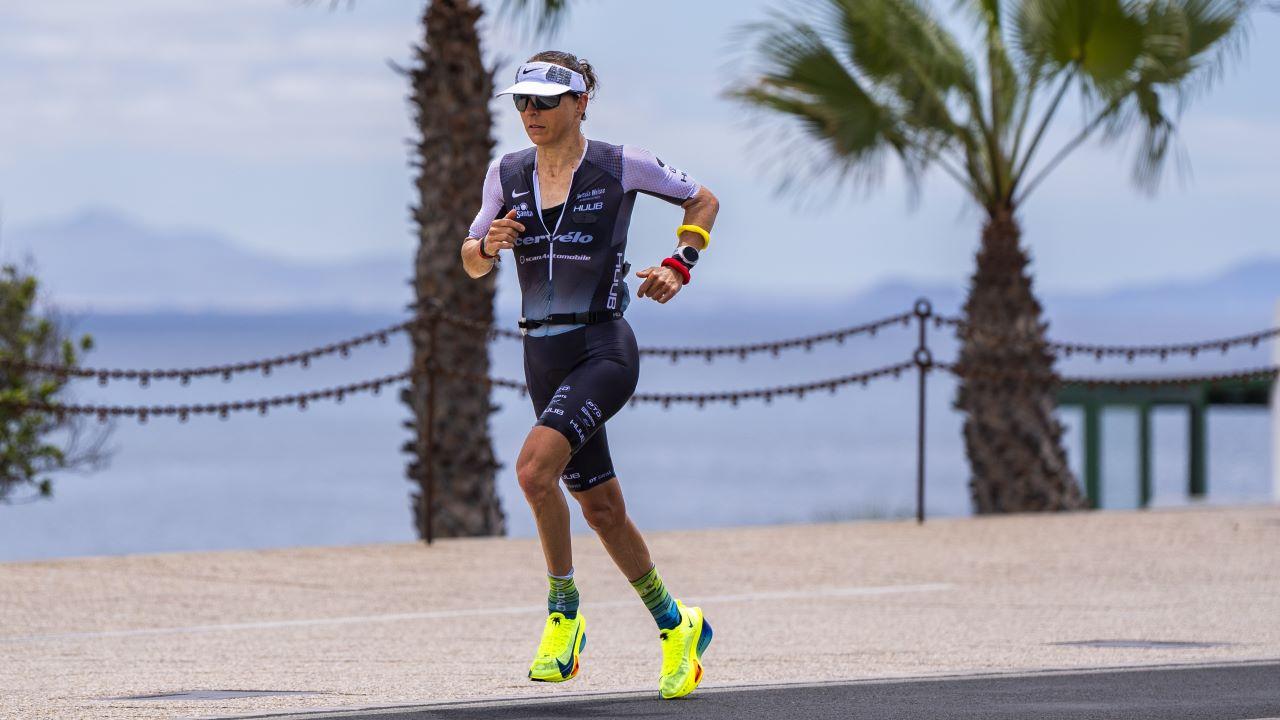
Anne Haug
The Unbreakable Will: The Contradictory Genius of Anne Haug.
The Unbreakable Will: The Contradictory Genius of Anne Haug#
In the pantheon of endurance sports, greatness often follows a familiar script: the child prodigy, the preternaturally gifted athlete, the one for whom the sport seems an extension of their own being. Anne Haug’s story rips that script to shreds. Hers is a narrative of contradictions: a world champion in a sport she came to by accident, an endurance queen who hated long training sessions, a dominant force whose greatest weapon was forged not from talent, but from the relentless sharpening of an unbreakable will against the stone of her own perceived limitations. This is the story of how a woman who taught herself to swim at 20, who was told she was too old and too untalented, methodically, stubbornly, and quietly conquered one of the world's most grueling sports, leaving behind a legacy not of effortless grace, but of profound and awe-inspiring grit.
Part I: The Accidental Champion#
An Unlikely Beginning#
Anne Haug’s journey to the pinnacle of triathlon began not on a pool deck or a running track, but in the town of Bayreuth, Germany, where she was born on January 20, 1983. Her youth was a tapestry of athletic pursuits, a showcase of a competitive drive in search of a home. Inspired by fellow German Steffi Graf, she picked up tennis at age five; later came judo, volleyball, badminton, and skiing. She was a sporting polymath, proficient in many disciplines but a master of none that pointed toward a future in professional sport. Her one world title from this era came in Indiaca, a Brazilian variant of volleyball played with a giant shuttlecock, a niche achievement that hinted at a world-class competitive spirit waiting for the right stage.
The three disciplines of triathlon, however, were conspicuously absent. Crucially, Haug did not learn to swim as a child; she was allergic to chlorine and only taught herself the basics at the age of 20 This single fact is the cornerstone of her entire story. It immediately reframes her career not as the realization of innate talent, but as a monumental act of self-creation. Her entry into the sport itself was, in her own words, something that "just happened by accident". It was not a calling she answered, but a path she stumbled upon, one that would require her to build her foundation from the ground up, long after her peers had laid theirs. This delayed, almost reluctant, start meant that her greatest athletic gift—her willpower—had to be developed to an extraordinary degree simply to participate, let alone compete. The arduous process of teaching herself to swim was the first, and perhaps most defining, test of the mental fortitude that would become her trademark.
The Munich Connection: Forging a Partnership for the Ages#
As Haug embarked on her accidental journey into triathlon, a fateful encounter at the Technological University of Munich, where she was studying Sports Science, would set the course for her entire professional life. During a university triathlon course, she met a fellow student named Dan Lorang. He saw her potential and began coaching her, a partnership that would remain steadfast for the next two decades. Haug was Lorang's first-ever athlete, a detail that underscores the unique nature of their bond. Theirs was not a typical relationship where an established coach takes on a promising athlete; it was a co-evolution. They learned the sport together—she as a competitor, he as a tactician—growing from university students into a world-beating duo.
This symbiosis proved to be a critical factor in her success. Lorang’s coaching methodology was shaped by the unique puzzle Haug presented: an athlete with a massive run engine but a significant swim deficit. His philosophy, focused on a "slow and very healthy progression" over long-term development, was perfectly suited to Haug’s late-blooming career. He never pushed for short-term gains at the expense of her overall development. Haug has called Lorang "the most important person in my career," a testament to a partnership built on mutual trust, discovery, and a shared, two-decade-long project to reach the absolute maximum of her potential.
Early Signs: From Duathlon to the Pro Ranks#
Before she could become a force in triathlon, Haug first found success in disciplines that played to her strengths and minimized her primary weakness. Her powerful run and bike combination made her a natural at duathlon, and she quickly became the German National Duathlon Champion in both 2008 and 2009. She also leveraged her skiing background to compete in winter triathlons. These early victories were proof of concept, demonstrating that her physiological engine was world-class, even if her swimming technique was still a work in progress.
Emboldened by these results, Haug made the decision to turn professional in 2010 at the age of 27 In a sport where many athletes turn pro in their late teens or early twenties, this was a remarkably late start. It meant her window for a professional career would be compressed, requiring an intensity and focus that left no room for error. Her trajectory, from a 20-year-old non-swimmer to a 27-year-old professional triathlete, was a testament to the sheer force of will that would come to define her.
Part II: The Hard Way: Chasing the Olympic Dream#
Defying the Naysayers#
Upon turning professional, the conventional wisdom was clear and unanimous: with her swim deficit, Haug’s only viable path was long-course triathlon, where the swim is a smaller percentage of the overall race. But Haug rejected this logic. She chose what she knew was "the hard way," setting her sights on the fast-paced, draft-legal, swim-dominant world of short-course racing with the audacious goal of qualifying for the Olympic Games. "Everyone said I was crazy to try short course racing," she recalled, noting that she was considered "so untalented in terms of swimming".
Her motivation was deeply personal. It was not about choosing the path of least resistance or greatest immediate reward, but about testing her own limits. She wanted to give it her "absolute very best" so that she would have "nothing to regret". This decision was the ultimate expression of her character. The early results confirmed the challenge she had set for herself. In her first full season on the top-tier ITU World Championship Series in 2011, she struggled to keep pace, logging finishes of 24th, 42nd, and 54th. The swim was a constant anchor, often leaving her in a desperate chase on the bike. But this struggle was precisely the point. The high-pressure environment of short-course racing, where a poor swim can end one's race in the first 20 minutes, became a crucible. It forced her to develop an extraordinary bike and run, and more importantly, it forged an unparalleled mental resilience. She was not just training her body; she was training her will to fight from behind, a skill that would later become her superpower.
The Breakthrough (2011-2013)#
Through sheer persistence, Haug’s relentless work began to pay dividends. The 2011 season saw her first major international victories, with a win at the ETU European Cup in Quarteira, Portugal, followed quickly by her first ITU World Cup podium in Mexico. But it was the 2012 season that marked her arrival as a true global contender. She transformed from a chaser to a consistent threat, logging six top-10 finishes in the World Triathlon Series. The season culminated in a stunning maiden victory at the Grand Final in Auckland, New Zealand, a performance that secured her the overall silver medal in the World Championship Series standings.
She proved it was no fluke by backing it up with an arguably stronger season in 2013. She took victories at the World Cup in Mooloolaba and the World Triathlon Series events in Auckland and Hamburg. That year, in front of a roaring home crowd in Hamburg, she also anchored the German team to a gold medal at the Mixed Relay World Championships. She finished the 2013 season ranked third in the world, adding a series bronze to the silver she won the year before. In just two years, the woman who was "crazy" to even attempt short-course racing had become one of its most formidable athletes.
The Olympic Experience: London and Rio#
Haug’s primary goal in choosing the "hard way" was realized in 2012 when she qualified for the German Olympic team. At the London Games, she delivered an impressive 11th place finish, a remarkable achievement for an athlete who had turned professional just two years prior. She had proven the naysayers wrong and validated her difficult choice.
Four years later, she qualified for her second Olympics in Rio de Janeiro. But the 2016 Games would provide a harsh and painful lesson. The swim once again proved to be her Achilles' heel. She exited the water with a significant deficit and was forced to expend enormous energy working alone on the bike in a futile attempt to catch the leaders. She ultimately finished a deeply disappointed 36th, losing more than six minutes by the end of the race.
The result was a crushing blow, representing a definitive end to a chapter of her career. For both Haug and her coach Dan Lorang, it was a significant low point that forced a period of intense reflection and prompted serious discussions about her future. The dream of an Olympic medal was over. The failure, however, was not an endpoint but a catalyst. The profound disappointment of Rio forced a necessary reinvention. It was the moment that the "hard way" had reached its limit, closing the door on her Olympic ambitions but, in doing so, opening another, much wider door to a different kind of glory.
Part III: The Reluctant Queen: Conquering the Distance#
A Ferrari Engine in a Diesel Race#
The transition to long-distance racing, the path she had so deliberately avoided, was a monumental challenge for Haug, both physically and psychologically. "I never, ever could imagine doing a long course race," she admitted, explaining that her body was built for explosive power, not sustained endurance. She described herself as having "more of a Ferrari engine than a diesel engine," one that wanted to go "quick and fast". Her aversion was visceral: "I hate long bike rides. I hate long runs," she confessed.
Yet, it was this very reluctance that became her motivation. The move to Ironman was not born of a newfound love for the distance, but from an insatiable desire to test herself against something she found profoundly difficult. It was, she said, a "massive challenge to prove myself and be good in something which I originally didn't like at all". This mindset is the key to understanding her long-course dominance. She didn't conquer the distance by embracing it, but by attacking it with the same ferocious will she had used to overcome her swimming deficiencies years earlier.
Immediate and Devastating Impact (2017-2018)#
The skills Haug had honed in the crucible of short-course racing translated to the longer format with shocking and immediate effect. In her first-ever professional middle-distance race, the notoriously tough Ironman 70.3 Lanzarote in 2017, she delivered a statement performance. After giving up time in the swim and bike to the powerful Lucy Charles-Barclay, Haug unleashed a devastating run, erasing the deficit and taking an astonishing 11 minutes out of her rival on the half-marathon alone to win by nearly eight minutes. It was a clear warning: a new predator had entered the ecosystem.
The 2018 season confirmed her status as an elite long-course talent. She claimed dominant victories at Ironman 70.3 Dubai and Oceanside. Her full-distance debut at the Ironman European Championship in Frankfurt was a tough learning experience, where she finished fourth against a world-class field. But she rebounded spectacularly at the end of the season, earning bronze medals at both the Ironman 70.3 World Championship in South Africa and, in her first attempt, the Ironman World Championship in Kona, Hawaii. Her 2:55:20 marathon on the Big Island was a glimpse of the weapon she was about to unleash on the sport.
The Crowning: Kona 2019#
If 2018 was the warning shot, 2019 was the coronation. Yet Haug’s path to the Ironman World Championship throne was anything but smooth. Her preparation was severely hampered by an injury that prevented her from running for nearly half the year. She was forced to validate her Kona spot at the last possible opportunity, Ironman Copenhagen in August. She did more than just finish; she obliterated the field and the course record with a time of 8:31:32, signaling she was back to her best. "On the day everything came together," she would later say of her Kona performance, but it was a day built on months of uncertainty.
The race in Kona on October 12, 2019, unfolded in what would become classic Anne Haug fashion. As expected, Great Britain’s Lucy Charles-Barclay stormed to a huge lead in the 2.4-mile swim, exiting the water in 49:02.19 Haug emerged in 54:09, part of the main chase pack but already facing a deficit of nearly five minutes. On the grueling 112-mile bike ride across the lava fields, Charles-Barclay relentlessly pushed her advantage, while four-time defending champion Daniela Ryf of Switzerland uncharacteristically struggled and fell out of contention. By the time she reached the second transition, Charles-Barclay had built a seemingly insurmountable lead of just under eight minutes on Haug and a small group of chasers.
What followed was one of the most memorable performances in the history of the sport. Haug, the hunter, set off on the marathon with a singular focus: the target eight minutes up the road. She ran with a fluid, powerful stride that belied the brutal heat and humidity. The gap, which had seemed so vast, began to shrink with metronomic certainty. By the bottom of the notorious Palani Hill, it was down to five minutes. The inevitable pass came at mile 15, deep within the suffocating heat of the Natural Energy Lab, a section of the course known for breaking athletes’ spirits. Haug surged past Charles-Barclay and never looked back. She flew down Ali’i Drive to the finish line, having clocked a blistering 2:51:07 marathon to claim her first Ironman World Championship title in a time of 8:40:10.
The victory was historic. She became the first German woman to win the coveted title, and with Jan Frodeno winning the men’s race, she completed a German double. For her and coach Dan Lorang, who guided both champions, it was the ultimate validation of their two-decade journey together. Haug's entire career had conditioned her to be the hunter, and on the biggest stage, she delivered a psychological and physical masterpiece, turning a massive deficit into a decisive victory.
Anne Haug's Ironman World Championship Legacy#
Her 2019 victory was the centerpiece of a period of remarkable consistency at the sport's most prestigious event. Aside from a mechanical failure in 2024, she never finished off the podium at an Ironman World Championship she started, a testament to her ability to perform when the stakes were highest.
| Year | Location | Result | Time | Key Narrative |
|---|---|---|---|---|
| 2018 | Kailua-Kona, HI | 3rd | 8:41:58 | The stunning debut; a warning shot to the establishment. |
| 2019 | Kailua-Kona, HI | 1st | 8:40:10 | The crowning achievement; the historic run-down victory. |
| 2021. | St. George, UT | 3rd | 8:47:03 | Post-pandemic consistency on a different, challenging course. |
| 2022 | Kailua-Kona, HI | 3rd | 8:42:22 | Proving her 2019 win was no fluke; back on the Kona podium. |
| 2023 | Kailua-Kona, HI | 2nd | 8:27:33 | A new Kona run course record (2:48:23) in a valiant chase. |
| 2024 | Nice, France | DNF | N/A | A frustrating mechanical issue, foreshadowing late-career struggles. |
| Note: The 2021 championship was held in May 2022 due to the pandemic. |
Part IV: The Record Breaker and The Breaking Point#
Chasing History at Home#
In the years following her Kona triumph, Haug continued to defy expectations, particularly around the subject of age. Her connection to Challenge Roth, Germany’s iconic long-distance race, became a central part of her late-career legacy. She won the event multiple times, but her performance in July 2024 was a watershed moment for the sport. At the age of 41, just weeks after recovering from a viral infection that had disrupted her season, Haug entered the race as a late addition. What she did next was astonishing. She dominated the race from the early stages of the bike, but it was on the run where she entered another dimension. She clocked a jaw-dropping 2:38:52 marathon, propelling her to a finishing time of 8:02:38. The performance shattered the previous world best time for the distance by nearly six minutes and brought her tantalizingly close to the mythical sub-eight-hour barrier. It was a masterful display that challenged conventional wisdom about athletic longevity, proving that a career is defined not by the age you start, but by the intelligence and will you apply throughout.
The Body's Betrayal#
Even as she was setting records, Haug was engaged in a private battle with her own body. Her final two years in the sport were, in her words, a "massive struggle in terms of my physical health". The challenges were numerous and relentless. After contracting COVID-19 in March 2021, she developed COVID-related diabetes, a condition that created significant difficulties with in-race fueling and energy management.
A series of illnesses and setbacks plagued her through 2023 and 2024, forcing her to withdraw from several key races. The most public and painful of these setbacks came at the 2024 Ironman World Championship in Nice, France. Seen as a top contender, her race ended before it truly began when she suffered a flat tire coming out of the first transition and was unable to repair it, resulting in an agonizing DNF. It was a cruel blow, a sign that the fine margins on which an elite career balances were beginning to fray.
The Will Breaks#
The end came not with a blaze of glory, but with a quiet, internal realization during Ironman Vitoria-Gasteiz on July 13, 2025 Haug was on the run course when she was confronted with a feeling she had never experienced in her 20-year career. "For the first time... I was feeling that I can't even imagine how to run this IRONMAN," she explained. "I just don't have this crazy willpower to push myself through, and that was just such a shocking feeling".
Her unbreakable will, the very engine of her success, had finally broken. In that moment, she made the decision to pull out of the race, breaking a personal rule she had held for two decades: never quit a race out of anything but necessity. "It was always very clear: If I break the rule, it's over," she stated. The decision was immediate and absolute. A few days later, at the age of 42, Anne Haug announced her retirement from professional triathlon. The same willpower that had propelled her to the top of the sport also dictated the terms of her departure. She could not accept a gentle decline; the moment she could no longer summon the will to fight, her time was over.
Part V: The Aftermath: A Quiet Legacy#
The Triathlon Monk#
To understand Anne Haug's success is to understand her singular, almost ascetic devotion to her craft. Her life was a testament to focused, purposeful work. Since 2013, she has lived at the German Olympic training center, creating an environment with minimal distractions and maximal efficiency. She famously stated, "17 years I have never had a weekend or a holiday," a fact she presented not as a sacrifice, but as a privilege she had chosen and fought for. When asked about other passions, her answer was simple and telling: "I don't have capacity for another passion in my life. I put all my heart and soul into triathlon". This monk-like dedication, as some fans have called it, was the price of her greatness, a price she paid willingly. Her life was not balanced, nor was it meant to be. It was a life sharpened to a single point: to see what was possible.
A Champion's Character#
Anne Haug leaves the sport not as its most decorated champion, but as one of its most respected and compelling. Her legacy is not just in the world titles or the world records, but in the path she forged. In a heartfelt tribute upon her retirement, her coach Dan Lorang praised her unparalleled professionalism and, most tellingly, her strength to "always find the strength to rise again" from the many valleys she faced in her career.
Her own reflection on her career is one of quiet pride, not in any single victory, but in the journey itself. She is most proud of her "maybe not perfect short course career," because she chose the "hardest path" and proved that "you can achieve a lot of things just with will power and dedication and work". She never won the Olympic medal she once dreamed of, but in reaching the pinnacle of a sport she was "not made for," she achieved something perhaps more profound. She leaves behind a powerful example of a self-made champion who, through quiet, relentless, and obsessive work, answered the question she first posed to herself as a 20-year-old non-swimmer:
How far can I go? The answer, it turns out, was all the way to the very top.